
Bruichladdich Distillery: Islay's Unpeated Rebel and the Smokiest Whisky on Earth
Nobody at Bruichladdich has ever wanted to make an ordinary Islay whisky. In 1881 the Harvey brothers built it as the island's first purpose-designed distillery, with stills so tall and narrow-necked they seemed to be arguing with everything else on the island; in 2001 a wine merchant and a veteran distiller reopened it after seven silent years and set about distilling the most heavily peated spirit on earth in a plant whose flagship malt is not peated at all. A quarter of a century on, the same Victorian mash tun is still turning, half the barley is grown on Islay, and the whisky is bottled on site by the island's largest private employer.
Bruichladdich is, in other words, a distillery with opinions, and it has produced whisky to match: unpeated Bruichladdich, 40 ppm Port Charlotte and the ferociously smoky Octomore, plus experiments in barley, wine casks and even quadruple distillation. We have bottled it more than most independents, from a Sauternes cask that picked up an award to a bourbon barrel that ended up in a Netflix documentary, so this guide to the Islay maverick comes with first-hand tasting notes as well as the history.
Bruichladdich at a glance
| Region | Islay, on the shore of Loch Indaal on the Rhinns, the island's western peninsula |
| Founded | 1881 by brothers William, John and Robert Harvey; closed 1994, reopened 2001 |
| Owner | Rémy Cointreau, which bought the distillery for £58 million in 2012 |
| Capacity | Around 1.5 million litres of pure alcohol a year |
| Stills | Four unusually tall, narrow-necked pot stills (two wash, two spirit), plus the Lomond still "Ugly Betty" for The Botanist gin |
| Water source | An Torran reservoir above the distillery for production; a spring at Octomore Farm for reducing the whisky at bottling |
| Fermentation | Long, typically 60 to 80 hours and longer over weekends, in six wooden washbacks |
| Malt spec | Three styles: unpeated Bruichladdich, Port Charlotte at 40 ppm and Octomore at 80 ppm and far beyond; 100% Scottish barley, around half of it grown on Islay |
| Style | Unpeated: fresh, floral, malty and citrus-led with a saline edge; the peated makes add bonfire smoke, smoked fish and sweetness |
| Visitor centre | Yes, with tours, warehouse tastings and a shop; open year round |

Bruichladdich from above
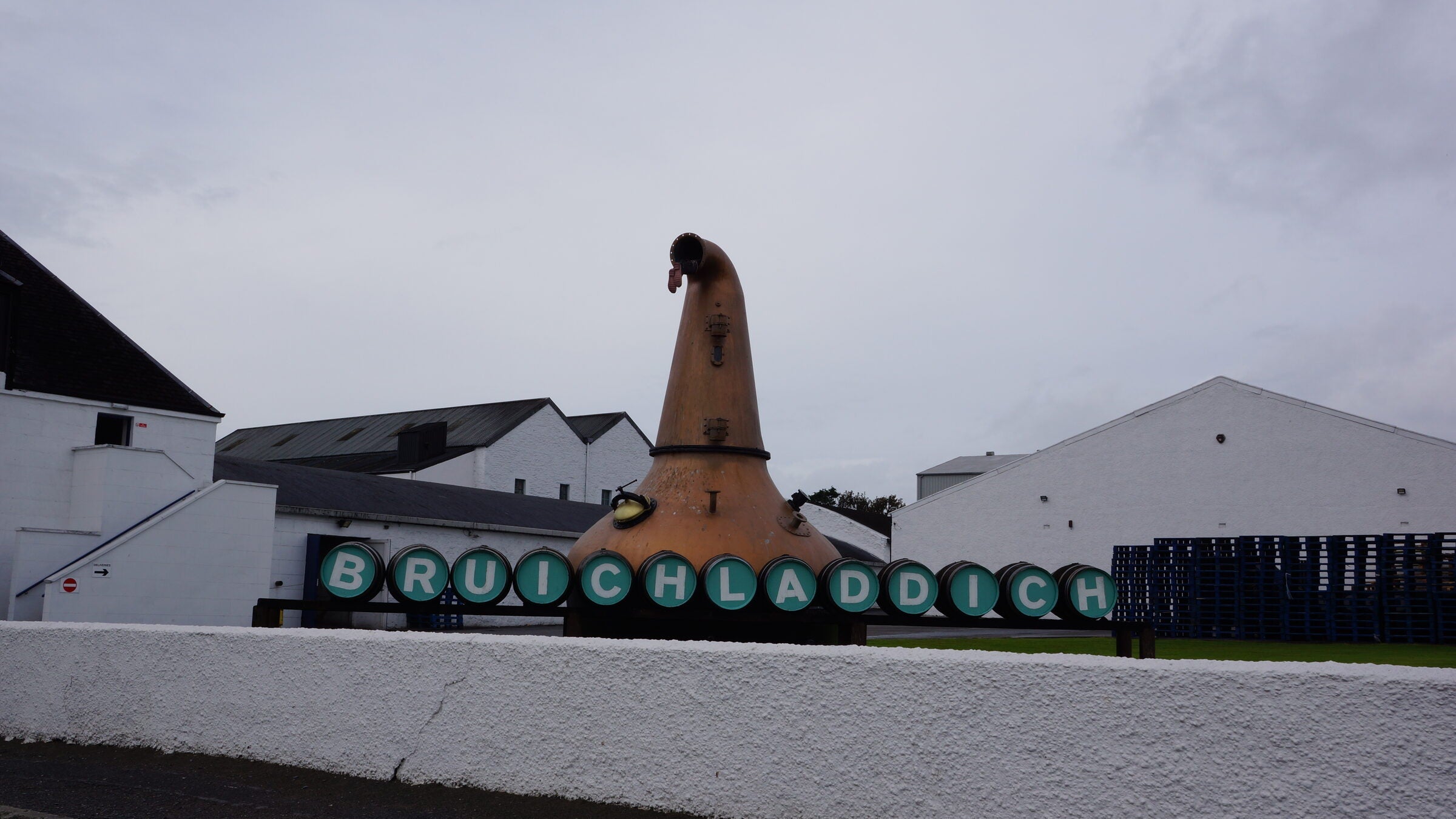
Bruichladdich announces itself with a bright aquamarine gate and whitewashed walls, and from the air you can see why the Harveys chose the spot: the courtyard layout sits square to Loch Indaal, with the village of Port Charlotte down the shore and Bowmore across the water. Our drone flew the length of the site to show that Victorian plan still intact, warehouses and bottling hall included.
History of Bruichladdich
The Harvey family had been distilling in Glasgow since 1770, and in 1881 three of its sons pooled an inheritance to build something new on Islay: William, then 32, put up the money, John brought the distilling knowledge and Robert, at 23, drew the plans and engineered the plant. Where the island's older distilleries had grown out of farm steadings, Bruichladdich was designed from scratch around a large courtyard, built from stone off the shore, with a cast-iron mash tun and stills chosen to make a purer, lighter spirit than the farm distilleries. The brothers fell out almost before it was finished, and William ran the place alone until his death in 1936, weathering a long silent period from 1907, closure in the Depression and a fire in the 1930s.
What followed was half a century of being passed around. Joseph Hobbs bought it in 1937 and flipped it within the year to National Distillers of America; Ross & Coulter, A.B. Grant and Invergordon Distillers each took a turn, and in the early 1990s Whyte & Mackay acquired Invergordon and with it Bruichladdich. Production stopped in late 1993 and the distillery was formally closed in 1994 as surplus to requirements. For a while it looked finished.
The rescue came on 19 December 2000, when a group of private investors led by Mark Reynier, a London wine merchant behind the Murray McDavid independent bottling label, and his partner Simon Coughlin bought the distillery and its stock for a sum usually quoted at £6.5 million. Reynier hired Jim McEwan, who had spent 38 years at Bowmore, as production director, and between January and May 2001 the whole plant was taken apart, cleaned and put back together with the Victorian kit intact. The first spirit off the stills on 29 May 2001 was heavily peated, the beginning of Port Charlotte; the following year they distilled Octomore for the first time. A bottling hall opened on site in 2003, Islay-grown barley followed in 2004, The Botanist gin in 2011, and by then Bruichladdich had become the loudest voice for provenance and transparency in Scotch. In July 2012 Rémy Cointreau bought the company for £58 million, and Reynier, outvoted, departed. McEwan retired in 2015 and handed over to Adam Hannett, an Islay native who had joined as a tour guide in 2004 and was named master blender in 2025.
How Bruichladdich makes its whisky
Bruichladdich is one of the few distilleries where the equipment is a genuine part of the story. The 1881 open-topped cast-iron mash tun, rake-and-plough type and one of only a handful surviving in Scotland, still does the mashing; because it is open, evaporation means it needs four waters rather than the usual three. Malt arrives from Bairds in Inverness, but the barley behind it is now entirely Scottish and, in the case of the Islay Barley releases, grown on around twenty farms on the island. Fermentation runs long in six wooden washbacks, sixty to eighty hours as a rule and past a hundred over weekends, and there is not a computer in the production process; the stillmen work by eye, hydrometer and experience.
The four stills are the distillery's signature: unusually tall, with long, narrow necks that force plenty of reflux and produce a light, clean, elegant spirit even from heavily peated malt. The same stills make all three styles, which is why Octomore, for all its 100-plus or 200-plus ppm malt, is never simply a smoke bomb; the shape of the copper strips out the heaviest phenols and leaves something surprisingly sweet and floral underneath. Beside them stands "Ugly Betty", a Lomond still rescued from the closed Inverleven distillery in Dumbarton and installed in 2010, which distils The Botanist with 22 hand-foraged Islay botanicals on a 17-hour run.
Everything is matured on Islay, in dunnage and racked warehouses at the distillery and in the old Lochindaal warehouses at Port Charlotte, and the cask policy is famously adventurous: alongside first-fill bourbon from the American majors, Bruichladdich fills oloroso and PX sherry, Sauternes, Bordeaux and Rhône wine casks and much else, and its Micro-Provenance single casks let drinkers taste one barrel at a time. Bottling happens on site at natural colour without chill-filtration, using spring water from Octomore Farm to reduce strength. The distillery became the first Scotch whisky maker to earn B Corp certification in 2020 and has been chasing decarbonised distilling since, first through a hydrogen feasibility study and more recently through renewable heating oil, with 2030 the current target.
What does Bruichladdich taste like?
The unpeated Bruichladdich spirit is fresh, malty and clean, with citrus, green apple, honey and cereal and a distinct saline lick that comes with maturing beside the sea. The Classic Laddie, the flagship, is bright and barley-forward; the Islay Barley and Bere Barley releases show how much the grain alone can shift the flavour, and older stock, particularly the annual Black Art releases and the Eighteen and Thirty launched in 2024, drifts into honey, tropical fruit and polished oak. Port Charlotte, peated to 40 ppm, is smoky in a warm, sweet way: bonfire, smoked bacon, vanilla and lemon. Octomore is the extreme end, ashy and tarry on paper but, in the glass, weirdly gentle, with sweet barley, cream and orchard fruit riding under the smoke.
What all three share is texture, an oily, mouth-coating quality that comes from those tall stills and long ferments, and a habit of taking on wine casks without being swamped by them. Sauternes and Bruichladdich, in our experience, is a particularly happy marriage.
Bruichladdich and independent bottlers
The distillery has an unusual relationship with the independent sector because it was, in effect, reborn out of it: Mark Reynier's Murray McDavid was an independent bottler before it owned a distillery. Casks from the pre-closure Invergordon era circulated freely and gave rise to a generation of well-regarded 1980s and 1990s independent Bruichladdich, and even after the 2001 restart the distillery sold and swapped casks with brokers and blenders, which is why independent bottlings of both unpeated Bruichladdich and peated spirit, sometimes labelled Lochindaal or Port Charlotte, are still reasonably common at cask strength. Since Rémy Cointreau's arrival the tap has tightened, as it has everywhere on Islay, and current parcels are scarce, but Bruichladdich casks laid down in the 2000s and early 2010s do still change hands, and they remain among the most interesting Islay casks an independent can hope to work with.
The Single Cask and Bruichladdich
We have bottled Bruichladdich a good deal, and it has given us some of our proudest labels. The one that travelled furthest was Bruichladdich 11 Year Old, cask 3615, a first-fill bourbon barrel distilled in 2009 and bottled at 61.3%, 247 bottles, released as our Water of Life Film Edition to mark the documentary in which Jim McEwan and Mark Reynier tell the story of the distillery's revival; the same cask later appeared as our Netflix Project bottling. It was Bruichladdich at its most vivid: macadamia, sea salt, honey and cacao on the nose, then a rush of liquorice, lemon, key lime and fennel that opened out into green apple, pineapple and mint, and dried into malt, white pepper and coriander seed. Full-bodied and decadent is how we described it at the time, and we stand by it.
The peated side has been just as generous. Bruichladdich Lochindaal 12 Year Old, cask 76, distilled in 2009 and bottled at 61.3% from a first-fill bourbon barrel, was a farmyard of a whisky: ash, camphor, bacon and sea salt, then lemons, burning driftwood, barbecued meat and salted caramel, with honey, warm ash and menthol on the finish. Then in 2024 we bottled a pair of sister casks from the same day of distillation, 2 November 2011, as our contribution to Fèis Íle. Bruichladdich 12 Year Old, cask R11/281-46, a fresh bourbon hogshead at 60.4%, gave us beach bonfire smoke around rockpools and lobster pots, barbecued pineapple, salted lemon and smoked crab, then juicy pineapple wrapped in salted caramel; its neighbour cask R11/282-35, a Premier Cru Sauternes cask at 60.5%, went darker, all toasted walnuts, singed pastry, smoked kippers and double cream, then ginger, chimney soot and burnt rhubarb crumble. Same spirit, same day, two utterly different whiskies, which is the whole point of single cask bottling. Along the way there was also a 14 Year Old sherry cask from 2004 at 59.5%, thick with rancio, leather, dark chocolate and sour cherries, and a plucky little 8 Year Old, cask BR09AQ, just 59 bottles at 55.9% of marshmallow, dark rum and salted peanuts. All of these are now sold out. When another Bruichladdich cask crosses our path, our mailing list hears first.

Collectability and cask ownership
Bruichladdich has built a serious collectors' following in a short time. The early Octomore editions, the annual Black Art releases and the limited Still Series (Blacker Still, Redder Still, Golder Still and, in August 2026, Greener Still) are chased at auction, as are the pre-closure vintages such as the Bruichladdich Forty, a 1964 spirit bottled in 2004. Whole casks have appeared at auction too: a 2003 Port Charlotte hogshead sold in bond for £32,750 in 2022, according to auction trackers, and a 2004 hogshead for £29,250 in 2024. The X4+18, a quadruple-distilled 18 year old released in 2025, and the Eighteen and Thirty in the Luxury Re/Defined range have pushed the distillery firmly into the premium bracket.
For cask owners the appeal is obvious: a distinctive Islay spirit with a passionate international fanbase, three peating styles to choose from and a track record of ageing gracefully in both bourbon and wine wood. The caveats matter just as much. Genuine Bruichladdich casks are hard to find and are occasionally offered by people who do not actually own them, so insist on a delivery order or direct warehouse confirmation and independent advice before any money changes hands. Cask ownership involves risk, values can go down as well as up, storage and insurance are ongoing costs, and a cask can only be sold as whisky. None of this is financial advice. If you are unfamiliar with the difference between a barrel, a hogshead and a butt, our guide to whisky cask sizes and types is the place to start, and we are always happy to give a straight opinion on any Islay cask you are considering.
Visiting Bruichladdich
Bruichladdich sits on the A847 between Bridgend and Port Charlotte, about twenty minutes from Bowmore, and its visitor centre is open year round: daily from March to October and Tuesday to Sunday through the winter. The standard guided tour lasts around ninety minutes and takes in the Victorian mash tun, the tall stills, Ugly Betty and the bottling hall; there is also a warehouse tasting drawn straight from the cask and a longer Bruichladdich Experience for the committed, plus cocktail classes built around The Botanist. The shop sells distillery-only bottlings and Valinch fills. Fèis Íle day at Bruichladdich, in late May, is one of the liveliest on the island's festival calendar; in 2026 it marked 25 years since the reopening. Caol Ila, Lagavulin, Laphroaig and Ardbeg are all within an hour's drive on the other side of the island.
Bruichladdich FAQs
Who owns Bruichladdich distillery?
Bruichladdich is owned by Rémy Cointreau, the French drinks group, which bought it in July 2012 for £58 million from the private investors who had reopened it in 2001.
Is Bruichladdich peated?
Whisky sold under the Bruichladdich name is unpeated. The distillery also makes Port Charlotte, peated to around 40 ppm, and Octomore, the most heavily peated whisky in the world, with some batches made from malt above 200 or even 300 ppm.
What is the difference between Bruichladdich, Port Charlotte and Octomore?
All three are made at Bruichladdich on the same stills. Bruichladdich is the unpeated house style; Port Charlotte is heavily peated at 40 ppm; Octomore is super-heavily peated, released in numbered series and always at cask strength.
Does Bruichladdich use Islay barley?
Yes. Bruichladdich has used only Scottish barley since 2013 and works with around twenty Islay farms; more than half of its barley is now grown on the island. It also grows Bere barley on Orkney and buys organic and biodynamic barley for specific releases.
Can you visit Bruichladdich distillery?
Yes. The distillery on the shore of Loch Indaal is open year round with tours, warehouse tastings and a shop selling distillery-only bottlings.
Can you buy a cask of Bruichladdich?
Occasionally. Bruichladdich casks from the 2000s and 2010s do change hands privately, though supply is limited and provenance must be checked carefully. We have bottled several ourselves; contact us and we will tell you honestly what is available.
Own a piece of Bruichladdich
Few distilleries make you feel the possibilities of a single cask as sharply as Bruichladdich: one spirit, three peating levels, endless wood, and two sister casks from the same day that taste like different islands. If that appeals to you as an owner rather than just a drinker, start with our plain-English guide to buying a whisky cask, read up on cask sizes and types, and then talk to us. We will tell you what Islay casks are honestly available and, as always, we will only ever recommend one we would be happy to bottle under our own label.
Work with The Single Cask
Buy a whisky cask, bottle under your own label, or store casks in our HMRC approved bonded warehouse in Fife.
Read more
GlenDronach Distillery: The Valley of the Brambles and the Sherry Cask
One of the first licensed distilleries in Scotland, the last to fire its stills with coal, and home to some of the finest sherry casks in the Highlands. Our full GlenDronach guide, with drone foota...
Read more
Craigellachie Distillery: Speyside's Meaty, Worm-Tub Maverick
Worm tubs, short fermentations and a sulphury new make that turns tropical with age: Craigellachie is the heavyweight of Speyside. We have bottled it many times, from bourbon casks to sherried octa...
Read more


