
Glen Ord Distillery: The Malting Giant That Feeds Talisker
Glen Ord grows almost all of its own barley malt and shares almost none of its whisky. This Highland distillery north of Inverness runs the biggest maltings complex Diageo owns, feeding a dozen sister distilleries including Talisker and, on rare peated runs, the Islay plants, yet it barely sells a bottle under its own name outside Asia. That contradiction, a giant that hides in plain sight, is what makes Glen Ord worth understanding before you go looking for a cask of it.
This guide covers the distillery's Black Isle origins, how its enormous maltings and hot shell-and-tube condensers shape the whisky, what it tastes like, and the honest story of the single cask we bottled ourselves.
Glen Ord at a glance
| Region | Highland (Muir of Ord, Ross-shire) |
| Founded | 1838, by Thomas Mackenzie |
| Owner | Diageo |
| Capacity | Around 10-12 million litres of pure alcohol per year, after a 2015 expansion roughly doubled output |
| Stills | 14 (7 wash, 7 spirit), plain-shaped, across two still houses |
| Water source | Loch nam Bonnach and Loch nan Eun |
| Fermentation | Long, typically quoted at around 75 hours |
| Malt spec | Mostly unpeated, from the distillery's own on-site maltings; occasional heavily peated runs for other Diageo malts |
| Style | Grassy new make maturing into toffee, ginger spice and light peat |
| Visitor centre | Yes; reopened in 2021 in a converted warehouse |

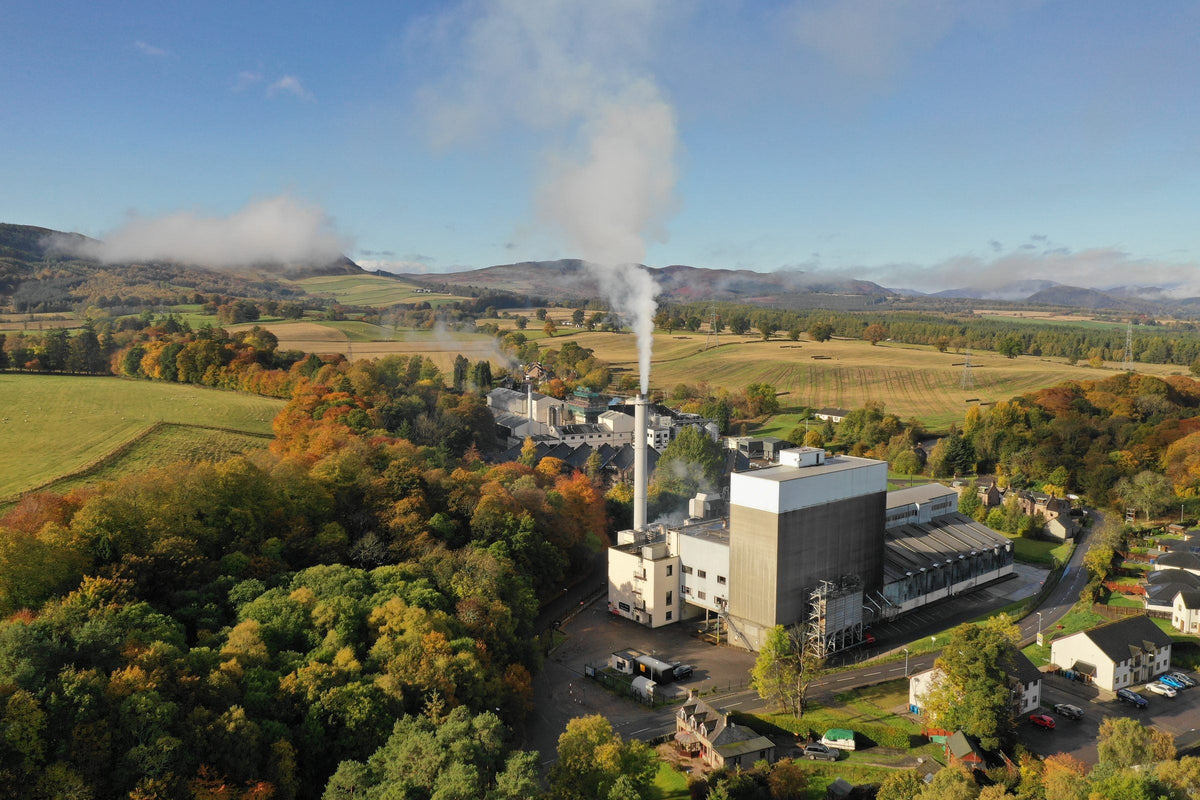
Glen Ord from above
Our drone crossed the Black Isle to film a distillery that most whisky drinkers walk straight past, dwarfed as it is by its own maltings buildings. From the air you can see exactly why: the malting complex is bigger than the distillery itself.
History of Glen Ord
Glen Ord sits on ground with a long distilling pedigree; land in the area was granted to the Mackenzie family by King Alexander III as far back as 1263, and illicit stills reputedly worked these glens for generations before anything was licensed. The distillery itself was founded in 1838 by local landowner Thomas Mackenzie, though its early decades were rocky: within nine years Mackenzie had put it up for sale, and it lay silent until Alexander MacLennan and Thomas McGregor bought and relicensed it in 1855.
Ownership changed hands repeatedly over the following decades, from MacLennan's widow and her second husband Alexander Mackenzie, to the Dundee blending firm James Watson & Co in 1896. In 1923, whisky grandees John Dewar & Sons bought the site and restored the name Glen Ord after a period of rebranding. Two years later the distillery was absorbed into the vast Distillers Company Limited empire, the corporate ancestor of today's Diageo, and it has stayed within that lineage ever since, through United Distillers in the 1980s to Diageo from 1997.
The defining feature of Glen Ord's twentieth century was not the stillhouse but the maltings. Floor maltings gave way to Saladin boxes in 1961, which were themselves demolished when large drum maltings were built in 1968. Today's plant, expanded further since, makes Glen Ord one of only a handful of distilleries anywhere still capable of malting all of its own barley on site, and it does far more than that: it supplies malt to Diageo's northern distilleries, Talisker among them, and on occasion produces the heavily peated malt used at the company's Islay sites. Demand for blends and for The Singleton brand pushed Diageo to expand the distillery itself twice since the 2000s, doubling capacity again with a major 2015 rebuild that added a second, larger still house alongside the original one and took annual output to somewhere in the region of 10 to 12 million litres of pure alcohol, depending on the year and how the figure is measured.
How Glen Ord makes its whisky
Because Glen Ord malts so much of its own barley, the distillery has more control over its raw material than almost anyone in Scotland, and the process from there is built for a particular kind of new make. A generous 25-tonne mash tun feeds a long fermentation, typically quoted at around 75 hours, well beyond the industry minimum, which develops fruity, grassy character in the wash before it ever reaches the stills.
Distillation runs across two still houses. The original room holds three wash stills of around 17,000 litres and three spirit stills of around 16,000 litres; the 2015 expansion added four more of each, slightly smaller, bringing the total to fourteen plain-shaped stills. A high cut point and copper-rich distillation extend the contact between vapour and metal, and Glen Ord condenses unusually: the shell-and-tube condensers are kept running hot rather than cold, prolonging that conversation between spirit and copper even further before the vapour finally liquefies in separate after-coolers. The combination gives new make with a distinctive, almost startling aroma of freshly cut grass, which settles down in cask into toffee sweetness and a gingery spice, with the low-level peat in some batches showing through as the whisky matures. Water for the whole process is drawn from two hill lochs, Loch nam Bonnach and Loch nan Eun.
What does Glen Ord taste like?
Mature Glen Ord trades the grass of new make for orchard fruit, honey and toffee, with a warming ginger spice and a light waxy texture from the hot-condenser distillation. Where the malt carries a touch of peat, the smoke sits in the background rather than the foreground, more a savoury undertone than a bonfire. It is a gentle, food-friendly Highland style, built for approachability rather than intensity.
The official expression is The Singleton of Glen Ord, rebranded from the old Glen Ord and Ordie names in 2006 as part of Diageo's Singleton trio alongside Dufftown and Glendullan. Bottlings run from a 12 year old core expression up through 15 and 18 year olds and limited travel-retail releases, but almost none of it is sold in the UK: The Singleton of Glen Ord is aimed squarely at export markets, Taiwan and wider South East Asia above all, where it has been one of the best-selling single malts for years. British drinkers, oddly, are among the least likely people on earth to have tried the whisky made an hour from Inverness.
Glen Ord and independent bottlers
Independent Glen Ord is scarce, and what exists tends to come from a small circle of established names. Douglas Laing and Signatory Vintage have released the majority of what has reached the market under the distillery's own name, occasionally joined by Gordon & MacPhail and other long-established bottlers with older stock relationships. Diageo keeps a tight grip on new-make casks, unsurprising for a distillery that feeds so much of its own group's blending and Singleton programme, so genuine, well-documented single casks from other bottlers are worth seeking out when they appear rather than assuming you can find one on demand. That scarcity is part of what makes the category interesting: unlike a Speyside workhorse where a dozen indie bottlings might be on the market at any moment, an independent Glen Ord is genuinely something to notice.
The Single Cask and Glen Ord
We have bottled Glen Ord once, and it remains one of the more unusual casks we have released. Cask 243A, distilled in 2013 and bottled at 8 years old at a cask strength of 57.2%, spent its finishing period in a PX quarter cask, a small format that concentrates sherry influence quickly. The result leaned hard into rancio, cherries, white grapes and blackberries, with green tea, white pepper, brown sugar, oak and nutmeg running through a long, dignified finish. It captured Glen Ord's usual honeyed, spicy character but pushed it somewhere richer and more sherried than the official Singleton range typically goes, a reminder of what independent bottlers can do with a distillery whose own casks rarely leave Diageo's control. The outturn was modest, 138 bottles, and it has since sold through, which is often the way with the more unusual casks we release: the ones that push a distillery's known character somewhere unexpected tend not to hang around.

Collectability and cask ownership
Glen Ord does not have a significant secondary auction market of its own; The Singleton range is made for drinking and exported in volume rather than chased by collectors, and independent releases are too rare to have built a track record at auction. That scarcity cuts both ways for a would-be buyer: a documented independent Glen Ord cask is a genuine curiosity precisely because so few exist, but that same rarity means there is little price history to lean on when judging what one is worth.
As with any distillery, the fundamentals of cask ownership apply in full. It is unregulated, values can go down as well as up, storage and insurance cost money every year, and nothing in this article is financial advice. Because Glen Ord casks are so uncommon on the open market, provenance matters even more than usual, insist on full paperwork tracing the cask back to a genuine fill, and start with our plain-English guide to cask sizes and types before committing to anything.
Visiting Glen Ord
Glen Ord's visitor centre reopened in 2021 inside a converted warehouse and has been well received, with tours and a small museum exploring the distillery's maltings alongside the more usual mash house and stillhouse stops. It sits at Muir of Ord on the Black Isle, a short drive north-west of Inverness, making it an easy addition to a Highland distillery tour that might also take in Glenmorangie or Dalmore further along the coast. Opening hours vary seasonally; check the distillery's own booking page before travelling.
Glen Ord FAQs
Who owns Glen Ord distillery?
Glen Ord is owned by Diageo, part of the same corporate lineage that has controlled the distillery since it joined the Distillers Company Limited in 1925.
Why is Glen Ord whisky hard to find in the UK?
Almost all of Glen Ord's official output is bottled as The Singleton of Glen Ord and exported to Asian markets, Taiwan in particular, where it is one of the best-selling single malts. Very little is sold domestically, which is why so few British drinkers have tried it despite the distillery's size.
Is Glen Ord peated?
Mostly not. Glen Ord's own malt is lightly peated to unpeated, though the distillery's large on-site maltings occasionally produce heavily peated malt for other Diageo distilleries, including some Islay sites, and traces of that peat programme can show up in Glen Ord's own character.
What does Glen Ord taste like?
Toffee, honey and ginger spice over a soft, waxy texture, with a grassy freshness carried over from the new make and, in some batches, a gentle smoky undertone.
Can I buy a cask of Glen Ord?
Rarely. Diageo keeps tight control of new-make casks from Glen Ord given how much of its output feeds the group's own Singleton brand and blending stock, so independent single casks are uncommon. When genuine ones do appear, careful checking of provenance and paperwork is essential.
Own a piece of Glen Ord
Glen Ord's own casks may be hard to come by, but the wider world of Highland whisky is not. The Single Cask helps clients buy whisky casks from distilleries whose owners still make stock available, store them in our own bonded warehouse, and bottle them under their own name when the whisky is ready; our guide to the four steps to bottling your own whisky shows how that journey works.
Educate first, buy second: read the guides, understand the costs, and if a genuine Glen Ord cask or another Highland malt is what you are after, contact us for a straight conversation with realistic numbers.
Work with The Single Cask
Buy a whisky cask, bottle under your own label, or store casks in our HMRC approved bonded warehouse in Fife.
Read more
Glen Elgin Distillery: The Blenders' Secret Behind White Horse
Glen Elgin guide: Charles Doig's famous prophecy, the worm tubs and 90-hour fermentations behind its lush fruity malt, the White Horse connection, our own port, sherry and rye cask bottlings, and w...
Read more
Bowmore Distillery: Islay's Oldest, and the Vaults Below the Sea
Islay's oldest licensed distillery still turns its malt by hand and matures whisky below sea level in the No.1 Vaults. Here is the full Bowmore story, from Black Bowmore's £100 beginnings to £562,5...
Read more


