
Glentauchers Distillery: The Speyside Malt the Blenders Keep
Ask a roomful of whisky drinkers to name a great Speyside distillery and you will hear the same handful of answers: Macallan, Glenfiddich, Balvenie, perhaps Glenfarclas. Almost nobody says Glentauchers. Most drinkers have never seen a bottle carrying its name, let alone tasted one. Yet this six-still distillery at Mulben, a few miles west of Keith, has been running hard since 1992 and produces roughly 4.5 million litres of pure alcohol a year, more than many household names. Nearly all of it disappears into blends, above all Ballantine's, where Glentauchers is one of the four signature malts at the core of one of the world's best-selling Scotch whiskies.
That anonymity is exactly why we rate it. Blenders have prized Glentauchers for well over a century, and independent bottlers quietly compete for its casks because the spirit matures reliably and gracefully in almost any decent oak. At The Single Cask we have bottled it at least ten times, from bright seven-year-old ex-bourbon casks to a pair of 22-year-olds, and watched the same light, fruity spirit deepen from crisp orchard fruit into waxy honey. This is a workhorse distillery story, and, we would argue, one of the best-value tickets in Speyside whisky.
Glentauchers at a glance
| Region | Speyside (Mulben, near Keith, Moray) |
| Founded | 1897 to 1898, by James Buchanan and W.P. Lowrie |
| Owner | Chivas Brothers (Pernod Ricard), since 2005 |
| Capacity | Approximately 4.5 million litres of pure alcohol per year |
| Stills | Six: three wash, three spirit |
| Water source | Springs near the Rosarie Burn |
| Fermentation | Long: around 56 hours, stretching past 100 at weekends |
| Malt spec | Unpeated |
| Style | Light, fruity, floral; built for blending, superb in single casks |
| Visitor centre | None |
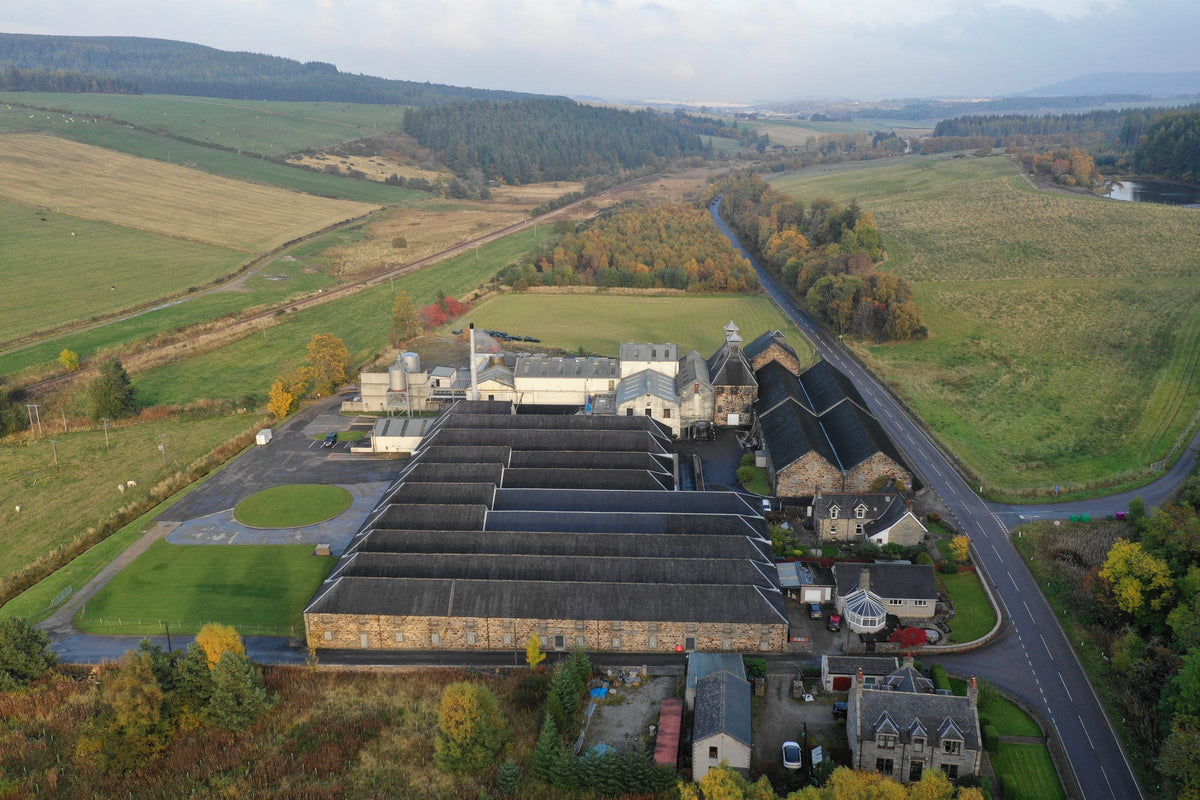
Glentauchers from above
Since the distillery has no visitor centre, our drone is about as close a look as most people will ever get at this quietly indispensable corner of Speyside.
History of Glentauchers
Glentauchers was born in the great Speyside building boom of the 1890s, when blended Scotch was conquering the world and blending houses raced to secure their own supplies of malt. James Buchanan was the most flamboyant of the whisky barons, a London-based salesman whose Black & White blend sat on the bar of the House of Commons, and W.P. Lowrie was the Glasgow broker and blender who supplied him. In 1897 the pair put up the money for a distillery of their own at Mulben, choosing the site for hard-nosed commercial reasons: good spring water near the Rosarie Burn, and the Keith to Elgin railway line running past the front gate. Spirit was flowing by 1898, and for decades the distillery even had its own railway halt, Tauchers Platform, which served it until 1964. It belongs to the same class of the 1890s as Craigellachie, distilleries conceived not as brands but as flavour factories for the blending trade.
Buchanan took sole control in the 1900s, and Glentauchers followed him into the great consolidation: Buchanan-Dewar, then the Distillers Company Limited (DCL) in 1925. It was also, briefly, a laboratory. Around 1910 Glentauchers hosted experiments in continuous pot-still distillation, an attempt to make malt whisky on something closer to a grain distillery's economics, which were trialled here and at Convalmore before being abandoned. The distillery grew from two stills to six in 1966, but the 1980s downturn showed no sentiment: DCL's successors mothballed Glentauchers in 1985, and it sat silent while the industry drained the whisky loch.
The rescue came from an unexpected direction. Allied Distillers bought the silent site in 1989, a contrarian move at the time, and restarted production in 1992, putting Glentauchers to work for Ballantine's and Teacher's. When Pernod Ricard carved up Allied Domecq in 2005, the distillery passed to Chivas Brothers, and it has run at full tilt ever since. There it remains: unglamorous, unvisited, and utterly indispensable.
How Glentauchers makes its whisky
Everything at Glentauchers is set up to make a light, fruity, estery spirit, the classic pre-war Speyside style that blenders build around. The 12-tonne mash tun, fitted with a handsome copper dome during the 2007 refurbishment, feeds six washbacks, and the fermentations are genuinely long: around 56 hours as a minimum, stretching beyond 100 hours over weekends when the washbacks are left to stand. Long ferments push the wash towards fruit and flowers rather than cereal weight. Distillation in the six pear-shaped stills is deliberately slow, giving the vapour plenty of copper contact and stripping out heavier notes before the spirit is filled to cask.
What makes the place genuinely unusual, though, is how it is run. Glentauchers is the only fully manually operated distillery in the Chivas Brothers estate. There are computers on site, but the two operators on each shift open every valve and judge every cut themselves. When the distillery was refurbished in 2007, Chivas deliberately chose not to automate it, and it now serves as the company's training ground, a centre of excellence where operators, warehouse staff and even directors are sent to learn how whisky is actually made, by hand, before returning to more automated sites.
The distillery has recently earned attention of a different kind. Glentauchers was the pilot site for Chivas Brothers' heat-recovery programme, using mechanical and thermo vapour recompression to capture and recycle heat from distillation. The results, total energy consumption down by nearly 48% and site carbon emissions down 53%, were considered so significant that Chivas published the technical findings open-source in 2023 and invited more than 130 industry peers to an open house at the distillery. A Victorian blend-filler quietly became one of the most closely studied sites in Scotch.
What does Glentauchers taste like?
Young Glentauchers from ex-bourbon casks is one of Speyside's purest expressions of orchard fruit: green apple, ripe pear, barley sugar and white blossom, with a soft vanilla seam from the oak. It is clean, sweet and dangerously easy to drink, which is precisely what a blender wants from a top-dressing malt.
Give it time and something more interesting happens. In our experience the fruit slowly candies and thickens: apple becomes baked apple, blossom becomes beeswax, and a distinctive waxy honey note builds through the teens and into the twenties. We have followed that arc first-hand, having bottled Glentauchers at 7, 13, 14, 18, 20 and 22 years old. Our seven-year-old ex-bourbon trio was all lively orchard fruit and citrus zest; by 13 and 14 years the honey and soft pastry notes had moved to the centre; and our 20 and 22-year-old casks showed deep waxed lemon, heather honey and polished oak that would embarrass many far grander names.
Cask type steers the journey rather than rewriting it. Ex-bourbon keeps the spirit bright and lets the estery fruit lead, which is why we so often choose it for younger Glentauchers. Ex-sherry, as in our 22-year-old sherry cask, folds in dried fruit, gentle spice and a nuttier weight, but the make is robust enough in character never to be smothered, provided the cask is chosen with restraint. Because the spirit is unpeated and light on new-make aggression, there is nowhere for a tired or over-active cask to hide, which keeps everyone honest.
Glentauchers and independent bottlers
Distilleries like Glentauchers are the independent bottler's bread and butter. Because the owner needs the spirit for blending rather than for a single malt brand, casks have historically been traded, swapped and sold in ways that Macallan's or Springbank's never are, and because the distillery spends nothing on marketing its own name, the casks are priced on liquid quality rather than label prestige. For bottlers, that is the whole game: exceptional maturing stock without the brand tax. The same logic underpins our love of Miltonduff and Linkwood, two more blender's favourites we return to again and again.
Gordon & MacPhail did more than anyone to keep the name alive, bottling Glentauchers under its own licensed labels from the 1990s onwards when official releases were nowhere to be found. Officially, the record is remarkably thin: a 15-year-old released in 2000, a Ballantine's-branded 15-year-old single malt from 2017, and occasional cask-strength releases through Chivas Brothers' own distillery shops. That is more or less it, from a distillery approaching its 130th year. In practical terms, independent bottlings are not an alternative way to drink Glentauchers, they are the way. You will find more of our write-ups on distilleries like this in our distillery guides.
The Single Cask and Glentauchers
We have bottled at least ten casks of Glentauchers: trios of 7-year-old ex-bourbon casks, single casks at 13, 14 and 18 years, a 20-year-old, and a pair of 22-year-olds from ex-sherry and ex-bourbon wood. Few distilleries appear in our range so often, and none by accident, when good Glentauchers comes up, we buy it.
Currently on the shelf is our Glentauchers 13 Years Old, cask 461, distilled in April 2010 and bottled at a natural cask strength of 50.4%, priced at £55 as part of our Scotch & Tattoos series. With 104 bottles available it is our biggest current stock line, and it captures the distillery mid-transformation: orchard fruit still fresh, honey and waxiness building underneath. At £55 for a 13-year-old single cask at full strength, it is the sort of bottle that explains why bottlers guard their Glentauchers contacts jealously.
What do we look for in a Glentauchers cask? Refill and first-fill ex-bourbon that lets the distillate speak; sherry wood only where the spirit has the age to carry it; and clean, unhurried maturation, the kind of slow, cool ageing our own bonded warehouse in Scotland is built for. Cask format matters too: hogsheads and barrels suit this spirit far better than heavy-handed small casks, a topic we cover in our guide to whisky cask sizes and types.

Collectability and cask ownership
Let us be honest: Glentauchers is not a trophy name. Nobody is flipping it at auction the way they flip The Macallan, and a Glentauchers bottling will not fund your retirement. But for cask buyers, that is largely the point. Because the name carries no brand premium, casks are accessible at sensible prices; because the spirit is a proven, consistent maturer with more than a century of blending pedigree behind it, the liquid risk is low; and because Ballantine's underwrites constant demand for the distillery's output, the stock has a natural commercial floor. Pound for pound, it is one of the better value propositions in Speyside, whisky you buy to mature and bottle proudly, not merely to trade.
The honest caveats apply, and we will always spell them out. Cask values can fall as well as rise, and the cask market is unregulated, no ombudsman, no compensation scheme. Storage, insurance, regauging and eventual bottling all cost money that must be factored into any return, and your exit routes (selling on, or bottling and selling the bottles) need thinking about before you buy, not after. This is not financial advice. If you want the full, unvarnished picture, start with our guide to buying a whisky cask.
Glentauchers FAQs
How do you pronounce Glentauchers?
"Glen-TOCH-ers", with the "ch" pronounced as in "loch". You will also hear the softer "glen-TAWK-ers" from those south of the border, and nobody at the distillery will hold it against you.
Who owns Glentauchers?
Chivas Brothers, the Scotch whisky arm of Pernod Ricard, which has owned the distillery since acquiring Allied Domecq's whisky assets in 2005.
What is Glentauchers used for?
Almost all of its roughly 4.5 million litres of annual production goes into blended Scotch, principally Ballantine's, where it is one of the four signature malts. It also serves as Chivas Brothers' hands-on training distillery.
Are there official bottlings of Glentauchers?
Very few. A 15-year-old appeared in 2000, Ballantine's released a 15-year-old Glentauchers single malt in 2017, and occasional cask-strength bottles surface through Chivas' distillery shops. Independent bottlings remain the realistic way to drink it.
Can I buy a cask of Glentauchers?
Yes, casks appear on the independent market at accessible prices precisely because the distillery has no single malt brand to protect. We can help you source, store and eventually bottle one; see our cask ownership guide.
Is Glentauchers peated?
No. Glentauchers runs on unpeated malt, and its light, fruity, floral spirit is the antithesis of a smoky dram.
Taste what the blenders keep for themselves
For thirty-odd pounds less than most 13-year-old single casks on the market, our Glentauchers 13 Years Old, cask 461 at 50.4% will show you exactly what Ballantine's blenders have been quietly hoarding for a century. And if this article has you thinking bigger, we can put your name on a cask of Speyside spirit and mature it in our own bonded warehouse until it is ready, our guide to buying a whisky cask and our four steps to bottling your own whisky explain how it works, or simply get in touch and talk to us directly. The blenders have had Glentauchers to themselves for long enough.
Work with The Single Cask
Buy a whisky cask, bottle under your own label, or store casks in our HMRC approved bonded warehouse in Fife.
Read more
The Glenlivet Distillery: The Malt That Made Speyside Legal
The Glenlivet guide: George Smith's pistol-carrying 1824 gamble, the 1884 court case over the name, lantern-shaped stills, what the whisky tastes like, and a clear-eyed look at Glenlivet casks and ...
Read more
Lagavulin Distillery: Islay's Slow-Burning Legend
Lagavulin distils slower than anyone on Islay and makes you wait sixteen years for the result. Here is the full story of the Kildalton legend, and an honest answer to the question every cask buyer ...
Read more


