
Ardmore Distillery: The Peated Highlander Built for Teacher's
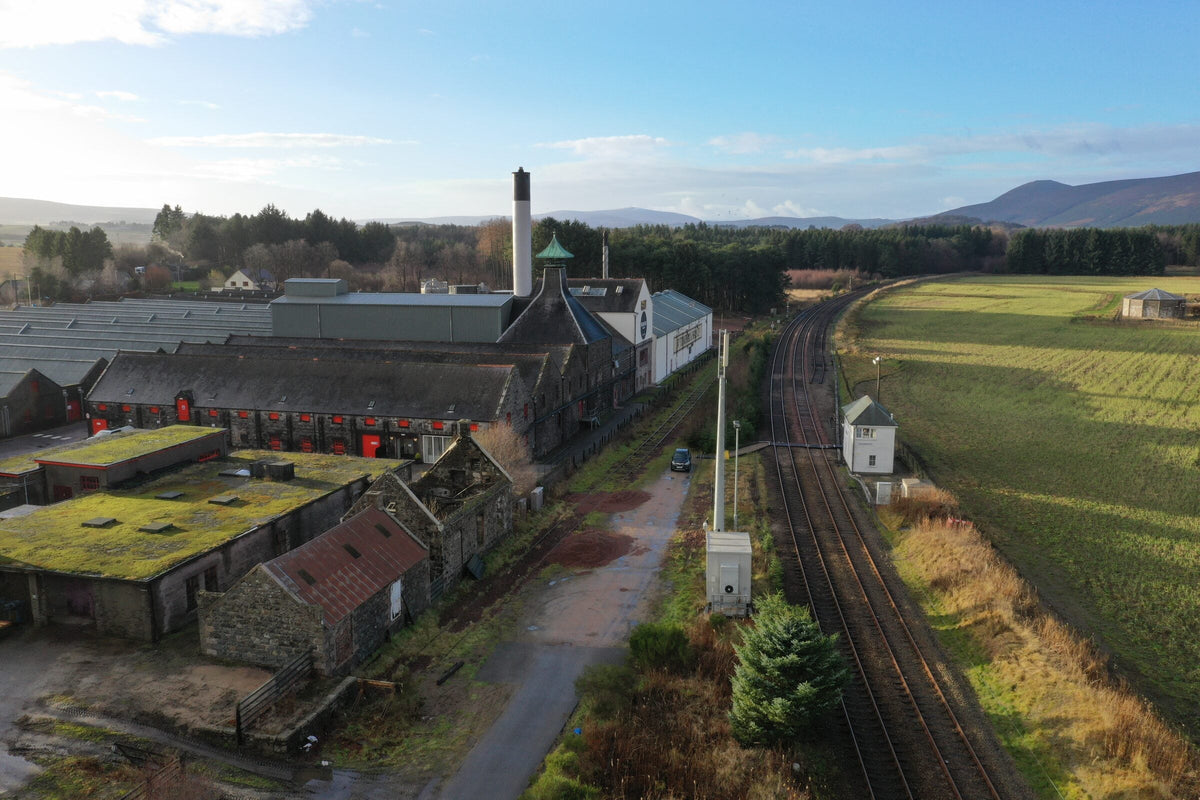
Stand on the platform at Insch and wait for the Aberdeen to Inverness train, and a few minutes up the line you will pass a granite distillery sitting at the very summit of the route, six hundred feet above sea level, with a working signal box on the other side of the track. That is Ardmore, and the railway is not incidental: the Teacher family built the distillery here in 1898 precisely because the line could bring in barley and coal and carry the filled casks away to Glasgow. More than a century later, trains still rattle past the warehouses.
Ardmore is one of the great under-the-radar names of the Highlands. It has made peated malt continuously since the day it opened, which is unusual this far east; it kept coal fires burning under its stills until the twenty-first century; and almost all of what it makes disappears into Teacher's Highland Cream, one of the biggest-selling blends in India and Brazil. That combination of peat, scale and anonymity makes it a favourite of independent bottlers, and of ours in particular. We have bottled Ardmore six times, and there is a cask on our shelves right now, so we will get to what it actually tastes like further down.
Ardmore at a glance
| Region | Highland, at Kennethmont near Huntly in Aberdeenshire, on the eastern edge of Speyside country |
| Founded | 1898 by Adam Teacher, son of William Teacher, for William Teacher & Sons; first spirit ran in 1899 |
| Owner | Suntory Global Spirits (formerly Beam Suntory), owners since 2014 via Fortune Brands' 2005 purchase from Allied Domecq |
| Capacity | Typically quoted at up to around 5.5 million litres of pure alcohol a year, one of the larger malt distilleries in Scotland |
| Stills | Eight onion-shaped stills in a row: four wash (about 15,000 litres) and four spirit (about 15,500 litres), with short, wide necks and lyne arms that fall away after the bend |
| Water source | Springs on Knockandy Hill, around 1,500 feet above the distillery; sources count fourteen to sixteen of them |
| Fermentation | Douglas fir washbacks (sixteen since 2022); historically around 54 hours, now closer to 70 |
| Malt spec | Peated to around 12 to 14 ppm using Aberdeenshire peat; an unpeated make, Ardlair, is also distilled for part of the year |
| Style | Medium-peated Highland malt: woodsmoke and bonfire embers over green apple, heather honey and cereal sweetness |
| Visitor centre | No, and no public tours; the site is a working production distillery |
History of Ardmore
William Teacher was a Glasgow grocer who took to selling whisky in the 1830s and built a chain of "dram shops" across the city. His firm registered Teacher's Highland Cream in 1884, and by the 1890s the blend was selling well enough that relying on other people's malt had become a risk. So the family did what a handful of ambitious blenders were doing during the whisky boom of that decade: they built their own distillery. Adam Teacher, William's son, chose a farm at Kennethmont in Aberdeenshire with plentiful spring water on Knockandy Hill, local barley, peat close at hand and, crucially, the Great North of Scotland Railway running along the northern boundary. Charles Doig, the Elgin architect responsible for the pagoda roofs on half the distilleries in Speyside, drew up the plans, reportedly for a fee of £1,000. Adam Teacher died before the first spirit ran in 1899, so he never saw his distillery work.
What he left behind was built to last. The main buildings are squared granite with slate roofs, and the old maltings, kiln, mill room and first two warehouses are now Category B listed. Ardmore was, from day one, Teacher's engine room, and it grew with the blend: two stills became four in 1955 and eight in 1974, at which point it became one of the largest malt distilleries in the country, though Diageo's Highland giants Teaninich and Glen Ord have since outgrown it.
The Teacher family sold to Allied Breweries in 1976, and Ardmore then rode the corporate escalator through Allied Lyons and Allied Domecq. When Pernod Ricard broke up Allied Domecq in 2005, the Teacher's brand and its distillery went to Fortune Brands, the American owner of Jim Beam. Beam was spun off in 2011 and bought by Suntory of Japan in 2014, and the resulting company renamed itself Suntory Global Spirits in 2024. So Ardmore today sits in the same portfolio as Bowmore, Laphroaig and Auchentoshan, still doing what it was built for: quietly making the peated malt that gives Teacher's its character.
The distillery's own bottlings arrived very late. Apart from a scarce 12 year old and a few one-offs, there was no proprietary single malt at all until Ardmore Traditional Cask appeared in 2007, more than a hundred years after the first spirit was distilled. That, more than anything, explains why so many whisky drinkers have never heard the name, and why the independent bottlers have had such a good time with it.
How Ardmore makes its whisky
The first thing to know is the peat. Most Highland distilleries went unpeated decades ago; Ardmore never did, and it is generally described as the only Highland distillery to have made peated malt continuously since it opened. The malt is peated to around 12 to 14 ppm, which is roughly a third of the level at Laphroaig or Ardbeg, and the peat is Aberdeenshire peat rather than Islay's, drier and more heathery, which gives Ardmore's smoke a bonfire and woodsmoke character rather than a medicinal one. Since the early 2000s the distillery has also made an unpeated spirit called Ardlair, named after a nearby stone circle and inevitably nicknamed "Ard-less" by the staff; it runs for a stretch of the year and goes mostly into blends.
Water comes down from the springs on Knockandy Hill to a cast-iron semi-lauter mash tun with a copper dome, taking a grist of around twelve and a half tonnes. Fermentation is in Douglas fir washbacks, of which there are now sixteen after two were added in 2022. Ferments used to run to about 54 hours; in recent years they have been stretched towards 70, which tends to push the spirit in a fruitier, more estery direction. The eight onion-shaped stills stand in a line, four wash and four spirit, and they are not built for elegance: short, wide necks, no reflux bowls, and lyne arms that fall away after the bend, so the heavier vapours are encouraged to carry over into the spirit rather than being sent back for another pass. The result is a new make with real mid-palate weight.
For most of its life that weight was helped along by coal. Ardmore's stills were direct-fired until 2001, one of the very last in Scotland to be, and when the fires finally went out the engineers spent seven months designing kinked steam coils to replicate the hot spots that coal had produced inside the stills. Maturation is mostly in ex-bourbon American oak, with a distillery fondness for 125 litre quarter casks, which the Traditional Cask bottling was built around; the site holds roughly 42,000 casks across dunnage and racked warehouses.
What does Ardmore taste like?
Ardmore is a peated Highland malt rather than a Highland malt with a bit of peat, and the difference matters. The smoke is always there, but it reads as woodsmoke, bonfire embers, dry heather and a whiff of struck match rather than tar or iodine. Underneath it the spirit is surprisingly sweet and orchard-fruity: green apple, pear, heather honey, malted barley and vanilla from the bourbon wood, with an earthy, faintly farmyard note that lifts it out of the crowd.
Given time in a good cask it becomes something else. Well-aged bourbon-matured Ardmore, in the eighteen to twenty-five year bracket, turns the smoke into something soft and fragrant, adds orange oil, honey and beeswax, and finishes with a pinch of salt and black pepper. Sherry and wine casks are a more divisive marriage, but done with a light hand they can be excellent: the smoke and the dried fruit meet in barbecue and roasted meat territory.
Ardmore and independent bottlers
Because Ardmore was built to feed a blend and barely bottled its own malt for a century, an unusually large amount of it has always circulated through brokers and blenders. Independent bottlers have taken full advantage: Gordon & MacPhail have bottled 1970s vintages under Connoisseurs Choice, and Signatory, Cadenhead's, Douglas Laing, Duncan Taylor and the Scotch Malt Whisky Society (where it is Distillery 66) have all released it regularly. Whiskybase lists well over two thousand Ardmore bottlings, the overwhelming majority of them from independents.
This has kept prices sane and the distillery's reputation quietly excellent among people who pay attention. It also makes Ardmore an unusually approachable distillery for cask buyers, since casks do move through the market with a frequency that Islay names can only dream of, and the spirit is robust enough to cope with an ambitious cask choice. There is one caveat: since around 2001 a growing share of production has been unpeated Ardlair, so a modern Ardmore cask is not automatically a peated one. Always ask.
The Single Cask and Ardmore
We have a genuine soft spot for this distillery. Ardmore was one of the first names we bottled, and over the years we have released six single casks from it, which is more than from almost any other Highland distillery. Some were young and punchy: our Ardmore 10 year old, cask 705212, distilled in 2008 and bottled at 59.4% from an American oak cask that had previously held Laphroaig, gave us lingering smoke and coastal salinity, wet slate and citrus on the nose, then creamy vanilla, subtle smoke and soft stone fruit on the palate. We also bottled an Ardmore 11 year old from a red wine octave, cask 709249, at 55.7%, which went a different way entirely: sweet peat, nutmeg and heavily charred wood, then rich red fruits, smoky driftwood and a slightly sweet roasted meat note, with a long, nutty, drying finish. Only 82 bottles came out of that octave, and it showed how well Ardmore's smoke can carry a wine cask if you keep the finish short.
The older casks were the revelation. Our Ardmore 18 year old, cask AR99A (distilled 1999, 56.8%, 59 bottles) was all sweet barley, gentle smoke and earth on the nose, barbecued pork and grist on the palate and a long, aromatic, smoky oak finish; and our Ardmore 21 year old, cask AR96A (distilled 1996, 53.8%) was well-oaked with orange oil developing under fragrant smoke, thick waves of honey and caramel, and a pinch of sea salt and black pepper on the finish. More recently we released an Ardmore 16 year old from a red wine hogshead, cask 14545, distilled on 24 June 2008 and bottled at 57.2%.
And right now you can taste the distillery for yourself: our Ardmore 9 Year Old, cask 1312 is in stock. Distilled in 2009 and bottled at a cask strength of 58.5% from an ex-bourbon American oak cask, with an outturn of 217 bottles, it is Ardmore in its natural, unfussy state: honey-roast peanuts, brown sugar and a hint of cherry on the nose, then earthy vanilla contending with the nuttiness on the palate, wisps of smoke around everything, and a finish of burnt toffee, leafy mint and orange. If you have never tried Ardmore, this is the bottle to start with, and it is one of the best-value peated single casks we have on the shelf.

Collectability and cask ownership
Let us be straight about this: Ardmore is not a trophy distillery. It has no equivalent of Black Bowmore or the Macallan Fine and Rare, and most of the ten thousand-odd Ardmore lots that have passed through UK auction houses have sold for two- or three-figure sums. That is part of its charm. Older independent bottlings, especially 1970s and 1980s vintages from Gordon & MacPhail and the like, do attract a steady following, and the rare distillery releases such as the 25 and 30 year olds hold their value, but nobody buys Ardmore expecting headlines.
For cask owners that is a more interesting proposition than it might sound. Ardmore casks come onto the private market fairly regularly, the spirit ages gracefully in refill bourbon wood, and the peat gives it a distinct identity when the time comes to bottle, which is more than can be said for many blending-fodder Speysiders. As always, though, cask ownership involves risk: values can go down as well as up, storage and insurance are ongoing costs, and the whisky must eventually be bottled or sold as whisky. Nothing on this page is financial advice. Check whether a cask is peated Ardmore or unpeated Ardlair, insist on proper documentation, and if you are new to all this our guide to whisky cask sizes and types is a sensible place to start.
Visiting Ardmore
Ardmore does not have a visitor centre and does not run public tours; it is a working production site first and last. That said, it is well worth a look from the outside if you are exploring the whisky country between Huntly and Insch, and it is a short drive from Glen Garioch at Oldmeldrum and from GlenDronach at Forgue, both of which do welcome visitors.
Ardmore FAQs
Who owns Ardmore distillery?
Ardmore is owned by Suntory Global Spirits, the company formerly known as Beam Suntory, which also owns Bowmore, Laphroaig, Auchentoshan and the Teacher's blend. It passed from the Teacher family to Allied Breweries in 1976, then to Fortune Brands and Jim Beam in 2005, and into Suntory's hands in 2014.
Is Ardmore a peated whisky?
Yes. Ardmore has made peated malt continuously since 1898, using Aberdeenshire peat at around 12 to 14 ppm, which gives a medium woodsmoke character rather than heavy Islay-style smoke. The distillery also makes an unpeated spirit, Ardlair, for part of the year, mostly for blending.
What blend is Ardmore used in?
Ardmore is the signature malt in Teacher's Highland Cream, the blend the distillery was built to supply in 1898. Historically almost all of Ardmore's output went into Teacher's, which remains one of the best-selling Scotch blends in India and Brazil.
Can you visit Ardmore distillery?
No. Ardmore has no visitor centre and does not offer public tours. The nearest distilleries with visitor facilities are Glen Garioch and GlenDronach.
Can you buy a cask of Ardmore?
Yes, Ardmore casks come onto the private market fairly regularly, and we have bottled six of them ourselves. If you are interested, contact us and we will tell you honestly what is available and whether it is peated Ardmore or unpeated Ardlair.
Why is Ardmore so cheap for a peated whisky?
Because it was built to feed a blend and barely bottled its own single malt until 2007, so it never developed the collector following of the Islay names. That keeps both bottle and cask prices sensible relative to the quality of the spirit.
Own a piece of Ardmore
Ardmore is the kind of distillery whisky lovers end up recommending to each other in a slightly conspiratorial tone: peated Highland malt of real weight and character, made on a scale that keeps casks available and prices grounded. If you would like to own some of it rather than just drink it, our plain-English guide to buying a whisky cask explains how the process works, our page on cask sizes and types shows how the wood shapes the whisky, and then talk to us. We have bottled Ardmore six times and would happily do it again, and we will only ever recommend a cask we would be proud to put our own label on.
Work with The Single Cask
Buy a whisky cask, bottle under your own label, or store casks in our HMRC approved bonded warehouse in Fife.
Read more
Bowmore Distillery: Islay's Oldest, and the Vaults Below the Sea
Islay's oldest licensed distillery still turns its malt by hand and matures whisky below sea level in the No.1 Vaults. Here is the full Bowmore story, from Black Bowmore's £100 beginnings to £562,5...
Read more
Glenfarclas Distillery: Six Generations, Direct Fire and Sherry Oak
Bought by John Grant for £511 19s 0d in 1865 and still owned by his family, Glenfarclas direct-fires the largest stills on Speyside and fills almost everything into Oloroso sherry oak. Here is the ...
Read more


