
Linkwood Distillery: The Whisky Nobody Was Allowed to Change
Roderick Mackenzie, who managed Linkwood for nearly twenty years after the war, forbade his staff from removing the spiders' webs in the rafters. Nothing at the distillery was to change, he insisted, in case the whisky changed with it. That story tells you almost everything about Linkwood: this is a spirit so prized, so particular, that generations of custodians have treated it as something to be protected rather than improved.
Whisky drinkers could be forgiven for never having seen the name on a shelf. Well over 90% of Linkwood disappears into Diageo's blends, and the company offers just one regular official bottling. Yet among blenders, and among independent bottlers like us, Linkwood is spoken of as one of Speyside's very finest makes. We have bottled it sixteen times, more than almost any other distillery we work with. Here is why.
Linkwood at a glance
| Region | Speyside, on the outskirts of Elgin, Moray |
| Founded | 1821, by Peter Brown; distilling from around 1824 |
| Owner | Diageo |
| Capacity | Typically quoted at around 5.6 million litres of pure alcohol a year |
| Stills | Six since the 2012 to 2013 expansion: three wash, three spirit, plain-shaped |
| Water source | Springs near Millbuies Loch |
| Fermentation | Around 75 hours, unusually long |
| Malt spec | Unpeated |
| Style | Fresh cut grass, apple and peach blossom on a surprisingly thick, silky body |
| Visitor centre | No, a working production site, not open to the public |
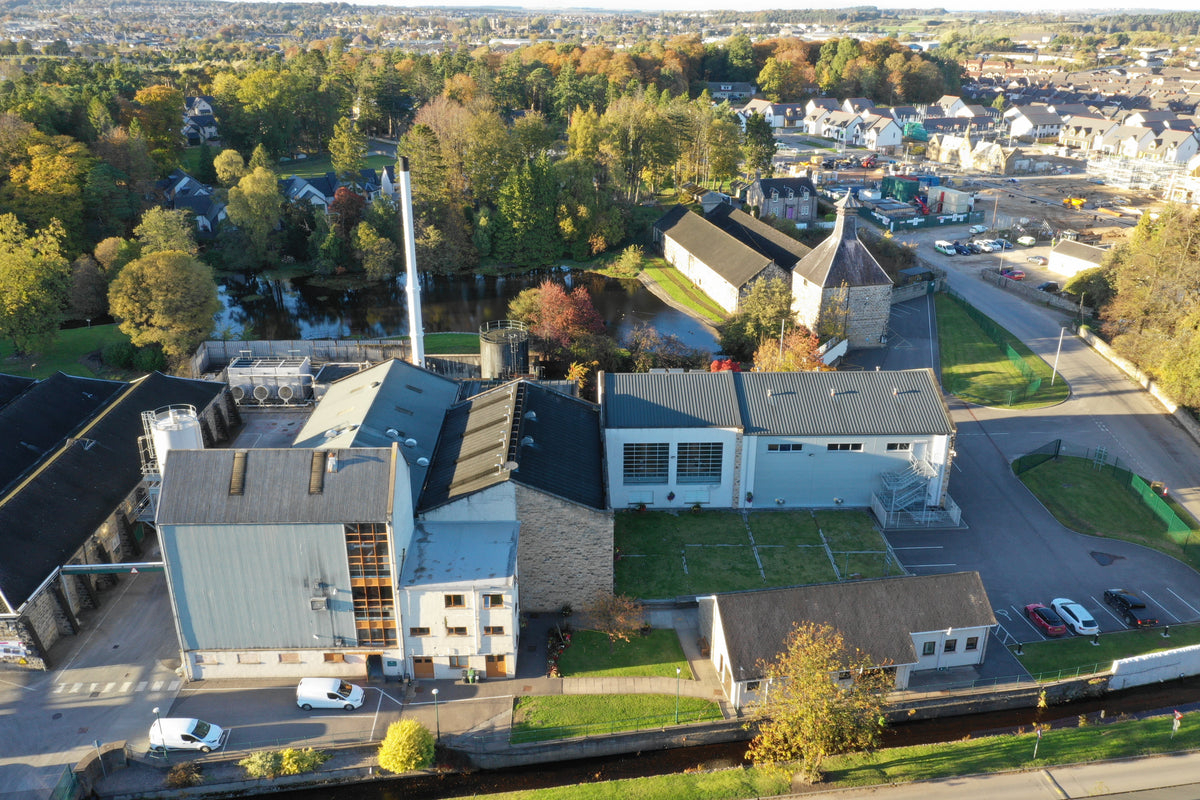
Linkwood from above
Linkwood keeps its gates closed to visitors, so the best view most whisky lovers will ever get of the distillery, its tree-lined dam and the swans that patrol it is from the air. Our drone went over the fence for you.
History of Linkwood
Linkwood was founded in 1821 by Peter Brown, an agricultural improver who managed the Linkwood estate on the southern edge of Elgin. Brown was a farmer first and a distiller second, and his distillery was conceived as part of a neat agricultural loop: barley grown on the estate was distilled into whisky, the spent draff fed his cattle, and the cattle manured the fields that grew the next season's barley. A whisky-based ecosystem, in other words, and a rather modern idea for the 1820s.
Distilling began around 1824, in the first wave of distilleries licensed after the Excise Act made legal whisky-making viable. When Peter Brown died in 1868 the estate passed to his son William, who took a bolder view of the whisky trade: between 1872 and 1874 he demolished his father's distillery and built a much larger one in its place. The Linkwood-Glenlivet Distillery Company followed in 1898, and from 1902 the business came under the stewardship of Innes Cameron, a noted Elgin whisky broker who steered it until his death in 1932, after which Linkwood was sold to Scottish Malt Distillers and folded into the empire that would eventually become Diageo.
The Second World War closed the distillery from 1941 to 1945 for want of barley. Its post-war revival belongs to Roderick Mackenzie, the manager whose reverence for the make bordered on superstition. When the distillery was refurbished and electrified in 1962, Mackenzie insisted the new stills be exact replicas of the old ones, down to the dents, and his famous protection of the stillhouse spiders passed into whisky folklore.
In 1971 a second, modern distillery, Linkwood B, was built alongside the Victorian original, which became Linkwood A. The old plant worked only intermittently thereafter, the whole site was mothballed from 1985 to 1990, and the original stillhouse fell silent for good in the mid-1990s. Between 2011 and 2013 Diageo swept much of the old site away: the Linkwood A buildings were largely demolished and the modern distillery was extended with a new mash tun, additional washbacks and an enlarged stillhouse, roughly doubling capacity. Sentiment aside, the investment says something clear: Diageo considers Linkwood spirit worth a great deal.
Mackenzie, one suspects, would have grumbled about the demolition and then quietly approved of the priorities. The new plant was designed to make exactly the same spirit in greater quantity, and the swans still glide across the dam beside the stillhouse, as they have for as long as anyone at Linkwood can remember.
How Linkwood makes its whisky
Linkwood's character is built on patience. Water comes from springs near Millbuies Loch, south of the distillery, and mashing, with a grist of around 12.5 tonnes per mash in a lauter tun, is run deliberately slowly to draw off clear wort. That clarity matters: cloudy wort carries cereal solids into fermentation and gives a nutty, malty spirit, while clear wort steers the flavour towards fruit and grass, which is exactly where Linkwood wants to be.
Fermentation is the second act of patience. The washbacks, traditionally of wood with more modern additions from the 2013 expansion, run for around 75 hours, far longer than the industry norm of 48 to 55. Long fermentations let the yeast finish its work and secondary bacterial activity begin, developing the estery, floral complexity that blenders pay a premium for. It is an expensive way to make whisky, since it slows the whole plant down, and the fact that Diageo has never shortened it tells you how much the blending rooms value the result.
The six plain-shaped stills, three wash and three spirit, are run slowly to maximise copper contact, and the spirit is condensed in shell-and-tube condensers before being filled to cask at 63.5%. The result is a new make that Diageo's own blenders describe in terms of a spring meadow: cut grass, apple and peach blossom. What makes Linkwood remarkable is that this delicacy comes with real weight, a thick, almost waxy texture that survives long maturation. Light whiskies are common; light whiskies with body are rare, and that combination is precisely why Linkwood is classed among the elite of Diageo's blending malts.
Almost all of it goes into blends, Johnnie Walker among them, with White Horse and Bell's historic customers too. The sole regular official single malt is the 12-year-old in Diageo's Flora & Fauna range, its label carrying the swans that live on the distillery dam.
What does Linkwood taste like?
Young Linkwood from ex-bourbon wood is all orchard and meadow: green apple, pear, white blossom, lemon and fresh-cut grass over vanilla and honey, with that characteristic silky thickness on the tongue. Give it a decade or more and the fruit deepens towards ripe apples, stone fruit and beeswax, while good casks add layers of toffee, marzipan and gentle baking spice. The texture is the tell. Plenty of Speysiders offer apples and blossom, but few carry them on a body this weighty, and it is the mouthfeel that lets you pick Linkwood out of a blind line-up.
It is also a superb whisky for interesting maturation. Because the distillate is clean, weighty and confident, it can carry sherry, port or even rum wood without losing itself, which is one reason we have experimented with Linkwood in more cask types than almost anything else in our warehouse. Gordon & MacPhail's long-aged sherried Linkwoods have a devoted following for the same reason.
Linkwood and independent bottlers
With official releases limited to the Flora & Fauna 12-year-old and the odd special edition, such as the Woven Honor release that appeared through Diageo's Orphan Barrel programme in 2024, independent bottlers are effectively the custodians of Linkwood's single malt reputation. Happily, casks have historically been obtainable, and the make's quality means the indie shelf is where Linkwood's range truly shows: bourbon-matured examples that sparkle, sherried versions that turn honeyed and plump, and single casks at full strength that the official range simply never offers.
Among Speyside's blending workhorses, Linkwood sits in the top tier of independent bottlers' affections alongside the likes of Benrinnes and Glentauchers, and its bottlings tend to disappear quickly when they are priced sensibly. It is also a name that rewards comparison: taste an indie Linkwood from bourbon wood next to one from sherry and you learn more about what casks do to spirit than any book will teach you, because the distillate underneath is so consistent.
The Single Cask and Linkwood
Linkwood is a house favourite. We have bottled it sixteen times, at ages from five to fifteen years, and we have deliberately used it as a canvas for wood: ex-bourbon hogsheads, oloroso and fino sherry, PX and moscatel octaves, ruby and tawny port barrels, even rum casks. Few distillates could stay recognisable across that range. Linkwood does, that thick grassy-fruity core comes through every time.
Two of our Linkwoods are available right now. Our 14-year-old from ex-bourbon hogshead 301554, distilled in February 2010 and bottled at a cask strength of 59.2%, is Linkwood at its most joyful: apple crumble, vanilla sponge and marzipan on the nose, toffee-wrapped apples, orange zest and grilled pineapple on the palate, and a long buttery finish of shortbread and coconut. One of 269 bottles.
Alongside it sits something rather more unusual: a 15-year-old finished in a Catoctin Creek rye quarter cask, distilled in September 2008 and bottled at 53.3%. The American rye wood pushes the classic Linkwood fruit and toffee into spicier territory, buttery pastry with a proper spice punch and a curious dusty sweetness. Just 111 bottles exist, and it is a fine example of why we experiment with this make.
As with everything we release, both are single casks, natural colour and non-chill filtered.

Collectability and cask ownership
Linkwood is not a trophy name at auction the way The Macallan is, and that is exactly what appeals to the people who buy it. Prices for independent Linkwood remain reasonable relative to quality, long-aged Gordon & MacPhail expressions have shown steady collector interest, and the distillery's standing among blenders gives casks a natural secondary market. A make that Diageo spent heavily to expand is unlikely to fall out of demand.
For cask buyers, Linkwood offers a well-regarded, versatile Speyside spirit that responds to almost any sensible wood policy, with the caveat that mature stock is sought after and availability comes and goes. The honest counterpoint applies here as everywhere: cask ownership involves risk, values can go down as well as up, and nothing on this page is financial advice. If you are considering it, start with our guide to cask sizes and types, and ask us what we would actually pay for a given cask, because we will tell you.
Linkwood FAQs
Who owns Linkwood distillery?
Diageo. Linkwood has been part of the Distillers Company lineage since the early 1930s, when it was sold to Scottish Malt Distillers following the death of Innes Cameron.
Is Linkwood peated?
No. Linkwood distils an unpeated spirit known for grassy, floral, orchard-fruit character. Any smoky Linkwood you encounter, including a peated cask we once bottled, got its smoke from the cask or a finish rather than the malt.
Can you visit Linkwood distillery?
No. Linkwood is a working production site with no visitor centre. The nearby town of Elgin makes a good base for exploring Speyside, and our drone film above shows the site better than the roadside ever could.
What is the only official Linkwood bottling?
The Linkwood 12-year-old in Diageo's Flora & Fauna range, whose label features the swans that live on the distillery dam. Beyond occasional special releases, everything else comes from independent bottlers.
Why do blenders rate Linkwood so highly?
Because it combines delicacy with body. Long 75-hour fermentations and slow distillation produce a fragrant, floral spirit with an unusually thick texture, a rare combination that earns it a place in top blends including Johnnie Walker.
Can you buy a cask of Linkwood?
From time to time, yes. We have bought and bottled many Linkwood casks and sometimes have stock available. Contact us and we will tell you what is available and what it should cost.
Own a piece of Linkwood
Blenders have quietly hoarded Linkwood for a century and a half; the rest of us get the independent bottlings and, occasionally, the casks. A bottle of our 14-year-old or the rye-finished 15-year-old is the easy way in. A cask of your own, maturing towards whatever Linkwood becomes at twenty, is the ambitious one.
If you are curious about buying a whisky cask, from Linkwood or any distillery we work with, or about bottling a cask under your own label, get in touch. We taste everything we sell, and we will give you a straight answer about availability, cost and whether the whisky is any good.
Work with The Single Cask
Buy a whisky cask, bottle under your own label, or store casks in our HMRC approved bonded warehouse in Fife.
Read more
Talisker Distillery: The Peppery King of Skye
Skye's oldest distillery has been making peppery, maritime malt since 1830, in stills rebuilt as exact replicas after the 1960 fire. Here is the full Talisker story, and an honest answer to the que...
Read more
Springbank Distillery: Campbeltown's Stubborn Survivor
The last great Campbeltown house malts, distils and bottles everything on one site, makes three different whiskies from one pair of malting floors, and cannot come close to meeting demand. Here is ...
Read more


