
Ben Nevis Distillery: The Highland Malt With a Japanese Passport
Around a third of the spirit made at the foot of Britain's highest mountain never becomes Scotch whisky at all. It is filled into tankers, shipped east and folded quietly into Nikka's Japanese blends, because since 1989 this most Highland of distilleries has answered to Tokyo, and the Japanese have always understood exactly how special it is.
Whisky drinkers at home took longer to catch on. For decades Ben Nevis was a name you saw on a blend label or walked past on the way up the mountain. Today it has one of the most devoted cult followings in Scotch, and the reasons come down to stubbornly old-fashioned ways of working that most of the industry abandoned half a century ago.
Ben Nevis at a glance
| Region | Western Highland, at Lochy Bridge on the edge of Fort William, directly below Ben Nevis itself |
| Founded | 1825, by John 'Long John' McDonald |
| Owner | Nikka Whisky Distilling of Japan, part of Asahi Group Holdings, since 1989 |
| Capacity | Typically quoted at around 2 million litres of pure alcohol a year |
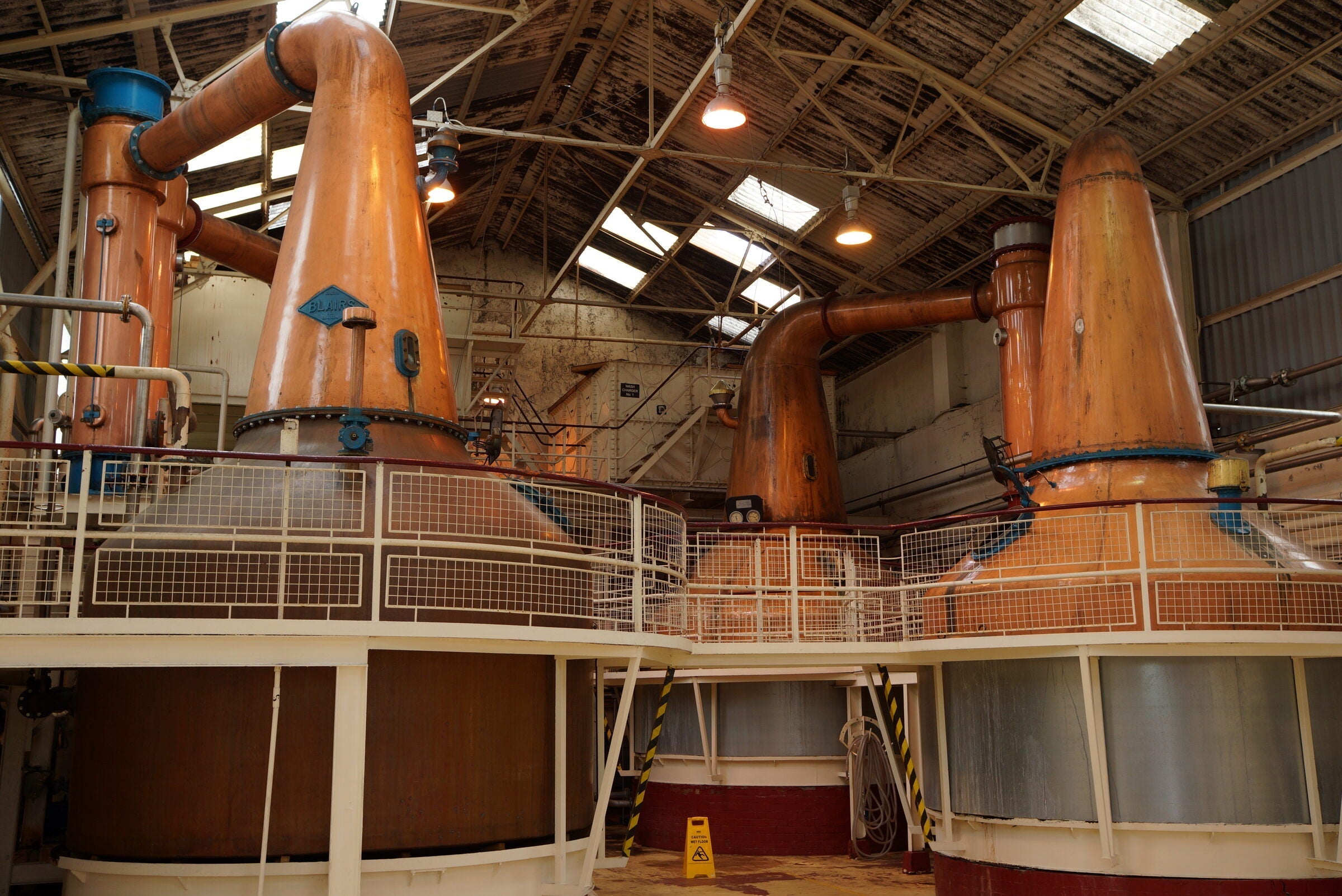
| Stills | Four: two wash and two spirit, plain in shape with deep bases |
| Water source | The Allt a' Mhuilinn burn, fed by two pools high on the mountain, Coire Leis and Coire na' Ciste |
| Fermentation | Around 48 hours, longer over weekends, in eight washbacks, six stainless steel and two Oregon pine |
| Malt spec | Mostly unpeated; around one week a year runs heavily peated malt at roughly 40ppm |
| Style | Heavy, oily and fruity, with a famously funky streak that turns tropical with age |
| Visitor centre | Yes, open since 1991 |
History of Ben Nevis
Ben Nevis was licensed in 1825 by John McDonald, a crofter's son who claimed descent from the rulers of the western kingdom of Argyll and stood six feet four inches tall, which in the early nineteenth century made him close to a giant. Everyone called him Long John. He was among the first in the west Highlands to take out a licence after the 1823 Excise Act made legal distilling viable, and his whisky, sold as Long John's Dew of Ben Nevis, became famous enough that the Long John name survived as a blended Scotch brand for well over a century after his family lost control of it.
The distillery still tells the story that when Queen Victoria visited Fort William in 1848, Long John presented her with a cask to be opened when the Prince of Wales came of age. True or embellished, it says something about the whisky's standing that the story stuck.
After Long John died in 1856 his son Donald took over, and business was good enough that in 1878 the family built a second, larger distillery next door, named simply Nevis. The two ran side by side until demand slackened, and around 1908 production was consolidated back at the original site, with the newer buildings surviving as warehousing.
The most colourful chapter arrived in 1955 with Joseph Hobbs, a Scots-born adventurer who had made and lost a fortune in Canada, with interests spanning shipping, construction and, during American Prohibition, activities usually described politely as whisky exporting. Back in Scotland he bought and sold a string of distilleries, Bruichladdich, Glenury Royal and Glenkinchie among them, before settling at Fort William, where he also ran the Great Glen Cattle Ranch. At Ben Nevis he did something almost heretical: he installed a Coffey still alongside the pot stills, making it one of the first distilleries in Scotland to produce malt and grain spirit under one roof, and experimented with blending the two at birth, straight into the cask. The Coffey still stayed until 1981.
Hobbs died in 1963 and the distillery drifted, passing in 1981 to Whitbread's Long John Distillers, a neat homecoming for the name, which refurbished the site but mothballed it by 1986. Rescue came from an unexpected direction. Nikka, the Japanese distiller founded by Masataka Taketsuru, who had learned his craft in Scotland after the First World War, bought Ben Nevis in 1989, restarted the stills in 1990 and opened the visitor centre the following year. The logic was sound: Nikka wanted a source of genuine Highland malt for its blends, and Ben Nevis wanted an owner who valued its old-fashioned spirit exactly as it was. Around a third of the new make is still exported to Japan, where it disappears into blends such as Nikka Black, while at home the distillery bottles its single malt alongside the Dew of Ben Nevis blend and the Glencoe blended malt.
How Ben Nevis makes its whisky
The production regime is where Ben Nevis earns its cult status, and the heart of it is yeast. Almost every distillery in Scotland long ago switched to cultured distiller's yeast, chosen for efficiency and consistency. Ben Nevis is one of the very last to persist with brewer's yeast in its fermentations, and the distillery credits it with much of the spirit's character: fermentation is less complete, the esters pile up, and the result is a wash with far more personality than the industry norm. Fermentations run around 48 hours during the week and considerably longer over weekends, in eight washbacks, six of stainless steel and two of Oregon pine.
Mashing happens in a stainless steel lauter tun with a charge of around eight and a half tonnes, and distillation in four plain, deep-based stills that produce a heavy, oily new make, filled into cask at around 63.4%. Water comes from the Allt a' Mhuilinn, the burn that drains two pools high in the mountain's northern corries, Coire Leis and Coire na' Ciste, often described as the highest water source of any Scotch whisky distillery. Capacity is typically quoted at around 2 million litres of pure alcohol a year, modest by modern Highland standards.
The malt is mostly unpeated, to a Speyside-style specification, but for around one week a year the distillery runs heavily peated malt at roughly 40ppm, softening to something like 15ppm in the new make. Those rare peated casks have become collectors' quarry in their own right, and we were lucky enough to land two of them, as you will see below. Maturation uses a mix of ex-bourbon and sherry wood, much of it in the distillery's own dunnage warehouses.
What does Ben Nevis taste like?
Young Ben Nevis is a big, broad-shouldered spirit: thick cereal sweetness, orchard fruit, cocoa and a slightly wild, leathery edge that polite modern malts have had bred out of them. It takes sherry wood particularly well, the weight of the spirit standing up to oloroso and PX where lighter makes would drown.
Give it fifteen or twenty years, though, and something remarkable happens. The wildness resolves into tropical fruit, pineapple, mango and overripe peach, layered with hazelnut, coffee, old leather and that hard-to-define savoury depth enthusiasts call funk. It is a profile that recalls long-lost old-style Highland malts, which is precisely why collectors chase it. The mid-1990s vintages, 1996 especially, have built a formidable reputation at auction and in whisky bars from Glasgow to Tokyo.
The occasional heavily peated spirit adds another dimension: bonfire smoke and dark chocolate laid over the same muscular, fruity base, closer in spirit to an Islay heavyweight than anything else made on the west Highland mainland.
Ben Nevis and independent bottlers
The official range is small. The 10 year old, relaunched in the mid-1990s, carries the flag, joined in recent years by the cask-strength Coire Leis and the deliberately old-fashioned MacDonald's Traditional, plus occasional limited releases. With so much spirit committed to blends, the single malt has always been rationed, and that scarcity has made independent bottlers the main road into the distillery for curious drinkers. Signatory, Cadenhead's, Blackadder and Douglas Laing have all bottled memorable casks, and unlike blending workhorses such as Blair Athol or Teaninich, whose indie bottlings tend to be plentiful and quietly priced, independent Ben Nevis now sells on the strength of its name alone.
Batch variation is part of the deal. Brewer's yeast and old-school distilling do not produce a uniform spirit, and two casks from the same year can head in quite different directions. To a certain kind of whisky lover, and we count ourselves in that number, this is exactly the point.
The Single Cask and Ben Nevis
We have bottled Ben Nevis ten times, which makes it one of the most frequent visitors to our shelves of any distillery in Scotland. That is not an accident. The combination of heavy spirit, honest pricing and sheer character makes it close to the perfect independent bottler's malt, and every time a good cask has come our way we have taken it.
Our Ben Nevis (Heavily Peated) 8 year old, cask 36, distilled in 2015 during one of those rare peated weeks and matured in a refill PX quarter cask. Bottled at a cask strength of 51.7% with an outturn of 177 bottles, it piles popcorn, peat and malt onto raisins, leather, dark chocolate and rancio, the peated spirit and the sherry wood pulling in the same old-fashioned direction. Its sister cask 38, from the same 2015 peated run, sold out some time ago.

Two departed favourites show what age does to this make. Our 25 year old from cask 1332, distilled in that celebrated 1996 vintage and bottled at 51.9% from a single hogshead, was textbook aged Ben Nevis: tropical fruits, funk, citrus, malt, white pepper and white chocolate, from nose to finish.

Our 20 year old from ex-bourbon cask 170, bottled at 53.0%, showed the brighter side of the spirit, sweet malt, lime and dry roasted nuts over buttery toasted oak, with a long, warming orange finish. Around them we have bottled everything from a pair of cheerful 5 year old quarter casks to a 7 year old oloroso cask, a 19 year old and a 22 year old from the mid-1990s, and a 10 year old hogshead. Few distilleries have given us so much range to play with.

Collectability and cask ownership
Ben Nevis's stock has risen sharply over the past decade. The 1996 vintage bottlings, official and independent alike, have developed a strong following at auction, older Hobbs-era rarities command serious money when they surface, and even young official releases now sell through quickly. The distillery's small official output and blend-first allocation mean supply will always be tight, which is much of the appeal.
Casks do reach the private market more often than at most cult-name distilleries, partly because Ben Nevis has long sold to brokers and blenders, and a well-chosen cask from a good vintage has an obvious story to tell. The usual questions still apply: is the provenance watertight, what wood is it in, and what would the liquid honestly be worth bottled. Cask ownership involves risk, values can go down as well as up, and nothing on this page is financial advice. If you are weighing up a purchase, our guide to cask sizes and types covers the practicalities, and we will always tell you plainly whether we think a price makes sense.
Visiting Ben Nevis
The distillery sits at Lochy Bridge on the A82, on the northern edge of Fort William, with the mountain rising straight behind it, a setting few distilleries in Scotland can match. The visitor centre has been running since 1991 and keeps things cheerfully unpretentious, with tours of the working distillery, tastings, and a long-running introductory film built around the legend of Hector McDram. Fort William is the self-styled outdoor capital of the UK, so a distillery tour slots easily between a day on the hill and a seafood dinner.
For whisky travellers, Ben Nevis pairs naturally with a run up the Great Glen or over the sea to Skye, where Talisker waits on the shore of Loch Harport, while those heading for the north-east coast can call at Dalmore on the Cromarty Firth.
Ben Nevis FAQs
Who owns Ben Nevis distillery?
Nikka Whisky Distilling of Japan, which bought the distillery in 1989 and restarted production in 1990. Nikka is part of Asahi Group Holdings. Around a third of the new make spirit is exported to Japan for use in Nikka's blends.
Is Ben Nevis whisky peated?
Mostly no. The standard malt is unpeated, but for around one week a year the distillery runs heavily peated malt at roughly 40ppm, and those rare peated casks are keenly sought after.
Why does Ben Nevis whisky taste funky?
Ben Nevis is one of the last distilleries in Scotland still fermenting with brewer's yeast, which produces a heavier, more estery wash than modern distiller's yeast. Combined with old-fashioned distillation and long maturation, it gives the whisky its signature savoury, tropical, slightly wild character.
What is special about the 1996 Ben Nevis vintage?
Casks distilled in the mid-1990s, and 1996 in particular, have matured into spectacularly fruity, complex whiskies that recall old-style Highland malts. Bottlings from that vintage, including our own 25 year old, have developed a strong following among collectors.
Can you visit Ben Nevis distillery?
Yes. The visitor centre at Lochy Bridge, Fort William has been open since 1991 and offers tours and tastings, with the mountain itself as the backdrop. Check the distillery's website for current times and book ahead in summer.
Can you buy a cask of Ben Nevis?
Sometimes, yes. Ben Nevis casks reach the independent market more often than most distilleries with this level of cult appeal, though good ones move quickly. Ask us and we will give you an honest picture of what is available.
Own a piece of Ben Nevis
Ben Nevis is what Scotch whisky used to taste like before efficiency tidied it up: brewer's yeast, heavy spirit, dunnage warehouses and a make that turns tropical if you give it time. We have bottled it ten times and fully intend to make it eleven.
If the idea of owning a cask from the foot of Britain's highest mountain appeals, start with our guide to buying a whisky cask, then get in touch. We taste everything we sell, we own casks of Ben Nevis ourselves, and we will tell you straight whether the cask in front of you is worth your money.
Work with The Single Cask
Buy a whisky cask, bottle under your own label, or store casks in our HMRC approved bonded warehouse in Fife.
Read more
Highland Park Distillery: Orkney's Viking Malt and the Whisky That Hides Its Name
Floor maltings, heathery peat and sherry oak on an island the Vikings ruled for 600 years. The full Highland Park story, plus why independent bottlings never carry its name and what our own Whitlaw...
Read more
Glenmorangie Distillery: The Tallest Stills in Scotland
Home of Scotland's tallest stills, giraffe-necked copper fed by rare hard spring water, and the cask finishes that changed whisky forever. Here is the full Glenmorangie story, and the honest truth ...
Read more


