
Article: Longmorn Distillery: The Blenders' Treasure That Taught Japan to Make Whisky
Longmorn Distillery: The Blenders' Treasure That Taught Japan to Make Whisky
In 1920 a young Japanese chemistry student named Masataka Taketsuru talked his way into a placement at a distillery just south of Elgin, and spent his days there filling notebooks with sketches and measurements. He went home, founded Nikka, and built stills said to be modelled on the ones he had studied; which is how a quiet Speyside workhorse called Longmorn became, quite plausibly, the most influential distillery in the history of Japanese whisky.
That story would be the headline fact at most distilleries. At Longmorn it has competition, because among blenders and whisky obsessives this is one of the most revered names in Scotland: a malt so dependable and so deeply fruity that generations of professionals have quietly ranked it alongside far more famous neighbours. This guide covers the gloriously chaotic career of its founder, how the whisky is made, why the Japanese connection matters, and our own Longmorn bottlings, including two new casks about to join the list.
Longmorn at a glance
| Region | Speyside (Longmorn, between Elgin and Rothes, Moray) |
| Founded | 1893, by John Duff and partners; the first spirit ran in December 1894 |
| Owner | Chivas Brothers (Pernod Ricard), since 2001 |
| Capacity | Around 4.5 million litres of pure alcohol a year |
| Stills | 8 (4 wash, 4 spirit), onion-shaped |
| Water source | A borehole beneath the site, in the well-watered farmland south of Elgin |
| Fermentation | Around 50 hours, in ten stainless steel washbacks |
| Malt spec | Unpeated, from commercial maltings |
| Style | Rich, sweet and deeply fruity, with a creamy, weighty texture |
| Visitor centre | No; the distillery is not open to the public |

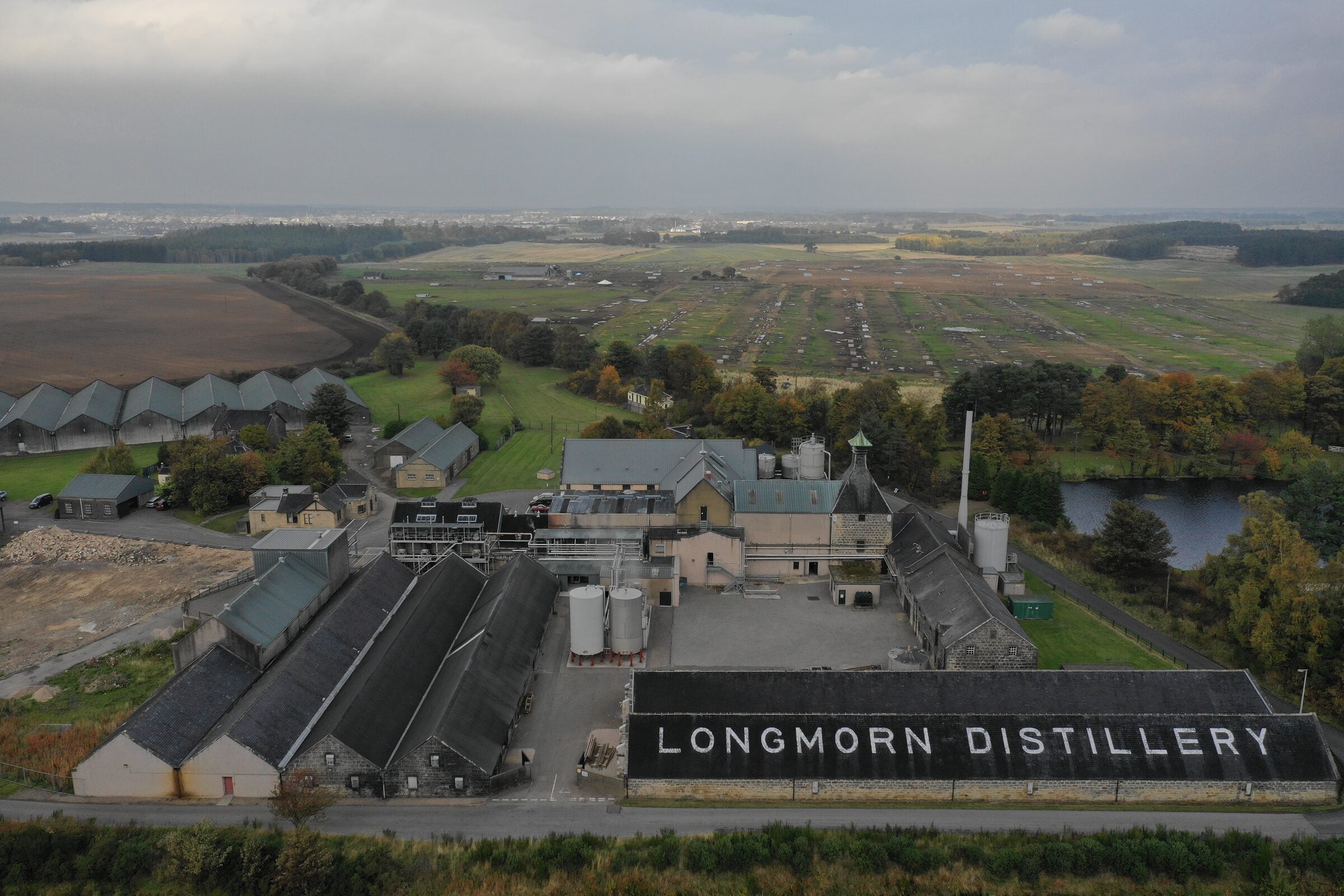
Longmorn from above
Longmorn keeps its head down in the barley fields between Elgin and Rothes, with no visitor centre and no signposted fanfare, so for most people the closest look they will ever get is from the air. Our drone caught the Victorian stone buildings and their pagoda sitting neatly beside the old railway line that once carried its casks north.
History of Longmorn
John Duff was the sort of Victorian whisky man who makes modern entrepreneurs look timid. A former distillery manager who had designed Glenlossie in 1876, he emigrated to try to start whisky industries first in South Africa and then in the United States, failed at both, and came home to Speyside apparently undeterred. In 1893, with partners Charles Shirres and George Thomson, he began building Longmorn on the road south from Elgin, on a site whose name is often translated as "the place of the holy man", after an early chapel there. The first spirit ran in December 1894, and the whisky found admirers among blenders almost immediately.
Duff, characteristically, doubled down: in 1898 he built a second distillery, BenRiach, literally next door. His timing was as bad as his energy was boundless. The Pattison crash hit that same year, demand collapsed, and by 1899 Duff was forced to sell his interests. Longmorn passed into the orbit of the Grant family and the Edinburgh blending firm Hill Thomson, whose Something Special blend leaned on it for decades, and it simply never stopped working: through the twentieth century Longmorn ran quietly and almost continuously while its reputation among professionals grew into something close to reverence.
The corporate history since is quickly told. In 1970 Longmorn merged with The Glenlivet and Glen Grant to form The Glenlivet Distillers Ltd, which passed to Seagram's Chivas Brothers at the end of that decade, and to Pernod Ricard when it bought Chivas Brothers in 2001. A 2012 refurbishment renewed the mash tun and washbacks while leaving the character alone. Through all of it, the malt has remained what it always was: a blender's treasure, ring-fenced for the Chivas Brothers portfolio, with official single malt bottlings kept deliberately scarce.
How Longmorn makes its whisky
Longmorn's fame rests on a spirit that manages to be both rich and clean. The eight onion-shaped stills, four wash and four spirit, produce a new make with real weight to it, and the distillery draws its water from a borehole beneath the site. Fermentation runs around 50 hours in ten stainless steel washbacks, and the malt is unpeated; nothing about the process chases smoke or austerity. New make comes off the stills at a relatively high strength, around 72%, clean enough to keep the fruit bright but with enough body to carry decades in oak.
For most of its life the distillery did things the hard way, and old hands still talk about how long the traditions survived here compared with its neighbours. Longmorn malted its own barley for decades, and its spirit stills stayed direct-fired long after most of Speyside had converted to steam; dates into the 1990s are often quoted for the final switch. The site even had its own railway connection in its early years, with the Great North of Scotland line running past the door, a legacy you can still trace in the layout from the air. Today's setup is modern and efficient, but the cut is run for the same deeply fruity, faintly honeyed spirit the blenders have always demanded, and Chivas Brothers has been careful to change nothing that matters.
That spirit takes oak superbly. Ex-bourbon casks let the orchard fruit and cream shine; sherry wood turns Longmorn into something opulent, all dried fruit and polished furniture, which is why aged sherry-cask Longmorns are among the most sought-after independent bottlings in Speyside. The house style rewards patience: this is a malt that hits its stride in its teens and keeps improving well past twenty.

What does Longmorn taste like?
Ripe orchard fruit, first of all: apples baked with brown sugar, pears, apricots, often a tropical flash of pineapple or mango in older casks. Underneath sits a creamy, malty richness, barley sugar and toffee, with gentle baking spice and a texture that fills the mouth. It is a whisky with very few edges, which sounds like faint praise until you taste a good one and realise how difficult that is to achieve at this depth of flavour.
Official bottlings have come and gone: a 15 year old launched in 1993 earned a devoted following, its 16 year old replacement arrived in 2007, and the current range keeps to older, dearer expressions. The truth is that most Longmorn never sees a single malt label at all, disappearing instead into Chivas Brothers' blends, and the surest way to drink it at its best has long been through independent bottlers.
If you are trying to place it on the Speyside map: drinkers who love the sherried depth of Glenfarclas or the lush fruit of Glen Elgin tend to fall for Longmorn hardest, because it combines the weight of the former with the fruit of the latter and adds a creaminess that is entirely its own.
Longmorn and independent bottlers
For a malt the owners keep on a short leash, an encouraging amount of Longmorn has reached the independent market over the years, and bottlers treat it with unusual respect: this is a name that sells on reputation to people who know. Gordon & MacPhail in Elgin have a particularly deep history with the distillery, including some legendary long-aged sherry casks, and the Scotch Malt Whisky Society and the usual serious independents return to it whenever parcels appear. Collectors in Japan, primed by the Taketsuru story, compete hard for the best of them, and Gordon & MacPhail's aged sherry-cask Longmorns from mid-century vintages now rank among the most celebrated Speyside bottlings ever released by an independent. Among its Elgin-area neighbours, only Glen Elgin and Linkwood inspire anything like the same quiet devotion, and Longmorn arguably outranks both in blender prestige.
The Single Cask and Longmorn
Longmorn casks do not come our way often, which makes the ones that do all the more satisfying. Our first was cask R2020/9460, an 18 year old distilled in 2002 and matured in an ex-bourbon barrel, bottled at its natural cask strength of 45.5%, mellowed by all those years in oak, with an outturn of just 68 bottles. It sold through, as 18 year old Longmorn at cask strength tends to.
Now we have two more on the way, and they bracket the distillery's range beautifully. Cask 336A is a 14 year old, distilled on 28 September 2009 and finished in a second-fill sherry octave, bottled at a muscular 60.5%; small sherry casks work fast, and this one leans into Longmorn's dried-fruit, spiced side. Cask 60460 is the jewel: a 25 year old distilled on 20 July 1999, drawn from a refill hogshead at 57.1%, the kind of patient, subtle cask that lets a quarter-century of Longmorn's fruit develop without the oak shouting over it. Both are being prepared for release as we write, so keep an eye on the shop, or contact us to hear about them first.

Collectability and cask ownership
Longmorn sits in the sweet spot of the collectors' market: revered enough that older bottlings, especially sherry-cask independents and the discontinued 15 year old, climb steadily at auction, yet not so hyped that prices have detached from the liquid. Japanese demand adds a distinctive floor to the market for aged expressions. As ever, reputation cuts both ways, and fashion in whisky is no more permanent than anywhere else.
Casks of Longmorn are genuinely scarce in private hands, which is precisely why they deserve a clear head when they do appear. The fundamentals apply in full: whisky cask ownership is unregulated, values can go down as well as up, storage and insurance cost money every year, and nothing in this article is financial advice. A revered name is not a substitute for verifiable provenance and honest paperwork. Start with our guide to cask sizes and types, note what small casks like our sherry octave do to maturation speed, and deal only with sellers who will show you the documents.
Longmorn FAQs
Who owns Longmorn?
Longmorn is owned by Chivas Brothers, the Scotch whisky arm of Pernod Ricard, which acquired it in 2001. Before that it belonged to Seagram, and earlier to The Glenlivet Distillers, the company it formed with The Glenlivet and Glen Grant in 1970.
What does Longmorn taste like?
Rich orchard fruit, baked apples, apricots and barley sugar over a creamy, weighty malt base, with tropical notes emerging in older casks. It is unpeated, takes both bourbon and sherry oak superbly, and matures brilliantly past its teens.
Why is Longmorn famous in Japan?
Masataka Taketsuru, the founding father of Japanese whisky and of Nikka, trained at Longmorn in 1920 during his apprenticeship in Scotland. The stills at Nikka's distilleries are said to have been modelled on Longmorn's, and the connection still drives fierce Japanese demand for its whisky.
Is Longmorn peated?
No. Longmorn uses unpeated malt, and its character comes from a weighty, fruity spirit and good casks rather than smoke.
Can you visit Longmorn distillery?
No. Longmorn has no visitor centre and is not open to the public. It sits in farmland just south of Elgin, and this corner of Speyside is largely a working one; its neighbours Glen Elgin and Miltonduff keep their doors closed too.
Can I buy a cask of Longmorn?
Rarely, but it happens; our own bottlings prove that casks do reach the independent market. When one appears, verify its provenance and paperwork through a reputable specialist before committing, and expect the price to reflect the name's standing among blenders and collectors.
Own a piece of Longmorn
Longmorn is the whisky insider's Speyside: the malt the blenders hoard, the distillery Japan built an industry around, and a name that rewards anyone patient enough to seek out its single casks. Our 25 year old cask 60460 and 14 year old sherry octave 336A are the next chapter, and casks of this calibre are exactly why we do what we do. If owning a cask of your own appeals, The Single Cask helps clients buy whisky casks with verified provenance, store them in our bonded warehouse and bottle them under their own label when the whisky is ready.
Read first, buy second: our guides set out the costs and the risks in plain English, and when you want a straight conversation about Longmorn, or any other Speyside malt, contact us.
Work with The Single Cask
Buy a whisky cask, bottle under your own label, or store casks in our HMRC approved bonded warehouse in Fife.
Read more
The English Whisky Co: The Norfolk Farm That Brought Whisky Back to England
The English Whisky Co. guide: how the Nelstrop family built England's first whisky distillery in a century at Roudham, Norfolk — the Forsyths stills, Breckland water, peated and unpeated styles, ou...
Read more


