
Highland Park Distillery: Orkney's Viking Malt and the Whisky That Hides Its Name
The man usually credited with founding Highland Park spent his Sundays in church and his nights running contraband whisky past the excise. Magnus Eunson, beadle, butcher and smuggler, is said to have hidden his casks under the pulpit while the officers searched his house, and it was on his patch of ground above Kirkwall, the High Park, that Orkney's most famous distillery took root in 1798.
More than two centuries later, Highland Park is one of the most complete distilleries in Scotland: it still turns part of its own barley on malting floors, still cuts its own peat from Hobbister Moor, and still fills almost everything into sherry-seasoned oak. For drinkers that adds up to one of the great balancing acts in whisky, heather honey on one side and gentle aromatic smoke on the other. For cask buyers it produces a curiosity we know first-hand: a whisky that almost never travels under its own name. Here is the full story.
Highland Park at a glance
| Region | Islands (Orkney); officially grouped within the Highland region |
| Founded | 1798, credited to smuggler Magnus Eunson; first licensed around 1826 under Robert Borwick |
| Owner | Edrington, owners of The Macallan; part of Highland Distillers since 1937, with Edrington taking full control in 1999 |
| Capacity | Around 2.5 million litres of pure alcohol a year |
| Stills | Four: two wash stills and two smaller spirit stills, steam-heated |
| Water source | Cattie Maggie's pool and springs above the distillery, supplemented from Crantit |
| Fermentation | Long and unhurried, typically quoted at 50 to 90 hours in a dozen wooden washbacks |
| Malt spec | Around a fifth floor-malted on site and peated to roughly 20 ppm with heathery Hobbister Moor peat, married with unpeated mainland malt |
| Style | Heather honey, orange peel and sherry fruit wrapped in soft, floral peat smoke |
| Visitor centre | Yes, open since 1986, with the working malting floors on the tour |

Highland Park from above
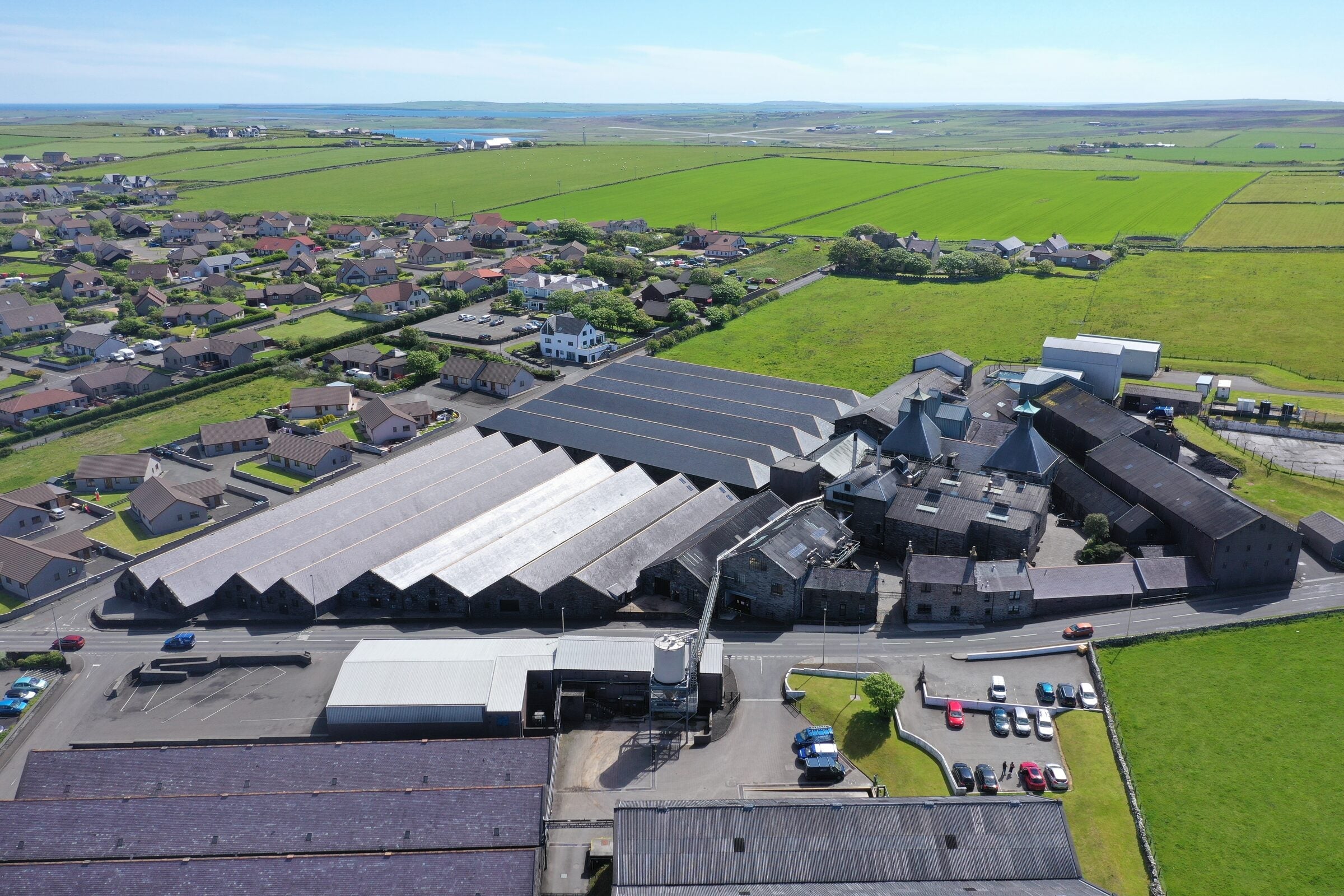
Orkney rewards a drone like almost nowhere else in whisky. Our footage shows the distillery's grey flagstone roofs and twin pagodas on the hill above Kirkwall, with Scapa Flow and the treeless sweep of the island beyond, and if you look closely you can see the smoke rising from the peat-fired kilns.
History of Highland Park
Orkney was Norse before it was Scottish. The islands were ruled from Norway until 1468, the local dialect kept its Viking inflections for centuries, and Kirkwall's red sandstone cathedral is named for St Magnus, a martyred Norse earl. Highland Park leans on that inheritance today, but the distillery's own beginnings are more Presbyterian than Viking, and pleasingly disreputable.
The Eunson story is the one everyone tells: a church officer who distilled illegally on the High Park above the town and used the kirk itself to hide the evidence. What the records more soberly support is that a distillery took shape on the site around 1798, with local accounts also crediting one David Robertson, and that Robert Borwick took out the first licence around 1826. The Borwick family ran it for the next four decades, after which it passed through Stuart & Mackay to James Grant, formerly of The Glenlivet, who bought the distillery in 1895 and doubled the still count from two to four.
By then Highland Park malt was already prized by blenders, and the ships of the Hudson's Bay Company and other northern traders calling at Kirkwall carried its reputation abroad. In 1937 the distillery joined Highland Distillers, and through the Robertson & Baxter connection it eventually came under Edrington, the Glasgow group that took full control in 1999 and also owns The Macallan. Highland Park was bottled as a single malt in earnest from the late 1970s, and the 12 year old that followed became a fixture on shelves worldwide. The modern era has been defined by confident Norse branding, from the Valhalla series of the 2010s to Valkyrie and its siblings, and by a run of critical acclaim few distilleries can match. The distillery marked its 225th anniversary in 2023 by releasing a 54 year old, its oldest whisky ever.
How Highland Park makes its whisky
Highland Park is one of a handful of Scottish distilleries, alongside the likes of Springbank and Balvenie, that still malts part of its own barley on traditional floors. Around a fifth of the requirement is steeped, spread and turned by hand on site, then dried in kilns fired with peat cut from Hobbister Moor a few miles to the south-west. That peat is the heart of the house style. Orkney has been more or less treeless for thousands of years, so its bogs are built from heather and sphagnum rather than ancient woodland, and the smoke they give off is scented and floral rather than tarry. The floor-malted barley comes off the kiln peated to a level typically quoted at around 20 ppm, and is then married with unpeated malt from the mainland, so the finished spirit carries a perfume of smoke rather than a wall of it.
The rest of the process is patient. Water comes from Cattie Maggie's pool and springs above the distillery. Fermentation runs long in a dozen wooden washbacks, often well past the industry's minimum, building fruit before the wash reaches the four steam-heated stills. Distillation is conventional Orcadian understatement, two wash stills and two smaller spirit stills, but what happens next is anything but standard practice. Since the mid-2000s Highland Park has filled almost exclusively into sherry-seasoned casks, American and European oak sent to Spain to be seasoned with dry Oloroso before coming north. The distillery also harmonises its whiskies, marrying matured casks together and returning them to wood to settle before bottling, and its single malts are bottled at natural colour. Cool Orkney warehouses, where the temperature barely moves all year, do the slow work in between.
What does Highland Park taste like?
Where Talisker, its great island rival on Skye, answers the sea with pepper and brine, Highland Park answers with honey. The classic signature is heather honey and smoke in the same breath. Expect orange peel, baked apple and dried fruit from the sherry wood, a waxy maltiness through the middle, and then that distinctive aromatic smokiness drifting over the top, floral and almost incense-like, closer to a smouldering herb garden than to an Islay bonfire. The 12 year old shows the balance at its most approachable; the 18 year old, twice named the best spirit in the world by the American critic F. Paul Pacult, adds polish and depth, and the older releases pile on dark chocolate, leather and antique sweetness. Young Highland Park, the kind that reaches independent bottlers, is a different pleasure: brighter, saltier and more obviously coastal, with the smoke sitting closer to the surface.
Highland Park and independent bottlers
Here is the quirk every whisky hunter eventually discovers. Independent bottlings of this make almost never say Highland Park on the label. Edrington guards its brand names closely, so casks that reach the open market are sold on condition the distillery name stays off the bottle. The trade's solution is the cover name, and Orkney's are among the best known in whisky: Whitlaw, an old name for land near the distillery, along with variations on Secret Orkney and Orkney's finest. Since the only other distillery on the islands is Scapa, whose casks circulate far less, decoding these labels is not exactly detective work.
It was not always so. Older licensed and independent bottlings under the full Highland Park name, from houses such as Gordon & MacPhail, do exist and are keenly collected. But for the modern cask trade, Whitlaw is the name to know, and it is the name under which we know this distillery best.
The Single Cask and Highland Park
We have bottled Highland Park spirit twice, both times as Whitlaw, and both casks were siblings with an unusual story. Distilled on 27 January 2017, they were filled not into the expected ex-bourbon wood but into first-fill quarter casks that had previously held Catoctin Creek rye whiskey from Virginia. Small casks, active American wood and lightly peated Orkney spirit make for a fast, vivid maturation, and at six years old the results surprised everyone who tasted them.
Cask 0000004A gave 145 bottles at a cask strength of 59.8% and has now sold through. Its sister, cask 4, bottled at 56.1% with an outturn of 130, is still on our shelves as we write. Our tasting notes for both ran to peaches, apricots and white grapes up front, then malt, oak and lime, with white pepper and cinnamon from the rye cask and just a hint of peat underneath. It is Highland Park with the sherry overcoat swapped for something spicier, and a good example of why we think single casks are the most interesting way to drink Scotland's most consistent distilleries.

Collectability and cask ownership
At auction, Highland Park sits near the very top table. In 2018 it ranked second only to its sister distillery The Macallan by value sold at UK whisky auctions, and its limited editions have serious followings: the Valhalla Collection of Thor, Loki, Freya and Odin, the Warrior series, single casks bottled for retailers and societies, and venerable official releases up to the 54 year old crowning the range. The 25 year old was the first spirit ever awarded a perfect 100 points at the Ultimate Spirits Challenge, the kind of accolade that keeps collectors circling.
On the cask side, Whitlaw casks do appear on the market, and well-chosen ones have obvious attractions: a famous source, a distinctive lightly peated style that ages gracefully, and a price far below what the name on a label would suggest. But the cover name cuts both ways, because a cask that cannot be bottled as Highland Park will never sell for Highland Park money, and anyone quoting official-bottling auction prices to value a Whitlaw cask is telling you a story. As ever, cask ownership involves risk, values can go down as well as up, and nothing here is financial advice. If you are weighing up a cask, start with our guide to cask sizes and types, remember that a quarter cask and a butt from the same distillery are different propositions entirely, and ask us before you commit; we will give you a straight answer.
Visiting Highland Park
Kirkwall is a long way north, but Highland Park is one of the best distillery visits in Scotland precisely because so much still happens on site. Tours take in the working malting floors, the peat-fired kilns beneath the twin pagodas, the tun room and stillhouse, and warehouses where sherry casks rest a few feet from the door. The distillery sits on the southern edge of town, an easy walk from St Magnus Cathedral, and pairs well with a trip to the Neolithic sites of Skara Brae and the Ring of Brodgar, both older than the pyramids. Ferries run from Aberdeen and the north coast, and flights from the mainland land ten minutes away. Book tours ahead in summer; Orkney's charms are no longer a secret.
Highland Park FAQs
Who owns Highland Park distillery?
Edrington, the Glasgow-based group that also owns The Macallan and The Glenrothes. Highland Park had been part of Highland Distillers since 1937, and Edrington took full control in 1999.
Is Highland Park peated?
Lightly and distinctively. Around a fifth of the malt is produced on the distillery's own floors and peated to roughly 20 ppm with heathery Orkney peat from Hobbister Moor, then married with unpeated mainland malt. The result is aromatic, floral smoke rather than heavy Islay-style phenols.
Why is it called Highland Park when it is not in the Highlands?
The name comes from the plot of land above Kirkwall where the distillery was founded, known as the High Park, and has nothing to do with the Highland whisky region. By the Scotch Whisky Association's official map, Orkney's distilleries are grouped within the Highland region all the same.
What is Whitlaw whisky?
Whitlaw is the cover name under which independently bottled Highland Park usually appears, taken from an old name for land near the distillery. Edrington does not permit third parties to use the Highland Park name, so bottlers like us label these casks as Whitlaw instead.
Can you buy a cask of Highland Park?
Casks of Highland Park spirit do reach the market as Whitlaw, and we have bottled two ourselves. They cannot be bottled under the distillery's own name, which affects resale value, so buy for the liquid rather than the label and take advice before committing. Contact us for an honest view of what is available.
Can you visit Highland Park?
Yes. The visitor centre has operated since 1986 and tours include the working floor maltings and peat kilns, a rarity in modern Scotch whisky. Book ahead in the summer season.
Own a piece of Highland Park
Orkney's great distillery guards its name jealously, but the whisky itself is within reach. Our current Whitlaw 6 year old from cask 4 is Highland Park spirit matured in a rye quarter cask, bottled by us at cask strength and natural colour, and there are more Orcadian casks in our warehouse programme. If owning a cask of your own appeals, read our plain-English guide to buying a whisky cask or get in touch and tell us what you are looking for. We taste everything we buy, we bottle nothing we would not drink ourselves, and if the right Orkney cask crosses our path, our mailing list hears about it first.
Work with The Single Cask
Buy a whisky cask, bottle under your own label, or store casks in our HMRC approved bonded warehouse in Fife.
Read more
Dailuaine Distillery: The Green Vale That Gave Whisky the Pagoda
Every pagoda roof in Scotch whisky copies a design first built at Dailuaine in 1889. We explore Speyside's meaty, blend-bound heavyweight, from Charles Doig's original pagoda to the nine single cas...
Read more
Ben Nevis Distillery: The Highland Malt With a Japanese Passport
Founded in 1825 by a six-foot-four giant, rescued by a Prohibition-era adventurer and owned since 1989 by Japan's Nikka, Ben Nevis makes some of the fruitiest, funkiest spirit in the Highlands. We ...
Read more


