
Inchgower Distillery: The Manzanilla of Speyside
In 1936, the fishing town of Buckie did something no British town had done before and none has done since: it bought itself a whisky distillery. The Wilson family, who had run Inchgower since 1871, had gone bankrupt, and rather than watch a local employer close, Buckie Town Council paid a sum usually quoted at around £1,600 for the whole site. Two years later it sold the distillery to Arthur Bell & Sons for £3,000, roughly doubling its money, one of the shrewder pieces of municipal business in Scottish history.
That sale set the course for everything that followed. Inchgower became, and remains, one of the engine rooms of Bell's, Britain's best-selling blended whisky for decades. Almost none of it is bottled as single malt, which is exactly why independent bottlers like us keep going back to it. We have bottled Inchgower more than a dozen times, more than almost any other distillery we work with, and this guide explains why.
Inchgower at a glance
| Region | Speyside (Lower Speyside), on the edge of Buckie, Moray |
| Founded | 1871, by Alexander Wilson & Co |
| Owner | Diageo (via Arthur Bell & Sons from 1938, Guinness from 1985) |
| Capacity | Typically quoted at around 2.2 million litres of pure alcohol a year, though some sources give a higher figure |
| Stills | Four: two wash, two spirit, with steeply angled lyne arms |
| Water source | Springs in the Menduff Hills, south of Buckie |
| Fermentation | Short, around 46 hours, in six washbacks |
| Malt spec | Unpeated |
| Style | Spicy, saline, robust; nicknamed the "Manzanilla of Speyside" |
| Visitor centre | No, a working production site, not open to the public |

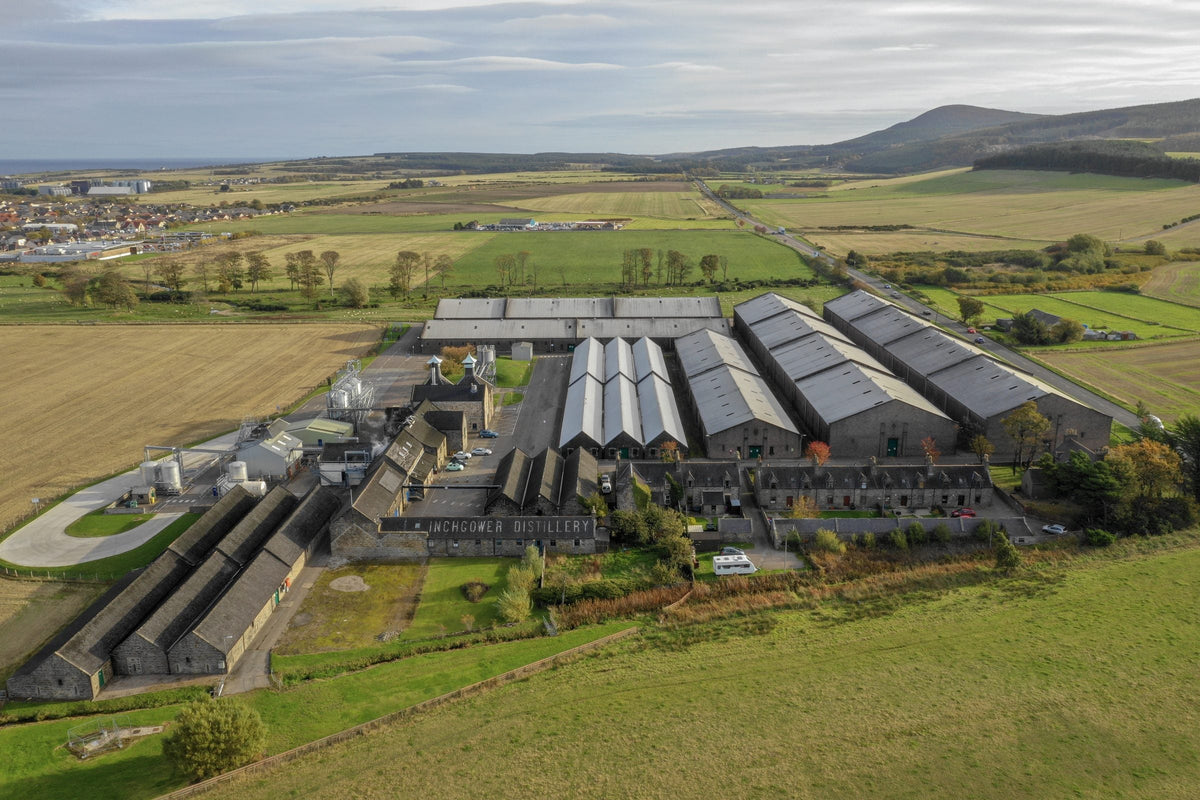
Inchgower from above
Inchgower has no visitor centre, so the best view most whisky lovers will ever get of it is from the air. Our drone flew over the distillery's handsome Victorian courtyard and its warehouses on the coastal plain outside Buckie, with the Moray Firth just beyond, close enough that you can see why the whisky tastes the way it does.
History of Inchgower
Inchgower exists because of a rent dispute. Alexander Wilson & Co had been distilling at Tochineal, near Cullen, since the 1820s, but when the landlord raised the rent sharply, Wilson's response was to dismantle the distillery, cart the equipment a few miles west along the coast, and build a bigger and better one on the outskirts of Buckie in 1871. He called it, with no false modesty, "The Great Distillery of Inchgower". The original Tochineal kit was used to get the new site running, and Tochineal itself never made whisky again.
The Wilsons ran Inchgower for six decades, but the business failed in the 1930s, a grim decade for Scotch generally. What happened next is the distillery's claim to fame: Buckie Town Council stepped in and bought it in 1936, saving the jobs and, in the process, becoming the only local authority ever to own a Scotch whisky distillery. The council was never likely to be a long-term distiller, and in 1938 it sold Inchgower to Arthur Bell & Sons of Perth for £3,000, at roughly twice what it is usually said to have paid, a profit ratepayers presumably toasted.
Bell's made Inchgower a cornerstone of its blend and, in the mid-1960s, doubled the distillery by adding a second pair of stills. From there Inchgower followed the consolidation of the industry: Guinness bought Bell's in 1985, the business merged into United Distillers in 1987, and the 1997 creation of Diageo brought Inchgower to its present owner. Through every change of hands its job has stayed the same, filling casks for blends, with as much as 99% of production going into Bell's, Johnnie Walker and their stablemates.
How Inchgower makes its whisky
Inchgower's character is engineered in the details, and they are unusual ones. The mashing regime is quick, with a hotter than usual second water, a choice that strips back the nutty, cereal notes many Speyside distilleries embrace. Fermentation is short at around 46 hours in six washbacks, which keeps the spirit robust rather than delicately fruity. Water comes from springs in the Menduff Hills above the town, and the malt is unpeated.
The four stills carry steeply angled lyne arms that capture weightier elements of the vapour, giving the new make real texture and a distinctive spicy bite. The spirit comes off the stills at a strength in the mid-60s and goes into cask at the industry-standard 63.5%. There is even a flash of waxiness in the spirit that whisky people compare to Clynelish, another coastal distillery with a cult following among blenders and bottlers alike.
Maturation happens on site on a scale that surprises people: thirteen warehouses, a mix of traditional dunnage and modern racking, holding tens of thousands of casks on the coastal plain. Salt air, low warehouses, decades of patience, it all ends up in the glass.
What does Inchgower taste like?
Inchgower is Speyside on the map but not really in the glass. Where its inland neighbours run to orchard fruit and honey, Inchgower is spicy and distinctly saline, an intense, tongue-tingling character that reads as saltiness, which is why it has been called the Manzanilla of Speyside, after the famously briny sherry. Underneath sits malt, black pepper, green apple and that faint Clynelish-like waxiness.
It is a whisky with elbows, and that is a compliment. The robust spirit stands up to assertive casks that would flatten a gentler malt, which is why sherry butts, wine casks and quarter casks suit it so well. In ex-bourbon wood it stays taut and peppery with green fruit and tea-leaf notes; in sherry or wine casks it turns into something rich and spiced without ever losing that coastal edge.
Inchgower and independent bottlers
Official Inchgower is genuinely scarce. Diageo bottles a 14 year old in its Flora & Fauna series, and beyond that the cupboard is nearly bare: a couple of Rare Malts releases, a well-received 27 year old from 1976 bottled in 2004, and a 27 year old distilled in 1990 that appeared in the 2018 Special Releases at 55.3%. That is a thin official catalogue for a distillery with 150 years of history.
So independent bottlers carry the flag. Signatory, Douglas Laing, Hunter Laing and others have all released Inchgower over the years, and because the make is a blending workhorse rather than a jealously guarded single malt brand, casks reach the market with reasonable regularity, at prices that look sensible next to more famous Speyside names like Benrinnes or Linkwood, fellow Diageo blending malts we have also written about. If you want to understand what Inchgower actually tastes like across different casks and ages, the independents are the only realistic route.
The Single Cask and Inchgower
Inchgower is one of our house favourites, and we can prove it: we have bottled it more than a dozen times, across an unusually wide spread of ages and cask types. As we wrote on one of our labels, what do you do when your landlord doubles the rent on your distillery? You move all of your equipment and build a new distillery up the road. Obviously. We admire the resourcefulness at Inchgower almost as much as we admire the whisky.
Our current bottling is Inchgower 10 years old, cask 803621, distilled in 2009 and drawn from an ex-bourbon hogshead at a cask strength of 57.8%, an outturn of 130 bottles. The nose gives oak, nutmeg and green tea, followed by green apple, figs and black pepper; the palate adds rich figs and a squeeze of lime over tea leaves and spice; the finish is long and smooth, green tea and juicy apples with a hint of fig. It is textbook Inchgower from honest wood, and bottles are available now.
Past releases show how far this spirit can stretch. We have bottled 13 year olds from first-fill oloroso quarter casks (casks 802605 and 814356, all demerara sugar, fruitcake and clove), a 13 year old from a first-fill PX quarter cask, a pair of 13 year olds from red wine octaves that turned the whisky towards rancio and red fruits, 6 year olds from Moscatel and PX octaves, a 14 year old from a first-fill bourbon barrel (cask 812263, supple oak, pear drops, salted butter and white chocolate), and even a 6 year old finished in a quarter cask that previously held Catoctin Creek rye. Very few distillates could carry that range of wood. Inchgower does it without breaking stride, which is exactly why we keep coming back.

Collectability and cask ownership
Inchgower is not a trophy name, and its bottles rarely make headlines at auction, with the occasional exception for the old Rare Malts and the 2018 Special Release. What it offers instead is substance: a distinctive, characterful make from a distillery that almost never releases it officially, at prices that let you drink and collect rather than merely display. Among blenders and seasoned malt drinkers its reputation runs well ahead of its fame, and that gap is usually where the interesting opportunities sit.
For cask buyers the case is practical. Inchgower casks appear on the independent market with fair regularity, the robust spirit takes well to the sorts of active casks, sherry, wine, smaller formats, that build flavour quickly, and the style is distinctive enough to stand out in any private bottling. The honest counterpoint is that Inchgower lacks the brand recognition that drives the strongest secondary-market demand, so a cask here is a bet on liquid quality rather than label prestige. As with any cask, ownership involves risk and values can go down as well as up, and nothing here is financial advice. If you are weighing up a purchase, start with our guide to cask sizes and types, and ask us what we would actually pay.
Inchgower FAQs
Who owns Inchgower distillery?
Diageo. The distillery passed from Arthur Bell & Sons to Guinness in 1985, into United Distillers in 1987, and into Diageo when it was formed in 1997. Almost all production goes into blends, Bell's above all.
Why does Inchgower taste salty?
A combination of a robust, spicy spirit, made with a quick mash, short fermentation and steeply angled lyne arms, and long maturation in warehouses on the Moray coast. The spicy intensity reads on the tongue as salinity, earning it the nickname the Manzanilla of Speyside.
Is Inchgower peated?
No. Inchgower's malt is unpeated; its coastal, saline character comes from the spirit and the maturation, not from peat smoke.
Can you visit Inchgower distillery?
No, it is a working production site with no visitor centre. Buckie itself is worth a wander if you are touring the Moray coast, and our drone film above is the best close look at the site you will find.
Was Inchgower really owned by a town council?
Yes. Buckie Town Council bought the distillery in 1936 after the Wilson family's bankruptcy, then sold it to Arthur Bell & Sons in 1938 for £3,000, about double what it is usually said to have paid. It remains the only Scotch whisky distillery ever owned by a local authority.
Can you buy a cask of Inchgower?
Yes, from time to time. Inchgower casks reach the independent market more often than most Diageo malts. Ask us and we will tell you honestly what is available and what it should cost.
Own a piece of Inchgower
Inchgower has spent 150 years doing its work out of the spotlight, first for the Wilsons, briefly for the ratepayers of Buckie, and for the better part of a century for Bell's. That obscurity is the whisky lover's gain: a salty, spicy, thoroughly individual Speyside malt that you can still buy, bottle and even own by the cask at honest prices.
If you would like to taste it, our 10 year old cask 803621 is on the shelf now. If you are curious about buying a whisky cask, from Inchgower or any distillery we work with, or about bottling a cask under your own label, get in touch. We will give you a straight answer about availability, cost and what the whisky is actually like, because we taste everything we sell.
Work with The Single Cask
Buy a whisky cask, bottle under your own label, or store casks in our HMRC approved bonded warehouse in Fife.
Read more
Springbank Distillery: Campbeltown's Stubborn Survivor
The last great Campbeltown house malts, distils and bottles everything on one site, makes three different whiskies from one pair of malting floors, and cannot come close to meeting demand. Here is ...
Read more
Dalmore Distillery: The Stag, the Sherry and a £40 Million Bet
Dalmore wears a royal stag earned in 1263, matures its whisky in sherry casks few others can get, and has just doubled in size after a £40 million rebuild. Here is the full story of the Highland lu...
Read more


