
Miltonduff Distillery: The Speyside Malt at the Heart of Ballantine's
Around 107 million bottles of Ballantine's leave Scotland every year, and a good deal of the fruit and floral lift in every one of them comes from a distillery most drinkers could not place on a map. Miltonduff sits in the Glen of Pluscarden a few miles south-west of Elgin, on the site of an old meal mill that once belonged to the Benedictine monks of Pluscarden Abbey, and for two centuries it has been quietly doing the least glamorous, most important job in Scotch: making beautifully clean spirit for blends.
That is precisely why it interests us. Miltonduff has almost no official single malt profile, so its casks tend to be judged on what is in the wood rather than what is on the label, and we have bottled a fair few of them over the years, from a seven year old PX quarter cask to a pair of nineteen year old rye barrels. Below is the full story of this Speyside workhorse: the monks and the blessed burn, the strange Lomond stills that produced a whisky called Mosstowie, the £88 million expansion, and what our own Miltonduff casks actually tasted like.
Miltonduff at a glance
| Region | Speyside, in the Glen of Pluscarden near Elgin, Moray |
| Founded | Licensed in 1824 by Andrew Peary and Robert Bain, after years of illicit distilling in the glen |
| Owner | Chivas Brothers (Pernod Ricard), since the 2005 break-up of Allied Domecq |
| Capacity | Typically quoted at around 5.5 to 5.9 million litres of pure alcohol a year from the original plant; a new adjacent distillery announced in 2022 is designed to add up to 10 million more |
| Stills | Six onion-shaped pot stills, three wash and three spirit, with shell-and-tube condensers |
| Water source | The Black Burn, said to have been blessed by an abbot of Pluscarden |
| Fermentation | Around 48 to 56 hours in sixteen stainless steel washbacks |
| Malt spec | Unpeated, bought in from commercial maltsters such as Simpsons and Bairds |
| Style | Light, fresh and floral, with pears, orchard fruit and gentle cinnamon warmth; a classic blending malt |
| Visitor centre | No; Miltonduff is a working production site and is not open to the public |
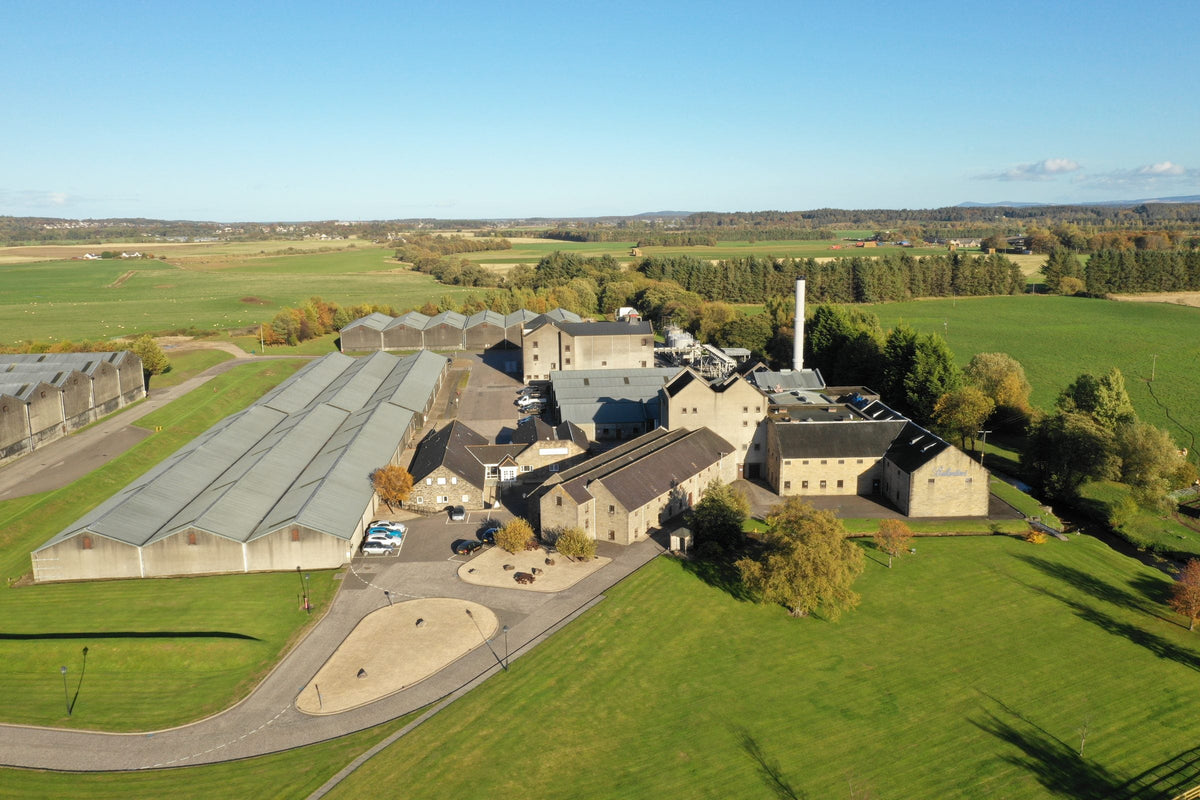
Miltonduff from above
There is no visitor centre at Miltonduff, so for most people the only way to see it properly is the way we did: from the air. Our drone flew over the distillery to show the sprawl of the site in the flat farmland of the Pluscarden glen, the long warehouse ranges and the stillhouse that Allied once ran as the largest malt distillery in its portfolio.
History of Miltonduff
Long before there was a licence, there was whisky in the Glen of Pluscarden. Alfred Barnard, touring Scotland's distilleries in the 1880s, was told that at one time as many as fifty illicit stills had operated in the glen, and the story the distillery tells about itself goes back further still. Pluscarden Abbey, founded in the 1230s, kept a meal mill on the Black Burn, and local tradition holds that on New Year's Day the monks would bless the burn to ensure good brewing. A 1924 trade account even records that the stone on which an aged abbot knelt to do so was built into the maltings until the 1890s. Whether or not you believe in blessed water, the mill site is where Andrew Peary and Robert Bain took out their licence in 1824, a year after the Excise Act made honest distilling possible, and the name joined the old "Milton" of the mill to the Duffs, the family who owned the surrounding land.
The distillery grew fast. William Stuart, who was also a co-owner of Highland Park, bought it in 1866, and by the 1890s, in partnership with Thomas Yool, Miltonduff was producing more than a million litres a year and was one of the largest malt distilleries in Scotland. Unusually for Speyside, it did so by triple distillation. New mash-house and still house were built in 1896, and by 1924 the plant was still recognisably Victorian: two furnace-heated stills, four washbacks and a water-wheel driven by the burn.
The decisive moment came in 1936. Hiram Walker, the Canadian distiller who had bought George Ballantine & Son the year before, needed reliable Speyside malt for the Ballantine's blend and bought Miltonduff along with its near neighbour Glenburgie. Miltonduff has been a Ballantine's distillery ever since, through Hiram Walker's absorption into Allied Lyons in the late 1980s, the Allied Domecq years and finally the 2005 carve-up of Allied Domecq that delivered it to Pernod Ricard and its Scotch arm, Chivas Brothers.
Along the way there were experiments. In 1964 the company installed a pair of Lomond stills, pot stills topped with a rectifying column of adjustable plates, a design that had been developed within Hiram Walker to make different styles of spirit from one still. The Lomond spirit was sold as Mosstowie, a lighter, sweeter, faintly grassy malt made from lightly peated barley, and it ran until 1981, when the stills were replaced by conventional pots. Bottles of Mosstowie still surface at auction and are prized by collectors of oddities. In 1974 the distillery was almost entirely rebuilt and expanded from four stills to six, and in April 2022 Chivas Brothers announced an £88 million package for Miltonduff and Aberlour that included a new, sustainable distillery on land next to the existing Miltonduff site, designed to add ten million litres of capacity with mechanical vapour recompression on the stills, a bio-plant and carbon-neutral distillation as the goal. Chivas said at the time it aimed for full production by mid-2025; we have not seen a formal opening announcement, so treat that timeline as an aspiration rather than a confirmed fact.
How Miltonduff makes its whisky
Miltonduff is built for consistency, and its process reflects that. Unpeated malt from commercial maltsters is ground and mashed in a full-lauter stainless steel tun with a copper dome, drawing water from the Black Burn. Fermentation takes place in sixteen stainless steel washbacks; the distillery has quoted a minimum of 48 hours, and 56 hours is the figure most often given. That is a moderately long ferment for a plant this size, and it is where the fruity esters that define the make begin to form.
The stillhouse holds six onion-shaped stills, three wash and three spirit. The commonly quoted sizes are wash stills of around 22,700 litres charged with about 12,000 litres, and spirit stills of around 18,200 litres, though published figures vary and we would not swear to the last hundred litres. What matters is the shape and the run: plain onion stills, indirect steam heating with a thermocompression heat-recovery system, and shell-and-tube condensers with sub-coolers, all tuned to make a light, clean, fruity new make at around 68 to 69% abv. Wikipedia notes that as far back as 1960 Miltonduff pioneered a wash-still heating method using heat exchangers, which fits a distillery that has always been more engineer than romantic.
Maturation is on site in a mixture of dunnage and racked warehouses, and the great majority of the spirit goes into refill and first-fill American oak destined for Ballantine's, with the balance to Chivas Regal, Royal Salute and other house blends. Miltonduff has never had floor maltings of note in living memory and has never really needed a visitor's face; it is a distillery designed to feed some of the biggest brands in the world without fuss.
What does Miltonduff taste like?
Sandy Hyslop, Ballantine's master blender, describes Miltonduff's contribution as sweet orchard fruit, especially pears, with an aromatic floral lift. That is a fair summary of the new make: fresh, floral, faintly grassy, with a succulent, almost oily texture that carries flavour well. It is the sort of spirit that lets its cask speak. In refill American oak Miltonduff stays pale, pear-led and delicate, with green tea, white pepper, lime and malt; in first-fill bourbon it picks up vanilla, brown sugar and banana; in a good sherry cask the fruit darkens to raisin, red berry and chocolate while a peppery, gently spicy backbone keeps everything in shape.
The official bottlings, such as they are, tell the same story. Ballantine's Miltonduff 15 Year Old, launched in 2017 alongside sister single malts from Glenburgie and Glentauchers, is all peaches in syrup, orange, toffee and toasted almonds; the 17 Year Old at 48%, which won an IWSC silver medal in 2023, was described by the judges as "sticky toffee pudding in a glass". Older independent releases from the 1960s and 1980s show what decades in wood can do, adding waxy tropical fruit and honeyed depth to a spirit that starts out light. It is not a shouty whisky, but it is a very well-mannered one.
Miltonduff and independent bottlers
Because Chivas Brothers has little use for Miltonduff as a stand-alone brand, the independent sector has effectively been its shop window for decades. Gordon & MacPhail of Elgin, just down the road, has bottled it since the days when it held a licence to sell it under the distillery name, and its Connoisseurs Choice releases from 1968, 1969, 1984 and 1989 remain the reference points for mature Miltonduff. Signatory Vintage, Cadenhead's, Duncan Taylor and the Scotch Malt Whisky Society (which has released well over a hundred casks, including a 40 year old) have all bottled it regularly, and Whiskybase lists more than 1,300 separate Miltonduff bottlings, the overwhelming majority of them independent. Chivas Brothers itself has released occasional cask-strength editions, a 1991 18 year old among them, plus single casks in its Distillery Reserve Collection and a 24 year old under the Secret Speyside label.
For independent bottlers this is a happy state of affairs. Miltonduff spirit is plentiful, consistent, reasonably priced and rewards good wood, which is why you will see it in so many well-regarded small releases and why we have kept coming back to it ourselves.
The Single Cask and Miltonduff
Miltonduff is one of the distilleries we have bottled most often, and every cask has shown a slightly different face of the same clean spirit. Our first outing was Miltonduff 13 Years Old, cask 700988, distilled in 2008 and matured in a first-fill bourbon barrel, bottled at a cask strength of 57.3% with an outturn of 212 bottles. It was Miltonduff at its most honest: malt, oak, white pepper, green tea and pear juice on the nose, lime and brown sugar on the palate, and a medium finish of nutmeg and malt. Then came the sherry casks. Miltonduff 14 Years Old, cask 900350, distilled in 2007 and finished in a first-fill PX hogshead, went out at 59% and 269 bottles as part of our Family Series, and it was a different animal altogether: banana, red fruits, dark chocolate and sweet raisins, with ginger and black pepper on the finish. A little later a first-fill PX quarter cask gave us the plucky Miltonduff 7 Years Old, cask 800259A, distilled in 2014 and bottled at 48.8%, just 177 bottles of red fruit, black pepper, rancio and nutmeg that proved a young Miltonduff can carry a serious sherry cask without being flattened by it.
We have also had the pleasure of a Miltonduff 10 Years Old from refill butt MIL09, a big 575-bottle outturn at a bracing 64.5%, all raisins, coffee beans, orange and leather, and a gentler 21 Years Old, cask 2594, distilled in 1995 and bottled at 45.8%, which was caramelised fruit, honey and toasted bread with a finish we could only describe as sugar-dusted pancakes with a squeeze of lemon. Most recently we bottled a pair of sister casks that show what this spirit does in unusual wood: Miltonduff 19 Year Old, cask 801424 and cask 801424A, both distilled on 26 June 2006 and matured in Hillrock rye barrels from New York state, bottled at 55.8% and 56% respectively. Rye barrels lend a spicy, minty edge that suits Miltonduff's pear-and-pepper character remarkably well. Every one of these bottlings has now sold out, which tells you something about how readily good Miltonduff finds a home; if another cask comes our way, our mailing list will be the first to know.

Collectability and cask ownership
Miltonduff is not an auction headliner in the way The Macallan or Bowmore are, and it is important to be clear-eyed about that. Its collectable end is niche: Gordon & MacPhail bottlings from the 1960s, the Mosstowie Lomond-still releases and the occasional old Signatory or SMWS cask attract steady interest from enthusiasts, and prices for well-aged examples have crept up as the pool of 1960s and 1970s Speyside shrinks. But the distillery's official releases are limited to travel retail and the Chivas visitor centres, and most Miltonduff sold at auction sells as good whisky rather than as a trophy.
For cask buyers that is arguably the attraction. Miltonduff spirit is available, its provenance is easy to verify because it comes from one of the largest and best-run companies in Scotch, and it responds well to both bourbon and sherry wood, so it gives an owner real choices about the whisky they eventually bottle. It is the kind of cask we would recommend to someone who wants to bottle something delicious under their own label rather than chase a name. The usual honesty applies: cask ownership involves risk, values can go down as well as up, storage and insurance cost money each year, and a cask can only ever be sold as whisky. Nothing here is financial advice. If you are weighing up a hogshead against a butt or a quarter cask, our guide to whisky cask sizes and types explains how the choice shapes the whisky, and we are always glad to give a plain-spoken view on any Speyside cask you are considering.
Miltonduff FAQs
Who owns Miltonduff distillery?
Miltonduff is owned by Chivas Brothers, the Scotch whisky business of Pernod Ricard. It came into the group in 2005 when Pernod Ricard acquired Allied Domecq, and before that it had belonged to Hiram Walker since 1936.
What blend is Miltonduff used in?
Miltonduff is one of the core malts in Ballantine's, the world's second-best-selling Scotch blend, and has been since Hiram Walker bought both the brand and the distillery in the 1930s. It also contributes to other Chivas Brothers blends.
Is Miltonduff peated?
No. Miltonduff uses unpeated malt and makes a light, floral, orchard-fruit style of spirit. Its 1964 to 1981 Lomond-still whisky, Mosstowie, used lightly peated malt and is the exception.
Can you visit Miltonduff distillery?
No. Miltonduff is a working production distillery with no visitor centre or public tours. The nearest Chivas Brothers visitor experiences are at Strathisla in Keith and Aberlour, and Gordon & MacPhail's shop in Elgin is a good place to find Miltonduff bottlings.
What is Mosstowie?
Mosstowie was the name given to spirit made at Miltonduff between 1964 and 1981 on a pair of Lomond stills, pot stills fitted with rectifying columns. Lighter and sweeter than standard Miltonduff, it was bottled mainly by independents and is now a collectors' curiosity.
Can you buy a cask of Miltonduff?
Yes, Miltonduff casks are among the more accessible on the Speyside market and we have bottled several ourselves. Get in touch and we will tell you honestly what is available and what it is likely to become.
Own a piece of Miltonduff
Miltonduff will never be the loudest name on the shelf, but that is rather the point: this is a distillery that has spent two hundred years perfecting a spirit that lets good oak shine, and its casks have given us some of our most quietly satisfying bottlings. If you would like to own one yourself, start with our plain-English guide to buying a whisky cask, read up on cask sizes and types, and then talk to us. We will only ever suggest a cask we would be happy to bottle under our own label.
Work with The Single Cask
Buy a whisky cask, bottle under your own label, or store casks in our HMRC approved bonded warehouse in Fife.
Read more
GlenDronach Distillery: The Valley of the Brambles and the Sherry Cask
One of the first licensed distilleries in Scotland, the last to fire its stills with coal, and home to some of the finest sherry casks in the Highlands. Our full GlenDronach guide, with drone foota...
Read more
Craigellachie Distillery: Speyside's Meaty, Worm-Tub Maverick
Worm tubs, short fermentations and a sulphury new make that turns tropical with age: Craigellachie is the heavyweight of Speyside. We have bottled it many times, from bourbon casks to sherried octa...
Read more


