Royal Brackla Distillery: The King's Own Whisky
Long before anyone thought to put a crown on a whisky label, a retired army captain near Nairn was posting casks of Highland malt to London and complaining to Parliament that smugglers had made it impossible to sell a legal dram within 120 miles of his own still house. Captain William Fraser's answer to that problem was to sell to the King instead. In 1833 (some sources quote 1835), William IV ordered Brackla for St James's Palace and granted the distillery the first Royal Warrant ever given to a Scotch whisky. The distillery has been "Royal" Brackla, and its whisky "The King's Own", ever since.
That headline is where most people's knowledge of Royal Brackla begins and ends, which is a shame, because the distillery on the Cawdor Estate has quietly made one of the most elegant, fruit-driven spirits in the Highlands for two centuries, most of it disappearing into Dewar's blends. Independent bottlers have long known what a good cask of Brackla can do, and so do we.
Royal Brackla at a glance
| Region | Highland (Cawdor, near Nairn) |
| Founded | 1812 by Captain William Fraser (a few sources quote 1817 for the licence) |
| Owner | John Dewar & Sons, part of Bacardi (since 1998) |
| Capacity | Around 4 to 4.1 million litres of pure alcohol per year |
| Stills | 4 (2 wash, 2 spirit), tall with rising lyne arms |
| Water source | Cawdor Burn and the Cursack Springs on the Cawdor Estate |
| Fermentation | Long, typically quoted at 68 to 80 hours, in six larch and two stainless steel washbacks |
| Malt spec | Unpeated |
| Style | Light, fresh, floral and fruity, with a clean acidic edge; takes sherry wood well |
| Visitor centre | None; not open to the public |
History of Royal Brackla
William Fraser was born on the Cawdor Estate, served as an army officer, and came home to farm at Brackla House, a short walk from Cawdor Castle, seat of the Thanes of Cawdor made famous by Shakespeare's Macbeth. He took out a licence to distil in 1812, when legal distilling in the Highlands was close to a losing game. Fraser reportedly lost around £2,500 in his first two years, and in 1821 he told a parliamentary enquiry that smugglers made it impossible to sell his whisky within 120 miles of the distillery. Reform came with the Excise Act of 1823.
Meanwhile he looked south. Brackla was shipped in quantity to London, where William IV, the "Sailor King", took a liking to it and in 1833 (1835 in some accounts) granted the Royal Warrant, the first ever to a whisky distillery. Fraser promptly added "Royal" to the name and sold the whisky as "The King's Own". Queen Victoria renewed the warrant, and the Morning Post in 1836 called it "the only malt spirit which proves alike congenial to the palate and constitution of connoisseurs". Only three Scotch distilleries have ever carried the "Royal" prefix: Royal Brackla, Royal Lochnagar and the long-closed Glenury Royal.
The whisky travelled well beyond London. James Augustus Grant, the Nairn-born explorer, took some on his 1860 expedition with John Hanning Speke to find the source of the Nile. He wrote to his sister that the adventurers felt "as comfortable as if we had our legs under your table drinking Brackla". Fraser had died in 1846, aged 78, and his son Robert ran the distillery until the family connection ended around 1878-79; by the late 1890s it was the Brackla Distillery Company.
The Usher connection is important. Andrew Usher & Co of Edinburgh, generally credited with creating the first branded blended Scotch (Old Vatted Glenlivet, around 1860), acted as Brackla's agents, and Andrew Usher himself became a director of the company in the 1880s and 1890s. Brackla's fresh, fruity spirit was ideal blending malt, and from then on that was its principal role. The distillery passed to John Mitchell and James Leith of Aberdeen in 1919, to the Leith blenders John Bisset & Co in 1926, and with Bisset into the Distillers Company Limited (DCL) in 1943. It was silent for part of the Second World War, when the surrounding fields became an RAF landing strip where surplus bombers were reportedly stored and scrapped after 1945.
DCL rebuilt the distillery between 1964 and 1966, replacing coal-fired stills with steam heating and closing the floor maltings, then doubled the stills from two to four in 1970 (1968 in some accounts). The industry-wide glut of the 1980s caught up with it in 1985 and Brackla was mothballed for six years, reopening in 1991 under United Distillers, DCL's successor. When Guinness and Grand Metropolitan merged to form Diageo in 1997, competition authorities required the sale of Dewar's, and Bacardi bought the business, Royal Brackla included, in 1998. It has run close to full capacity ever since.
Official bottlings were rare for most of the twentieth century: a 1978 Rare Malts release, a 10 year old in the early 2000s, and little else. That changed in 2014-15 when John Dewar & Sons launched "The Last Great Malts", putting Royal Brackla 12, 16 and 21 year olds on shelves alongside its sister distilleries. In 2019 Bacardi announced a revamp: the range became 12, 18 and 21 year olds, all at 46%, natural colour and non-chill filtered, each finished in first-fill sherry casks selected by malt master Stephanie Macleod from Bodegas Jose y Miguel Martin in Jerez. It reached wider markets over 2020-22, and a 25 year old with a Pedro Ximenez finish has since joined the line-up.
How Royal Brackla makes its whisky
Everything at Brackla is set up to make a light, fragrant, estery spirit. Mashing water comes from the Cursack Springs, with the Cawdor Burn used for cooling and process water. The malt is unpeated and bought in, and each mash of around 12.5 tonnes goes through a full lauter tun to produce a clear wort, the first step in keeping cereal heaviness out of the spirit.
Fermentation is where Brackla really shows its intentions. There are eight washbacks, six of Siberian larch and two of stainless steel, and fermentations are long: 68 to 70 hours is the figure most often quoted, with some recent accounts giving 70 to 80 hours. Long fermentations let bacteria add the fruity, floral esters that define the house style, and Dewar's has said the times were extended in recent years precisely to push that fruit further.
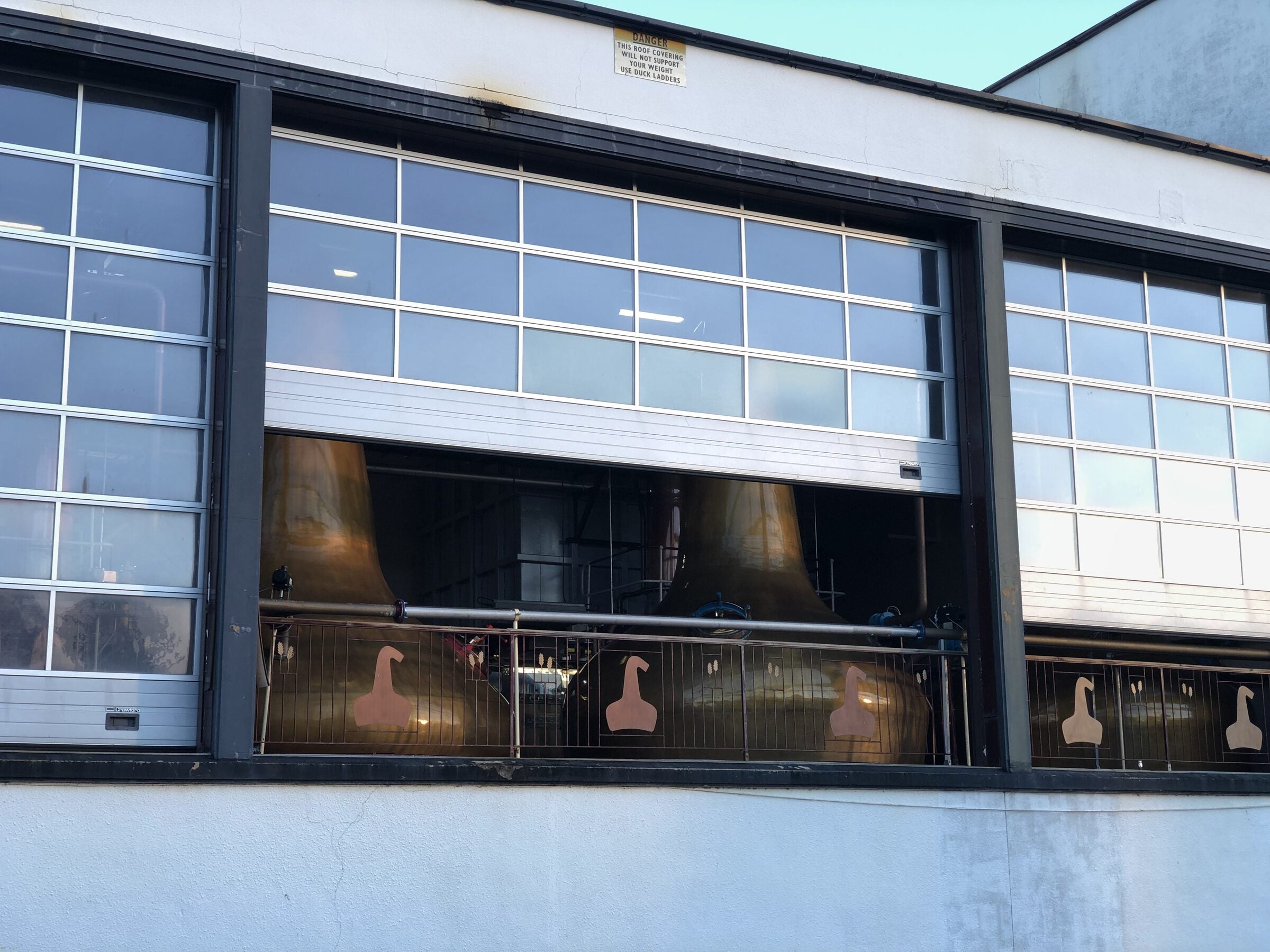
The four stills (two wash, two spirit, each around 21,000 to 22,000 litres) are unusually tall for the size of the distillery, with lyne arms that rise slightly rather than fall. Heavier vapours condense and fall back into the pot, so only the lightest, cleanest fraction makes it to the shell-and-tube condensers. Distillation is deliberately slow, and new make comes off at around 70% abv. The result is a spirit that is grassy, perfumed and clean, with a bright acidity that is quite different from the weightier malts made a few miles away at Glen Ord or up the coast at Dalmore.
Very little is matured on site; new make goes south to Dewar's centralised warehousing in Lanarkshire, mostly into refill American oak for blending. The single malt range is matured in ex-bourbon and finished in first-fill sherry butts. Independent bottlers tend to see refill sherry butts and ex-bourbon hogsheads, where the naked distillery character is easiest to appreciate.
What does Royal Brackla taste like?
Ask people inside Dewar's to describe Royal Brackla and the phrase that comes back is "summer breeze": elegant, fruity, with a crisp acidity. Young Brackla from refill wood is light gold, with green apple, pear, lime, cut grass, meadow flowers and a chalky minerality on the nose. The palate is soft-textured but lively, medium-sweet with a distinct tang, and often shows a gentle salinity.
Given time in ex-bourbon it develops banana, vanilla custard, baked apple, honeysuckle and a little white pepper. In sherry wood the fruit darkens towards peach, black cherry and marzipan, and the official 12 year old is a good example of the oloroso finish adding chocolate-covered almonds and muscovado without swamping the underlying freshness. Whatever the cask, the acidity remains, which is why Brackla rarely feels heavy even at 18 or 21 years old.
Nineteenth-century Brackla would have been peated, like almost every Highland whisky, and DCL-era spirit was heavier than today's; the modern unpeated, estery style dates from the 1960s rebuild. Fans of light, fruity Highland malts such as Glenmorangie or Teaninich will feel at home; those looking for smoke or oily weight should look elsewhere.
Royal Brackla and independent bottlers
Because Brackla spent so long as a blending malt, the independent sector effectively wrote its reputation as a single malt. Gordon & MacPhail's Connoisseurs Choice bottled 1970s vintages in the 1990s, and Signatory, Cadenhead's, Duncan Taylor, Douglas Laing, Hunter Laing, Berry Bros. & Rudd and many smaller houses have followed; one industry database puts the count at around 450 independent releases.
Independent casks tend to be either refill sherry butts or ex-bourbon hogsheads and barrels, usually filled in the 2006-2016 window when Bacardi was running the distillery hard for Dewar's stock. That gives drinkers something the official range does not: Royal Brackla at natural cask strength, without a finish. Prices have generally stayed sensible compared with more famous Highland names, which is one reason we keep going back to it.
The Single Cask and Royal Brackla
We have bottled Royal Brackla four times, and every cask has confirmed why we like it: it takes both bourbon and sherry wood gracefully, and a drop of water opens up whole new rooms in it. Two of those casks are available today.
Royal Brackla 9 Years Old, cask 300166 was distilled on 26 January 2015 and matured in a refill ex-sherry butt, then bottled at 57.6% with an outturn of 607 bottles. On the nose it is soft and buttery, almost like clarified ghee, with lime zest, watercress, green olives, rock salt and salted almonds; a splash of water brings out herbal teas. The palate is full-bodied, salty and medium-sweet, with a Manzanilla sherry note, croissant and fresh hops. Water adds agave syrup, olives, ferns and poached pears. The finish is long, with white pepper and a floral lift.
Royal Brackla 18 Year Old, cask 300472 was distilled on 18 January 2006 and spent its whole life in an ex-bourbon hogshead before we bottled it at 55.8%, 276 bottles. The nose opens on geranium, daisies and orchard blossom with a mineral note reminiscent of Chablis, then moves into cereal, banana bread and baked apple. The palate is tart, tangy and zesty, with apple strudel and a silky texture; water brings a buttery elegance. The finish is long, with liquorice, star anise and mocha.
Our two earlier casks are both sold out, but they are worth recording. Royal Brackla 11 Year Old (cask 310864) was distilled in 2006, matured in ex-bourbon and bottled at 60.9% with 285 bottles: fruit, barley and white pepper on the nose, green tea, rock sugar and white wine on the palate. Royal Brackla 12 Year Old (cask 304160) came from a first-fill bourbon barrel filled in 2009, bottled at 58.1% with 232 bottles, all ginger, cinnamon, citrus and barley sugar.
Collectability and cask ownership
Royal Brackla does not draw the frenzy of a Macallan or a closed Islay distillery at auction. The 1978 Rare Malts 20 year old and the older official expressions attract steady interest, but most independent Brackla sells to people who intend to drink it. That keeps bottles reasonably priced and means the whisky is judged on what is in the glass.
On the cask side, Royal Brackla appears in the trade fairly regularly because Bacardi filled a great deal of it for blending during the 2000s and 2010s. Refill sherry butts and bourbon hogsheads from that period turn up with brokers and bottlers, and the clean, estery spirit can sit happily for a long time without becoming over-oaked. If you are thinking about buying a cask, it helps to understand the difference between a butt, a hogshead and a barrel and how each affects maturation, which we explain in our guide to whisky cask sizes and types.
We would rather you owned a cask because you love the whisky and want to bottle it one day than because you expect it to make you money. Cask ownership involves risk, values can go down as well as up, and nothing on this page is financial advice. Storage, insurance and eventual bottling all carry costs, and a Highland malt without a cult following will not necessarily rise in value simply because it is getting older.
Visiting Royal Brackla
Royal Brackla has no visitor centre and is not open for tours or tastings; it is a working production site. You can see the buildings from the minor roads between Nairn and Cawdor, and Cawdor Castle, a mile or so away, with its gardens and Macbeth associations, is one of the best half-days in the area. Nairn has a fine beach and Inverness is twenty minutes' drive west.
Royal Brackla FAQs
Who owns Royal Brackla?
Royal Brackla is owned by John Dewar & Sons, the Scotch whisky arm of Bacardi. Bacardi acquired Dewar's, together with Royal Brackla, Aberfeldy, Aultmore, Craigellachie and Macduff, from Diageo in 1998.
Why is it called Royal Brackla?
King William IV granted the distillery a Royal Warrant in 1833 (some sources say 1835), the first ever given to a Scotch whisky, after ordering Brackla for the royal household. Founder William Fraser added "Royal" to the name and marketed the whisky as "The King's Own". Queen Victoria later renewed the warrant.
Is Royal Brackla peated?
No. Modern Royal Brackla is made from unpeated malt and is known for a fresh, floral, fruity character with a clean acidic edge. Nineteenth-century Brackla would have been peated, as most Highland whisky was, but the current style dates from the 1960s rebuild.
Can you visit Royal Brackla distillery?
No. Royal Brackla has no visitor centre and does not offer tours or tastings. The nearby Cawdor Castle, with its gardens and Macbeth links, is open to visitors in season and makes a good alternative stop.
Is Royal Brackla a good whisky?
Yes, if you like light, elegant, fruit-driven Highland malts. The official 12, 18 and 21 year olds are bottled at 46% with sherry finishes and have picked up medals at competitions including the World Whiskies Awards. Independent cask-strength bottlings show the distillery character in its purest form.
Can you buy a cask of Royal Brackla?
Casks of Royal Brackla, usually refill sherry butts or ex-bourbon hogsheads filled in the 2000s and 2010s, do come onto the market through independent brokers and bottlers, including us from time to time. Availability varies, so it is best to contact us and ask.
Own a piece of Royal Brackla
Royal Brackla has two centuries of history, a Royal Warrant older than the Victorian era, and a spirit more graceful than its low profile suggests. The two bottlings above are open now, and if you would like to hold a cask of your own, our buy a whisky cask page explains how ownership works, what it costs and what to watch out for. Have a question about the distillery, our bottlings or casks in general? Get in touch and we will give you a straight answer.
Work with The Single Cask
Buy a whisky cask, bottle under your own label, or store casks in our HMRC approved bonded warehouse in Fife.