
Laphroaig Distillery: Islay's Great Divider
Every independent bottler in Scotland wants to sell Laphroaig, and almost none of them are allowed to say so. Casks that leave this white-walled distillery on Islay's south coast travel the world under the polite alias "Williamson", and the story of that name, a Glasgow secretary who came for a summer job in 1934 and ended up owning the place, tells you more about Laphroaig than any tasting note could.
This is the most argued-about whisky in Scotland: medicinal, tarry and seaweedy, once advertised under the shameless slogan "love it or hate it". It is also a royal favourite, a Prohibition survivor and, for cask buyers, one of the few world-famous Islay names an independent bottler can honestly get hold of. We have bottled it more than once. Here is the full story.
Laphroaig at a glance
| Region | Islay, on the Kildalton coast just west of Port Ellen |
| Founded | 1815, by brothers Alexander and Donald Johnston |
| Owner | Suntory Global Spirits (the renamed Beam Suntory), via D. Johnston & Co. |
| Capacity | Around 3.4 million litres of pure alcohol a year |
| Stills | Seven: three wash stills and four spirit stills, one of them roughly double the size of its neighbours |
| Water source | The Kilbride reservoir, in the hills behind the distillery |
| Fermentation | A minimum of 55 hours in stainless steel washbacks |
| Malt spec | Minimum 35 ppm phenols; around 20% still floor-malted on site |
| Style | Medicinal peat, iodine, tar and sea salt over a sweet bourbon-cask core |
| Visitor centre | Yes, one of the busiest in Scotland, home of the Friends of Laphroaig plot |
Laphroaig from above
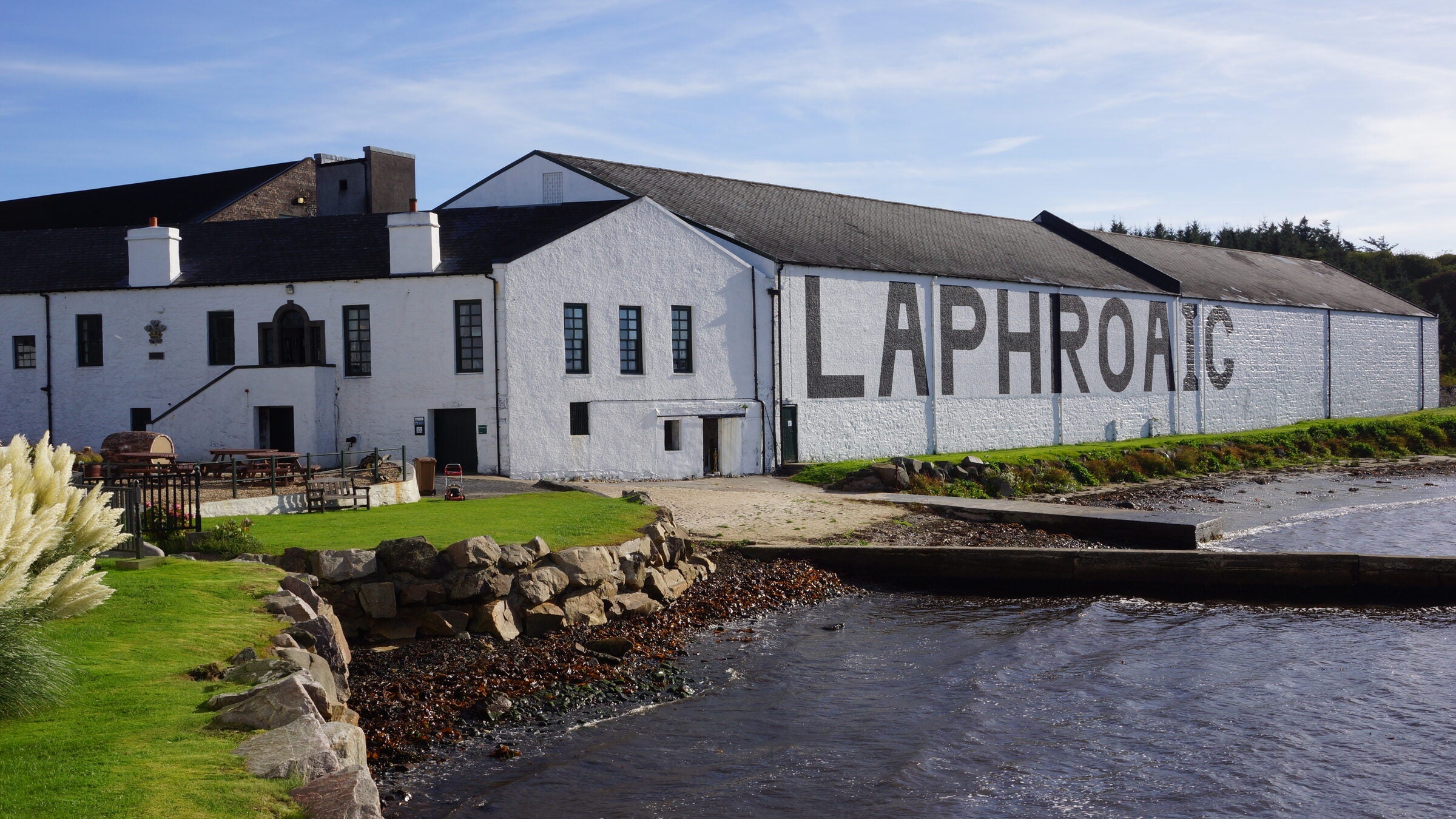
Our drone climbed out over the Kildalton shore to film the distillery the way sailors have always known it: white gables against green hills, warehouses at the tide line, and LAPHROAIG painted in vast black letters facing the sea, a label on the landscape itself.
History of Laphroaig
The Johnston brothers, Alexander and Donald, were farming the land at Laphroaig when they took up distilling in 1815, and the enterprise stayed a family affair for nearly a century and a half. It was not always a gentle one. Donald, who had bought out his brother in 1836, died in 1847 after falling into a vat of boiling pot ale, one of the grimmer entries in whisky's long ledger of industrial accidents, and the business passed down through the family as D. Johnston & Co., a name that survives on paper to this day.
Laphroaig spent the Victorian era selling most of its make to Peter Mackie, the restless owner of neighbouring Lagavulin, as its sales agent. When the Johnstons ended that arrangement in 1907, Mackie responded first by trying to divert Laphroaig's water supply, then by building a replica distillery called Malt Mill inside Lagavulin, staffed with poached Laphroaig workers, to copy the whisky outright. It never came close, which rather proves the point every distiller makes about the stubborn individuality of site and still.
The man who turned a farm distillery into a world brand was Ian Hunter, Donald Johnston's great-great-nephew, who took charge in the early twentieth century. Hunter doubled the stills from two to four in 1924, pushed Laphroaig as a single malt when almost everything on Islay vanished into blends, and pulled off one of whisky's great escapes during Prohibition, when Laphroaig reputedly slipped into America as "medicinal spirits", a claim its iodine-soaked character made oddly plausible. His American travels also fixed the distillery's lasting preference for ex-bourbon casks.
Hunter suffered a stroke on a sales trip and came to rely on Elisabeth "Bessie" Williamson, the Glasgow shorthand typist who had arrived for a summer job in 1934 and never left. When he died in 1954, childless, he left her the entire distillery. Williamson became the first woman to own and run a Scotch whisky distillery in the twentieth century, an era when women were scarcely allowed past a stillhouse door, and she ran it with distinction, championing Islay malt across America and expanding the stillhouse to its current seven stills before retiring in 1972. She had sold the company in stages during the 1960s to the American firm Schenley, through its Long John subsidiary, and Laphroaig then passed to Whitbread in 1975, Allied in 1989, and Fortune Brands, later Beam, in 2005. Suntory bought Beam in 2014, and since May 2024 the owner has traded as Suntory Global Spirits.
Two things happened in 1994 that still shape the distillery. The Prince of Wales, now King Charles III, visited in person and granted Laphroaig his Royal Warrant, the only Islay single malt to hold one; the 15 year old is reputedly his favourite dram. And the distillery launched the Friends of Laphroaig, gifting every registered drinker a lifetime lease on one square foot of Islay, with rent payable as a dram collected in person. More than 600,000 people have signed up, and the scheme, restructured in recent years, remains the most imitated piece of marketing in whisky. The distillery marked its bicentenary in 2015 with a series of special bottlings and a visit from its royal patron.
How Laphroaig makes its whisky
Laphroaig is one of the last distilleries in Scotland still turning a portion of its own barley on a malting floor, around a fifth of its requirement. The house belief, recorded across decades of production notes, is that its own kiln, fed with hand-cut Islay peat and run with cool smoke early in the drying, gives a more creosote-like, tarry phenolic character than bought-in malt, so the floor maltings survive on flavour grounds rather than nostalgia. The remainder comes from commercial maltsters to the same specification, a minimum of 35 ppm phenols.
Soft water runs off the hills from the Kilbride reservoir through peaty ground to the mash house, and fermentation runs a minimum of 55 hours in stainless steel washbacks. The stillhouse is where Laphroaig gets genuinely eccentric: seven stills, three wash and four spirit, one spirit still roughly twice the size of the others. Each produces a subtly different make, and the final new-make is a marriage of the large and small stills' runs. The spirit cut is unusual too, with a long foreshot run and a deep cut that deliberately sacrifices light estery notes to capture heavier phenols; the new make comes off around 18 ppm, tarry and medicinal from the first day.
Maturation leans hard on first-fill ex-bourbon barrels, many from Maker's Mark, a sister distillery within Suntory Global Spirits, which lay a seam of vanilla and coconut sweetness under the smoke. Quarter casks, revived in 2004 for the expression of the same name, speed the conversation between spirit and oak, and a smaller portion of sherry wood supports older and special releases. A good deal of stock still sleeps in the shoreline warehouses behind those famous painted letters, where Atlantic weather does its slow, salty work.
What does Laphroaig taste like?
Laphroaig is the extrovert of the Kildalton coast. Where Lagavulin is deep and dry and Ardbeg is bright and citric, Laphroaig is frankly medicinal: TCP and iodine, tarred rope, smoked fish, seaweed drying on a rock, then an unexpected sweetness underneath, vanilla, coconut and custard from all that first-fill bourbon wood, with a long salty finish. The 10 year old has carried that flag since Ian Hunter's day, and the cask strength batches of the same age are among the best-value serious whiskies on any shelf. Quarter Cask adds younger fire and extra oak; Lore layers in sherry depth; the 15, the royal favourite, is gentler and rounder than its reputation suggests. Nobody ever swirls a glass of Laphroaig and asks what it is.
Laphroaig and independent bottlers
Here is the quirk every whisky enthusiast learns eventually: independent bottlings of Laphroaig almost never say Laphroaig. The distillery guards its trademark closely, so casks that reach the independent market are sold on the understanding that the name stays off the label. The trade's solution is a fond one. Such casks appear as "Williamson", in tribute to Bessie, and seasoned drinkers treat the word as a wink; everyone at the auction table knows precisely which farmyard on the Kildalton coast a Williamson came from. Unlike its neighbour Lagavulin, whose casks essentially never circulate, Laphroaig does reach brokers and bottlers in modest quantities, which makes it one of the very few first-rank Islay names an independent can genuinely offer.
The Single Cask and Laphroaig
We have bottled this distillery more than once, always under the Williamson name and always at natural strength and colour. The pick of them was cask 918, a Williamson 13 year old, distilled on 4 November 2010 and matured in an ex-Laphroaig oloroso hogshead, bottled at a cask strength of 54.4% in an outturn of just 213 bottles. It was a glorious argument between sherry and smoke: bonfire, salted caramel, candied orange peel and Ibérico ham on the nose, then tar, old leather and scorched plums on the palate, finishing on barbecue bacon, vanilla curd and wood spice. We filed it under "Bold" in our tasting taxonomy, which if anything undersold it. Before that came cask 202A, a punchy 8 year old distilled in 2013 and bottled at 58.6%, proof that young Laphroaig spirit needs no apology. Both are now sold out, and we will not pretend otherwise; good Williamson casks move quickly. When the next one lands, our mailing list hears first, and our door is always open to enquiries about what is currently in the warehouse.

Collectability and cask ownership
Old Laphroaig is blue-chip auction territory. Bottlings from the Bessie Williamson era and the 1960s and 70s fetch four and five figures, the recent Ian Hunter series of aged releases sells through instantly, and the annual Cairdeas bottlings for the Feis Ile festival have a devoted collector following, as do the numbered batches of the 10 cask strength. Thirty and forty year old expressions sit firmly in luxury pricing. As ever, auction prices move with fashion and the wider economy, and past form is no promise of future results.
On the cask side, Laphroaig occupies a genuinely interesting position: real casks do appear on the independent market as Williamson, so private ownership is possible in a way it simply is not for some famous neighbours. Demand comfortably outruns supply, so provenance checks matter enormously, and a reputable bottler or broker with verifiable warehouse records is worth far more than a glossy brochure. Be clear-eyed about the basics: cask ownership involves risk, whisky values can go down as well as up, casks need insurance, storage and eventual bottling, and nothing in this guide is financial advice. If you are weighing it up, start with our plain-English guide to cask sizes and types, then ask us what Islay stock is honestly available.
Visiting Laphroaig
Laphroaig sits on the A846 just west of Port Ellen, the first of the three Kildalton distilleries, with Lagavulin and Ardbeg a pleasant coastal walk further east; committed pilgrims do all three in a day on foot. The visitor centre is one of the best in Scotland, and unusually the tours can include the working floor maltings and kiln, a sight most distilleries can no longer offer. Friends of Laphroaig can borrow wellies and a flag, squelch out to claim their square foot of Islay, and collect their dram of rent. Book ahead in summer and during Feis Ile, when the distillery's open day is one of the festival's loudest and smokiest.
Laphroaig FAQs
Who owns Laphroaig distillery?
Suntory Global Spirits, the Japanese-owned drinks group formerly known as Beam Suntory, which acquired it with the Beam portfolio in 2014. The operating company still carries the founding family's name, D. Johnston & Co.
Why are independent Laphroaig bottlings called Williamson?
Because the distillery does not permit its name on independent labels, the trade bottles it under "Williamson", honouring Bessie Williamson, the secretary who inherited Laphroaig in 1954 and became the first woman to run a Scotch distillery in the twentieth century.
How peaty is Laphroaig?
The malt is peated to a minimum of 35 ppm phenols, with the new-make spirit measuring around 18 ppm. Its distinctly medicinal, creosote-like character owes as much to the distillery's own cool-smoked floor maltings and its deep spirit cut as to the raw numbers.
What does Laphroaig taste like?
Peat smoke, TCP, iodine, tar and seaweed over a surprisingly sweet core of vanilla and coconut from first-fill bourbon casks, with a long, salty finish. It is famously divisive, which the distillery has always worn as a badge of honour.
Can you buy a cask of Laphroaig?
Yes, realistically, though casks trade under the Williamson name and supply is scarce. Provenance matters more than anything; buy through a reputable bottler or broker, remember values can fall as well as rise, and ask us for an honest view before committing.
Is Laphroaig really the King's favourite whisky?
King Charles III granted Laphroaig his Royal Warrant in 1994 after a personal visit, the only Islay single malt so honoured, and the 15 year old is widely reported to be his preferred expression.
Own a piece of Laphroaig
Laphroaig gives away square feet of Islay; we would rather help you own something you can drink. As independent bottlers we hunt for honest casks from distilleries like this one, bottle them at natural strength and colour, and tell you exactly what you are buying, alias and all. Read our guide to buying a whisky cask, browse what is currently maturing, or get in touch and tell us what you are looking for. If the next Williamson cask is half as good as cask 918, you will want to hear about it before everyone else does.
If you're an independent bottler rather than a private buyer, that same scarcity is exactly why it pays to talk to us directly rather than wait for something to appear online: see how we source, store and bottle for independent bottlers, Williamson included when the right cask comes along.
Work with The Single Cask
Buy a whisky cask, bottle under your own label, or store casks in our HMRC approved bonded warehouse in Fife.
Read more
Blair Athol Distillery: The Highland Heart of Bell's
Everyone has tasted Blair Athol; almost nobody knows it. Here is the story of the Pitlochry distillery behind Bell's, its nutty, sherry-loving malt, our dozen-plus single cask bottlings of it, and ...
Read more
Benrinnes Distillery: Speyside's Meaty Secret
Flooded, burned and rebuilt on the slopes of the mountain that names it, Benrinnes makes Speyside's meatiest malt, almost all of it destined for blends. We have bottled around twenty casks of The B...
Read more


