
Blair Athol Distillery: The Highland Heart of Bell's
The ivy-clad distillery at the southern entrance to Pitlochry is one of the oldest licensed in Scotland and, thanks to its position on the main road into the Highlands, one of the most visited. Yet the whisky made behind those walls is one most drinkers have tasted without knowing it, because the overwhelming majority of Blair Athol's make disappears into Bell's, one of Britain's best-loved blends.
That double life, famous doorstep and anonymous whisky, makes Blair Athol one of the more intriguing distilleries in the Highlands for the single cask drinker. The official range is tiny, independent bottlers do the heavy lifting, and we should know: Blair Athol is one of the distilleries we have bottled most often in our history. Here is the full story.
Blair Athol at a glance
| Region | Highland (Perthshire, at the gateway to the Highlands) |
| Founded | 1798, as Aldour, by John Stewart and Robert Robertson; revived and renamed Blair Athol around 1825 |
| Owner | Diageo, by way of Arthur Bell & Sons, which bought the distillery in 1933 |
| Capacity | Around 2.5 million litres of pure alcohol a year |
| Stills | Four, plain-shaped: two wash stills of about 13,000 litres and two spirit stills of about 11,500 litres |
| Water source | The Allt Dour, "the burn of the otter", flowing off the slopes above Pitlochry |
| Fermentation | Short: up to about 50 hours, in six washbacks, four wooden and two steel |
| Malt spec | Unpeated |
| Style | Nutty, spicy and malty, with a rich malt-loaf depth that loves sherry casks |
| Visitor centre | Yes, the brand home of Bell's, opened in 1987 |
Blair Athol from above
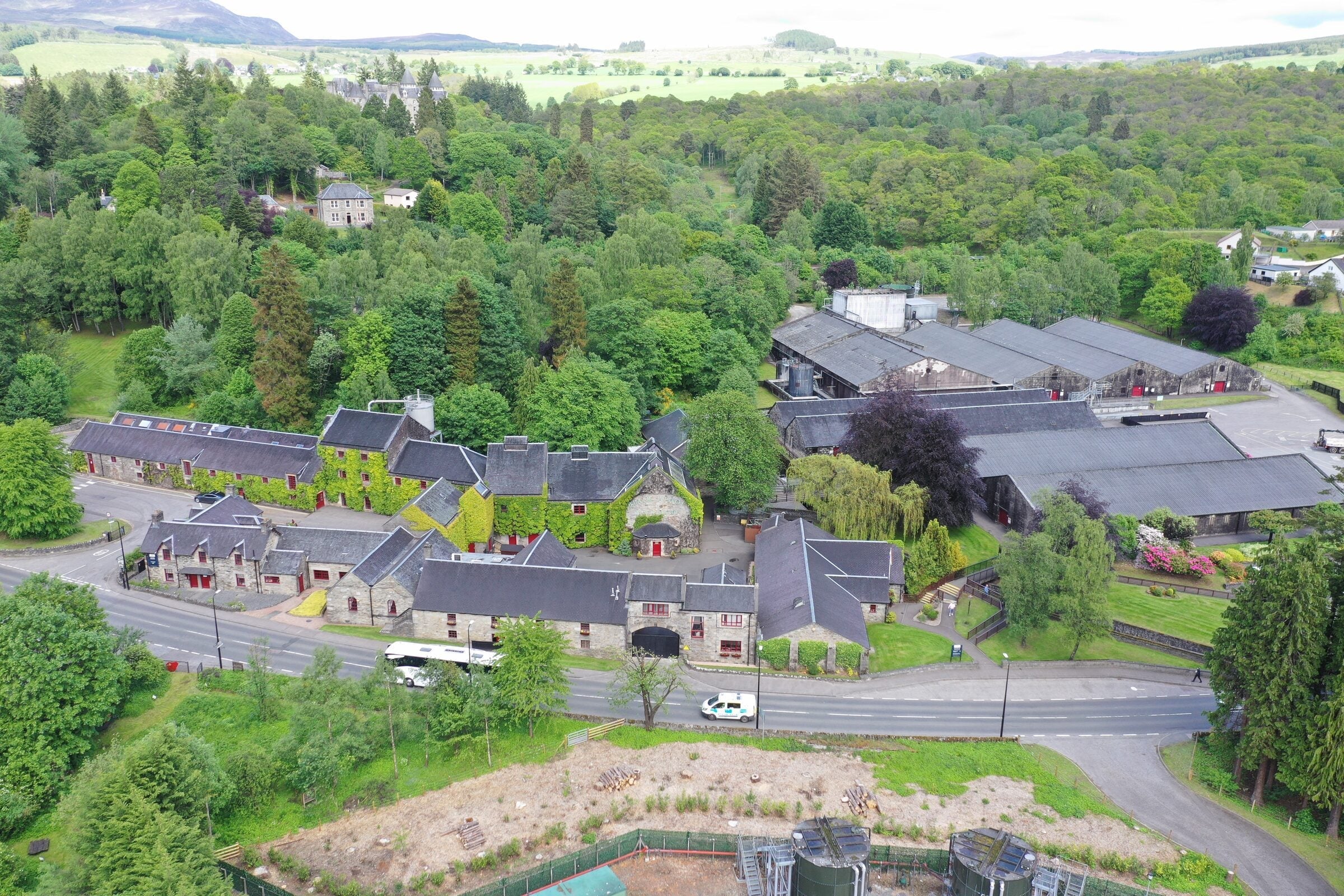
Blair Athol hides in plain sight: thousands of cars sweep past on the A9 every day without their drivers ever spotting the pagoda roof behind the trees. Our drone climbed above Perth Road to pick out the ivy-covered stone buildings against the wooded hills of Highland Perthshire, and the footage shows just how neatly the distillery is stitched into the southern edge of Pitlochry itself.
History of Blair Athol
John Stewart and Robert Robertson took out their licence in 1798, which puts Blair Athol among the earliest legal distilleries in Scotland, decades before the 1823 Excise Act made licensed distilling the norm. They called the place Aldour, after the Allt Dour burn that still supplies its water: the name translates, delightfully, as "the burn of the otter". The venture struggled and closed not long after opening, a common fate for legal distillers trying to compete with the untaxed bothies in the hills.
The revival came around 1825, when John Robertson restarted the distillery and it took the name Blair Athol, borrowed from the Duke of Atholl's village seven miles up the road. The story usually told is that the grander name flattered the landowning duke; whatever the truth, the spelling never quite matched, and to this day the distillery is Blair Athol with one L in a town called Pitlochry, while the village of Blair Atholl keeps two.
The Conacher family ran the distillery through the middle of the nineteenth century, and in 1882 it passed to P. Mackenzie & Co, who enlarged it in 1886 as the Victorian blending boom demanded ever more Highland malt. The twentieth century was less kind. Demand collapsed after the First World War, and in 1932, in the depths of the Depression, Blair Athol fell silent.
Salvation came quickly, though patience was needed. In 1933 Arthur Bell & Sons of Perth bought the silent distillery, one of the first distilleries the famous blending house ever owned, along with Dufftown. Bell's rebuilt Blair Athol after the war and brought it back to life in 1949. As Bell's grew into the best-selling blended Scotch in the UK during the 1970s, its Perthshire home distillery grew with it: the stills were doubled from two to four in 1973, and a dark grains plant followed in 1975. Guinness took over Bell's in 1985, the visitor centre opened in 1987, and the 1997 merger that created Diageo delivered Blair Athol to its current owner.
Under Diageo the distillery found a quiet second fame. The Flora & Fauna 12 year old, matured in first-fill sherry casks and wearing an otter on its label, became a cult favourite among drinkers who like their malts old-fashioned and hearty, and the distillery itself, as the brand home of Bell's, became one of the most visited in Scotland.
How Blair Athol makes its whisky
Blair Athol's character is decided early, in the mash house and the tun room, and it is all about making a deliberately heavy, nutty spirit. The eight-tonne lauter mash tun is run to produce cloudy worts, carrying fine solids from the grist into fermentation rather than filtering them out. Where a distillery chasing a light, grassy spirit wants its worts crystal clear, Blair Athol wants the opposite: those solids are the seed of its nutty, malt-loaf richness.
Fermentation is short, up to about 50 hours in six washbacks, four of wood and two of steel. Short ferments leave less time for the fruity esters that make light Speyside styles, and push the spirit further towards cereal and spice. The four plain-shaped stills then distil briskly, with shell-and-tube condensers, and the new make comes off at a notably high 67 per cent before being filled to cask at 63.5 per cent.
Most of that spirit is filled into ex-bourbon casks and matured for blending, with Bell's first in the queue. The slice destined for single malt goes largely into ex-sherry wood, where the robust, nutty spirit has the backbone to stand up to first-fill casks that would flatten a lighter make. It is a spirit built for big maturation, which is exactly why it rewards the sherry, port and fortified-wine octaves we have used on it ourselves.
What does Blair Athol taste like?
Blair Athol sits firmly in the nutty-spicy camp of Diageo's makes. From ex-bourbon wood it shows malt loaf, brown toast, hazelnuts and ginger cake, with an earthy, almost mineral edge and a drying finish. Give it sherry wood, as the distillery does for the Flora & Fauna 12 year old, and the malt loaf gets its raisins: dried fruit, dark honey and baking spice folded through that sturdy cereal core.
It makes an interesting contrast with its Bell's stablemates. Inchgower brings a salty, tangy sharpness to the blend and Dufftown a dry nuttiness, while Blair Athol supplies depth and warmth, the malty middle of the dram. On its own, at cask strength and without chill filtration, it is a far bolder whisky than its quiet reputation suggests, as anyone who has tried one of our bottlings will confirm.
Blair Athol and independent bottlers
Because the official range more or less begins and ends with the Flora & Fauna 12 year old, independent bottlers are how curious drinkers actually explore this distillery. Happily, Blair Athol is generous where some famous names are not. A distillery built to feed a major blend produces spirit at scale, and parcels of casks have found their way to brokers and blenders for decades, which means independent Blair Athol appears regularly and at honest prices.
Like Mannochmore, another of Diageo's quiet blending workhorses, Blair Athol arguably shows more of its personality through independent labels than official ones. Indies bottle it young and zesty from bourbon barrels, deep and figgy from sherry butts, and increasingly from more adventurous casks, where its muscular spirit copes with almost anything a bottler throws at it.
The Single Cask and Blair Athol
We can claim a longer relationship with Blair Athol than with almost any other distillery: more than a dozen single casks have passed through our hands, from seven-year-old octaves to a 22 year old distilled in 1991, and it has become something of a house favourite for cask experimentation.
That 1991 vintage, cask 7284, bottled at 22 years old and 58.4 per cent, remains one of the best Blair Athols we have tasted: thick vanilla and coconut sweetness from the bourbon cask set against sharp minerals, grapefruit and wet wool, with a long, mentholated finish. At the other end of the scale we bottled a family of 2013-vintage seven and eight year olds from sherry octaves, including cask 311432A, an oloroso octave at 56.6 per cent, which was musty, malty and pleasingly mezcal-like, with a savoury, herbaceous palate that shows what short-ferment spirit and active wood can do to each other in a hurry.
The 2008 vintage gave us our most talked-about Blair Athols. Cask 303387, a 13 year old drawn from a quarter cask that previously held Laphroaig, gave just 134 bottles at 55.3 per cent, an unpeated Highlander wearing borrowed Islay clothes: hints of peat, sea salt and grapefruit over white pepper, oak and green tea. Its Family Series label, painted for us by Torsten of Scotch & Tattoos, shows a caramel-coloured cat leaning into a blank, uncoloured figure; the cat is the whisky, the figure is the drinker it fills with warmth. From the same vintage, cask 303409A spent thirteen years in a rum quarter cask and came out all apples, pears and milky tea, with a sesame-seed salinity and a big peppery finish mellowed by golden syrup.
Every one of those bottlings has now sold out, which tells its own story about how quickly good Blair Athol moves. Casks of it pass through our warehouses regularly, so if you would like first refusal on the next one, get in touch and tell us.

Collectability and cask ownership
Blair Athol is not a trophy distillery, and we would be doing you no favours pretending otherwise. Auction interest is steady rather than spectacular: the Flora & Fauna 12 year old and the distillery-exclusive bottlings trade modestly, while genuinely old official releases, such as the 23 year old Special Release from 2017, are scarce enough to attract real attention. The value for collectors lies mostly in well-chosen independent bottlings, which deliver age and cask quality at prices that leave room to actually drink the whisky.
On the cask side, Blair Athol has a practical advantage over more glamorous names: casks genuinely circulate. Because the distillery produces at blending scale, parcels reach the broker market, and a well-selected cask, particularly one re-racked into good sherry or other fortified wine wood, gives the robust spirit something to feed on as it ages. If you are weighing up a purchase, our guide to cask sizes and types explains how octaves, quarter casks and hogsheads mature differently. Be clear-eyed, though: cask ownership involves risk, values can go down as well as up, and nothing on this page is financial advice. Buy a cask of Blair Athol because you want the whisky in it, and any upside becomes a bonus rather than a gamble.
Visiting Blair Athol
Few distilleries are easier to visit. Pitlochry is a Victorian resort town on the main road and railway line north, and Blair Athol sits on Perth Road at its southern end, ten minutes' walk from the station. As the brand home of Bell's it runs polished tours year round, and the better ones finish with a tasting drawn straight from the cask in the old stone warehouse. The ivy-covered buildings are among the prettiest in Highland distilling, and you can pair a tour with Pitlochry's other attractions, from the Festival Theatre to the salmon ladder at the hydro dam. If you are driving north up the A9 towards Speyside, this is the natural first stop of a whisky tour.
Blair Athol FAQs
Who owns Blair Athol distillery?
Diageo. Arthur Bell & Sons bought the distillery in 1933, Guinness took over Bell's in 1985, and the 1997 merger that created Diageo brought Blair Athol into the world's largest Scotch whisky company.
Why is Blair Athol distillery in Pitlochry and not Blair Atholl?
The distillery took the name of the Duke of Atholl's village seven miles to the north when it was revived around 1825, reputedly to borrow a little of its grandeur. The spellings differ too: the distillery uses one L, the village two.
Is Blair Athol whisky peated?
No. Blair Athol distils entirely unpeated malt. Its rich, nutty character comes from cloudy worts and short fermentations rather than smoke, although our bottling from a former Laphroaig cask showed it can wear a borrowed wisp of peat surprisingly well.
What official bottlings of Blair Athol exist?
The sherry-matured Flora & Fauna 12 year old is the only regular official bottling, joined by distillery-exclusive releases at the visitor centre and the occasional rarity such as the 23 year old Special Release of 2017. Most Blair Athol reaches drinkers either inside Bell's or through independent bottlers.
Can you buy a cask of Blair Athol?
Realistically, yes. Unlike many famous single malts, Blair Athol casks circulate on the broker market because the distillery produces at blending scale. We have bottled more than a dozen of them, and casks pass through our warehouses regularly: ask us what is currently available.
Can you visit Blair Athol distillery?
Yes, easily. The distillery is the brand home of Bell's, sits at the southern edge of Pitlochry within walking distance of the railway station, and offers tours and cask tastings year round.
Own a piece of Blair Athol
Blair Athol built its reputation quietly, one blend at a time, but at full strength from a single cask it speaks up for itself. If this page has made you curious, start with our guide to buying a whisky cask, which walks through the whole journey from choosing a distillery to bottling your own whisky, then contact us for an honest conversation about what Blair Athol casks are available right now. We have been bottling this distillery for years, we know what its spirit does in different wood, and we would be delighted to help you own a cask of the Highland malt everyone has tasted and almost nobody knows.
Work with The Single Cask
Buy a whisky cask, bottle under your own label, or store casks in our HMRC approved bonded warehouse in Fife.
Read more
Ardbeg Distillery: The £16 Million Comeback
A single 1975 cask of Ardbeg sold for £16 million; the whole distillery cost £7 million in 1997. The full story of Islay's great comeback — how Ardbeg makes its citric, tarry whisky, why independen...
Read more
Laphroaig Distillery: Islay's Great Divider
Every independent bottler sells Laphroaig, and almost none of them are allowed to say so. The story of Islay's most divisive malt takes in a fatal vat of pot ale, a Prohibition loophole, a secretar...
Read more


