
Craigellachie Distillery: Speyside's Meaty, Worm-Tub Maverick
Craigellachie is the Speyside distillery that smells of beef stock. Stand in the tun room on a mash day and you will catch cabbage water, struck matches and something faintly meaty on the air, and the people who make it would not have it any other way. In a region famous for gentle, honeyed malts, this is a whisky built to be muscular, sulphury when young and gloriously waxy and tropical when old, and it gets there by clinging on to Victorian technology that most of its neighbours abandoned decades ago.
We have bottled Craigellachie more often than almost any other Speyside distillery, from seven-year-old bourbon casks to sherried octaves and an 18-year-old first-fill oloroso, so we know its moods well. This guide covers the history, the kit, the flavour, and what it all means if you are thinking about a bottle or a cask of your own.
Craigellachie at a glance
| Region | Speyside, in the village of Craigellachie where the Fiddich meets the Spey |
| Founded | 1891 (company formed 1890), first spirit generally dated to 1898 |
| Owner | John Dewar & Sons (Bacardi) since 1998 |
| Capacity | Around 4 million litres of pure alcohol a year |
| Stills | Four: two wash and two spirit, large and bulb-shaped, condensed in worm tubs |
| Water source | The Blue Hill dam, fed from the Little Conval hills |
| Fermentation | Around 56 hours in eight Siberian larch washbacks |
| Malt spec | Essentially unpeated (typically quoted at 1 to 2 ppm) |
| Style | Heavy, meaty, waxy Speyside; sulphury new make, tropical fruit with age |
| Visitor centre | No, a working production site not generally open to the public |
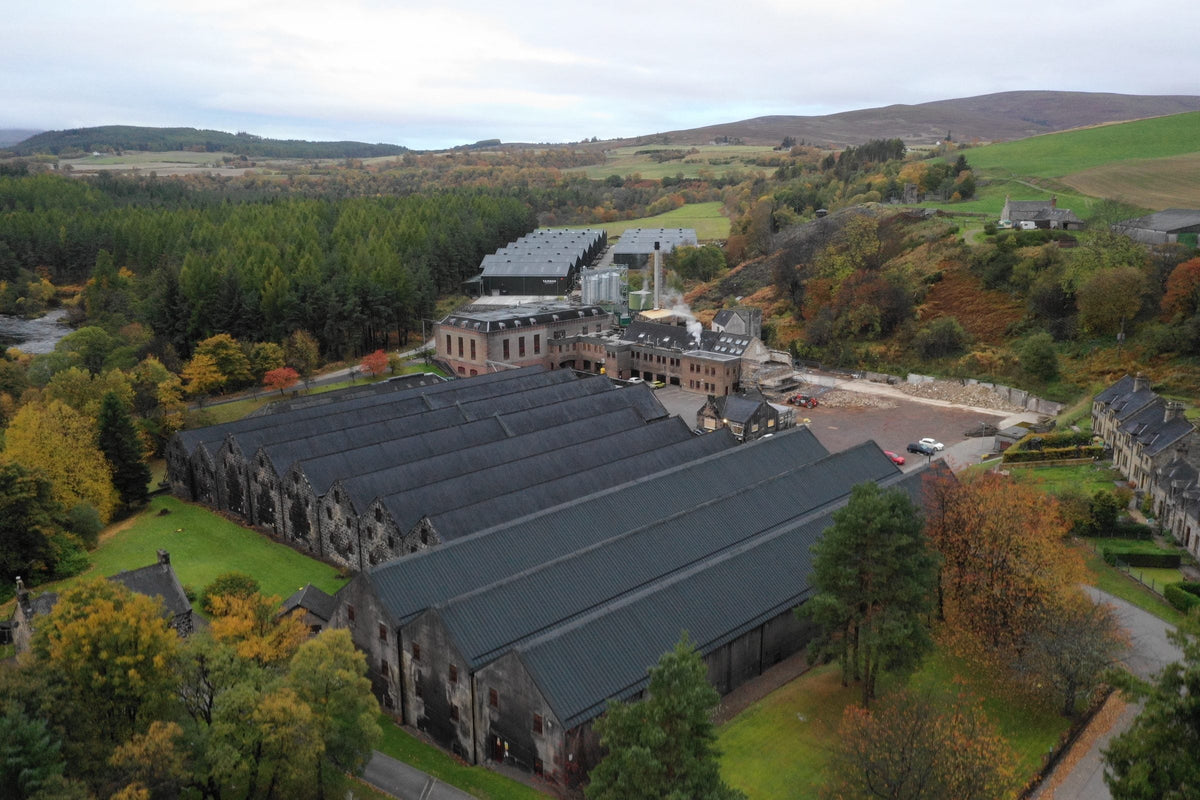
Craigellachie from above
Craigellachie has no visitor centre, so the best view most people will ever get of it is ours. Our drone flew over the glass-fronted 1960s stillhouse and the surviving Victorian pagoda, with the village and the wooded banks of the Spey spread out behind.
History of Craigellachie
The village came first. Craigellachie takes its name from the rocky crag above the Spey, and by the late nineteenth century it was a railway junction where lines from Elgin, Keith and Dufftown met, which made it an obvious place to build a distillery in the boom years of the 1890s. The men who did so were an unusual pairing: Alexander Edward, a young Speyside whisky entrepreneur who already leased Benrinnes and would go on to found Aultmore and Dallas Dhu, and Peter Mackie, the Glasgow blender behind what became White Horse. They engaged Charles Doig of Elgin, the architect who gave Scotland the pagoda roof, and the Craigellachie Distillery Company began work in 1890 with the plant complete by 1891. Doig also designed the Craigellachie Hotel next door in 1893, so the two landmarks share a hand.
Alfred Barnard, who visited every distillery in the country in the 1880s and returned to Speyside a few years later, wrote that the chief characteristic of the Craigellachie make was the pineapple flavour it developed with age. It is a remarkably early description of a whisky that, more than a century on, still turns tropical in a good cask.
The company was reconstructed as Craigellachie-Glenlivet in 1896, and Mackie bought his partners out in 1916, reportedly for around £9,000. Mackie was one of the great characters of the trade, a man once described as one third genius, one third megalomaniac and one third eccentric, and he was fiercely proud of the heavy make that anchored his White Horse blend. When he died in 1924 the firm floated as White Horse Distillers, and three years later it was absorbed into the Distillers Company Limited, the giant that would eventually become part of Diageo. Craigellachie spent the next seventy years as a blending malt in the DCL and United Distillers estate, feeding White Horse and its stablemates almost exclusively.
The distillery was largely rebuilt in 1964 and 1965, when most of Doig's original buildings were swept away in favour of the modern glass-fronted stillhouse you see today. The number of stills was doubled from two to four, but the maltings, kiln and pagoda survived, and so did the worm tubs, which is the decision that matters most. For most of the twentieth century the Speyside Cooperage operated from the distillery grounds before moving to its current site up the hill in the early 1990s, so Craigellachie has long been a small hub of the industry as well as a distillery.
The last great change came in 1998. When Guinness and Grand Metropolitan merged to form Diageo, the competition authorities required the sale of John Dewar & Sons, and Bacardi bought Dewar's together with four malt distilleries: Aberfeldy, Aultmore, Royal Brackla and Craigellachie. Under Bacardi it became a core component of Dewar's White Label and William Lawson's, and finally, in 2014, it was launched as a single malt in its own right.
How Craigellachie makes its whisky
Almost every choice at Craigellachie is made in the service of weight. Water comes from the Blue Hill dam in the Little Conval hills above Dufftown, and the malt arrives from Boortmalt's Glenesk maltings on the east coast, kilned separately and essentially unpeated at around 1 to 2 ppm phenols. A ten-tonne full-lauter mash tun, housed in the old kiln, produces a clear wort, and fermentation runs for a comparatively short 56 hours in eight larch washbacks of about 47,000 litres each. Short fermentation keeps the wash cereal-rich and stops the fruitier esters from taking over.
The stills are big, bulb-shaped and run in two pairs, the wash stills charged with around 23,500 litres. Large stills with a broad base give little reflux, so more of the heavy compounds pass over into the spirit. Then comes the part that really sets Craigellachie apart from its neighbours: instead of modern shell-and-tube condensers, the vapour is cooled in traditional worm tubs, long copper coils submerged in cold water outside the stillhouse. Worm tubs offer far less copper contact than a condenser, and copper is what strips sulphur compounds out of spirit. Less copper means more sulphur, and more sulphur means the new make comes off the still smelling of struck matches, meat stock and cooked vegetables. The distillery replaced its old iron tubs in 2014 but kept the copper worms themselves, precisely so the character would not change.
The spirit is filled into cask at a high strength, typically quoted at 70%, mostly into ex-bourbon American oak, with a proportion of ex-sherry wood. Very little of it goes to single malt; the great bulk still disappears into Dewar's blends, which is why casks reaching the independent market are so valued.
What does Craigellachie taste like?
New-make Craigellachie is not for the faint-hearted: sulphury, oily and savoury, with malt and a hint of smoke that has nothing to do with peat. Give it a few years in cask and the sulphur burns off, leaving a heavy, waxy spirit with real texture on the palate. In ex-bourbon wood you get vanilla, red apple, honey and toffee over that meaty backbone, plus a curious faint smokiness. In sherry casks it turns to raisins, dark sugar and nuts while staying savoury underneath. Give it long enough and Barnard's pineapple appears, along with mango, waxed lemon and beeswax, the profile that made the 31-year-old World's Best Single Malt at the 2017 World Whiskies Awards.
Official bottlings sit at 13, 17 and 23 years old, all at 46% and non chill-filtered, with occasional cask-finished editions and the Exceptional Cask Series above them. The distillery's most talked-about release, though, was never sold at all. In 2018 Dewar's opened 51 bottles of a 51-year-old Craigellachie and poured every drop for free at pop-up bars, starting at Bar 51 in London, calling it the world's most uncollectable whisky. It was a pointed comment on the prices old Scotch had reached, and a generous one.
Craigellachie and independent bottlers
Because so much of the make goes to blending, Craigellachie has been an independent bottlers' favourite for decades. Gordon & MacPhail, Signatory, the Scotch Malt Whisky Society and Douglas Laing have all released it, and casks appear at broker level with reasonable regularity, more so than for closely guarded neighbours such as Glenfiddich or The Macallan. That availability keeps single-cask prices sensible for what is a very characterful whisky.
Independent Craigellachie tends to be bottled at cask strength without colouring or chill filtration, and it shows a side the 46% official range only hints at. Young bourbon-cask examples can be sulphury and divisive; ten years or more in decent wood and the same spirit is one of the most satisfying malts in Speyside, sitting stylistically somewhere between Benrinnes and Dailuaine, its two meaty worm-tub cousins across the river.
The Single Cask and Craigellachie
Craigellachie has been in our range almost since the beginning, and it says something that we keep coming back. We love it because that robust body and faint smokiness makes it stand out from other Speyside single malts, and, as we once wrote on a label, we are drawn to unusual and quirky Scotch. And people.
Our earliest release was a seven-year-old from cask 800589, distilled in 2011 and bottled from ex-bourbon at 59.7%, all sinew and cereal, the distillery character undisguised. Then came a pair of eight-year-olds distilled in 2012 and split into two octaves, cask 800622A in second-fill oloroso and 800622B in PX. The oloroso octave gave cereal and red berries on the nose, raisins, sugar syrup and nuts on the palate, and a savoury, raspberry-jam finish, 65 bottles in all, and it sold out quickly.
Cask 301044, a 15-year-old distilled on 23 January 2009 and matured in an ex-sherry hogshead, was bottled at 54.2% (265 bottles) and became one of our Curious mood whiskies. Our tasting notes recorded wine gums and blackcurrant jelly babies alongside carrot cake, spiced rhubarb crumble and a touch of mustard powder, just as someone lights a match for the birthday candles, followed by cinnamon flapjack and ginger cake, and an unexpectedly mineral, mossy finish with a whiff of wood smoke. That struck match is Craigellachie's calling card. Our latest, cask 900075, is an 18-year-old distilled on 30 January 2007 and finished in a first-fill oloroso octave at 58.9%.
The one you can buy today is our Craigellachie 10 Years Old, cask 301035, from ex-bourbon American oak at 57.8%, 308 bottles. The nose is vanilla pods and raspberries resting on marshmallows with malt behind; the palate vanilla, toffee and red apples, then oak and malt; the finish long and drying with oak, marshmallows and an unexpected twist of citrus. It is a very good introduction to the distillery, at a price that lets you find out whether you are a Craigellachie person.

Collectability and cask ownership
Craigellachie is not a trophy distillery. Auction interest centres on the older official releases, the 31 and 33-year-olds and the Exceptional Cask Series, and on well-aged independent bottlings; the core range and young single casks trade at drinking prices. That is a strength if you buy to drink and a limitation if you buy to admire. The 51-year-old giveaway made the owner's view plain: this is a whisky meant to be poured.
For cask buyers the appeal is different and, we think, more interesting. Craigellachie is a heavy spirit that stands up to long maturation and to active sherry wood without being flattened, so a cask can be laid down with patience and a range of bottling options open. Refill hogsheads keep the distillate honest; first-fill oloroso or an octave finish gives a rich, savoury dram that suits our own-label bottling clients well. Because the make is chiefly a blending malt, filling prices have historically been reasonable relative to more famous names, and demand from independent bottlers gives a cask a realistic route to market. Our guide to cask sizes and types explains how much the vessel itself shapes the outcome.
The honest counterpoint: values are driven by supply decisions Bacardi controls, by the appetite of blenders and bottlers, and by the health of the wider Scotch market. As with any cask, ownership involves risk and values can go down as well as up, and nothing here is financial advice. If you are weighing up a Craigellachie cask, we will tell you plainly what we think it is worth and what it is likely to taste like, because we have bottled enough of it to know.
Craigellachie FAQs
Who owns Craigellachie distillery?
John Dewar & Sons, part of Bacardi, which bought the distillery in 1998 when Diageo was formed. It previously belonged to White Horse Distillers and then the Distillers Company Limited.
Why does Craigellachie taste meaty or sulphury?
The distillery condenses its spirit in traditional worm tubs rather than modern condensers, giving less copper contact and leaving more sulphur compounds in the new make. Short fermentation and large, low-reflux stills add to the weight. Maturation softens the sulphur into savoury, waxy depth.
Is Craigellachie peated?
Not meaningfully. The malt is essentially unpeated at around 1 to 2 ppm phenols; the faint smokiness some people find in Craigellachie comes from the sulphury, meaty distillery character rather than peat.
Can you visit Craigellachie distillery?
No. It is a working Dewar's production site with no visitor centre. The neighbouring Craigellachie Hotel and its Quaich Bar, and the Speyside Cooperage just up the road, are the places to go in the village.
Which blends use Craigellachie?
Historically White Horse; today its heart is Dewar's White Label and William Lawson's, which is why single malt bottlings remain a small share of output.
Can you buy a cask of Craigellachie?
Yes, casks reach the independent market with reasonable regularity. Ask us and we will tell you what is available, at what age and in what wood.
Own a piece of Craigellachie
Craigellachie is the Speyside malt for people who like their whisky with a bit of grip: waxy, savoury, honest and rewarding of patience. It has been part of what we do for years, in bourbon wood, sherry hogsheads and octaves, and we expect it to stay that way.
If you would like a bottle, our Craigellachie 10 Years Old (cask 301035) is available now. If you are thinking further ahead, about buying a whisky cask of Craigellachie or bottling one under your own label, get in touch and we will give you a straight answer on availability, cost and character. We taste everything we sell, and this is one we taste often.
Work with The Single Cask
Buy a whisky cask, bottle under your own label, or store casks in our HMRC approved bonded warehouse in Fife.
Read more
GlenDronach Distillery: The Valley of the Brambles and the Sherry Cask
One of the first licensed distilleries in Scotland, the last to fire its stills with coal, and home to some of the finest sherry casks in the Highlands. Our full GlenDronach guide, with drone foota...
Read more
Bruichladdich Distillery: Islay's Unpeated Rebel and the Smokiest Whisky on Earth
Built in 1881 as Islay's first purpose-designed distillery, closed in 1994 and reborn in 2001, Bruichladdich makes an unpeated flagship, 40 ppm Port Charlotte and the ferociously smoky Octomore on ...
Read more


