
Dalmore Distillery: The Stag, the Sherry and a £40 Million Bet
Every bottle of Dalmore wears a stag that earned its place nearly six centuries before the distillery existed. In 1263, so the story goes, an ancestor of Clan Mackenzie saved King Alexander III from a charging stag, and the clan carried the twelve-pointed "royal" antlers on its crest from that day on. When the Mackenzies took control of Dalmore they put the stag on the bottle, and it has been there ever since, through an opium fortune, a wartime mine factory and, most recently, a rebuild of around £40 million that has doubled the distillery's size.
Dalmore at a glance
| Region | Northern Highland, at Alness on the Cromarty Firth, north of Inverness |
| Founded | 1839, by Alexander Matheson |
| Owner | Whyte & Mackay, owned since 2014 by Emperador Inc of the Philippines |
| Capacity | Around 9 million litres of pure alcohol a year following the recent expansion, roughly double the previous figure |
| Stills | Eight in the original still house: four flat-topped wash stills and four spirit stills with water jackets, replicated in the new still house |
| Water source | Loch Morie, in the hills above the River Alness |
| Fermentation | Around 50 hours, in eight washbacks |
| Malt spec | Unpeated |
| Style | Rich, muscular and sherry-led: orange, chocolate, coffee and winter spice |
| Visitor centre | Yes, a new luxury visitor experience opened as part of the expansion |

Dalmore from above
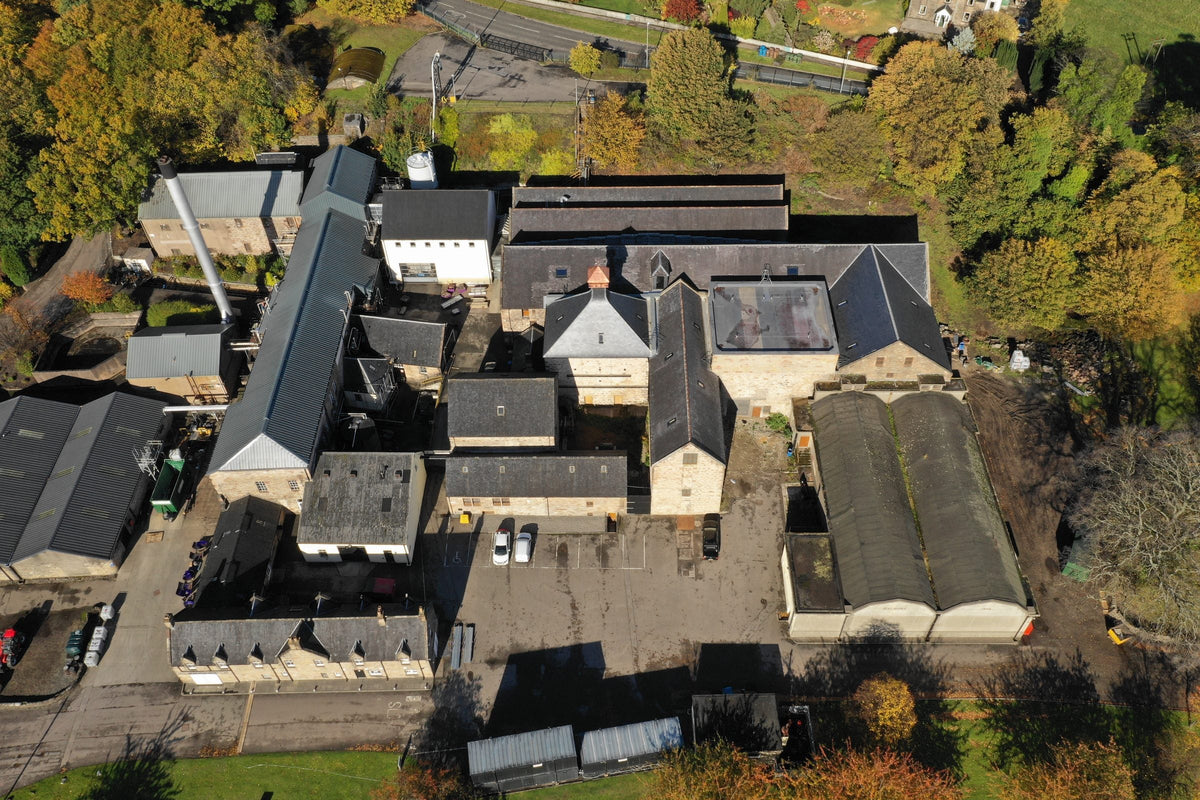
Dalmore sits right on the shore of the Cromarty Firth, close enough that the warehouses look out over the water towards the Black Isle. Our drone captured the distillery in 2019, before the diggers arrived for the big expansion, so the footage below is now a piece of history in its own right: the site as the Mackenzies would still have recognised it.
History of Dalmore
Dalmore was founded in 1839 by Alexander Matheson, and the money behind it had a story of its own. Matheson was a partner in Jardine Matheson, the Far East trading house that dominated the opium trade into China, and he ploughed part of that fortune into land in Ross-shire, including a distillery site on the firth at Alness whose name combines Norse and Gaelic and is usually translated as "the big meadowland". Matheson was an investor rather than a distiller, and for its first decades Dalmore was run by a series of tenants.
The family that defined the place arrived in 1867, when brothers Andrew and Charles Mackenzie took over the running of the distillery, buying it outright from the Matheson estate in 1891 for £14,500. It was the Mackenzies who put their clan's royal stag on the bottle, and their stewardship lasted nearly a century. It survived a strange interruption: in 1917 the Royal Navy requisitioned the site, using its buildings and deep-water anchorage for the assembly of sea mines, and between wartime damage and the slow hand-back, whisky did not flow again until 1922.
In 1960 the Mackenzies merged their business with Whyte & Mackay, the Glasgow blender that had long been Dalmore's biggest customer, and the distillery has been the jewel of that company ever since, even as the company itself changed hands repeatedly: Lonrho, Brent Walker, American Brands, a management buyout, then United Spirits of India in 2007. Since 2014 Whyte & Mackay has belonged to Emperador Inc, the Philippine brandy giant, which has proved a patient and ambitious owner.
The most visible proof of that ambition is the expansion completed in the past year or so: an investment usually reported at around £40 million that has added a second still house and roughly doubled capacity, from about 4.5 million litres of pure alcohol a year to around 9 million. Tellingly, the new stills are faithful copies of the old ones, flat tops, water jackets and all. Dalmore's owners know exactly which quirks make the spirit what it is, and they were not prepared to lose them for the sake of tidiness.
How Dalmore makes its whisky
Dalmore's still house is one of the oddest in Scotland, and gloriously so. The four wash stills have flat tops, sliced off where most stills taper to a swan neck, with the lyne arm emerging from the side. The four spirit stills wear copper water jackets around their necks, cold-water collars that increase reflux and are almost unique to Dalmore. One of the wash stills dates from 1874 and is still in service. To complicate matters further, the stills are not all the same size: some hold roughly twice as much as their neighbours, so different charges produce different weights of spirit, all of which are vatted together before filling. The result is a new make that is heavy, oily and complex, built for long ageing in serious wood.
The rest of the process is more conventional. Water comes from Loch Morie in the hills above Alness, the malt is unpeated, and fermentation runs to around 50 hours in eight washbacks. Spirit goes into cask at the industry-standard 63.5%.
It is the wood that turns Dalmore's muscular new make into Dalmore the whisky. The distillery is famous for its sherry casks, and above all for a relationship with the sherry house González Byass that dates back to 1961 and gives it access to butts seasoned for decades with aged oloroso, including the celebrated 30 year old Matusalem solera. Very few distilleries can call on wood like this, and it is the source of the house signature: that deep note of Seville orange, dark chocolate and spice that runs through almost everything Dalmore releases. If you want to understand how much difference a cask makes, our guide to cask sizes and types is a good place to start.
What does Dalmore taste like?
Orange is the word most people reach for first: Seville orange marmalade, candied peel, orange chocolate. Around it sit dark coffee, ginger, cinnamon and a plush, almost liqueur-like richness that comes from all that sherry wood laid over a genuinely weighty spirit. This is not a delicate Highland malt; it is a whisky built like a grand hotel, and it makes most sense after dinner.
Underneath the sherry, the spirit itself is thick-textured and gently cereal-sweet, with dried fruit and a savoury, old-fashioned depth from those odd stills. That weight is why the whisky can carry unusual cask finishes without falling apart, and why our own bottlings from port and rum wood worked so well. It has also made Dalmore a favourite with cigar smokers, a pairing the distillery itself leans into with its Cigar Malt Reserve.
Dalmore and independent bottlers
Here is the honest picture: independent Dalmore is scarce, and getting scarcer. Whyte & Mackay keeps a tight grip on its flagship single malt, and casks reach the open market far less often than they do from blending workhorses like Blair Athol or the Diageo estate. The bottlings that do appear tend to be snapped up quickly, partly because the brand is so recognisable and partly because an independent Dalmore usually costs a fraction of an official release of similar age.
For whisky lovers that scarcity cuts both ways. You will not find shelves of indie Dalmore the way you will Caol Ila or Clynelish, but when one does surface it offers something the official range rarely shows: Dalmore at natural cask strength, from a single cask, often from wood outside the classic sherry playbook. It is a different, rawer view of a spirit that is normally presented in black tie.
The Single Cask and Dalmore
We have bottled Dalmore twice, and the two casks were siblings: both distilled in 2014, both bottled at seven years old, both drawn from quarter casks, and numbered 800147 and 800147A. What separated them was the wood. Cask 800147 was finished in a tawny port quarter cask and bottled at a cask strength of 60.6%, an outturn of just 100 bottles. The nose gave red fruits, oak, malt, white pepper and rancio; the palate added cinnamon, allspice and raspberries; the finish carried nutmeg and that lingering rancio note. It was a personal favourite of Teo, our Europe brand ambassador, who swore by it alongside a good cigar, and having tasted it next to one, we see his point.
Cask 800147A took the same 2014 spirit in a completely different direction: a rum quarter cask finish, bottled at 59.7% with an outturn of 98 bottles. Brown sugar led the way, followed by caramel, green tea, white pepper, nutmeg and a squeeze of lime, a brighter, sweeter Dalmore than the port cask but unmistakably the same muscular spirit underneath. Both bottlings sold out, which tells you how quickly independent Dalmore moves. We would love to bottle it again, and we keep an eye out, but we will not pretend Dalmore casks come up often, because they do not.

Collectability and cask ownership
Dalmore has been engineered into one of the great luxury whisky brands, and the auction record shows it. A bottle of the 62 year old sold at Singapore's Changi Airport in 2011 for a then-record £125,000. The Dalmore Decades No.6 Collection made around US$1.1 million at Sotheby's Hong Kong in 2021, and Harrods offered the twelve-bottle Paterson Collection, named for Richard Paterson, the company's celebrated master blender of more than five decades, at £987,500. The Constellation series and the older age statements have a committed collector following, and the brand's push upmarket over the past twenty years has been relentless and largely successful.
What does that mean for casks? Mainly that supply, not demand, is the constraint. Dalmore casks very rarely reach private buyers, and any that do command a premium precisely because the brand above them is so strong. If you are offered one, the questions to ask are the same as ever: is the provenance watertight, what wood is it in, and what will it realistically be worth as liquid rather than as a story. Cask ownership involves risk, values can go down as well as up, and nothing on this page is financial advice. Our guide to cask sizes and types explains the practicalities, and we will always give you a straight opinion on whether a price makes sense.
Visiting Dalmore
Dalmore sits just off the A9 at Alness, around half an hour north of Inverness, and the setting alone justifies the detour: pagoda roof, Victorian stonework and the Cromarty Firth glittering beyond the warehouses. As part of the expansion the distillery has opened a new luxury visitor experience, with tastings pitched at the top end of the market, in keeping with the brand. Check the distillery's own site for current tours and prices, and book ahead. If you are heading further north, Clynelish at Brora makes a fine second stop, and Skye's Talisker is within reach for the ambitious.
Dalmore FAQs
Who owns Dalmore distillery?
Whyte & Mackay, which merged with the Mackenzie family's business in 1960. Whyte & Mackay has been owned since 2014 by Emperador Inc, the Philippine drinks group, which has funded the distillery's recent £40 million expansion.
Why is there a stag on the Dalmore bottle?
It is the emblem of Clan Mackenzie, whose ancestor is said to have saved King Alexander III from a charging stag in 1263 and been granted the right to bear the twelve-pointed royal stag. The Mackenzie brothers ran Dalmore from 1867 and put their crest on the bottle.
Is Dalmore peated?
No. Dalmore's malt is unpeated. Its richness comes from a heavy, oily spirit made in unusual flat-topped and water-jacketed stills, and from maturation dominated by aged oloroso sherry casks.
Can you visit Dalmore distillery?
Yes. A new visitor experience opened as part of the recent expansion, offering premium tours and tastings at the distillery in Alness, about 30 minutes north of Inverness. Booking ahead is strongly recommended.
Does Dalmore whisky hold its value?
Rare Dalmore bottles have set headline auction results, including £125,000 for a 62 year old in 2011 and around US$1.1 million for the Decades No.6 Collection in 2021, but past prices are no guarantee of anything. Whether bottle or cask, values can fall as well as rise, and you should never buy what you would not be happy to drink. This is not financial advice.
Can you buy a cask of Dalmore?
Very occasionally. Whyte & Mackay keeps most of its stock, so Dalmore casks rarely reach the private market. Ask us and we will tell you honestly what is available, from Dalmore or from comparable Highland distilleries.
Own a piece of Dalmore
Dalmore is what happens when a heavyweight spirit, extraordinary sherry wood and a century and a half of showmanship meet on the shore of the Cromarty Firth. Bottles wearing the stag now sell for more than houses, yet the whisky underneath remains exactly what the Mackenzies built: rich, orange-laced and unhurried.
Our two Dalmore casks are gone, but the hunt continues, and there is a whole Highland region of characterful casks we can offer today. If you are curious about buying a whisky cask, or about bottling one under your own label, get in touch. We taste everything we sell, and we will tell you plainly what your money buys, whether the label carries antlers or not.
Work with The Single Cask
Buy a whisky cask, bottle under your own label, or store casks in our HMRC approved bonded warehouse in Fife.
Read more
Inchgower Distillery: The Manzanilla of Speyside
Inchgower is the only Scotch distillery ever owned by a town council, and the salty, spicy Speyside workhorse behind Bell's. We have bottled it more than a dozen times — here is the full story, fro...
Read more
Teaninich Distillery: The Highland Giant Without a Mash Tun
One of Scotland's biggest and least-known distilleries, Teaninich threw out its mash tun in 2000 and never looked back. We have bottled it eleven times — here is the full guide to the grassy Highla...
Read more


