
Glenfarclas Distillery: Six Generations, Direct Fire and Sherry Oak
On 8 June 1865 a cattle farmer called John Grant paid £511, 19 shillings and no pence for a small farm distillery on the lower slopes of Ben Rinnes. His descendants have owned it ever since. In an industry where almost every famous name has changed hands three or four times, and where the biggest players are French, Japanese or listed in London, Glenfarclas is still run by the sixth generation of the same family, still direct-fires its stills, still fills almost everything into sherry casks and still says no, politely but firmly, whenever somebody offers to buy it.
The result is one of the most consistent and most collected whiskies in Speyside: a rich, sherried, old-fashioned malt with an unbroken run of vintages going back to the 1950s. It is also one of the harder distilleries for independent bottlers to work with, which shapes what we can and cannot offer, and we will be honest about that further down.
Glenfarclas at a glance
| Region | Speyside, at Ballindalloch in Banffshire, on the lower slopes of Ben Rinnes |
| Founded | Licensed 1836 by Robert Hay; farm distilling on the site is thought to go back to before 1791. Bought by John Grant on 8 June 1865 |
| Owner | J. & G. Grant, a private company owned by the Grant family since 1865; chairman John L.S. Grant, sixth-generation George S. Grant a director |
| Capacity | Typically quoted at around 3.5 million litres of pure alcohol a year, though figures from 3.2 to 4 million appear in print |
| Stills | Six, in three pairs, and the largest on Speyside; all directly fired by gas, with the wash stills charged at around 23,000 litres and the spirit stills at 21,000 |
| Water source | Springs on Ben Rinnes, under a supply agreement with the Ballindalloch estate that dates from 1930 |
| Fermentation | Twelve stainless steel washbacks with wooden lids, around 45,000 litres each; long ferments, recently quoted at over 100 hours on average |
| Malt spec | Unpeated or very lightly peated, in the region of 1 to 3 ppm |
| Style | Full-bodied, sherried Speyside: dried fruit, Christmas cake, dark chocolate, walnuts and warming spice, built for long ageing |
| Visitor centre | Yes, one of the first in Scotland (1973), with the famous Ship's Room panelled in oak from the liner Empress of Australia |

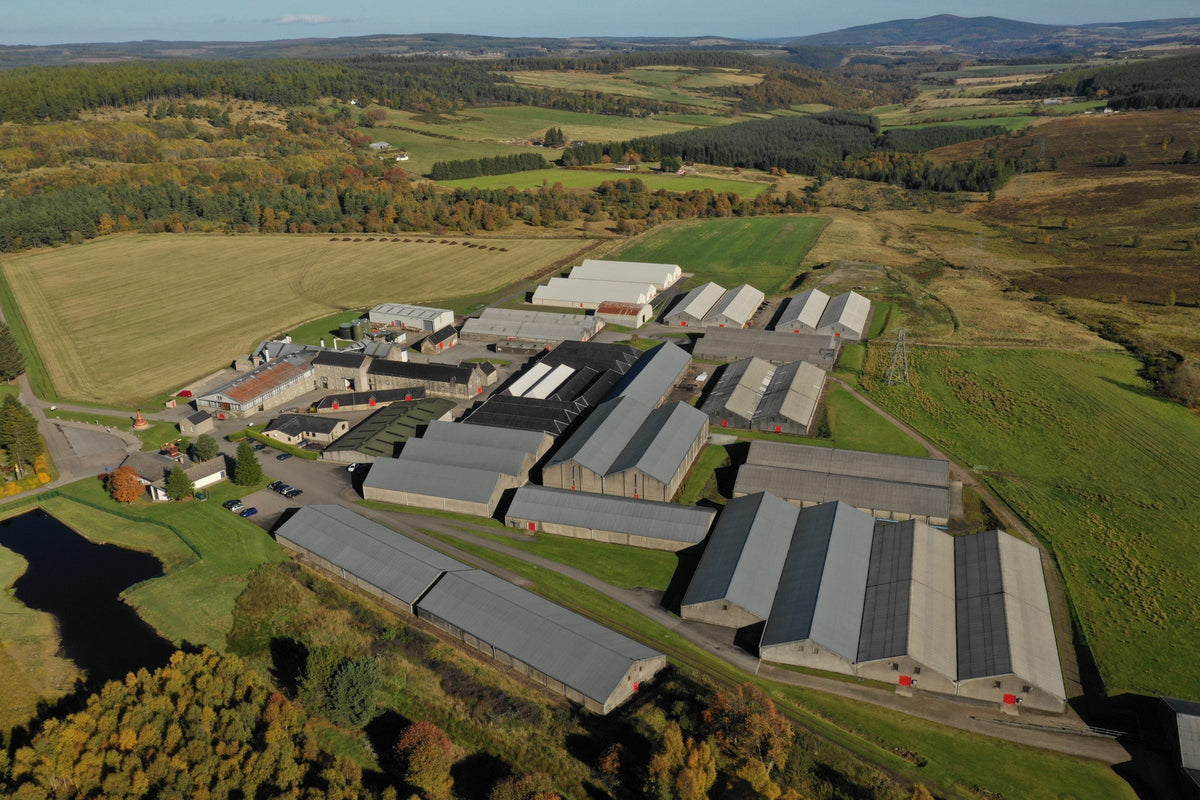
Glenfarclas from above
Our drone went up over Ballindalloch on a clear winter's day to film the distillery from the air, and the footage shows why the name means "valley of the green grass": low whitewashed buildings, the 1896 pagoda at the entrance, and row after row of dunnage warehouses spreading out across the flat ground beneath Ben Rinnes, which is where more than 100,000 casks of Glenfarclas are quietly getting older.
History of Glenfarclas
Whisky was almost certainly being made on Rechlerich farm long before anybody paid duty on it. The first licence was taken out in 1836 by the tenant, Robert Hay, and after his death the farm and its distillery were bought by his neighbour John Grant, a cattle breeder of some renown, for that famous £511 19s 0d. Grant was more interested in the land than the stillhouse at first, and leased the distillery for a spell to John Smith, who went on to found Cragganmore a few miles up the road from Glenlivet. In 1889 John Grant died and his son George took charge; George himself died within the year, leaving the licence to his widow Elsie, who ran Glenfarclas with her sons John and George through the boom years of the 1890s.
Those boom years nearly finished the family. In 1895 the Grants went into partnership with Pattison, Elder & Co. of Leith, the flashiest blenders of the age, who took a half share to fund a complete rebuild of the distillery. In December 1898 Pattisons collapsed in a fraud scandal that brought down a string of distilleries and banks with it, and the Grants had to buy back their own company. Whether that took until 1898 or 1900 depends on which history you read, but the family's own account is that it took a generation to recover, and the lesson stuck: never borrow, never partner, never sell.
The modern Glenfarclas is largely the work of George S. Grant, who with his brother John P. Grant turned J. & G. Grant into a private company in 1947 and ran it for more than fifty years. In 1952 some 96 per cent of Glenfarclas was still going to blenders; George decided the future was single malt and started laying down stock, from 1953 onwards, that the family had no immediate use for. He also grew the plant, from two stills to four in 1960 and six in 1976, and in 1968 released Glenfarclas 105, at 60% abv, generally credited as the first commercially bottled cask-strength single malt from any distillery. In 1973 Glenfarclas opened one of Scotland's first visitor centres. And in the 1980s, when the industry was drowning in a "whisky loch" and other distilleries were closing, Glenfarclas kept distilling and even expanded, which is why it has stock today that its competitors can only envy.
John L.S. Grant, George's son, joined in 1973 and became chairman on his father's death in 2002; his own son, George S. Grant, joined in 2000 and fronts the brand around the world. Between them they launched the Family Casks in 2007, and in 2015 marked 150 years of ownership with a bottling priced, naturally, at £511.19. In 2026 the distillery released Glenfarclas 190, vatted from 78 casks spanning the 1970s to the 2000s, to mark the 190th anniversary of Robert Hay's licence.
How Glenfarclas makes its whisky
Nothing about the process is designed to be fast. Water comes off Ben Rinnes, the mountain that also feeds Benrinnes and Dailuaine on the far side, and the malt is barely peated at all. A 16.5 tonne stainless steel semi-lauter mash tun, one of the biggest on Speyside, feeds twelve stainless steel washbacks fitted with wooden lids, and fermentation is deliberately long: the distillery has recently quoted an average of well over 100 hours, which builds the fruity esters that give the spirit its weight.
Then come the stills, which are the heart of the matter. Glenfarclas has six of them, in three matched pairs, and they are the largest on Speyside; wash still charges are around 23,000 litres and spirit stills around 21,000. More important than the size is the heat. Every still is directly fired by gas flame from underneath rather than by steam coils, which is now rare in Scotland. The distillery tried steam heating on one still in 1981, decided the spirit came out weaker and blander, and switched it back within weeks. That heavier, more robust new make is a large part of why Glenfarclas can shrug off fifty years in sherry oak without collapsing into wood. Ordinarily four of the six stills run, with two in reserve, and the spirit is filled at 63.5%.
The other half of the recipe is the wood. Since the late 1980s Glenfarclas has bought its sherry casks from a single source, the Jose y Miguel Martin bodega in Jerez, mostly ex-Oloroso European oak butts and hogsheads, at a cost the family has put at around £3 million a year. There is a scattering of plain refill hogsheads and the odd port pipe, but sherry oak is the house, a commitment shared, on a different scale, by nearby sherry-led Speysiders such as Aberlour. Everything matures on site in traditional dunnage warehouses, low stone buildings with earth floors where casks are stacked no more than three high; the estate now runs to more than forty of them, with over 100,000 casks and further warehouses under construction. Roughly two-thirds of production is sold as Glenfarclas single malt and 95 per cent of it goes abroad, to some ninety markets.
What does Glenfarclas taste like?
Glenfarclas is the reference point for the old-school sherried Speyside style, the sort of whisky Macallan was famous for before it changed direction. Expect dried fruit first: raisins, sultanas, figs and dates, then Christmas cake, dark chocolate, walnuts and orange peel, with a background of malty sweetness and warming clove and cinnamon spice. The texture is thick and mouth-coating, the colour is natural (the distillery is proud of it), and the finish tends to be long, dry and faintly tannic in the way good Oloroso casks are.
What makes it collectable rather than merely enjoyable is how gracefully it ages. Because the spirit is heavy and the casks are managed with a light touch, Glenfarclas can spend forty, fifty or even sixty years in wood and still taste like whisky rather than a piece of furniture. The 25, 30 and 40 year olds in the core range are among the best value old malts on the market, and the cask-strength 105 is a Speyside institution.
Glenfarclas and independent bottlers
Here is the part that catches people out. Glenfarclas casks do exist outside the distillery, because for most of the twentieth century a proportion of production was sold to blenders, and some of those casks eventually found their way to brokers and private buyers. But the Grant family have always taken a hard line on the use of their name: J. & G. Grant do not permit independent bottlers to put "Glenfarclas" on a label. As a result, independently bottled Glenfarclas almost always appears under a pseudonym ("Blairfindy" is the best known, along with various "Speyside" and "Probably Speyside's Finest" style labels), or with the distillery name discreetly omitted and a knowing wink from the retailer.
Compare that with the Family Casks, the distillery's own single-cask series, launched in 2007 with 43 vintages from 1952 to 1994 and now running to well over 380 releases. In effect, Glenfarclas has kept the single-cask market for itself, which is unusual and, from a collector's point of view, has been very good for the value of official bottlings. For cask owners it means one thing above all: a Glenfarclas cask is a wonderful thing to own and drink, but bottling it under the distillery name is not an option, and any buyer or seller who suggests otherwise should be treated with caution.
The Single Cask and Glenfarclas
We will be straight with you: we have never released a Glenfarclas under The Single Cask label, and given the family's stance on independent bottling, we are unlikely to. That is not for want of admiration. Sherried Speyside is a style we love and bottle regularly from distilleries such as Glentauchers, Inchgower and Linkwood, and Glenfarclas is the yardstick we measure them against.
Where we can help is with casks. Genuine Glenfarclas casks do surface in the private market from time to time, and over the years we have been asked to source, value and advise on them for private owners. If you own one, or are thinking of buying one, we can talk you through what it is likely to be worth, how it should be stored and, crucially, what your realistic options are when the time comes to bottle, given that the distillery name cannot appear on the label.
Collectability and cask ownership
Glenfarclas is one of the most actively collected distilleries in Scotland, and much of that is down to the depth of its own archive. The Family Casks gave collectors a complete run of vintages from 1952 onwards, and the rarest have climbed steadily: bottles from the 1950s regularly reach four and five figures, the Family Cask Trunk, fifty 20cl bottles from 1954 to 2003 in a leather case, has sold for between £55,000 and £62,000 at auction, and in October 2025 a 4.5 litre One of One 58 year old set a distillery record of £65,000 at Sotheby's. The Pagoda Series of decanters, drawing on 1953, 1954, 1956, 1967 and 1971 stock, has retailed at up to £67,000.
For casks, the picture is more nuanced. A Glenfarclas cask carries one of the strongest names in Speyside, the spirit is famously good at long maturation, and the family's refusal to sell or expand recklessly gives the brand a stability few can match. Against that, the label restriction is real, casks appear rarely and provenance must be checked carefully; some casks in private hands were filled into tired wood decades ago and are not what the name suggests. As with every cask, ownership involves risk, values can go down as well as up, storage and insurance are ongoing costs and whisky can only ever be sold as whisky. None of this is financial advice. If you are weighing up a sherried Speyside cask of any kind, our guide to whisky cask sizes and types explains why a butt behaves differently from a hogshead, and we are happy to give an honest second opinion.
Visiting Glenfarclas
Glenfarclas was one of the first distilleries in Scotland to open its doors to visitors, in 1973, and the visitor centre remains one of the best on the Speyside trail. Tours run on weekdays throughout the year and on Saturdays in summer, taking in the mash house, the huge direct-fired stills and a dunnage warehouse. The highlight is the Ship's Room, panelled with oak salvaged from the Empress of Australia, the Canadian Pacific liner scrapped at Inverkeithing in 1952; the panelling spent twenty years in a British Legion club in Rosyth before the Grants installed it. The distillery sits on the A95 between Grantown-on-Spey and Aberlour, a few minutes from Ballindalloch Castle and within easy reach of Cragganmore, Macallan and Dalmunach.
Glenfarclas FAQs
Who owns Glenfarclas distillery?
Glenfarclas is owned by J. & G. Grant, a private company controlled by the Grant family, who bought the distillery in 1865. It is one of the very few Scotch distilleries still in the hands of the founding family, now in its sixth generation, and the family have turned down repeated offers to sell.
Is Glenfarclas a sherry-matured whisky?
Yes, almost entirely. Glenfarclas matures the great majority of its spirit in ex-Oloroso sherry casks bought from a single bodega in Jerez, and its whiskies are known for dried fruit, Christmas cake and dark chocolate flavours with natural colour.
What is Glenfarclas 105?
Glenfarclas 105 is a cask-strength single malt bottled at 60% abv (105 degrees proof in the old British system). Launched in 1968, it is generally regarded as the first commercially released cask-strength single malt from any distillery, and remains the brand's biggest seller.
What are the Glenfarclas Family Casks?
The Family Casks are Glenfarclas's own single-cask bottlings, launched in 2007 with vintages from 1952 to 1994 and now covering more than 380 releases up to the 2000s, all bottled at cask strength.
Can you buy a cask of Glenfarclas?
Occasionally, yes, though the distillery does not sell casks to the public and any cask on the private market must be checked carefully. Note that J. & G. Grant do not allow the Glenfarclas name on independent bottlings, so a privately owned cask cannot be bottled under the distillery name. Contact us for honest advice.
Can you visit Glenfarclas distillery?
Yes. The visitor centre at Ballindalloch, opened in 1973, offers tours on weekdays all year and Saturdays in the summer months, including the Ship's Room panelled with oak from the liner Empress of Australia.
Work with The Single Cask
Buy a whisky cask, bottle under your own label, or store casks in our HMRC approved bonded warehouse in Fife.
Read more
Ardmore Distillery: The Peated Highlander Built for Teacher's
Built beside the railway in 1898 to feed Teacher's Highland Cream, Ardmore is the Highlands' quiet peated giant: coal-fired until 2001, barely bottled as a single malt for a century, and a favourit...
Read more
Craigellachie Distillery: Speyside's Meaty, Worm-Tub Maverick
Worm tubs, short fermentations and a sulphury new make that turns tropical with age: Craigellachie is the heavyweight of Speyside. We have bottled it many times, from bourbon casks to sherried octa...
Read more


