
Ballindalloch Distillery: Scotland's Only Single Estate Whisky
Ballindalloch calls itself Scotland's first single estate distillery, and it is one of the few places in the country where that phrase is not marketing gloss. The barley is grown in the estate's own fields, the whisky is distilled and matured on site, and the leftover grain goes straight back into feeding the estate's cattle. It is also one of the smallest and youngest operations in this series, which shapes what we can honestly say about buying a cask from it.
Ballindalloch at a glance
| Region | Speyside, on the Ballindalloch Estate near the River Avon, close to Cragganmore |
| Founded | Built 2011 to 2014 by Guy Macpherson-Grant; first spirit ran in September 2014 |
| Owner | The Macpherson-Grant family, who have held Ballindalloch Estate since the 16th century |
| Capacity | Around 100,000 litres of pure alcohol a year |
| Stills | One wash still and one spirit still, both fitted with worm tub condensers |
| Water source | Garline Springs, on the estate |
| Distinction | Barley grown, distilled, matured and bottled entirely on the same estate |

Ballindalloch from above
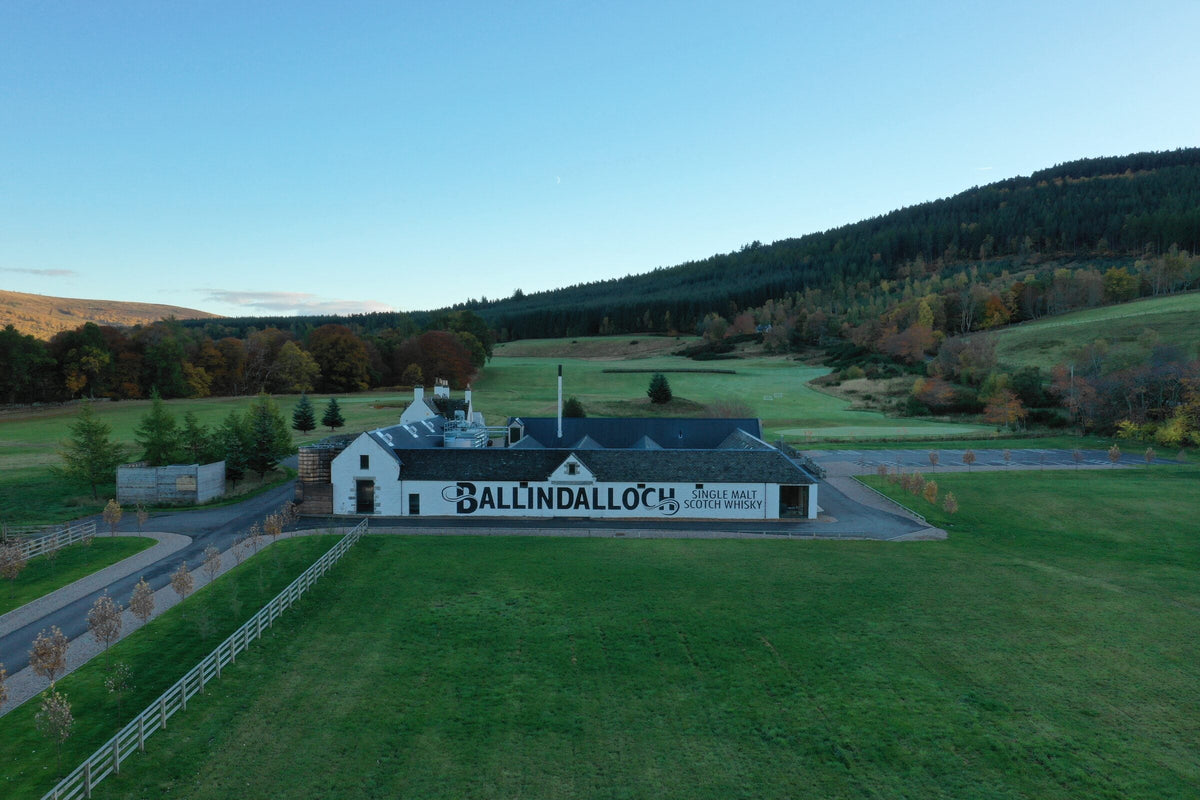
From the air, Ballindalloch reads more like a working farm than a distillery: a converted 19th century steading sitting among the estate's own barley fields, with the River Avon and the wider Ballindalloch Estate, including the castle itself, spread out around it. That mix of farmland and distillery buildings on a single site is exactly what the single estate claim looks like in practice, rather than just words on a label.
History of Ballindalloch
Ballindalloch Castle has belonged to the Macpherson-Grant family since 1546, and this is not their first venture into whisky. Sir George Macpherson-Grant leased part of the estate to John Smith in 1869 to build Cragganmore, one of Speyside's best known names, and the family kept a stake in it until selling out to the Distillers Company Limited in 1965. Nearly fifty years passed before the family returned to distilling on their own account. Guy Macpherson-Grant, the 23rd generation to hold the estate, began converting a 19th century farm steading into a distillery in 2011, and the first spirit ran in September 2014. The distillery was formally opened in 2015 by the then Duke and Duchess of Rothesay, now King Charles III and Queen Camilla, and the family committed from the outset to waiting at least eight years before bottling anything, which meant the first Ballindalloch single malt did not reach the market until well into the 2020s, sold as a dated Vintage Release rather than an age-statement range.

How Ballindalloch makes its whisky
The still house holds a single pair, a lamp glass shaped wash still and a ball shaped spirit still, both connected to traditional worm tub condensers rather than modern shell-and-tube ones, which is a similar setup in principle to a handful of older Speyside distilleries even though Ballindalloch's own new make is generally described as robust and fruity rather than sulphury. Barley is grown in the estate's own fields, and the spent grain left over after mashing, the draff, is fed straight to the estate's Aberdeen Angus herd rather than sold off site, closing the loop between farming and distilling in a way very few Scotch distilleries can genuinely claim. Maturation uses a mix of first-fill and refill barrels, hogsheads and first-fill sherry butts, and because the estate holds onto its own stock for the full eight-year minimum and beyond, everything released so far has come out as a specific vintage, including a limited bottling produced for King Charles's 75th birthday, rather than a standard core range built around fixed age statements.
Ballindalloch and The Single Cask
We do not currently hold a Ballindalloch cask, and it is worth being straightforward about why. This is a genuinely tiny distillery, producing roughly a tenth of what a mid-sized Speyside operation makes in a year, it only started distilling in 2014, and the family has chosen to keep hold of almost everything it produces for its own Vintage Release bottlings rather than releasing casks to brokers or independent bottlers. That makes Ballindalloch a distillery to know about rather than one we can currently offer stock from. If the appeal is a small, characterful single estate style, we are happy to talk through comparable Speyside casks with real availability, since the closed-loop, farm-to-bottle story is unusual but the flavour profile it produces is not the only way to get there.

Ballindalloch and independent bottlers
Independent bottlings of Ballindalloch are, as far as we can find, essentially nonexistent at this point, which is consistent with a distillery this young and this small keeping everything for its own name. That is a genuine difference from most distilleries in this series, where decades of casks have had time to circulate through the trade. It may change as the distillery matures and builds up a longer back catalogue of casks, but for now Ballindalloch sits closer to a boutique estate producer than a trade supplier.
Plan a bottling inspired by Ballindalloch
We cannot offer a Ballindalloch cask today, but we can put together something in a similar spirit: a genuinely small-batch, characterful Speyside single cask with a story behind it, rather than an anonymous parcel of stock. Get in touch and tell us what drew you to Ballindalloch specifically, whether that is the farm-to-bottle story, the worm tub character, or simply the region, and we will suggest real alternatives rather than a generic list.
For an independent bottler or a new brand building a range, we can talk through independent bottling and private label whisky built around stock that is genuinely available, walk through the four steps from cask to bottle, and hold everything in our own bonded warehouse while a plan comes together. If you are earlier in the process, our guide to cask sizes and types is a sensible place to start. A cask of whisky is not a regulated investment, its value can move in either direction over however long it matures, and nothing here is financial advice, just a plain account of what we see in this market day to day.
Get in touch and tell us what you are trying to build. We will give you a straight answer about what is realistically available, Ballindalloch or otherwise.
Ballindalloch FAQs
What makes Ballindalloch a single estate distillery?
Ballindalloch grows its own barley on the estate, distils and matures the whisky on site, and even feeds the leftover draff to its own cattle herd. Very few Scotch distilleries control that much of the process on one piece of land, which is why Ballindalloch describes itself as Scotland's first single estate distillery.
Is Ballindalloch connected to Cragganmore?
Yes, historically. The Macpherson-Grant family leased part of the Ballindalloch Estate to John Smith in 1869 to build Cragganmore distillery and held a stake in it until selling to the Distillers Company Limited in 1965. The current Ballindalloch distillery, built from 2011, is a separate and much later venture by the same family.
Can you buy a cask of Ballindalloch whisky?
Not through us at present. Ballindalloch is a very small, young distillery that keeps almost all of its output for its own Vintage Release bottlings, and independent bottlings are effectively nonexistent so far. Contact us if you want to discuss comparable Speyside alternatives with genuine availability.
Where does Ballindalloch's water come from?
Garline Springs, a water source on the estate itself, in keeping with the single estate concept behind the whole operation.
What happens to the leftover grain from Ballindalloch's mashing process?
The draff is fed directly to the estate's own Aberdeen Angus cattle herd rather than being sold off site, which is part of what makes the single estate claim more than a marketing line.
Work with The Single Cask
Buy a whisky cask, bottle under your own label, or store casks in our HMRC approved bonded warehouse in Fife.
Read more

Glasgow Distillery: The Whisky That Broke a 113 Year Drought
Glasgow went without a working distillery for over a century. The city that once had at least half a dozen licensed operations lost its last one in 1902, and for the next 113 years anyone wanting a...
Read more
Benromach Distillery: The Independent Bottler That Bought Its Own Distillery
Benromach spent most of the twentieth century opening, closing and changing hands, and by 1983 it had stopped altogether. What makes it worth a proper look now is who brought it back. Gordon & ...
Read more


