
Article: Benromach Distillery: The Independent Bottler That Bought Its Own Distillery
Benromach Distillery: The Independent Bottler That Bought Its Own Distillery
Benromach spent most of the twentieth century opening, closing and changing hands, and by 1983 it had stopped altogether. What makes it worth a proper look now is who brought it back. Gordon & MacPhail, the Elgin firm that built its name bottling other people's whisky long before it owned a drop of its own, bought the site in 1993 and reopened it in 1998 as the smallest working distillery in Speyside at the time. That makes Benromach an unusual case in this series: a distillery owned outright by one of the oldest independent bottlers in Scotland, run in a deliberately old-fashioned way. We do not currently hold a cask from it, and we will say so plainly rather than pretend otherwise, but the story and the production method are genuinely worth knowing if you are thinking about sourcing, bottling or simply understanding where Speyside whisky comes from.
Benromach at a glance
| Region | Speyside, Forres, on the edge of the Moray coast |
| Founded | 1898, by Duncan McCallum and F. W. Brickman; closed 1983; bought and restored by Gordon & MacPhail in 1993, reopened 1998 |
| Owner | Gordon & MacPhail, the independent, family-owned Elgin merchant and bottler founded in 1895 |
| Capacity | Around 400,000 litres of pure alcohol a year, deliberately modest for a single-site distillery of its type |
| Stills | One wash still (7,500 litres) and one spirit still (5,000 litres), both traditional copper pot stills |
| Water source | Chapelton Spring, in the Romach Hills above the distillery |
| Style | Predominantly unpeated, with a lightly peated Peat Smoke expression and an organic-certified range alongside it |

Benromach from above
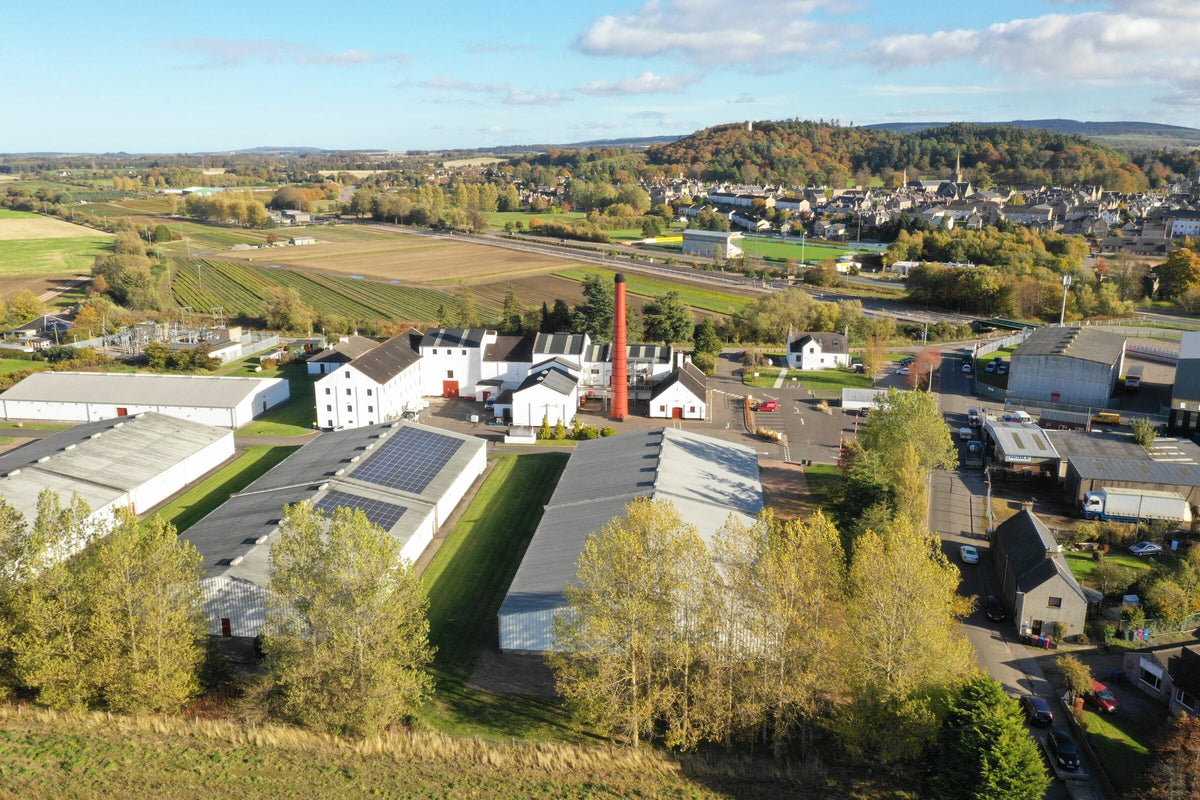
From the air, Benromach looks smaller and neater than its Speyside neighbours, which fits, since it was deliberately rebuilt as a compact, single-operator site rather than expanded for volume. The still house, warehousing and visitor centre sit close together on the edge of Forres, with the Romach Hills, where the distillery's own spring rises, visible in the wider landscape beyond. It is a useful aerial view for exactly the reason the distillery is interesting: what you see is a small, hand-run operation rather than an industrial one.
History of Benromach
Benromach was built in 1898 by Duncan McCallum and F. W. Brickman on the outskirts of Forres, one of a wave of new Speyside distilleries put up in the boom years before the whisky industry's first great crash. Production only lasted a matter of months before money ran out, and the site spent the next few decades passing between owners, including a period under Harvey McNair and Co from 1911, without ever building a settled identity of its own. It later came under the control of the giant Distillers Company Limited, alongside dozens of other Speyside sites, and was mothballed in 1983 during the same wave of closures that shut Coleburn, Convalmore and a long list of others that decade.
What happened next is the more interesting part. Gordon & MacPhail, the Elgin whisky merchant founded in 1895, had spent almost a century buying new-fill spirit from other people's distilleries, maturing it in its own warehouses and bottling it under its own labels, becoming one of the most important independent bottlers in the business long before "independent bottler" was a phrase anyone used casually. In 1993 the Urquhart family, who have run Gordon & MacPhail since the 1930s, bought the derelict Benromach site outright. They stripped much of the old plant back to nothing and rebuilt it as a small, single-operator distillery, reopening in 1998 with a ceremony performed by the then Prince of Wales. For the first time, an independent bottler with a century of buying other people's whisky owned a distillery capable of making its own.
How Benromach makes its whisky
The stated aim at Benromach has always been to make whisky the way Speyside distilleries did before automation took over, and the plant is built around that idea rather than around output. A single semi-lauter mash tun feeds thirteen larch washbacks, and fermentation runs for somewhere between 67 and 115 hours depending on the batch, considerably longer than the industry norm of around 48 hours. A longer fermentation lets more fruity, estery character develop before the wash ever reaches the stills, and Gordon & MacPhail has been consistent about using both distiller's and brewer's yeast together to push that fruitiness further. From there, one wash still and one spirit still, both traditional copper pots with tall, narrow necks, do the rest of the work, drawing on water carried down from Chapelton Spring in the Romach Hills.
Most Benromach is made from unpeated malt, but the distillery has run a lightly peated style since reopening, using malt peated to around 12 to 14 parts per million and bottled as Peat Smoke, a gentler smoke than an Islay malt but a genuine point of difference on a Speyside shelf where peat is the exception rather than the rule. An organic range, made from barley and yeast certified to organic standards, sits alongside it. Malting itself is outsourced to specialist maltsters rather than done on site, but almost everything after that, mashing, fermentation, distillation and filling, is still done by hand, without the computer control that runs most modern distilleries. Maturation happens entirely in traditional dunnage warehouses on site, mostly in first-fill American oak and first-fill sherry casks, the Urquhart family having sourced sherry wood from the same Spanish bodega for close to a century through Gordon & MacPhail's own wine and sherry trade.
Benromach, Gordon & MacPhail and independent bottlers
Benromach's relationship with independent bottling is not the usual story of a distillery's casks trading hands between brokers and bottlers over the decades. Its owner is itself one of the oldest and largest independent bottlers in Scotland, and Gordon & MacPhail's own back catalogue under labels such as Connoisseurs Choice, Rare Old and its various distillery-specific ranges draws heavily on stock built up over generations, much of it from distilleries the company never owned. Owning Benromach gave that same business a source of new-fill spirit it controls completely, rather than one it has to buy in.
The practical effect for anyone outside Gordon & MacPhail looking to source Benromach is that very little of it moves through the wider cask market in the way that, say, a Speyside distillery owned by a large drinks group and sold off in bulk to brokers might. What official Benromach releases exist are bottled by the owner, and third-party stock is limited and comes up occasionally rather than reliably. That does not make Benromach uninteresting for anyone studying how independent bottling actually works. If anything, it is a useful case study in what an independent bottler can build when it controls its own supply from the ground up rather than relying entirely on what other distilleries choose to sell.
Benromach and The Single Cask
We do not currently hold a cask of Benromach, and given how tightly Gordon & MacPhail controls its own output, that is unlikely to change through the ordinary broker market any time soon. We would rather say that clearly than dress up a guide with stock we do not have. What we can offer is a straight comparison: if it is the traditional, hand-worked, dunnage-warehouse style of Speyside production that draws you to Benromach, rather than the name on the bottle specifically, we can talk through what we do hold that shares that character, and be upfront about where the two genuinely differ.
Plan a bottling inspired by Benromach
Benromach itself is difficult to source outside its own owner's releases, so if the name matters more than anything else, the honest answer is that options are limited and worth discussing directly rather than assuming availability. If it is the wider Speyside style, traditional methods and a coastal Moray character that appeals, our Glen Moray guide covers a distillery a short drive along the same coast with a similarly old-fashioned, wine-cask-curious approach. For a Speyside malt built for decades as anonymous blending stock rather than a marketed single malt, our Longmorn guide is a useful point of comparison in the other direction.
For an independent bottler or a new brand working from a wider brief than one specific distillery name, we can talk through independent bottling and private label whisky built around stock that actually fits, walk through the four steps from cask to bottle, and hold everything in our own bonded warehouse while a plan comes together. If you are earlier in the process and thinking about buying a whisky cask generally, our guide to cask sizes and types is a sensible next stop. A cask is not a regulated investment, values can move in either direction over however many years it spends maturing, and nothing here is financial advice, only a straightforward account of what we see buying and selling casks day to day.
Get in touch and tell us what you are trying to build. We will give you a straight answer about what is realistically available and what it is likely to cost.
Benromach FAQs
Who owns Benromach distillery?
Gordon & MacPhail, the independent, family-owned whisky merchant and bottler founded in Elgin in 1895. The Urquhart family, who have run the company since the 1930s, bought the derelict Benromach site in 1993 and reopened it in 1998.
Is Benromach whisky peated?
Mostly not. The core range is unpeated, but Benromach has produced a lightly peated Peat Smoke expression since reopening, using malt peated to around 12 to 14 parts per million, alongside an organic-certified range made separately.
Why did Benromach close and reopen?
It closed in 1983 during the wave of closures that shut a long list of Speyside distilleries that decade. Gordon & MacPhail bought the derelict site in 1993, largely rebuilt it, and reopened it in 1998 as a small, deliberately old-fashioned distillery.
Can independent bottlers buy Benromach casks?
Only in limited quantities. Because Gordon & MacPhail owns the distillery and bottles most of its output itself, relatively little Benromach moves through the ordinary cask broker market compared with a distillery owned by a large drinks group.
What makes Benromach's production traditional?
Long fermentation times of up to 115 hours, mashing and distillation still done largely by hand rather than by computer control, and maturation entirely in traditional dunnage warehouses using first-fill American oak and sherry casks sourced through Gordon & MacPhail's own long-standing sherry trade.
Work with The Single Cask
Buy a whisky cask, bottle under your own label, or store casks in our HMRC approved bonded warehouse in Fife.
Read more
Ballindalloch Distillery: Scotland's Only Single Estate Whisky
Ballindalloch calls itself Scotland's first single estate distillery, and it is one of the few places in the country where that phrase is not marketing gloss. The barley is grown in the estate's ow...
Read more


