
Tomatin Distillery: History, Whisky and the Casks We've Bottled
Ask most whisky drinkers to name Scotland's largest malt distillery and you will get guesses about Speyside giants or famous Islay names. Almost nobody says Tomatin, and for most of the twentieth century that was exactly the point. Tucked into the hills south of Inverness, Tomatin spent decades quietly producing more spirit than anywhere else in the country, almost all of it destined for blends most of us drink without ever knowing its name. It has since become one of the more interesting stories in Highland whisky: the first Scotch distillery under Japanese ownership, a site that shrank itself by choice, and a source that independent bottlers have leaned on for years.
This guide covers how Tomatin got here, how the whisky is made, what it tastes like, and the two casks we have bottled ourselves. It closes with an honest look at what buying or bottling a Tomatin cask involves today.
Tomatin at a glance
| Region | Highland, around 16 miles south of Inverness |
| Founded | 1897, as the Tomatin Spey Distillery Company |
| Owner | Tomatin Distillery Co Ltd, majority owned by Takara Shuzo of Japan since 1986 |
| Capacity | Around 5 million litres of pure alcohol a year today, down from a peak above 10 million litres in the 1970s |
| Stills | 12 in total (6 wash, 6 spirit), onion shaped with a ball; several were decommissioned in 2000 when the site scaled back |
| Water source | The Allt na Frithe, a burn running off the hills above the distillery |
| Fermentation | Long, often reported at up to 168 hours (a week), among the longest of any Scottish distillery |
| Malt spec | Mostly unpeated at around 2ppm; a separate peated spirit, Cù Bòcan, is made for about a week each year |
| Style | Light, fruity and fragrant, with tropical and orchard notes that build into something richer with age |
| Visitor centre | Yes, with tours and tastings run from the distillery itself |

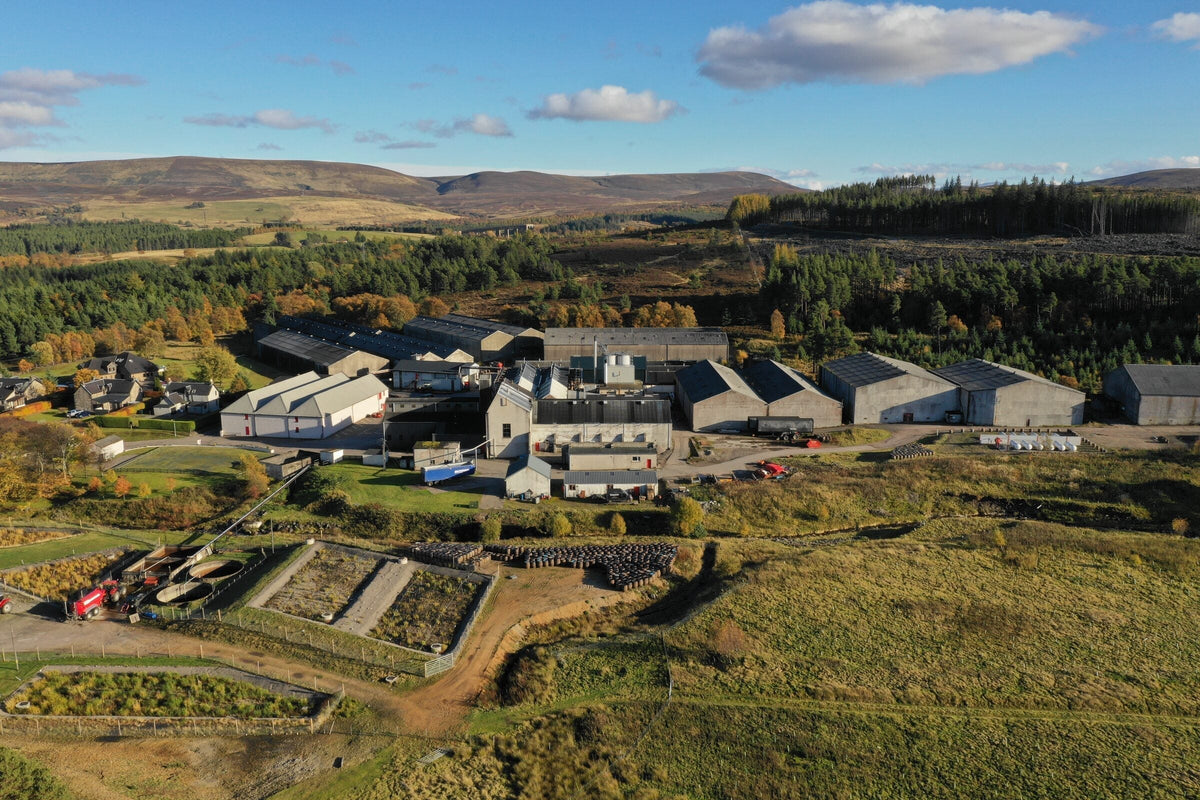
Tomatin from above
From the air, Tomatin looks like what it is: a working distillery built for volume rather than show, with row after row of warehouse roofs spreading out below the hills. It sits just off the old A9, in a spot chosen for water rather than scenery, and the scale is easy to underestimate from the ground. Seen from above, the sheer number of warehouses gives away decades spent as one of the busiest producers in the country.
The history of Tomatin
Whisky had been made informally around Tomatin long before anyone built a proper distillery there. Cattle drovers moving herds south along the old droving roads are said to have bought drams from a local still, and the name itself is thought to come from the Gaelic for "hill of the juniper bush." The formal distillery arrived in 1897, built by the Tomatin Spey Distillery Company on a site chosen for the Allt na Frithe, a soft, reliable burn running down from the hills above.
It was not an easy start. The whisky trade collapsed at the turn of the century and Tomatin closed within a decade, reopening in 1909 under new ownership as Tomatin Distillers Company. From there its story becomes one of almost continuous growth. By the 1950s it ran on two stills; by 1974 it had expanded, in stages, to twenty three, making it the largest malt distillery in Scotland by a wide margin. Output in the 1970s is often quoted at over ten million litres a year, most of it sold on as fillings for blenders rather than bottled under its own name.
That scale became a liability when demand for blended Scotch fell sharply in the 1980s. Tomatin Distillers Company went into liquidation in 1985, and in 1986 the distillery was bought by a consortium of Takara Shuzo and Okura & Co, two Japanese companies, making Tomatin the first Scotch whisky distillery to come under Japanese ownership. Okura's stake later passed to the trading house Marubeni, and Takara Shuzo has remained the controlling owner since, also picking up the respected Antiquary blend along the way through the 1997 acquisition of J&W Hardie.
Ownership brought a deliberate change in direction. Eleven of the site's stills were decommissioned in 2000 as Tomatin shifted its focus away from pure bulk supply and toward building its own single malt identity, a process that has continued ever since with new packaging, an expanded core range, and the launch of the peated Cù Bòcan expression in 2013. It is a rare example of a distillery choosing to get smaller and more distinctive rather than chasing scale for its own sake.

How Tomatin makes its whisky
Tomatin's process has always leaned toward the gentle end of Highland whisky making. The distillery draws its water from the Allt na Frithe and mills malt, mostly at a very light 2ppm phenol specification, in an eight tonne stainless steel mash tun. What sets the process apart is fermentation: reports on the distillery consistently point to unusually long fermentation times, sometimes given as up to a week in the stainless steel washbacks, well beyond the 48 to 72 hours typical elsewhere. Longer fermentation favours fruitier, more estery flavours over cereal notes, and it is one of the clearest reasons Tomatin's new make comes off so bright and tropical.
Twelve stills remain from the original twenty three, run as six wash and six spirit pairs, onion shaped with a distinctive ball on the neck that encourages reflux and a cleaner spirit. Once a year, production switches over for about a week to make Cù Bòcan, Tomatin's peated malt, using barley at a much higher phenol level before the stills are cleaned and the site returns to its usual unpeated character. The two spirits rarely mix, which keeps both identities honest.
Maturation draws on an unusually wide range of wood. Alongside the expected ex-bourbon barrels and sherry butts, Tomatin has experimented for years with port pipes and, more unusually, Italian wine casks including Marsala, Barolo and Amarone, on-site cooperage on hand to keep the fleet in good repair. With something in the region of 170,000 casks resting across its dunnage and racked warehouses, Tomatin holds one of the larger private stocks of maturing Highland whisky anywhere in Scotland.
What does Tomatin taste like?
Young Tomatin is light and fresh: green apple, pear, a floral lift and often a distinct tropical note of banana or overripe melon, a direct result of that long, slow fermentation. Given time in good wood it fills out considerably, taking on honey, vanilla and soft baking spice from bourbon casks, or deeper dried fruit and Christmas cake character from sherry, without ever losing the fruity backbone that defines the house style. It is a whisky built to age well rather than shout immediately, which may be part of why it spent so long as a blender's favourite rather than a household single malt name.

Tomatin and independent bottlers
Few Highland distilleries have a longer or more open relationship with independent bottling than Tomatin. Before its repositioning in the 2000s, Tomatin was a genuine workhorse for the blending industry, supplying fillings that went into some of the biggest names in Scotch, Johnnie Walker, Chivas Regal and J&B among them. That scale of production meant a correspondingly large pool of maturing stock available to brokers and bottlers over the years, and the results show: Tomatin has what one respected whisky reference calls "a profusion of independent bottlings," from long standing names like Gordon & MacPhail and Douglas Laing through to smaller specialist releases, even while the distillery's own official range has traditionally stayed fairly compact.
That history matters for anyone thinking about sourcing Tomatin today. It is not a distillery that has ever hoarded its stock jealously, and casks have moved through broker and independent bottler channels for decades. That does not mean supply is unlimited or guaranteed at any given moment, availability still depends on what is in the market when you are buying, but the underlying relationship between Tomatin and the independent sector is a warm one, unlike some of the more tightly controlled distilleries elsewhere in the Highlands.
The Single Cask and Tomatin
We have bottled two Tomatin casks to date, both distilled in 2006 and both, unusually, matured in firkins, small 41 litre casks that pack a lot of wood contact into a short maturation window. It is one of the smallest cask formats used in the whisky industry, smaller even than an octave, and it shows in how quickly these two developed real depth for their age.
Cask 5777B spent its eleven years in a PX firkin and came out at cask strength of 53.9%, with an outturn of 72 bottles. The sherry influence is obvious on the nose, intensely sweet and warmly spiced, with ginger, Christmas cake and a fiery edge that mellows into rich fruit and toasted nuts on the palate, and a long, warming finish that rewards taking your time over it.
Cask 5777C is its sibling in most ways but one: an Oloroso firkin rather than PX, bottled at 55.2% with an outturn of 70 bottles. The profile is close, sweet, spicy, fruity, with citrus and heavy oak alongside the nuts, but the Oloroso wood gives it a slightly drier, more savoury edge than its PX-finished sibling. Tasted side by side, they make an instructive pair on how much a sherry style, and not just sherry itself, changes a young whisky.
Both casks have long since sold through their small outturns, which is the nature of an 11 year old whisky bottled from a 41 litre firkin. We do not currently have Tomatin stock available, and given the pace at which small-format casks like these move, we would not want to overstate what might come next. What we can say, based on Tomatin's own history, is that casks from this distillery do continue to reach the independent market with some regularity, and we would be glad to talk to anyone specifically interested in Tomatin about what realistic options look like, now or when something suitable appears.
Cask ownership and collectability
Tomatin does not carry the collector premium of some flashier Highland names, which is arguably part of its appeal: it is a serious, well made whisky bought on the strength of what is in the glass rather than a story built for auction catalogues. That said, whisky cask ownership sits outside any financial regulator, whatever the distillery, and the value of a maturing cask can move in either direction over the years it spends in a warehouse. None of this is a reason to avoid cask ownership, plenty of people find real satisfaction in it, but it is a reason to go in with clear eyes, good paperwork, and no assumption that any cask is a guaranteed return. Treat this article as background reading, not financial advice.
Tomatin FAQs
Where is Tomatin distillery?
Tomatin sits in the Highlands, around 16 miles south of Inverness, just off the main A9 road. It is one of the more accessible Highland distilleries to visit if you are travelling that route.
Who owns Tomatin?
Tomatin Distillery Co Ltd is majority owned by the Japanese drinks group Takara Shuzo, which bought the distillery out of liquidation in 1986 alongside Okura & Co. Okura's share later passed to Marubeni. It was the first Scotch whisky distillery under Japanese ownership.
Is Tomatin peated?
The core Tomatin range is unpeated, made from malt at around 2ppm. Once a year the distillery produces a separate peated spirit, Cù Bòcan, using much smokier malt, before switching back.
Can I buy a cask of Tomatin whisky?
Sometimes. Tomatin has a long history of supplying casks to brokers and independent bottlers, so stock does appear on the market with some regularity, though not always at any given moment. We do not have Tomatin available right now, but if it is specifically Tomatin you are after, get in touch and we will let you know when that changes or what comes closest.
What does Tomatin whisky taste like?
Light and fruity when young, with green apple, pear and tropical notes from its unusually long fermentation. With age it develops honey, vanilla and spice from bourbon wood, or dried fruit and Christmas cake character from sherry casks, while keeping its fruity core.
How many stills does Tomatin have?
Twelve, run as six wash and six spirit stills, down from a peak of twenty three in the 1970s when Tomatin was Scotland's largest malt distillery by volume.
Plan a bottling inspired by Tomatin
Tomatin's own history makes an honest case for itself here: a distillery built for volume, with a long and unusually open relationship with brokers and independent bottlers, and a fruity, food-friendly style that takes well to a wide range of cask finishes. If a Tomatin cask specifically becomes available, it fits naturally into a single cask release, an independent bottling for a retailer or bar, or a private label project built around an approachable, crowd-pleasing Highland malt.
We do not have Tomatin casks in stock at the time of writing, and we would rather say that plainly than suggest otherwise. What we can do is talk through what is currently available in a similar style, light, fruity Highland or Speyside spirit suited to a range of finishes, and help you think through the wider project: sourcing a cask, maturing and managing it in our bonded warehouse in Glenrothes, and eventually bottling it under your own name through our private label service. Our four steps to bottling your own whisky page is a good place to see the whole process laid out, and our current whisky casks available page shows what we do have on hand today.
If you would like to talk through a Tomatin-inspired bottling, or anything else in the Highland style, get in touch. We are always happy to have that conversation before you commit to anything.
Work with The Single Cask
Buy a whisky cask, bottle under your own label, or store casks in our HMRC approved bonded warehouse in Fife.
Read more
Glenrothes Distillery: History, Whisky and Seven Casks We've Bottled
In 1878, a partnership building a new distillery beside the Burn of Rothes ran out of money halfway through construction, after the Glasgow Bank collapsed. The loan that saved the project came from...
Read more
Loch Lomond Distillery: Eleven Whiskies, One Address
Most distilleries make one whisky. Loch Lomond makes eleven. Walk through the gates at Alexandria, on the southern edge of the loch that gives the place its name, and you will find swan neck pot st...
Read more


