
Glen Moray Distillery: The Wine Cask Pioneer on Elgin's Gallows Hill
Whisky has been made at Glen Moray on ground with a darker past than most: the low hill beside the distillery, Gallow Crook, is where the burgh of Elgin hanged its criminals until the late seventeenth century. These days the only thing suspended over the site is the smell of malt, because Glen Moray has spent more than a century quietly becoming one of the hardest-working distilleries in Speyside, and one of its most experimental.
This is a distillery with two reputations. To supermarket shoppers it is the friendly, affordable single malt on the bottom shelf; to whisky insiders it is the place that was finishing spirit in Chardonnay casks before "finishing" was even a word the industry used, and whose first-fill bourbon casks are prized by independent bottlers. This guide covers the brewery it grew out of, the near-constant expansion under its French owner, what the whisky actually tastes like, and our own experience bottling it at The Single Cask.
Glen Moray at a glance
| Region | Speyside (Elgin, Moray) |
| Founded | 1897, converted from Elgin's West Brewery; brewing on the site dates to the 1820s |
| Owner | La Martiniquaise-Bardinet (since 2008) |
| Capacity | Expanded repeatedly; recent figures are quoted at between 6 and 9 million litres of pure alcohol a year |
| Stills | Around ten following the latest expansions, up from the original two; short and squat with flattish lyne arms |
| Water source | The River Lossie, which runs alongside the distillery |
| Fermentation | Large bank of outdoor stainless steel washbacks; around 60 hours is typically quoted |
| Malt spec | Overwhelmingly unpeated; a small heavily peated run (around 50ppm) most years since 2010 |
| Style | Soft, sweet and buttery; orchard fruit, vanilla and butterscotch from first-fill American oak |
| Visitor centre | Yes, open year-round, on Scotland's Malt Whisky Trail |

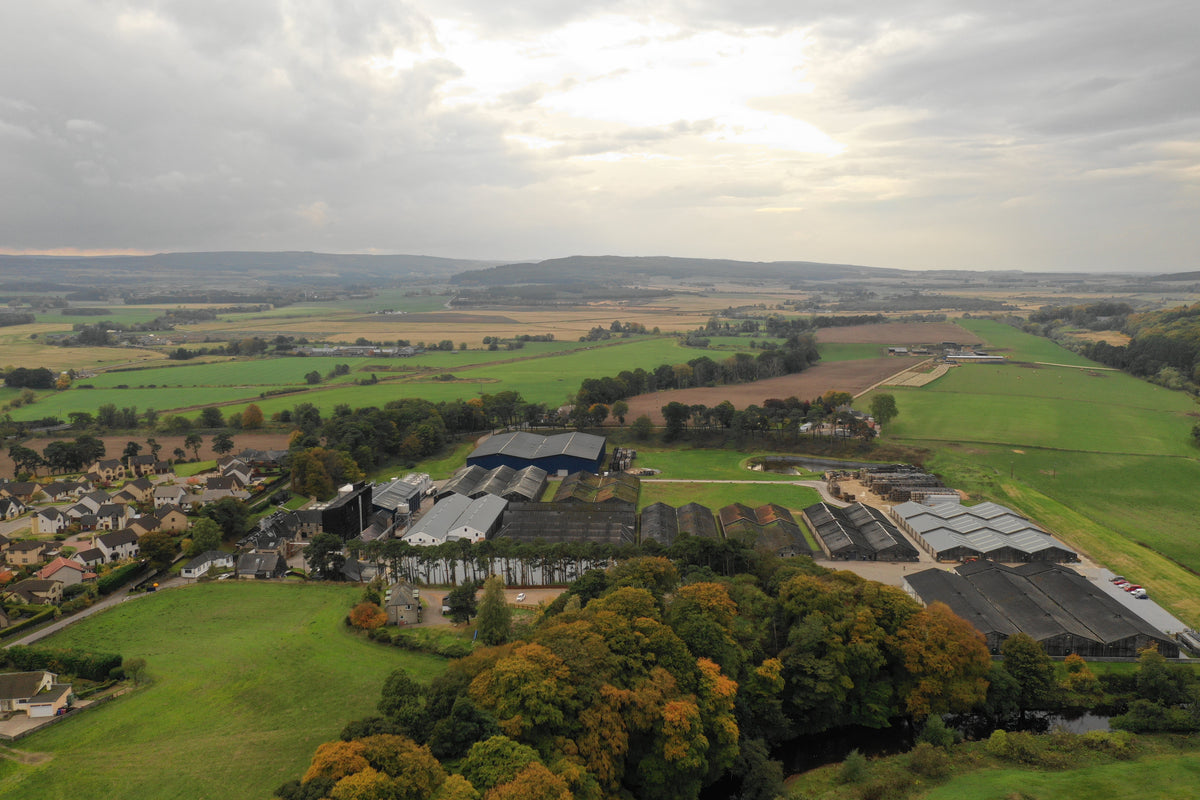
Glen Moray from above
Glen Moray is one of the few Speyside distilleries that sits inside a town rather than up a glen: our drone shows the whitewashed buildings tucked into a bend of the River Lossie on Elgin's western edge, with the warehouses fanning out across the flood plain. From the air you can see just how much the site has grown since its brewing days.
History of Glen Moray
Glen Moray did not start as a distillery at all. From the 1820s the site on the banks of the Lossie housed Elgin's West Brewery, and it was only in 1897, at the very peak of the Victorian whisky boom, that the brewery was converted into a distillery with a pair of stills. The timing could hardly have been worse. The Pattison crash of 1898 tipped the industry into a long slump, and Glen Moray struggled on until 1910 before falling silent.
Salvation came from the north. Macdonald & Muir, the Leith firm behind Glenmorangie, bought the mothballed distillery around 1920 and restarted it in 1923. For the next eight decades Glen Moray and Glenmorangie were sister distilleries, and Glen Moray's soft, easy-drinking malt did the unglamorous work: filling the firm's blends and, from the 1970s, serving as the value single malt alongside its more famous Highland sibling. The 1958 rebuild brought the still count to four and added a Saladin box maltings, one of the earlier mechanical malting systems in Speyside, which kept the distillery in home-made malt until it was decommissioned in 1978.
When LVMH bought Glenmorangie's parent company in 2004, Glen Moray did not fit the luxury story, and in 2008 it was sold to La Martiniquaise, the French spirits group behind Label 5 and Glen Turner. It is easy to read that as a demotion. It was the opposite. As La Martiniquaise's only malt distillery in Scotland at the time, Glen Moray became the engine of its Scotch business, and the new owner has invested almost continuously since: new washbacks, a new mash tun in 2016, the stillhouse roof lifted off in 2017 to crane in extra stills and condensers, and further expansion since. A distillery that made around two million litres a year at purchase now has its capacity quoted at as much as nine million, with a reported 120,000 or so casks maturing on site. In 2022 it celebrated its 125th anniversary as one of the busiest distilleries in the region.
How Glen Moray makes its whisky
Glen Moray's spirit is designed to be generous. The stills are shorter and squatter than the Speyside norm, with fairly flat lyne arms, so the distillery keeps more of the heavier, richer alcohols in its new make rather than stripping the spirit back to something austere. Fermentation is unhurried, at around 60 hours in a bank of stainless steel washbacks, most of them standing outdoors, and the water comes from the River Lossie beside the site. The river gives as well as takes: its low-lying flood plain has put the warehouses under water more than once, but the riverside setting is also credited with a slightly milder, more humid microclimate that suits slow maturation.
The malt is overwhelmingly unpeated, though since 2010 the distillery has run a small heavily peated campaign most years, at around 50ppm, a few percent of total production that goes into its smoky expressions and the occasional independent cask. Maturation leans hard on first-fill American oak, which is where the house butterscotch and vanilla come from. And then there is the cask experimentation. Glen Moray was bottling "Chardonnay-mellowed" whisky in 1999, before wine finishing had a vocabulary, and the warehouses have since held Port, Oloroso, Sauternes, Barolo, Tokaji and Amarone casks among many others. Few distilleries at any price point have tried more cask types, which makes Glen Moray a fascinating name for anyone interested in what different casks actually do to a spirit.
What does Glen Moray taste like?
Soft is the word that follows Glen Moray around, but it undersells the whisky. From ex-bourbon casks the malt gives orchard fruit, melon and citrus peel over barley sugar, vanilla and a distinctly buttery, shortbread-like sweetness. There is usually a light grassy freshness in younger whisky that deepens into honey and baking spice with age. It is an approachable style, which is why the core range, at 10, 12, 15, 18 and 21 years old, has built its reputation on value, and why the wine-cask and peated releases can be so striking: the gentle spirit is a blank canvas that lets an ambitious cask speak clearly.
The awards shelf backs this up. A 1994 Sherry Cask Finish took Best Speyside Single Cask at the 2018 World Whiskies Awards, and the distillery's limited releases regularly outperform their modest prices in blind judging. Most of the make, though, still disappears into Label 5 and Glen Turner, La Martiniquaise's big blended Scotch and malt brands, which is one reason single casks of Glen Moray circulate so freely.
Glen Moray and independent bottlers
Glen Moray is a fixture of the independent scene, and the reasons are structural. The distillery produces a lot of spirit, much of it destined for blending, and its casks have long moved through the broker market at sensible prices. Gordon & MacPhail, up the road in Elgin, have bottled it for generations, and most serious independents have had a Glen Moray on their list at some point. For drinkers this is excellent news: independent bottlings, usually at cask strength from single first-fill bourbon casks, show a punchier, more textured Glen Moray than the gentle official 40% releases, and they rarely cost silly money. In that respect it sits alongside neighbours like Linkwood and Miltonduff: Elgin-area malts whose best advocates are often the bottlers who never built the brand.
The Single Cask and Glen Moray
We have bottled Glen Moray twice, and both casks made the case for drinking this distillery at full strength. The first was cask 5742, an 11 year old from a bourbon hogshead, bottled at a cask strength of 61.4% for our Signature Series with an outturn of 208 bottles. It opened soft and sweet, with melon, orange zest and wood shavings on the nose, then turned spicier on the palate, nutmeg amongst sawdust, fruit peels, potpourri and refresher bars, before a finish we could only describe as reminiscent of a well-made Old Fashioned.
Its sister, cask 5735, was a 10 year old from a first-fill ex-bourbon cask at 60.0%, just 142 bottles. This one was Glen Moray with the American oak turned up: intense bourbon notes and rose water on the nose with barley sugar and floral touches, a sweet, malty, gristy palate with lime, a touch of kiwi and something tropical underneath, and a medium-to-long finish of cinnamon, nutmeg, oak and malt. Both bottlings sold through, which tells its own story about how cask-strength Glen Moray is received once it is actually in a glass. We would happily bottle it again, and casks from this distillery do come our way; if you want first refusal on the next one, it is worth getting in touch.

Collectability and cask ownership
Glen Moray is not a name that ignites bidding wars, and that is precisely its virtue. At auction, official bottlings change hands at drinker-friendly prices, with only the older vintages and unusual finishes attracting a premium. Nobody buys Glen Moray to flip it; they buy it to open it, which keeps the market honest.
For cask ownership the same logic applies, with real advantages. Because so much spirit is laid down and casks do circulate, Glen Moray is one of the more attainable Speyside names for private buyers, and its dependable, cask-friendly spirit gives an owner genuine options at bottling time, from classic bourbon-barrel maturation to a wine-cask finish in the distillery's own experimental tradition. The fundamentals still apply in full: whisky cask ownership is unregulated, values can go down as well as up, storage and insurance cost money every year, and nothing in this article is financial advice. Provenance and paperwork matter more than promises, so start by understanding cask sizes and types and deal only with sellers who will show you the documents.
Visiting Glen Moray
Glen Moray is one of the easiest Speyside distilleries to visit, because it is one of the few you can walk to from a town centre. The distillery sits on Elgin's western edge, a short stroll from the high street, and the visitor centre runs tours and tastings year-round as a stop on Scotland's Malt Whisky Trail. Tours are good value, the tasting range is broad thanks to all that cask experimentation, and Elgin itself, with its ruined cathedral and its whisky-merchant heritage, makes a natural base for a Speyside trip. Most of the region's famous names, from Glen Elgin to Benrinnes, are within an easy drive.
Glen Moray FAQs
Who owns Glen Moray?
Glen Moray has been owned by La Martiniquaise, the French spirits group behind the Label 5 and Glen Turner brands, since 2008. Before that it spent the best part of a century with Macdonald & Muir and its successor Glenmorangie plc, and briefly with LVMH.
What does Glen Moray taste like?
Soft, sweet Speyside: melon and orchard fruit, vanilla, barley sugar and a buttery, shortbread note from first-fill American oak. Wine-cask finishes add richer dried fruit and spice, and the occasional peated release wraps the sweetness in smoke.
Is Glen Moray peated?
Mostly not. The house style is unpeated, but since 2010 the distillery has distilled a small heavily peated batch, at around 50ppm, in most years. It appears in official smoky expressions and occasionally as independent single casks.
Can you visit Glen Moray distillery?
Yes. The distillery is on the western edge of Elgin, walkable from the town centre, and its visitor centre offers tours and tastings all year as part of Scotland's Malt Whisky Trail.
Which blends use Glen Moray whisky?
Most Glen Moray goes into La Martiniquaise's blends, principally Label 5, one of the world's bigger blended Scotches, and the Glen Turner malt brand. Historically it also supplied the blends of Macdonald & Muir, including Highland Queen.
Can I buy a cask of Glen Moray?
Realistically, yes. Glen Moray casks circulate through the broker market more freely than most Speyside names, which makes it a sensible starting point for private cask ownership. As always, verify provenance and paperwork through a reputable specialist before committing.
Own a piece of Glen Moray
Glen Moray is the working drinker's Speyside: honest spirit, adventurous casks and prices that have not yet caught up with the quality. Both of our own bottlings sold out, and we expect the next one to do the same, so if this guide has put the distillery on your radar, the logical next step is a cask of your own. The Single Cask helps clients buy whisky casks with verified provenance, store them in our bonded warehouse and bottle them under their own label when the whisky is ready.
Read first, buy second: our guides set out the costs and the risks in plain English, and when you are ready for a straight conversation about owning a cask of Glen Moray or any other Speyside malt, contact us.
Work with The Single Cask
Buy a whisky cask, bottle under your own label, or store casks in our HMRC approved bonded warehouse in Fife.
Read more

Tobermory Distillery: One Island, Two Whiskies
One distillery, two whiskies: unpeated Tobermory and heavily peated Ledaig, made on Mull's colourful harbour front since 1798. Our guide covers the history, the S-shaped stills, what both malts tas...
Read more
Macduff Distillery: The Blend's Best-Kept Secret on the Moray Coast
Macduff makes millions of litres a year for William Lawson's blend and barely sells any of it under its own name. Here is the full story, how the whisky is made on its unusual five stills, and hone...
Read more


