
Article: Glenglassaugh Distillery: The Moray Coast Malt That Keeps Starting Over
Glenglassaugh Distillery: The Moray Coast Malt That Keeps Starting Over
Glenglassaugh sits on the Moray Firth coast between Sandend and Portsoy, close enough to the sea that storms have genuinely shaped how the place works. It is usually filed under the Highland region rather than Speyside, even though it is barely a few miles from the Speyside boundary, and that slightly awkward geography suits a distillery whose whole history has been a run of false starts, rescues and second chances.
If you ask around the trade why Glenglassaugh matters, the answer is rarely the whisky alone. It is the story: a distillery that has been closed more often than it has been open, bought and sold by everyone from a Victorian grain merchant to an American spirits giant, and currently working to a reduced schedule again while it waits out a quiet patch in the industry. For independent bottlers and cask buyers, that history has direct, practical consequences for what stock actually exists and who controls it.
Glenglassaugh at a glance
| Region | Highland (Moray coast) |
| Location | Sandend, near Portsoy, Aberdeenshire |
| Founded | 1875 |
| Owner | Brown-Forman Corporation, since 2016 |
| Status | Working distillery, currently on a reduced production schedule since January 2025 |
| Stills | 1 wash still, 1 spirit still |
| Capacity | Around 1,000,000 litres of pure alcohol a year at full production |
| Spirit style | Mostly unpeated, with peated runs at certain times of year |
| Visitor access | Yes, visitor centre open year round on weekdays, weekends in summer |

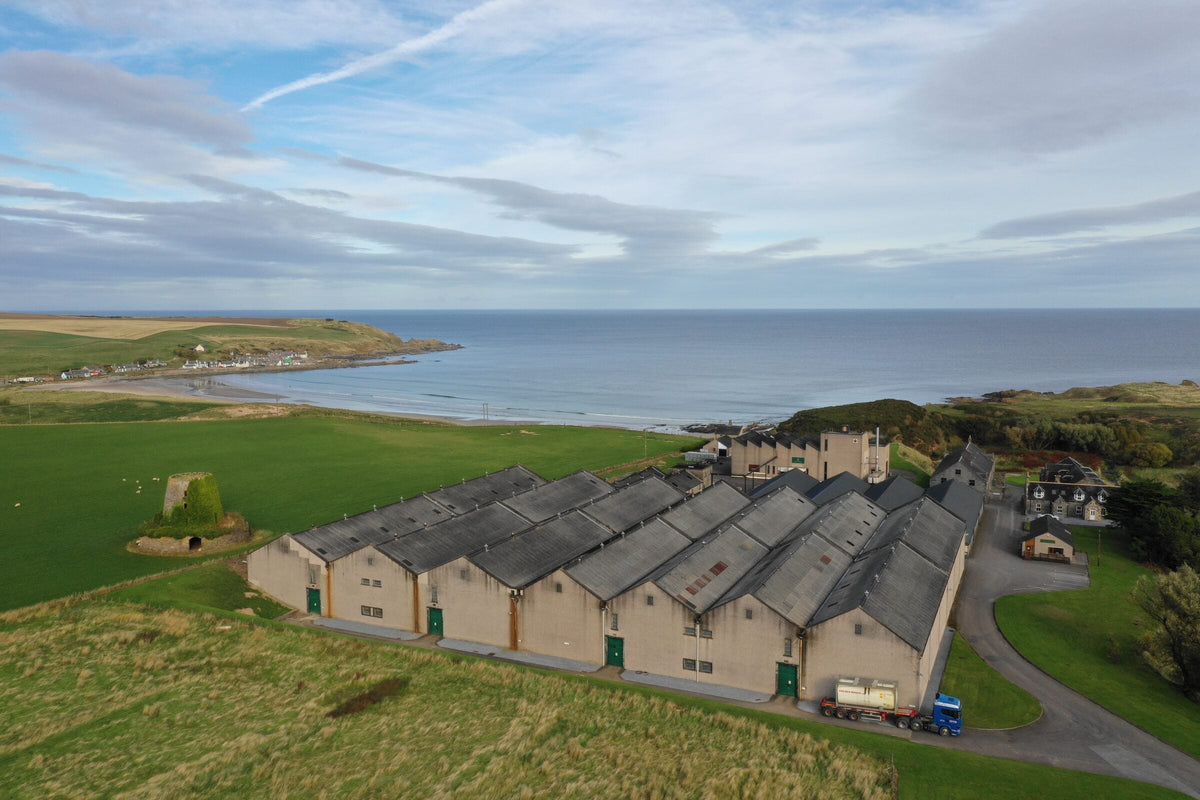
Glenglassaugh from above
Seen from the air, Glenglassaugh's small scale is obvious straight away: a tight cluster of distillery buildings and warehousing set hard against the Moray coastline, with the sea itself part of the picture rather than a backdrop. It is a useful reminder of just how modest this site is physically, for a distillery with such a long and complicated history behind it.
History
Glenglassaugh was founded in 1875 by the local businessman James Moir, working with family and investment partners, on a site chosen for its spring water and its closeness to the Moray coast barley country. It was a sound enough business from the start, but the twentieth century treated it roughly. The distillery closed in 1907, barely a decade after routine production had settled down, and spent most of the next fifty years silent. There was a brief reopening in the 1930s before it shut again, and it was not until 1960 that Glenglassaugh returned to continuous production.
That run lasted until 1986, when Highland Distillers, the group that had owned Glenglassaugh since the 1890s, mothballed it during the downturn that closed so many Scottish distilleries in that decade. Highland Distillers later became part of the Edrington Group, whose attention and investment went mainly to its bigger names, Glenglassaugh included among the sites it simply left standing. It stayed closed for twenty two years.
The distillery's modern story begins in 2008, when a private investment group bought the site and brought in Stuart Nickerson, a former Highland Distilleries and Glenmorangie manager, to oversee its revival. Glenglassaugh reopened on 24 November 2008, with the then First Minister Alex Salmond on hand to mark the occasion, and the new owners did something unusual for a distillery this size: rather than waiting years for stock to mature before selling anything, they sold individual casks directly to private buyers almost from day one. It is a decision that still shapes who holds Glenglassaugh stock today, and it helped the business turn a profit within three years of reopening, four years ahead of its own schedule.
In 2013 Glenglassaugh was sold again, this time to the BenRiach Distillery Company, the business built by whisky veteran Billy Walker around BenRiach and GlenDronach. Walker's group ran all three distilleries together for three years before selling the whole portfolio to Brown-Forman, the American drinks group behind Jack Daniel's, in a deal worth around £285 million in 2016. Brown-Forman has owned Glenglassaugh ever since, alongside its sister sites BenRiach and GlenDronach.
Most recently, in January 2025, Brown-Forman announced it was pausing production at Glenglassaugh as part of a shared schedule with BenRiach, citing a wider slowdown across the whisky industry. The company was clear that this was not a closure. Management described it as alternating "periods of production alongside occasional silent seasons" rather than a shutdown, and said operations were expected to pick back up before the end of 2025. We have not been able to confirm from public sources exactly where that schedule stands as this guide is being written, so treat the current production status as the most recently confirmed position rather than a live fact, and expect it may have moved on since.
Production
Glenglassaugh draws its process water from the Glassaugh Spring on site, a resource the distillery has relied on since 1875. The mash tun is a traditional open, rake and plough design rather than one of the enclosed, pressure-sealed tuns more common at newer or larger distilleries, and fermentation runs in six washbacks, four of them the original wood and two stainless steel added during a 1966 refurbishment, each holding around 43,000 litres. Fermentation itself is long by industry standards, a minimum of 60 hours using Mauri pressed yeast, which gives the wash more time to develop the fruity character the whisky is known for before it ever reaches the stills.
Spirit comes off a single pair of stills, one wash and one spirit, both boil ball shaped and on the smaller side: 17,200 litres and 12,700 litres respectively. That is a modest setup for a distillery with ambitions beyond its own visitor centre, and it caps Glenglassaugh's realistic output at around a million litres of pure alcohol a year even when running flat out. The malt is mostly unpeated, sourced from maltsters including Crisps, Boort and Bairds, though the distillery also runs peated spirit at specific points in the year using malt above 30 parts per million phenols, giving it a genuine smoky variant alongside its usual style. Unpeated new make comes off the still at around 69% ABV. Matured whisky is typically described as medium weight and fruity, with a honeyed, floral character that comes through clearly in the distillery's own core range.

Cask policy has shifted with ownership. The current core range, relaunched in June 2023 around a flagship 12 year old, uses a mix of ex-bourbon and ex-sherry wood, with occasional special releases in more unusual finishes, including a 15 year old matured in Pedro Ximenez and Spanish wine casks. It is a broader cask programme than some of its single-style neighbours run, which in practice means Glenglassaugh's own flavour range is wider than a one-line description can really capture.
Glenglassaugh and independent bottlers
Glenglassaugh's relationship with the independent bottling trade is unusually layered, because it genuinely has two separate eras of stock in circulation. The first is the old material distilled before the 1986 mothballing, under Highland Distillers ownership. Vintages from the 1960s and 1970s have circulated through the independent bottling world for years, released by houses such as Duncan Taylor and Signatory among others, and they are now scarce, collectible and priced well beyond anything a new bottling project would normally budget for.
The second era is everything distilled since the 2008 reopening. This is where Glenglassaugh did something genuinely unusual for a distillery its size: rather than keeping all new production in-house, the 2008 owners sold individual casks directly to private buyers from very early on, a practice that predates most of the current wave of cask ownership marketing by several years. A meaningful amount of post-2008 Glenglassaugh stock is therefore not held by the distillery at all, but by private individuals and brokers who bought it directly, which means genuinely available casks do turn up, just not predictably and rarely straight from the distillery itself.
Layered on top of both of those is the January 2025 production pause. Even once it clears, a quieter production schedule at the distillery means less new spirit being filled in the near term, which can only tighten availability of younger stock further. Taken together, an independent bottler chasing a genuine Glenglassaugh cask today is usually choosing between rare, expensive older Highland Distillers era whisky, or working the broker and private-owner market for post-2008 stock, rather than buying straightforwardly from the distillery.
Glenglassaugh and The Single Cask
We do not currently hold a Glenglassaugh cask. Given how much of the distillery's post-2008 stock sits with private owners and brokers rather than the distillery itself, sourcing one would mean working that same secondary market, and we would only do that for a client with a specific reason to want this distillery by name rather than its general style.
What we can speak to directly is the kind of whisky Glenglassaugh makes: fruity, honeyed, coastal Highland spirit with real range across its bourbon and sherry cask releases. If that profile is what draws you rather than the name on the label, we hold and source Highland and Speyside stock with similar character regularly, matured properly, in bond, with full paperwork behind it.
Plan a bottling inspired by Glenglassaugh
Glenglassaugh itself is a genuinely difficult distillery to buy from directly right now, between its layered ownership history and its current reduced schedule. The more useful starting point for most independent bottlers is the profile: coastal Highland character, fruit forward, honeyed, with room to go either bourbon or sherry depending on what you want the finished whisky to say.
Our whisky casks available page shows genuine current stock, and our buy a whisky cask page explains how sourcing and ownership work when you buy directly from us rather than through a broker. For independent bottlers building a wider range, our independent bottling services cover sourcing, storage and bottling together, and if you are building something under your own name, our private label whisky page sets out how that process runs end to end. Everything matures in our own bonded warehouse here in Fife while you decide.
Worth reading alongside this guide: our GlenDronach distillery guide, Glenglassaugh's sister site under the same Brown-Forman ownership, our Macduff distillery guide, another working distillery on the same stretch of Moray coast, and our Highland whisky region page for the wider picture.
A general note on cask ownership: buying a whisky cask is not a regulated financial product, and nobody can honestly promise what a given cask will be worth once it is ready to bottle. Values move in both directions depending on the spirit, the cask and market conditions at the time, so read this guide, and anything else on cask ownership, as background rather than financial advice.
If you want to talk through Highland or coastal-style stock we do have available, or discuss sourcing, storage or bottling more generally, get in touch through our contact page and tell us what you are trying to achieve. We will give you a straight answer, including when that answer is that we cannot help with something specific.
Frequently asked questions
Can I buy a genuine Glenglassaugh whisky cask?
It is possible but not straightforward. Pre-1986 stock from the Highland Distillers era is scarce and expensive when it does appear through specialist bottlers. Post-2008 stock is often held by private buyers and brokers rather than the distillery itself, because Glenglassaugh sold casks directly to individuals from early in its 2008 revival. A genuine cask can turn up through either route, but rarely as a straightforward purchase from the distillery.
Is Glenglassaugh distillery still producing whisky?
Yes, but on a reduced schedule. Brown-Forman announced in January 2025 that Glenglassaugh would move to a shared production pattern with sister distillery BenRiach, alternating production periods with quieter spells, rather than closing outright. The company said it expected to resume fuller production before the end of 2025. We have not been able to confirm the current position from public sources, so treat this as the most recently confirmed status rather than live fact.
Why has Glenglassaugh closed and reopened so many times?
Mostly because of industry-wide conditions rather than anything specific to the site. It closed in 1907, briefly reopened in the 1930s, closed again, and did not return to continuous production until 1960. It then ran until 1986, when owner Highland Distillers mothballed it during that decade's broader downturn, and it stayed closed until a new ownership group reopened it in 2008. The 2025 production pause follows the same pattern of responding to wider market conditions rather than a problem unique to Glenglassaugh.
What does Glenglassaugh whisky taste like?
The house style is usually described as medium weight and fruity, with a honeyed, floral character that comes from the distillery's long fermentation and its coastal Highland setting. The current core range, built around bourbon and sherry cask maturation, also includes a peated variant made from malt treated at specific times of year, so the range covers more ground than a single flavour description suggests.
Can I visit Glenglassaugh distillery?
Yes. Glenglassaugh has run a visitor centre since 2012, open on weekdays year round and at weekends during the summer season. It is worth checking current opening times directly with the distillery before planning a visit, particularly while production is running to its reduced 2025 schedule.
What is a realistic alternative to a Glenglassaugh cask for an independent bottling?
Look at the profile rather than waiting for a named Glenglassaugh cask to surface. Fruity, honeyed Highland and coastal Speyside stock in a similar style is genuinely available, and we can talk through what is actually in bond now rather than what might eventually come up through a broker.
Work with The Single Cask
Buy a whisky cask, bottle under your own label, or store casks in our HMRC approved bonded warehouse in Fife.
Read more
Tamdhu Distillery: The Speyside Malt That Went All-In on Sherry
Tamdhu sits on the banks of the River Spey at Knockando, in the thick of Speyside's distillery country, but it looks slightly different from its neighbours the moment you see it from the air. There...
Read more


