
Macduff Distillery: The Blend's Best-Kept Secret on the Moray Coast
Ask most whisky drinkers to name a Macduff and you will likely get a blank look, yet the odds are good they have already tasted its spirit without knowing it. A large share of what comes off Macduff's five stills each year disappears into William Lawson's, one of the biggest-selling blended Scotches on earth. The distillery itself keeps a low profile, has no visitor centre, and sells its own single malt under a different name entirely. For anyone who wants to actually taste Macduff as Macduff, independent bottlers are close to the only route in, and we have been one of them three times over the years.
Macduff at a glance
| Region | Highland (Eastern Highlands), on the River Deveron where it meets the Moray Firth, opposite Banff |
| Founded | Built in 1959 to 1960 by a consortium of Glasgow whisky brokers during the industry's post-war expansion; distilling began in 1960 |
| Owner | John Dewar & Sons, part of Bacardi, since the early 1990s |
| Capacity | Around 4 million litres of pure alcohol a year |
| Stills | Five: two wash stills and three spirit stills, all with upward-tilting lyne arms that bend sharply at a right angle before reaching horizontal shell-and-tube condensers |
| Water source | A nearby spring and burn, drawn from the hills above the town |
| Fermentation | On the brisk side for a modern distillery, commonly quoted at somewhere between 55 and 68 hours depending on the source |
| Malt spec | Unpeated |
| Style | Nutty and slightly sulphury as new make, settling into a balanced fruitiness with age; sherry wood brings out dried fruit and dark sugar |
| Visitor centre | No, Macduff is not open to the public |
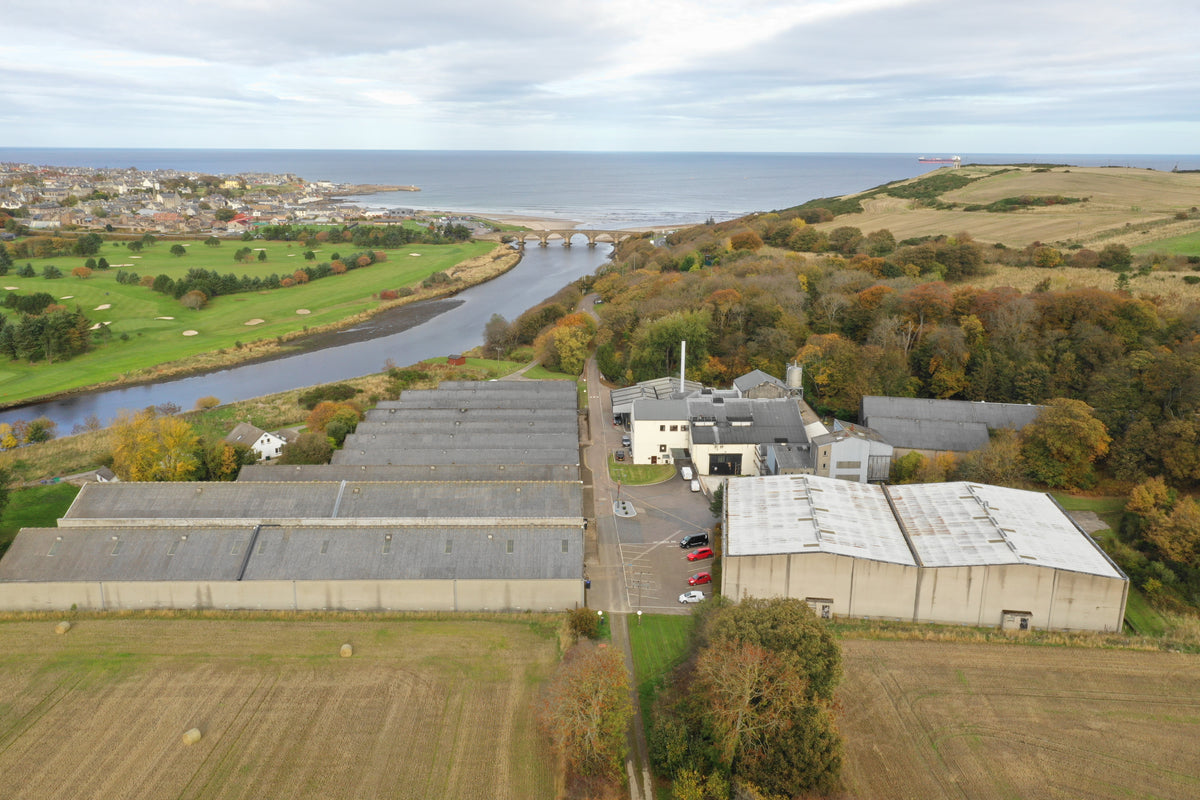
Macduff from above
Our drone flew Macduff on a day when the Deveron was running high and the tide was out on the Moray Firth beyond it, which is about as good as this stretch of coast gets for showing off a working distillery with no gates open to visitors. There is something to be said for filming a site that almost nobody outside the trade ever sees from ground level, let alone from the air, and our footage is probably the closest most people will get to Macduff's stillhouse and warehouses.
History
Macduff went up in 1959 and 1960, one of a wave of new distilleries built as the Scotch whisky industry expanded to meet growing demand for blends in the post-war decades. It was the work of a consortium of Glasgow whisky brokers rather than an established distilling family, a common pattern for that generation of builds, and production started in 1960 with a modest pair of stills. The site was chosen for practical reasons: a fishing town on the Moray coast with good transport links, a river for cooling water, and enough space beside the Deveron to grow.
And grow it did. A third still was added within a few years, taking Macduff to two wash and two spirit stills by the mid-1960s, and a fifth still arrived in 1990, giving the distillery its present configuration of two wash stills and three spirit stills. That five-still layout is unusual. Talisker is the only other distillery in Scotland to run the same split of two wash to three spirit, and Macduff's stills carry their own signature quirk on top of that: lyne arms that rise and then kink sharply to a right angle before reaching the condensers, a shape that is not quite replicated anywhere else.
Ownership has changed hands more often than the stillhouse has. The original brokers sold on in the early 1970s, and the distillery passed through William Lawson Distillers under the Italian drinks group Martini & Rossi, then through a further change of corporate parent in the 1980s, before Bacardi bought the business in the early 1990s. Macduff has operated under Bacardi's Scotch whisky arm, John Dewar & Sons, ever since, sitting alongside sister distilleries Aberfeldy, Aultmore, Craigellachie and Royal Brackla in a portfolio built mainly to feed Dewar's blends and William Lawson's.
That blending role is the real story of Macduff's modern history. William Lawson's has grown into one of the best-selling Scotch whisky blends in the world, and Macduff's fruity, malty new make is a significant part of what makes it work. The distillery's own single malt, by contrast, has spent decades as something of a side project, released under a different name so as not to compete for shelf space with the blend it feeds. It is a quietly unusual position for a 4-million-litre distillery to be in: hugely productive, commercially important, and almost invisible to the average whisky drinker.
How Macduff makes its whisky
Macduff uses unpeated malt, bought in rather than grown or floor-malted on site, which puts the emphasis squarely on fermentation and distillation to build character rather than on smoke. Process water comes from a spring and burn in the hills behind the town, and mashing takes place in a modern full-lauter tun, the equipment having been upgraded in recent years as part of wider investment across the Dewar's distilleries.
Fermentation is where things get interesting. Sources differ on the exact hours (anywhere from the mid-50s to the high 60s depending on when the figure was quoted), but it sits at the shorter end for a modern Scotch distillery, and short ferments tend to preserve cereal and nutty notes rather than pushing fermentation deep into the fruity esters that long ferments produce. That helps explain Macduff's reputation for a slightly nutty, occasionally sulphury character straight off the still, a trait new-make spirit shares with several other brisk-fermentation distilleries before maturation has a chance to work on it.
Distillation runs through those five idiosyncratic stills, with the wash stills charged at around 20,000 litres and the spirit stills a little larger. The right-angled kink in each lyne arm creates extra turbulence and copper contact compared with a smooth, gently rising arm, and the horizontal shell-and-tube condensers that follow do a similar job to worm tubs in giving the spirit a slightly weightier, less overtly floral character than distilleries that condense with simple vertical coils. The combination is part of why Macduff's new make needs time in wood to really open up: it starts out relatively closed and needs sherry or active oak to draw out the fruit that lies underneath the nuttiness.
What does Macduff taste like?
Young or in refill wood, Macduff tends toward nutty and malty, with brown sugar, marzipan and vanilla, and a texture that some tasters describe as a little austere or reticent, particularly in the official Deveron range at standard strength. It is not a shy flavour once it has had proper time and active cask influence, though. In good sherry wood the nuttiness turns into something closer to dried fruit, raisin and stewed peach, with rancio, dark chocolate and baking spice building on top, which is exactly the profile several of our own casks have shown.
The official single malt is bottled today as The Deveron (previously Glen Deveron), released mainly as younger, ex-bourbon-led expressions built for easy, approachable drinking. Independent bottlers, working from older stock and more adventurous cask types, tend to show a different and generally more interesting side of the distillery, which is one reason Macduff has quietly built a following among cask-strength single malt enthusiasts even without much of a public profile.
Macduff and independent bottlers
Because so much of Macduff's output goes into William Lawson's and other Dewar's blends, and because the owner's own single malt line goes out under the Deveron name rather than Macduff, independent bottlers are effectively where the distillery's real single malt identity lives. Ranges built specifically around Macduff casks, including the long-running House of MacDuff and Golden Cask series, along with member-led outfits such as the Scotch Malt Whisky Society and collector-focused groups like the Malt Whisky Association, have released Macduff over the decades, often from older stock distilled in the 1970s and 1980s that shows the sherried, fruit-forward side of the distillery at its best.
The Scotch Malt Whisky Society has described Macduff as something of an unsung hero of the independent bottling world, which is a fair summary: it rarely gets the marketing budget or the mystique of the famous Speyside and Islay names, but the whisky itself, particularly from a well-chosen cask with a few decades on it, regularly outperforms its reputation. That gap between profile and quality is exactly the kind of thing independent bottlers exist to close.
The Single Cask and Macduff
We have bottled Macduff three times, and each cask told a slightly different part of the distillery's story. Our 8 year old from cask 800568, distilled in 2013 and matured in an Oloroso hogshead, showed how quickly sherry wood can work on young Macduff: sherried raisins and dark chocolate alongside wet leaves, sea salt, rancio, allspice and chewy malt on the nose, with stewed apricots and nutmeg building through the palate before a drying oak finish. It was bottled at a hefty natural cask strength of 63.5%, evidence that Macduff can carry serious ABV without falling apart.
Our 23 year old from cask 5233, distilled in 1997 and matured first in a refill bourbon hogshead before a secondary period in an Oloroso hogshead, went further down that sherried road: dulce de leche, toffee, peach liqueur, angelica root, coffee bean and sultana on the nose, then dried fruit, raisins and prunes on the palate with rich honey, white pepper and clove, finishing long, drying and full of stewed fruit. And our 19 year old from cask 5278, a first-fill ex-bourbon cask, took the opposite path: slightly herbal with sage and sea salt, sweetness from burnt marshmallow and strawberry, white pepper and violets on the nose, then red chilli spice against peaches and runny honey on the palate. Three casks, three genuinely different whiskies, all recognisably Macduff underneath.
All three are now sold out, which says something about how independent bottlings of this distillery tend to move once people taste them rather than judge them by name recognition. We do not currently hold a Macduff cask, but casks do reach the independent market from this distillery every so often, ours included, and we would happily bottle another if the right one came along.

Collectability and cask ownership
Macduff has never chased the auction headlines the way Macallan or Bowmore do, and it would be misleading to pretend otherwise. What it has instead is a steady, genuine following among people who buy whisky to drink and share rather than to speculate on, built cask by cask through independent bottlers over several decades. Older single casks from the 1970s and 1980s do turn up at auction and through specialist independent ranges from time to time, generally trading as good, honestly priced whisky rather than as trophy bottles.
That makes Macduff a sensible name to know if you are thinking about cask ownership away from the famous, heavily marked-up distilleries. It is worth being clear, though, that cask ownership of any distillery involves genuine risk. Values can go down as well as up, storage and insurance cost money every year the cask sits in bond, and whisky can only ever legally be sold as whisky. None of this is financial advice, and anyone weighing up a cask, from Macduff or anywhere else, should read our plain-English guide to cask sizes and types and take independent advice before committing any money.
Macduff FAQs
Who owns Macduff distillery?
Macduff is owned by John Dewar & Sons, the Scotch whisky arm of Bacardi. Bacardi acquired the distillery in the early 1990s, and it now sits alongside sister distilleries including Aultmore, Craigellachie and Royal Brackla.
Why is Macduff sold as The Deveron?
The distillery's owner releases its official single malt under the name The Deveron (formerly Glen Deveron) rather than Macduff, largely to keep it distinct from the Macduff name used in blending and by independent bottlers. Whisky labelled Macduff on a shelf will almost always be an independent bottling rather than an official release.
How many stills does Macduff have?
Five: two wash stills and three spirit stills, a configuration shared with only one other Scottish distillery, Talisker. Macduff's stills also have a distinctive kinked lyne arm design not found elsewhere.
What does Macduff whisky taste like?
New make and younger Macduff tends to be nutty and malty with brown sugar and vanilla. With age, particularly in sherry wood, it develops into dried fruit, rancio, dark chocolate and baking spice, a profile our own casks have shown clearly.
Can you visit Macduff distillery?
No. Macduff has no visitor centre and is not open to the public, which is part of why independent bottlings and footage like ours are one of the few ways to get a real sense of the place.
Can you buy a cask of Macduff?
Occasionally. Macduff casks reach independent bottlers from time to time rather than constantly, and we have bottled three ourselves over the years. We do not hold one at the moment, but contact us and we will give you an honest view of what is realistically available.
Plan a bottling inspired by Macduff
We will not pretend a Macduff cask is sitting ready for you today, because it is not, our own three have long since sold out and we do not currently hold one. What we can say honestly is that Macduff casks do surface for independent bottlers from time to time, ourselves included, and older stock from the 1970s and 1980s in particular continues to circulate through specialist ranges and auctions. It is not a common cask to find, but it is not one that never appears either.
If you like the idea of a nutty, sherry-friendly Highland malt from a distillery most people have never heard of, that is exactly the kind of project we can help plan properly, whether or not a genuine Macduff cask happens to be available when you come to us. Tell us the flavour or distillery style you are after, roughly how many bottles you need, your approximate budget, and when you would like to bottle by. Let us know too whether this is for a drinks brand, a retailer, a hospitality venue, a company gift, a whisky club, an event or simply your own private bottling, and whether you will need help with naming, label design, bonded storage or the bottling run itself.
From there we can come back with an honest view of what is actually available, including from sister distilleries like Aultmore, Craigellachie and Royal Brackla if a comparable but easier-to-source cask suits your project better than waiting on Macduff itself. We can also give you a realistic bottle yield, walk through the main costs and stages involved, and set out a practical route from choosing a cask to holding finished bottles in your hand. Our guide to the four steps to bottling your own whisky is a good starting point, our page on private label whisky covers projects built around your own brand, and our independent bottling services page explains how we handle everything from cask to label. When you are ready, get in touch and tell us what you have in mind.
Work with The Single Cask
Buy a whisky cask, bottle under your own label, or store casks in our HMRC approved bonded warehouse in Fife.
Read more
Glen Moray Distillery: The Wine Cask Pioneer on Elgin's Gallows Hill
Glen Moray guide: the Elgin brewery that became Speyside's great experimenter — gallows-hill history, Chardonnay-cask pioneering, La Martiniquaise's expansion, what it tastes like, our own cask-str...
Read more
Aberlour Distillery: History, Casks & Whisky
Aberlour is one of Speyside's most sherry-driven distilleries, and one of the least visible by name. We look at its history, its sherry cask policy, the two independent casks we've bottled ourselve...
Read more


