
GlenDronach Distillery: The Valley of the Brambles and the Sherry Cask
Every spring the rooks come back to the trees around GlenDronach, and legend has it that when they leave for good the distillery will close. They have not left yet, and the distillery has been making dark, sherry-soaked Highland malt in the valley of the brambles for two hundred years, through a fire, a bankruptcy, six years of silence and more changes of owner than most of us have had cars. It was one of the very first distilleries to take out a licence after the 1823 Excise Act, and it was the last in Scotland to give up firing its stills with coal.
We have not bottled GlenDronach, and we will explain why: casks of it almost never leave the owner's warehouses. What follows is a guide to one of the great sherried malts of Scotland, what makes it taste the way it does, and what that means if you love this style and are thinking about a bottle, or a cask of your own.
GlenDronach at a glance
| Region | Highland, near Forgue by Huntly, Aberdeenshire |
| Founded | 1826 by James Allardice and a partnership of local farmers |
| Owner | Brown-Forman (via The BenRiach Distillery Company) since 2016 |
| Capacity | Around 1.4 million litres of pure alcohol a year |
| Stills | Four: two wash and two spirit, onion-shaped with tall necks; coal-fired until 2005 |
| Water source | The Dronac burn, which runs through the distillery grounds |
| Fermentation | Long, typically quoted at 60 hours or more, in wooden washbacks |
| Malt spec | Unpeated (under 2 ppm); the old floor maltings once produced lightly peated malt |
| Style | Rich, full-bodied, sherried Highland: dried fruit, dark chocolate, walnut, spice |
| Visitor centre | Yes, tours, tastings and hand-fill bottling |

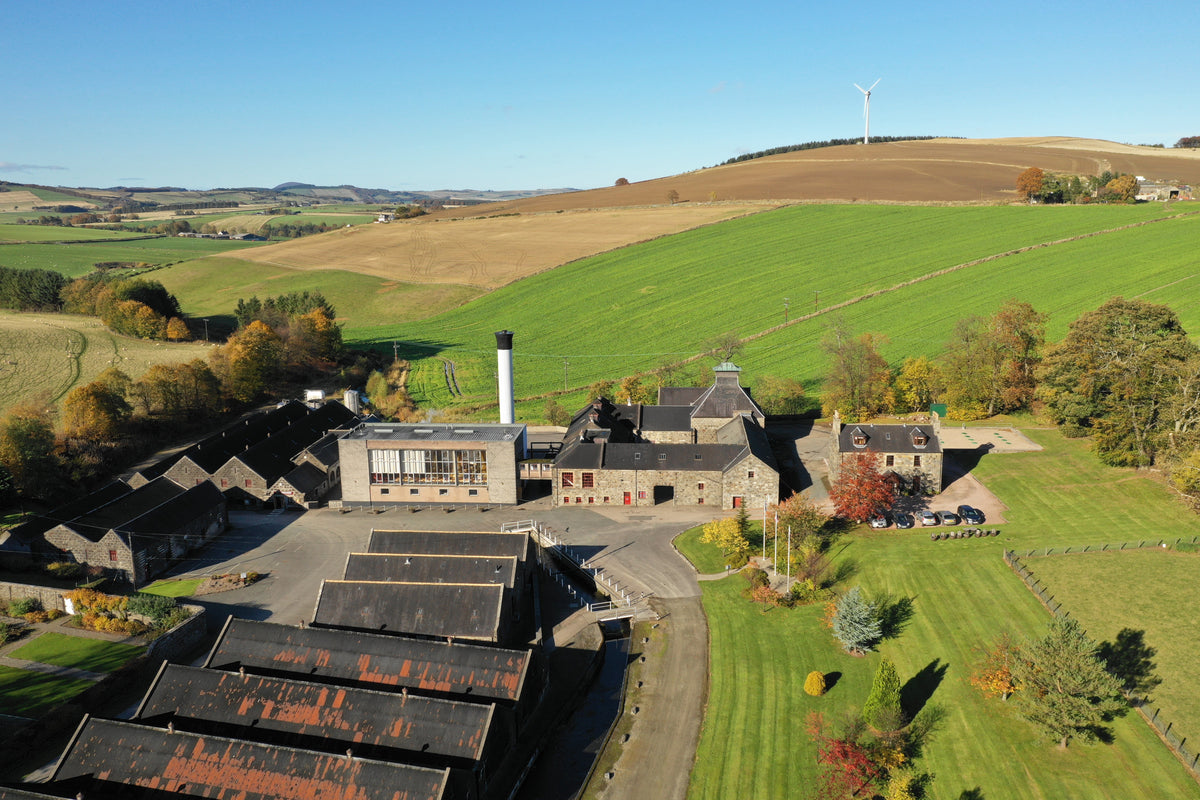
GlenDronach from above
GlenDronach sits low in its wooded valley, a huddle of grey stone, pagoda and courtyard that could pass for a farm steading, which is what much of it once was. Our drone flew over the site to show how the old maltings, warehouses and Boynsmill House fit together along the burn.
History of GlenDronach
James Allardice was a farmer with a taste for the finer things, and in 1826, three years after the Excise Act made legal distilling worthwhile, he and a group of neighbouring farmers took out one of the earliest licences in Scotland and built a distillery beside Boynsmill House, a laird's house dating from 1771 on the Dronac burn. The name is Gaelic, gleann dronach, the valley of the brambles. Allardice was a showman as well as a distiller. The story every guide tells, and which is too good to check, is that he took his Guid GlenDronach to Edinburgh, failed to sell a drop to the city's publicans, and gave the rest away to the women of the Canongate, who created such a thirst for it in the taverns that the orders followed him home. True or not, the whisky did reach London early and sold well.
Fortune did not last. A fire in 1837 destroyed much of the distillery, and Allardice went bankrupt in 1842. Walter Scott, formerly of Teaninich, took the distillery on and rebuilt it, and by 1862 GlenDronach was reportedly the largest duty-paying distillery in the Highlands. Scott ran it until his death in 1887, when a Leith consortium took over, and after a spell in government hands during the First World War it was bought in 1920 by Captain Charles Grant, son of William Grant, the founder of Glenfiddich. The Grants kept it for forty years.
In 1960 GlenDronach was sold to William Teacher & Sons, who needed a robust malt for their Highland Cream blend and doubled the still count from two to four in 1966 to get it. Teacher's ran the site the old way: floor maltings, coal-fired stills, and a heavy commitment to sherry wood, which is where the modern reputation of the whisky was made. Teacher's was absorbed into Allied in 1976, and Allied opened a visitor centre the same year and later gave GlenDronach a place in its Caledonian Malts range. But blends were struggling by the mid-1990s and in 1996 the distillery was mothballed. It stayed silent for six years, and the floor maltings never reopened.
Production resumed in 2002. When Allied was broken up in 2005, GlenDronach passed to Chivas Brothers, part of Pernod Ricard, who did the sensible and slightly sad thing and converted the stills from coal to steam heating, ending a tradition that had outlasted every other distillery in Scotland. Three years later Chivas sold it on, and this is where the story turns. The buyer in 2008 was The BenRiach Distillery Company, led by Billy Walker, Colin Scott and Wayne Kieswetter, who had already revived BenRiach. Walker found warehouses full of long-forgotten sherry casks and did what a good independent does with them: bottled them, at natural strength, one cask at a time. The single-cask batches and the relaunched core range of 12, 15, 18 and 21 year olds turned GlenDronach from a Teacher's workhorse into one of the most sought-after sherried malts on the planet.
The success attracted a bigger buyer. In 2016 Brown-Forman, the American owner of Jack Daniel's, bought The BenRiach Distillery Company and its three distilleries, GlenDronach, BenRiach and Glenglassaugh, for around £285 million. Rachel Barrie was appointed master blender in 2017, and the distillery has since expanded its visitor centre and, in 2024, redesigned its bottle. The rooks, so far, are still in the trees.
How GlenDronach makes its whisky
GlenDronach is a small distillery by modern standards, around 1.4 million litres a year, and it looks its age. Water is drawn from the Dronac burn that runs through the grounds. The mash tun is a traditional rake-and-plough type of about four tonnes, and the wort ferments in wooden washbacks for a long time, quoted at anywhere from 60 hours upwards, which builds the fruity, estery base the sherry casks later work on. The malt is bought in unpeated at under 2 ppm; the old floor maltings, kilned with coal and a little peat, gave the pre-1996 spirit a faint smokiness that older bottlings still carry.
Four stills, two wash and two spirit, are onion-shaped with tall necks and reflux bowls, and until 2005 they were heated by coal fires beneath the pots. Direct firing scorches the wash slightly and produces a heavier, more robust spirit; steam coils are gentler and more consistent. Rachel Barrie and her team have worked to keep the new make as full-bodied as it was, and the character of GlenDronach spirit remains rich and malty, an ideal foundation for the wood policy that defines it.
That policy is simple to state and expensive to run: sherry casks, first and foremost, from Spain. Oloroso butts and puncheons for depth and dry fruit, Pedro Ximénez for sweetness and treacle, with ex-bourbon in a supporting role in some expressions. GlenDronach has six warehouses on site, three dunnage and three racked, and its stock of long-aged sherry casks is one of the most valuable inventories in the Highlands.
What does GlenDronach taste like?
Think of a Christmas cake made by someone who has not stinted on the brandy. GlenDronach at 12 years old (the Original) is dried fruit, sultanas and figs, dark chocolate, walnut, a little tobacco and warm ginger, with a chewy, oily weight from the spirit underneath. The 15 Revival, matured in oloroso and PX, is darker and more raisined, with prunes and dark honey and a savoury, almost leathery edge; the 18 Allardice, from oloroso alone, is drier, all walnut, tobacco and cocoa; the 21 Parliament, named after the rooks, adds polished oak, blackcurrant and a long, spiced finish. The cask-strength batches show the same fruits at full volume with a peppery kick.
Very old GlenDronach, the kind that came out of Billy Walker's single-cask batches from the 1970s, 1980s and early 1990s, is something else again: dense, tarry, mahogany-coloured, with the faint smoke of the old floor maltings still detectable behind the fruit. Sulphur, the bugbear of some sherried whiskies, is generally well controlled here, which is one reason the distillery has such a loyal following among lovers of the style. Fans of The Macallan and Glenfarclas usually find GlenDronach a natural third.
GlenDronach and independent bottlers
Independent GlenDronach exists but is rare. In the Teacher's and Allied years, casks did trade, and older bottlings from Gordon & MacPhail, Cadenhead's, Signatory and a few others turn up at auction. Since 2008, however, the distillery has effectively been its own independent bottler: single casks are released by the distillery under its own batch programme, and very little spirit is sold to brokers or blenders. Under Brown-Forman that grip has, if anything, tightened, since sherried single malt is precisely what the owner bought the distillery to sell.
The practical result is that GlenDronach casks almost never appear on the open market, and when the occasional parcel does surface it commands a premium and is usually spoken for quickly. This is not a distillery whose spirit you can plan to buy new-make from, unlike blending malts such as Teaninich or Blair Athol, where the owners fill casks for others as a matter of routine.
The Single Cask and GlenDronach
We have never bottled a GlenDronach, and we would rather tell you why than pretend otherwise. Our model is to buy casks we can taste, mature and bottle at natural strength under our own label, and GlenDronach casks simply do not come to market in the way that, say, Ben Nevis or Craigellachie casks do. The distillery bottles its own single casks, and its owner keeps the rest for the core range. On the rare occasions GlenDronach is offered on the secondary cask market, the asking price tends to reflect the name on the cask rather than what is in it, and that is not a trade we are comfortable passing on to our customers.
What we can offer instead is honest advice. If you love the GlenDronach style, the deep, sherried, dried-fruit Highland malt, there are casks we can source that will get you a long way there: sherry-matured Highland and Speyside spirit from distilleries whose owners do sell, filled into first-fill oloroso or PX and matured under our eye. Our own sherried single casks, such as the Craigellachie oloroso and PX octaves we have bottled, show what first-fill Spanish wood does to a robust spirit, and our guides to Dalmore and Ben Nevis explain how two other Highland heavyweights take sherry wood. We know which distilleries and which casks deliver it. If a GlenDronach cask ever does become available at a fair price, we will say so, loudly.
Collectability and cask ownership
GlenDronach is one of the most collected sherried malts in the world. The single-cask batches released between 2009 and the mid-2010s, particularly the 1971, 1972 and 1990s vintages, have appreciated strongly at auction, and complete batch collections are a serious pursuit. Older official bottlings from the Teacher's era, and the odd independent, also fetch strong prices. The core range, by contrast, is made to be drunk and priced accordingly, and the introduction of the 2024 bottle design has created a small collector interest in the last of the old-label stock. As with any collectable, values follow fashion and can fall as well as rise, and this is not financial advice.
Cask ownership is where GlenDronach is unusual. Because the distillery bottles almost everything itself, private ownership of a GlenDronach cask is close to impossible for most people, and any cask offered as GlenDronach deserves close scrutiny of its paperwork and provenance. If you are drawn to the style rather than the name, a sherry-matured cask from a distillery that does sell to independents is a far more realistic route, and our guide to cask sizes and types explains why a first-fill oloroso hogshead and a refill butt will take the same spirit to very different places. In all cases, cask ownership involves risk, values can go down as well as up, and it should be approached with the same care as any other significant purchase.
Visiting GlenDronach
GlenDronach is one of the best distillery visits in the north-east: small, old, unhurried and set in genuinely lovely countryside about ten miles east of Huntly. Tours cover the mash house, tun room and coal-blackened stillhouse and end in the warehouses; the shop offers hand-fill bottlings drawn straight from a cask, which are a good way to take home something you cannot buy elsewhere. Book ahead, and combine it with a drive north to Glenglassaugh on the coast or west into Speyside proper.
GlenDronach FAQs
Who owns GlenDronach distillery?
Brown-Forman, the American company behind Jack Daniel's, which bought The BenRiach Distillery Company and its three distilleries (GlenDronach, BenRiach and Glenglassaugh) in 2016 for around £285 million.
Is GlenDronach a Speyside or a Highland whisky?
Highland. The distillery lies near Forgue in Aberdeenshire, east of the Speyside boundary, although its style, especially the sherry maturation, has much in common with Speyside neighbours.
Is GlenDronach peated?
Not today. Modern GlenDronach uses unpeated malt. Before the floor maltings closed in 1996 the malt was lightly peated, which is why very old bottlings carry a faint smokiness.
Why is GlenDronach so sherried?
Sherry cask maturation has been the house policy since the Teacher's era, and it was doubled down on after 2008. Most releases are matured entirely in Spanish oloroso and Pedro Ximénez casks.
Can you visit GlenDronach?
Yes. The distillery has a visitor centre offering tours, tastings and hand-fill bottling, expanded in 2020.
Can you buy a cask of GlenDronach?
Very rarely. The distillery bottles its own single casks and sells almost nothing to independents. If you love the style, talk to us about sherry-matured casks from distilleries that do sell.
Own a piece of GlenDronach
GlenDronach shows what happens when a distillery is patient with sherry wood and honest about what it puts in the bottle. If that is the whisky you love, the best way to own a piece of it is a bottle from the range or, better, a hand-fill from the warehouse. And if what you love is the style, we can help you build it: a first-fill sherry cask from a Highland or Speyside distillery, matured under our care and bottled under your name.
If you would like to know what is realistically available, at what age and in what wood, read our page on buying a whisky cask and get in touch. We will give you a straight answer, including the honest news that GlenDronach itself is rarely one of the options.
Work with The Single Cask
Buy a whisky cask, bottle under your own label, or store casks in our HMRC approved bonded warehouse in Fife.
Read more
Miltonduff Distillery: The Speyside Malt at the Heart of Ballantine's
Miltonduff has spent two centuries making the clean, pear-scented Speyside malt at the core of Ballantine's, from a mill once owned by monks. Here is the full story: the blessed Black Burn, the Lom...
Read more
Craigellachie Distillery: Speyside's Meaty, Worm-Tub Maverick
Worm tubs, short fermentations and a sulphury new make that turns tropical with age: Craigellachie is the heavyweight of Speyside. We have bottled it many times, from bourbon casks to sherried octa...
Read more


