
Article: Royal Lochnagar Distillery: Whisky From Queen Victoria's Back Garden
Royal Lochnagar Distillery: Whisky From Queen Victoria's Back Garden
Royal Lochnagar is easy to overlook simply because of where it sits. The distillery is tucked into the hillside above the River Dee, less than a mile from Balmoral Castle, and for most of its life that royal neighbour has done more to define its reputation than its whisky has. It is also, by output, the smallest distillery in Diageo's entire portfolio, a single wash still and a single spirit still quietly turning out a fraction of what its Speyside stablemates manage before breakfast. We do not currently hold a cask from here ourselves. It is a distillery that produces so little, and keeps so much of that little for Johnnie Walker and its own small releases, that a genuine independent cask is a rare thing to find. That scarcity is exactly why it is worth understanding properly, both for what it tells you about how a tiny distillery survives inside a giant drinks group, and for what it means if you are hunting for something in a similar register.
Royal Lochnagar at a glance
| Region | Highland, at Balmoral, Royal Deeside, Aberdeenshire |
| Founded | January 1845, by John Begg |
| Owner | Diageo, tracing back through DCL (from 1916) and United Distillers to the Guinness and Grand Metropolitan merger that formed Diageo in 1997 |
| Capacity | Roughly 450,000 litres of pure alcohol a year, the smallest of any Diageo distillery |
| Stills | One wash still and one spirit still, both fitted with worm tub condensers |
| Water source | Springs in the foothills of the mountain Lochnagar |
| Malt spec | Unpeated, sourced from Diageo's central maltings since the distillery's own floor maltings closed in 1963 |
| Style | Smooth and sweet, dry grass and fruit on the new make, built out with sherry-cask maturation into a rounder, spicier dram |
| Visitor centre | Yes, one of Diageo's Classic Malts distilleries, with tours and a shop close to Balmoral |
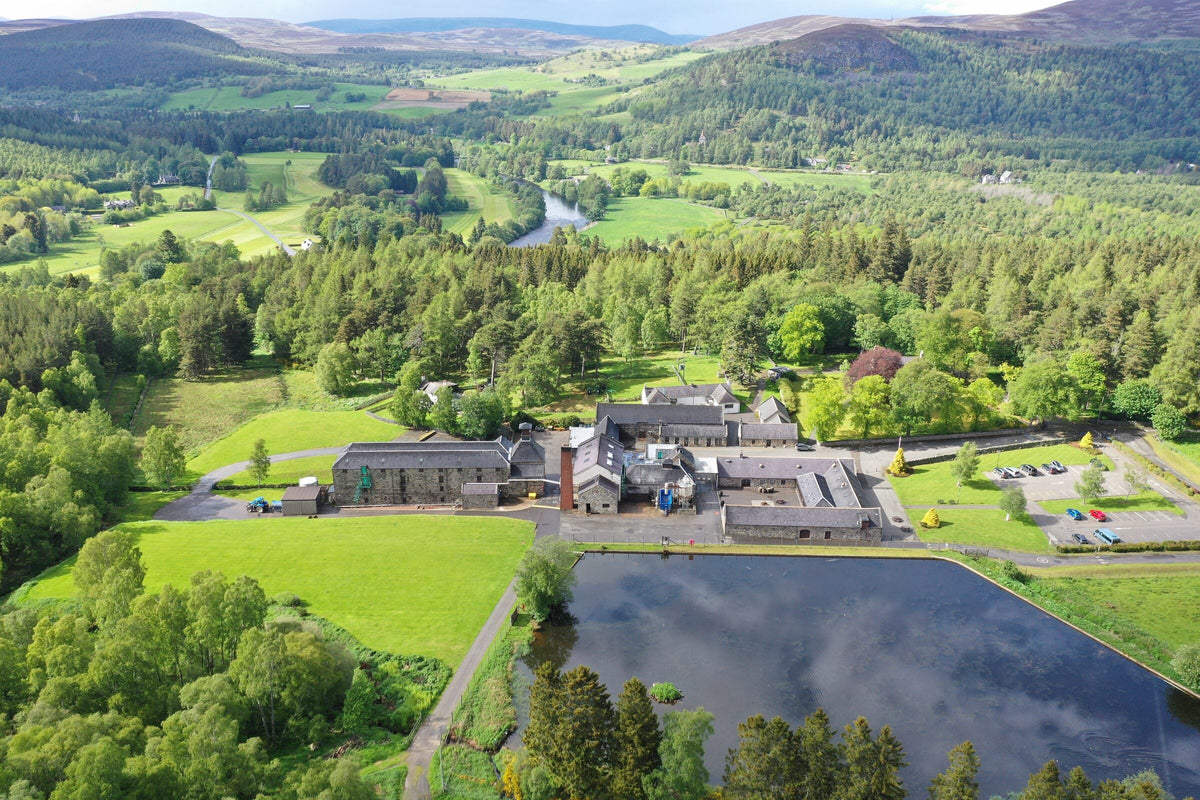
Royal Lochnagar from above
From the air, Royal Lochnagar looks less like an industrial site than a small farm estate that happens to make whisky. The distillery sits on a wooded shelf above the Dee, with the Abergeldie Estate's fields and the Balmoral grounds running along the valley floor and the higher ground of Lochnagar itself rising behind. It is a tight, low huddle of traditional stone buildings rather than the sprawling modern sheds you see at some of the bigger Speyside sites, which suits a distillery that has never tried to be anything other than small.
History of Royal Lochnagar
Whisky had already been made, badly and illegally, on this stretch of the Dee for years before Royal Lochnagar existed in anything like its current form. Three separate distilleries on or near the site burned down between 1824 and 1841, and the fires were widely put down to local opposition rather than accident: legal distilling was still a recent and unwelcome development to smugglers who had run the trade their own way for generations. John Begg built the distillery that survived in January 1845, on a new site closer to the river, and ran it well enough that within a few years he had a rather more useful neighbour than any rival distiller.
Balmoral Castle had been bought by Prince Albert in 1848, and Begg, in a piece of marketing instinct that would still be considered bold today, wrote directly to the Prince inviting him to see the distillery for himself. Albert visited, brought Queen Victoria along, and what is often described as the first formal distillery tour in Scotch whisky's history took place that same year. The royal party liked what they saw enough that a Royal Warrant followed shortly afterwards, and the distillery's name changed from plain Lochnagar to Royal Lochnagar not long after that. The warrant has been renewed by successive monarchs since, most recently in 2022, and Royal Lochnagar marked the late Queen's Platinum Jubilee that same year with a limited bottling.
Ownership moved from the Begg family into a private company in 1902, and the Distillers Company Limited bought the business in 1916, folding it into the corporate lineage that eventually became United Distillers and then, after the 1997 merger of Guinness and Grand Metropolitan, Diageo. One detail that surprises people: Diageo does not actually own the ground the distillery sits on. It leases the site from the Abergeldie Estate, the same arrangement that has applied for well over a century, which says something about how little has changed here compared with distilleries that have been rebuilt, expanded or relocated several times over.
How Royal Lochnagar makes its whisky
The distillery draws its water from springs high in the Lochnagar hills, and the malt itself is unpeated, sourced centrally from Diageo's own maltings since Royal Lochnagar's floor maltings shut in 1963. What makes the production side genuinely unusual is the stillhouse: a single wash still of 6,700 litres and a single spirit still of 3,720 litres, both feeding worm tub condensers rather than the shell-and-tube condensers most distilleries switched to decades ago. Worm tubs are old technology, coils of copper pipe sunk into a tank of cold water, and they are usually associated with a heavier, meatier style of spirit because they give the vapour less contact with copper as it condenses.
Royal Lochnagar runs against that expectation. Fermentation is kept long, distillation is run slow to build reflux, and the stills themselves are reportedly opened up after each run so that fresh air reaches the copper and keeps it working properly, a detail more usually associated with distilleries chasing a lighter, cleaner spirit than a distillery equipped the way this one is. The result, by most accounts, is a new make that leans smooth and sweet rather than sulphury or heavy, with dry grass and a background of orchard fruit that only really shows its full character once the whisky has spent time in cask, most often ex-sherry wood.

What does Royal Lochnagar taste like?
Royal Lochnagar's core range, a 12 year old bottled at 40%, is built around that smooth, sweet, sherry-influenced style: malt and dried fruit, a little spice, and a finish that leans on oak rather than smoke or peat, since there is none of either in the recipe. The Distillers Edition takes the same spirit and finishes it in casks that previously held Muscat wine, adding a lifted, grapey sweetness on top, and the Select Reserve blends together specially chosen sherry and American oak casks for something a little richer and more concentrated than the standard 12 year old. None of it is a loud whisky. It is built to be approachable, and the closeness to Balmoral has always made restraint more useful to the brand than showmanship.
Independent bottlings, where you can find them, often show a slightly different side of the distillery. A Signatory Vintage release from a 1991 refill sherry butt, bottled in 2011 at cask strength, was described as strong and punchy on the nose, thick malt, pine resin, potpourri and hazelnut, with chamomile tea, honey and citrus on the palate and a herbal, spiced finish. That is a noticeably more forceful whisky than the standard 12 year old, which tells you a fair amount about how much the official bottling is designed to be gentle rather than about what the spirit itself is actually capable of.
Royal Lochnagar and independent bottlers
Royal Lochnagar's relationship with independent bottlers is real but thin, and it is worth being honest about why. Most of what the distillery makes goes into Johnnie Walker, and what is held back mostly ends up in Diageo's own small core range rather than being sold on as bulk stock. Gordon & MacPhail have bottled Royal Lochnagar under their Connoisseurs Choice label for decades, but a lot of what shows up under that name now, vintages from the 1950s through the 1970s, tends to circulate through auction houses rather than sit on a current shelf. Wm Cadenhead's has released it more recently through their Small Batch range, including an 18 to 19 year old drawn from 1996 stock, and Signatory Vintage has bottled it through their Cask Strength Collection, including the 1991 sherry butt mentioned above. It is not a distillery you can rely on for a steady supply the way you can with some of the bigger, more independent-bottler-friendly names. What comes onto the open market tends to arrive in single casks, spaced years apart, rather than in the kind of volume that lets a broker simply go and buy one.

Royal Lochnagar and The Single Cask
We do not currently hold a cask of Royal Lochnagar, and given how little the distillery releases beyond its own core range, we are not going to pretend one is easy to find. What we can say honestly is that we would take one seriously if the right cask came up. It is a genuinely interesting distillery, both for the royal history and for a production process that quietly does the opposite of what its equipment suggests it should. If you have a specific interest in Royal Lochnagar, whether as a collector, a bottler or someone building a brand around Deeside and its royal associations, tell us and we will keep an eye on the market on your behalf rather than promising something we cannot deliver.
Plan a bottling inspired by Royal Lochnagar
If it is specifically Royal Lochnagar you are after, the honest answer is that you may be waiting a while, and that any cask that does surface is likely to be a one-off rather than the start of a supply line. If what actually matters is the style, smooth, sherried, restrained rather than smoky, there is more flexibility than the distillery name alone suggests. Two of Diageo's other small Classic Malts distilleries, Blair Athol in Pitlochry and Oban on the west coast, sit in a broadly similar register and come up for independent bottling slightly more often. Fettercairn, another Aberdeenshire distillery not far from Deeside, is also worth a look if the eastern Highland character matters to you as much as the specific name.
For an independent bottler or a new brand working from a wider brief, we can talk through independent bottling and private label whisky built around stock that genuinely fits, walk through the four steps from cask to bottle, and hold everything in our own bonded warehouse while a plan comes together. If you are earlier in the process and thinking about buying a whisky cask generally, our guide to cask sizes and types is a sensible next stop. A cask is not a regulated investment, values can move in either direction over however many years it spends maturing, and nothing here is financial advice, only a straightforward account of what we see buying and selling casks day to day.
Get in touch and tell us what you are trying to build. We will give you a straight answer about what is realistically available and what it is likely to cost.
Royal Lochnagar FAQs
Who owns Royal Lochnagar distillery?
Diageo, which traces its ownership back to the Distillers Company Limited buying the business in 1916. Diageo leases the site itself from the Abergeldie Estate rather than owning the land outright.
Why is it called Royal Lochnagar?
Prince Albert and Queen Victoria visited the distillery in 1848 after founder John Begg invited them, in what is often cited as the first formal distillery tour in Scotch whisky's history. A Royal Warrant followed soon afterwards, and the distillery has carried the Royal Lochnagar name since.
Is Royal Lochnagar peated?
No. The malt is unpeated, and the whisky's character comes from a combination of long fermentation, slow distillation and, in most bottlings, extended maturation in ex-sherry casks.
Can you visit Royal Lochnagar distillery?
Yes. It is one of Diageo's Classic Malts distilleries and welcomes visitors year-round, close to Balmoral in Royal Deeside, though it is worth checking current tour times before travelling given how small the site is.
Can you buy a cask of Royal Lochnagar?
Occasionally, through independent bottlers rather than the distillery itself, but not often. Most of what the distillery produces goes into Johnnie Walker or Diageo's own small core range, so genuine independent casks are rare and tend to appear as one-offs. We do not currently hold a Royal Lochnagar cask, but we are glad to look for one and to suggest well-matched alternatives in the meantime. Ask us what is realistically available.
Work with The Single Cask
Buy a whisky cask, bottle under your own label, or store casks in our HMRC approved bonded warehouse in Fife.
Read more
Invergordon Distillery: The Highland Grain Giant Behind Whyte & Mackay
Most of the distilleries on this blog make single malt you can buy by the bottle in a shop. Invergordon does not really work that way. It is the biggest grain distillery in the Highlands, tucked be...
Read more


