
Fettercairn Distillery: The Highland Whisky Scotland Almost Forgot
Fettercairn sits at the foot of the Cairngorms in Aberdeenshire, tucked below the Grampian hills in a part of the Highlands most whisky drinkers drive straight past. For a distillery licensed in 1824, one of the older names on the map, that quietness is a little strange. For most of its history Fettercairn has been one of Scotland's least written about single malts, and for a long stretch it was also one of the least well regarded. That has been changing steadily since the early 1990s and more visibly since 2018, and it is a story worth knowing before you go looking for a cask.
A Highland distillery with a patchy past
Sir Alexander Ramsay founded Fettercairn in 1824 (some sources say 1825) by converting an existing corn mill on his estate. Ramsay lost his fortune not long after and sold the site to the Gladstone family around 1829, whose descendant William Ewart Gladstone would later become Prime Minister four times. The distillery passed through several hands over the following century: Ross & Coulter took it on in 1924, it was folded into Associated Scottish Distilleries in 1939, and it sat mothballed for over a decade before that, closed between 1926 and 1939. A fire in 1887 didn't help matters either.
Whyte & Mackay bought Fettercairn in 1973, and it has stayed part of that group ever since, most recently under the Philippines based Emperador Inc and its parent Alliance Global Group, who took control of Whyte & Mackay in 2014. Throughout most of this ownership history Fettercairn was treated as a workhorse: a supplier of malt for Whyte & Mackay's blends rather than a single malt brand in its own right. Its own trade mark, an arch topped with a unicorn, commemorates a visit from Queen Victoria in 1861, which tells you how long the distillery has been quietly getting on with things without much fanfare.
The reputation problem ran deeper than obscurity. For years Fettercairn was talked about, when it was talked about at all, as one of the more difficult Highland malts: spirit that could turn sulphury or rubbery, official releases that were few and far between, and whisky reference books that had little to say about it. Andrew Lennie, who joined the distillery team in 2019, has spoken about how little had actually been written about Fettercairn in the standard whisky literature at that point. That has started to shift. A programme of investment beginning in 1991 rebuilt the tun room, added washback capacity, replaced problematic stainless steel condensers with copper, and put real thought into wood policy for the first time. A revamped core range followed in 2018, alongside annual limited releases and a push toward Scottish oak and locally grown barley.
Production: an old fashioned setup with one genuine quirk
Fettercairn draws its process water from springs in the Grampian hills above the distillery. The mash tun is a traditional open topped design, which produces a cloudier wort than the enclosed lauter tuns most modern distilleries use, and fermentation runs for a minimum of 48 hours in wooden washbacks. Sources differ slightly on the exact washback count and size (some put it at eight vessels of around 25,000 litres each, others at eleven), which is the kind of detail that seems to shift as the distillery has been rebuilt in stages over the decades.
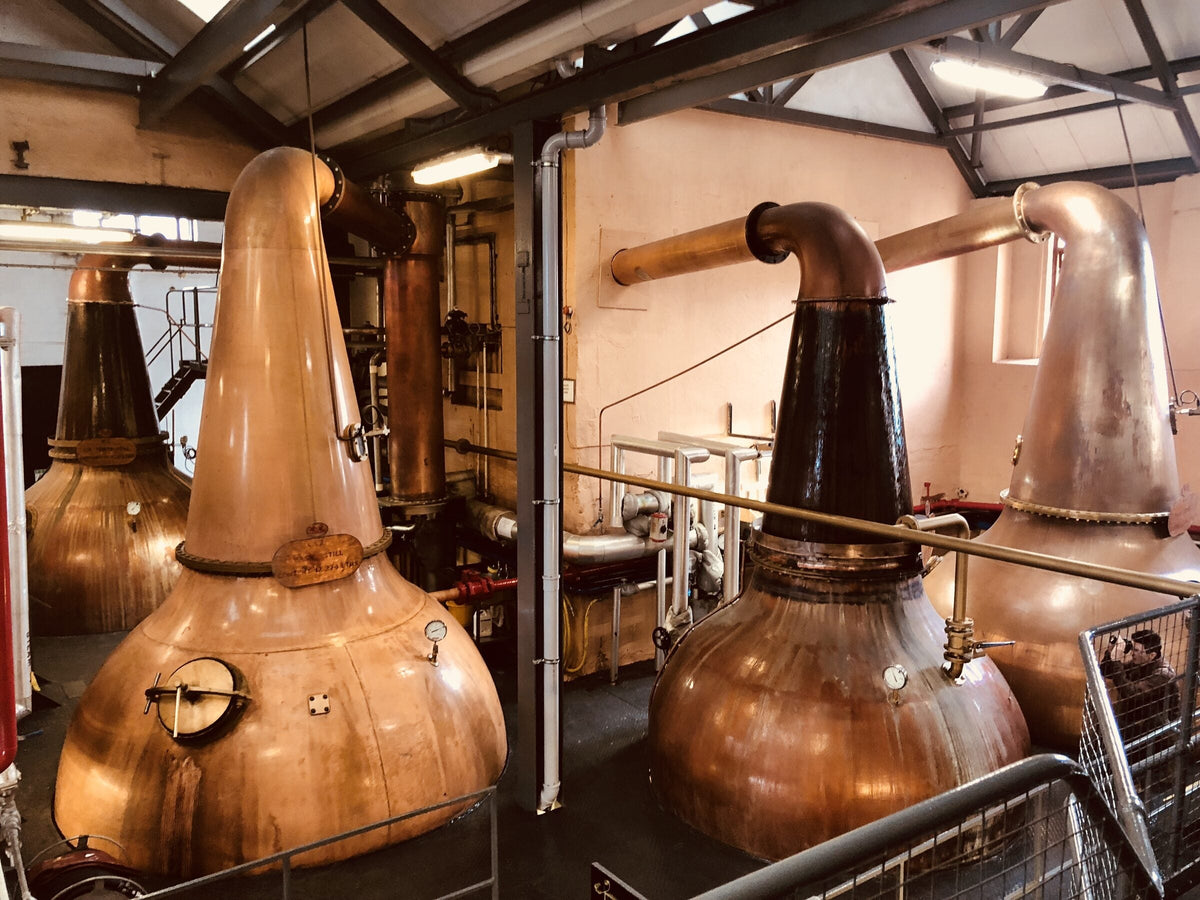
The stills are where Fettercairn earns its one genuinely distinctive claim. The wash and spirit stills carry an unusual cooling ring, sometimes called an irrigator ring, fitted around the neck. Cold spring water is sprayed continuously down the outside of the copper as the spirit runs, encouraging extra reflux and copper contact without slowing the still down. It's a simple, almost agricultural bit of engineering, and it is credited with giving Fettercairn's new make a lighter, fruitier character than you would expect from equipment this traditional. Older accounts of the distillery also mention soap grinders fitted to the stills to stop them boiling over during the run, a detail that turns up in The Single Cask's own product notes as well as third party sources. Annual capacity is usually quoted at around 2.2 million litres of pure alcohol, though this too varies a little by source and by year.
What Fettercairn tastes like
The house style leans firm and slightly nutty in youth, with the cooling ring's reflux pulling through cereal, straw and a gentle fruitiness that can read as tropical or stewed depending on the cask. Most maturation is in first fill and refill ex-bourbon casks, with sherry and other wine finishes used for the more premium and limited releases. Older expressions tend to pick up more weight from sherry wood: dried fruit, walnut and a savoury, almost tobacco-like edge that sits well against the underlying maltiness.
Where independent bottlers fit in
Because official Fettercairn releases were thin on the ground for so long, independent bottlers were often the only realistic way to try the distillery's spirit at all. Gordon & MacPhail have released Fettercairn under their Connoisseurs Choice range for years, Cadenhead's has put out small batch and Original Collection Fettercairn bottlings, and Signatory Vintage has issued single cask Fettercairn from various vintages and cask types. For a long period these independent releases carried more of the distillery's reputation than Whyte & Mackay's own bottlings did, which is exactly the kind of gap independent bottling exists to fill: distilleries with real character and a real story, but without the marketing budget or brand focus to tell it themselves.
The Single Cask's own Fettercairn casks
The Single Cask has bottled two Fettercairn casks over the years, and both give a fair sense of the range this distillery can produce.
Cask 107721 was distilled in 2006 and bottled at 12 years old, matured in a first fill ex-bourbon cask at a cask strength of 55.7%, yielding an outturn of 225 bottles. It showed light cereal and subtle malt on the nose, with straw and a hint of aniseed behind the fruit. The palate was gentle and sweet, with more intense malt and straw, running into a finish loaded with vanilla, oak and soft caramel over stewed peaches. It's a good illustration of what that cooling ring does for a younger, ex-bourbon matured spirit: light, clean and more approachable than the distillery's old reputation would suggest.

Cask 800343A took a very different route. Distilled in 2011 and bottled at just 7 years old, it came in at a punchy cask strength of 65.0% from an outturn of 74 bottles. The cask type isn't recorded on our own listing for this one, but the flavour speaks for itself: deep, resonant notes of dried fruit, raisin and fig, walnut and black pepper, with a thread of cigar smoke running through. The palate brought riper red fruit, raspberry and strawberry, a suggestion of grapefruit, before heavier sherry oak notes took over, finishing long and complex with soft oak and burning tobacco. Whatever wood that cask was, it was working hard, and it shows how differently Fettercairn can present itself once sherry influence gets involved.

Both casks are long sold through, which is honestly typical for single cask Fettercairn: outturns from a specific cask rarely run beyond a couple of hundred bottles, and once they're gone, they're gone.
Plan a bottling inspired by Fettercairn
If you've read this far because you like the idea of a Fettercairn cask specifically, the honest answer is that genuine stock is hard to come by. Whyte & Mackay keeps tight control of what leaves the distillery for independent bottling, and when casks do reach the open market they tend to move quickly given how few official releases there have historically been. We're not going to claim we have a Fettercairn cask sitting in bond when we don't. What we can do is talk through what you actually want from a Fettercairn style whisky: a firm, food friendly Highland malt with real fruit character, and either point you toward whisky with a genuinely comparable profile or help you track down the real thing if one becomes available.
For context, we already hold casks and TSC bottling history from two other Whyte & Mackay Highland sites, Dalmore and Jura, both worth a look if you're drawn to this stable's house character rather than Fettercairn by name alone. More broadly, our Highland whisky region guide covers the wider range of styles the region produces, from Fettercairn's lighter, fruit forward end through to the peated and coastal malts further north and west.
Whether you're after a specific distillery, a flavour profile, or stock to build an independent bottling or private label range around, our team works from real, currently available casks rather than a wish list. Have a look at the whisky casks we currently have available, or get in touch directly if you'd rather talk it through. If you're planning your first release, our four steps to bottling your own whisky page walks through what's involved from cask selection to finished bottle, and our independent bottling services and private label whisky pages cover the two most common routes people take. Anything you buy through us can also sit in our own bonded warehouse in Fife for as long as you need it to mature.
Fettercairn: frequently asked questions
Is Fettercairn a good whisky?
Its reputation has improved a great deal since the early 1990s rebuild and the 2018 relaunch of its core range. Older bottlings had a mixed reputation, but recent official releases and the independent bottlings we've tasted, including our own two casks, show a distillery capable of real complexity, from light and fruity in youth to genuinely rich once sherry wood gets involved.
Can you buy a whisky cask directly from Fettercairn distillery?
Whyte & Mackay does not generally sell casks direct to the public from Fettercairn. Access to genuine Fettercairn stock usually comes through the independent bottling market, which is a smaller and less predictable supply than buying direct from a distillery that runs its own cask ownership scheme.
Which independent bottlers have released Fettercairn?
Gordon & MacPhail, Cadenhead's and Signatory Vintage have all released single cask or small batch Fettercairn over the years, alongside smaller runs from other independent bottlers. The Single Cask has bottled two casks of our own, detailed above.
What does Fettercairn whisky taste like?
Younger, ex-bourbon matured Fettercairn tends toward light cereal, straw and gentle fruit, with vanilla and caramel on the finish. Sherry cask and older expressions bring dried fruit, walnut, pepper and a tobacco like note, with a longer, more savoury finish. The distillery's unusual still cooling ring is generally credited with the lighter, fruitier edge that runs through both styles.
Facts on Fettercairn's history, ownership and production have been drawn from Wikipedia, scotchwhisky.com's Whiskypedia and Master of Malt's own reporting on the distillery, and are noted above where sources disagree on specific figures such as founding year, washback count or still numbers. Cask details and tasting notes for casks 107721 and 800343A are taken directly from The Single Cask's own product records.
Work with The Single Cask
Buy a whisky cask, bottle under your own label, or store casks in our HMRC approved bonded warehouse in Fife.
Read more
Braeval Distillery: The Highest, Quietest Whisky Maker in Speyside
A distillery built to disappear into blends Braeval sits about as far into Speyside's back country as a distillery can get, tucked into the Braes of Glenlivet above the far more famous estate that ...
Read more
Glen Garioch Distillery: The Highland Malt That Swapped Peat for Fruit
Drive north out of Aberdeen for half an hour and the city gives way fast to open farmland. This is the Garioch, a broad valley of some of the best barley ground in Scotland, and it is where Glen Ga...
Read more


