
Article: Tamnavulin Distillery: From Blending Workhorse to Wine Cask Specialist
Tamnavulin Distillery: From Blending Workhorse to Wine Cask Specialist
Most Speyside distilleries built in the 1960s were designed to do one thing: make clean, reliable spirit for someone else's blend. Tamnavulin was built for exactly that reason, and for the best part of three decades it did the job so quietly that almost nobody outside the trade could have told you it existed. What makes it worth a proper look now is what happened after: a mothballing, a couple of false starts, and then a relaunch built almost entirely around wine and sherry cask finishing, a style choice bold enough that Tamnavulin now has more of an identity than most of the blending distilleries it grew up alongside.
Tamnavulin from above
Our drone flew over Tomnavoulin in Glenlivet to film Tamnavulin from the air, taking in the distillery's position on the banks of the River Livet with the Cairngorms rising behind it, a genuinely remote setting for a distillery built purely to supply blending stock.
Where Tamnavulin sits, and who owns it
Tamnavulin stands at Tomnavoulin in Glenlivet, Banffshire, on the banks of the River Livet below the Cairngorms, deep in the heart of Speyside. The name comes from the Gaelic for "mill on the hill", a reference to a wool carding mill that stood on or near the site from the 1560s. The distillery itself is much younger. It was built in 1966 by the Tamnavulin-Glenlivet Distillery Company, a subsidiary set up by Invergordon Distillers to feed growing demand for blending stock.
Ownership then followed a path familiar to a lot of Speyside distilleries of this era. Invergordon Distillers ran it through to the early 1990s, when the group was taken over and Tamnavulin passed into what became Whyte & Mackay's stable. Production stopped not long after, mothballed in the mid 1990s (most sources give 1995, one gives 1994, and the exact year seems to depend on which closure milestone is being counted). There was a brief reopening around 2000, but the distillery did not really come back to life until a substantial 2007 renovation under United Spirits, which owned Whyte & Mackay at the time. The current owner has held it since 2014, when Emperador Inc, part of the Philippines based Alliance Global Group, bought the whole Whyte & Mackay portfolio for around £430 million. Tamnavulin has run continuously since the 2007 restart.
That is three separate corporate parents in under sixty years, which is not unusual for a distillery built purely as a production asset rather than a brand. What makes Tamnavulin's story a little different is that its current owner chose, in 2016, to stop treating it as an anonymous supplier and to start selling it under its own name, betting that a fruity, fairly gentle spirit could carry a wine cask driven identity all on its own. On the evidence of the range now on shelves, from supermarkets to specialist retailers, that bet has largely paid off.
From silent workhorse to wine cask specialist
For most of its life, Tamnavulin's single malt identity barely existed outside a modest Glenlivet adjacent bottling aimed at supermarket shelves. That changed in 2016, when Whyte & Mackay relaunched Tamnavulin as a proper single malt brand to mark its 50th anniversary. Rather than lean on age statements, the relaunch leaned hard into cask finishing, built around a "Double Cask" expression combining bourbon and sherry maturation. The range has since expanded well beyond sherry: red wine cask editions followed in 2020 and 2021, then a Sauvignon Blanc finish in 2022, with Pinot Noir and Tempranillo variants added along the way. It is now genuinely one of the more wine forward single malt brands on the market, built on the idea that a fairly gentle base spirit takes finishing well without being overwhelmed by it.
That house style matters when you come to the independent bottling market, because it tells you something about the spirit underneath the marketing. Base new make from Tamnavulin is generally described as sweet, smooth and fruity rather than heavily peated or robustly oily, which is exactly the kind of spirit that takes well to an assertive cask without fighting it.
Production: built for volume, run for consistency
Tamnavulin is a sizeable operation by Speyside standards. Reported annual capacity sits around 4.3 million litres of pure alcohol, run through six stills, three wash and three spirit, feeding from nine washbacks. Process water is drawn from underground springs in the hills around the distillery, while cooling water comes from the River Livet itself, which runs down from the Grampians before joining the Avon. The distillery has no visitor centre and is not set up for public tours, which is typical of a site built primarily to supply blending stock and, more recently, its own branded wine cask range rather than to court whisky tourists.
What the spirit tastes like away from the wine casks
Because Tamnavulin's public identity is now so tied up with sherry and wine finishing, it is worth asking what the underlying new make actually tastes like on its own. Independent bottlings from before the 2016 relaunch give a useful, more neutral picture. A 1992 vintage bottled by Cadenhead's, reviewed by whisky writer Ruben Luyten at WhiskyNotes, describes a nose of honeyed cereal, Earl Grey tea, old roses and apple pie with a little vanilla and yellow raisin, moving into a palate with citrus, anise, pepper and a grassy, raw barley edge that turns buttery with time in the glass, and a medium, dry finish carrying walnut skin and ginger. That review also makes an observation worth repeating here: at the time it was written, in 2017, Tamnavulin barely existed as a single malt at all outside a handful of older independent casks like that one. It is a useful reminder that the wine cask driven brand most drinkers know today is a relatively recent invention sitting on top of a much older, quieter distillery.
Independent bottlings: more accessible than the brand's marketing suggests
Given how tightly some blending distilleries hold their stock, Tamnavulin is a pleasant surprise. Live listings turned up genuine independent releases from Gordon & MacPhail, including cask strength expressions from their Rare Old range distilled as far back as 1973, Signatory Vintage, Wm Cadenhead's, who currently list Tamnavulin bottlings in both their core Authentic Collection and their older Chairman's Stock range, and Hunter Laing's Old Malt Cask line alongside sister company Douglas Laing, both of which have released casks distilled in the 1980s and 1990s. That spread, from teenage casks through to whiskies over thirty years old, suggests parcels of Tamnavulin have moved through the broker and independent bottling market fairly steadily over the decades, even while the distillery itself kept a low public profile until 2016.
A cask we have handled at The Single Cask


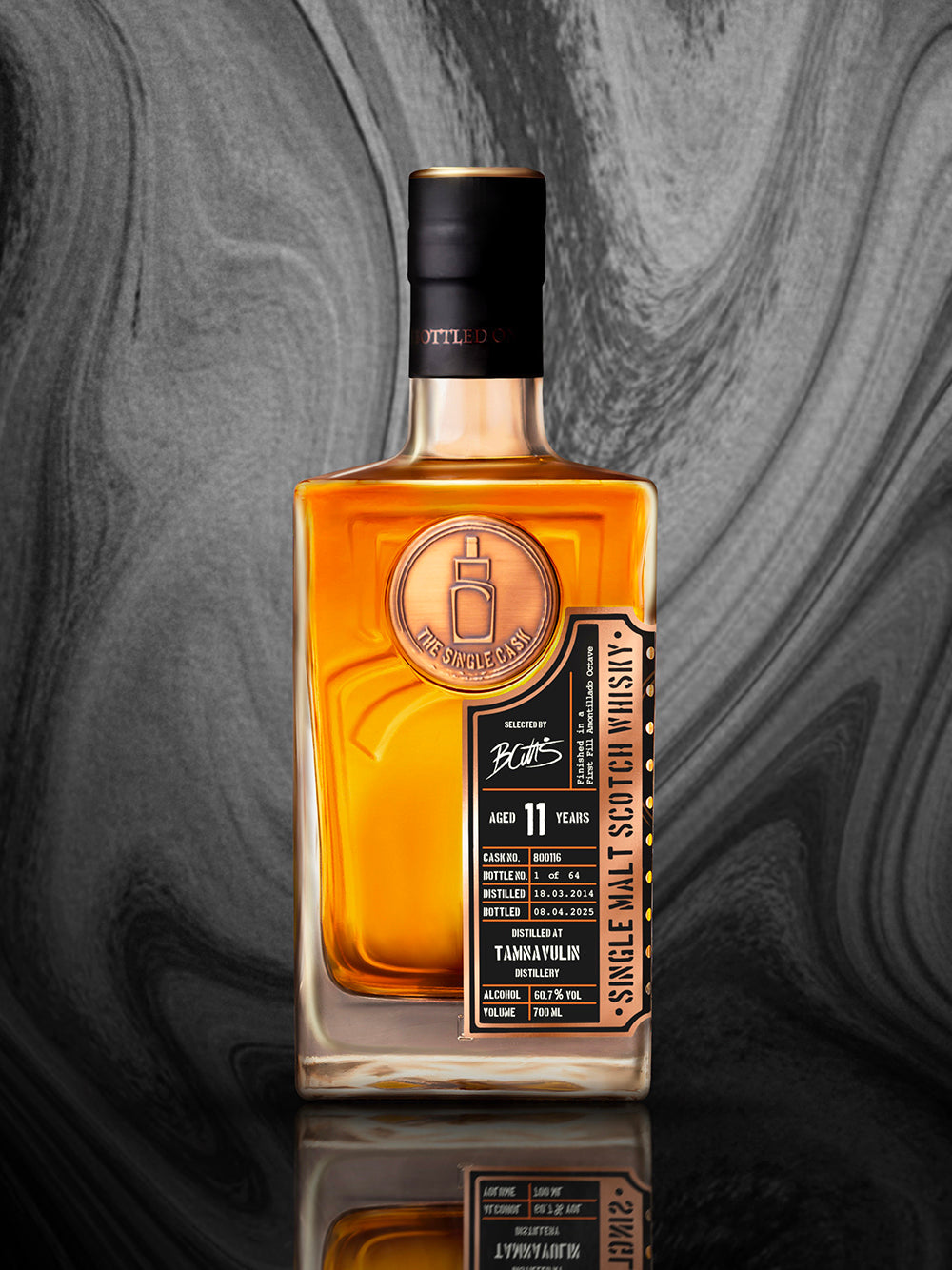
We have had one Tamnavulin cask through our hands, and it happens to line up neatly with the distillery's own current house style. Cask 800116 was distilled on 18 March 2014 and matured in a first fill Amontillado octave, a small format cask, roughly a third the size of a standard hogshead, that concentrates cask influence into a shorter maturation window. It was bottled at cask strength, 60.7% ABV, as part of our Signature Series at 700ml. In other words, our own cask took the same basic idea Whyte & Mackay use for the modern Tamnavulin range, sherry and wine cask influence layered onto a fruity, unassuming spirit, and pushed it further with a genuinely small format sherry cask. We should be straightforward here: this cask is sold through, and there is a data gap worth flagging rather than glossing over, since our records currently show it at a £0.00 list price with no SKU attached. That looks like a leftover placeholder from when the product was archived rather than a real price, and it is worth Ben checking against the original sale paperwork.
Frequently asked questions about Tamnavulin
Is Tamnavulin a single malt or a blending whisky?
Both, in practice. The distillery still supplies blending stock, chiefly to Whyte & Mackay's own blends, but since 2016 it has also been sold as a standalone single malt brand built around wine and sherry cask finishing.
Can you visit Tamnavulin distillery?
No. There is no visitor centre, and the site is not currently set up for public tours.
Why does Tamnavulin use so many wine cask finishes?
It is a deliberate brand strategy adopted at the 2016 relaunch, moving beyond a single Double Cask expression into red wine, Sauvignon Blanc, Pinot Noir and Tempranillo finished releases. The underlying spirit is fruity and fairly gentle, which suits an assertive finish without being overwhelmed by it.
Does The Single Cask have Tamnavulin casks available right now?
Not at the moment. The one Tamnavulin cask we have handled, cask 800116, is sold through. Our current cask stock changes regularly, so it is always worth checking what is available today.
Plan a bottling inspired by Tamnavulin
Tamnavulin is one of the more genuinely accessible blending distilleries when it comes to independent stock. Gordon & MacPhail, Signatory Vintage, Cadenhead's and the Laing family of bottlers have all released Tamnavulin across a real spread of ages, so a specific cask is a realistic thing to look for rather than a long shot. If sherry or wine cask character is what drew you to this guide, our whisky cask sizes and types page explains how something like a small format octave, the same style our own Tamnavulin cask matured in, concentrates that influence faster than a standard hogshead or barrel. For a similarly fruit forward Speyside spirit with a long independent bottling history behind it, our Balmenach guide is worth a look, and if a fully sherry driven house style is the main draw, our Glenburgie guide covers a distillery on the more sherry leaning end of Speyside blending stock, albeit one that is much harder to source.
Whether you are after a specific Tamnavulin cask or open to something with a similar profile, our four steps to bottling your own whisky page walks through what independent bottling actually involves, from sourcing through to a finished label. Our buying a cask page explains how that process works with us directly, and casks bought through The Single Cask are matured and stored under bond at our own bonded warehouse here in Glenrothes. If you are building a brand around bottling rather than a one-off release, our private label whisky and independent bottling services pages cover labelling, logistics and bottling support.
One thing worth saying plainly, since it comes up whenever cask ownership is discussed: a whisky cask is a physical asset whose value can move in either direction depending on the spirit, the market and time, and cask ownership sits outside financial regulation. We are not an investment company and this is not financial advice. The reason to buy a cask is that you want a genuine connection to a whisky you will one day bottle, not a promised return.
If you would like to talk through what is realistically available, whether that is a Tamnavulin, a Balmenach, or something else entirely, get in touch with us and we will talk you through current stock.
Work with The Single Cask
Buy a whisky cask, bottle under your own label, or store casks in our HMRC approved bonded warehouse in Fife.
Read more
Glenburgie Distillery: The Speyside Malt Ballantine's Won't Let Go
Ask most whisky drinkers what Glenburgie tastes like and you will get a blank look. Ask them if they have ever drunk it, and the honest answer for the vast majority is yes, almost certainly, they j...
Read more


