
Glenburgie Distillery: The Speyside Malt Ballantine's Won't Let Go
Ask most whisky drinkers what Glenburgie tastes like and you will get a blank look. Ask them if they have ever drunk it, and the honest answer for the vast majority is yes, almost certainly, they just did not know it. Glenburgie sits in the hills above the Moray coast near Forres, quietly filling tankers bound for the Ballantine's blending hall, and single malt bottlings from the place are rare enough that even people in the trade have to think for a moment before they can name one they have tried.
That obscurity is part of what makes it interesting. Glenburgie is not a mystery because nobody makes good whisky there. It is a mystery because almost nobody outside Chivas Brothers gets to keep any of it.
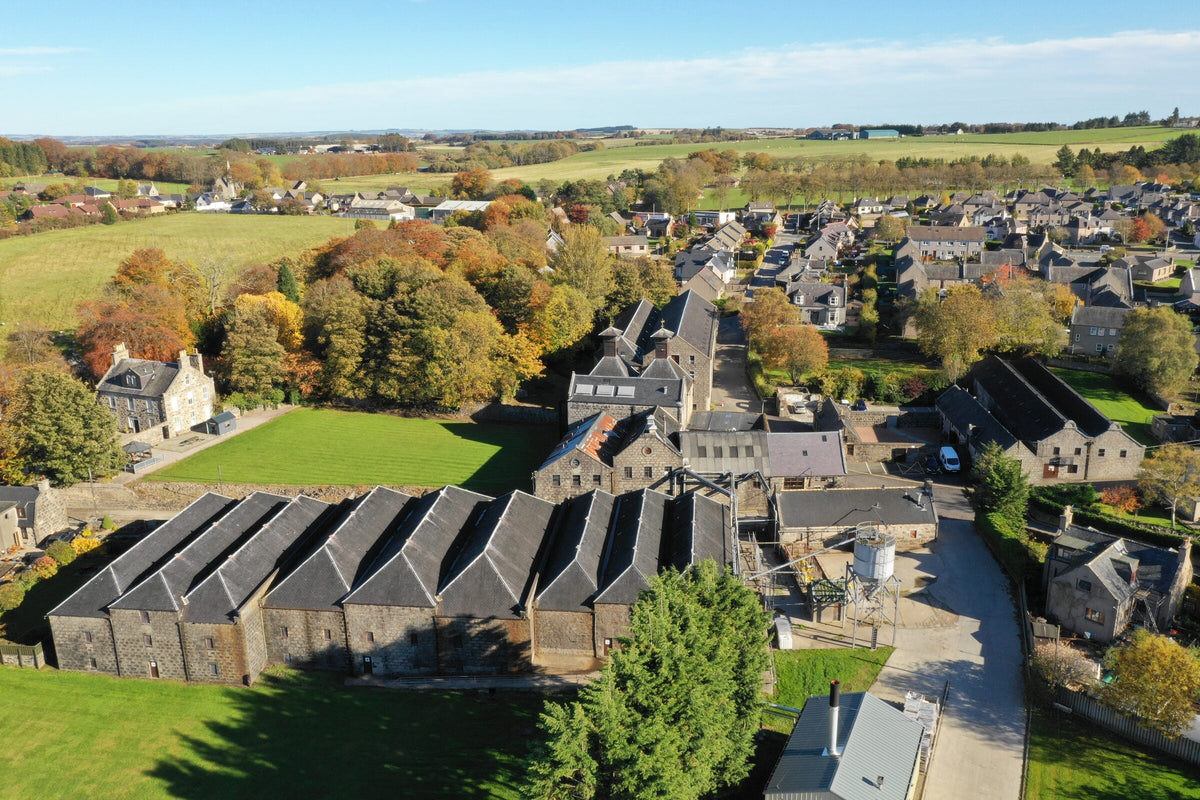
Glenburgie from above
Our drone flew over the Mill Buie estate near Alves to film Glenburgie from the air, and from height the site reads exactly as what it is: a modern, efficient production plant built for volume rather than visitors, with none of the traditional pagoda roofs or postcard charm of some of its Speyside neighbours.
Where Glenburgie sits, and who owns it
Glenburgie is a Speyside distillery in the loosest geographic sense, sitting closer to the Moray coast than to the Spey itself, on the Mill Buie estate near the village of Alves, between Forres and Elgin. It has been part of Pernod Ricard's Chivas Brothers stable since 2005, when Pernod Ricard bought the Allied Domecq portfolio. Before that it was owned by Allied Lyons from 1987, and by Hiram Walker & Sons before that, going back to 1936. The Hiram Walker era is the one that matters most to the distillery's identity, because that is when Glenburgie became tied to Ballantine's, a relationship that has not loosened since.
The site's history stretches back further than most people assume. There are references to a distillery here as early as 1810, trading as Kilnflat, with more formal records from 1829. It was renamed Glenburgie in 1871 under owner Charles Hay, after an earlier closure caused by financial trouble. That was not the last time the taps ran dry. Records show the distillery silent from 1870 to 1878, again from 1927 to 1935, and once more from 2000 to 2004, when the old distillery buildings were demolished and replaced with the modern plant that runs today. Two centuries of Scottish distilling history rarely runs in a straight line, and Glenburgie's does not either.
One footnote worth knowing: in the 1920s and 1930s, Glenburgie was managed by Margaret Nichol, who is generally reckoned to be the first woman to manage a Scotch whisky distillery. It is a detail that gets mentioned in passing more often than it gets explored, but it deserves a line of its own.
The Glencraig years
Between 1958 and 1981, Glenburgie ran two Lomond stills, a squat, plate-fitted still design that a handful of distilleries experimented with in the mid twentieth century to vary spirit character without building an entirely separate site. Whisky made on those stills was not sold as Glenburgie at all. It was labelled Glencraig, after a former distillery manager, and it survives today only in a small number of independent bottlings, mostly from Gordon & MacPhail. The Lomond stills were removed in 1981 and Glenburgie has run as a single, conventional distillery ever since, with two extra stills added in 2006 to bring the current total to three wash stills and three spirit stills, a fairly traditional onion-shaped design.
Production: built for scale, not showmanship
Glenburgie is not a distillery that courts visitors or builds a personality around its process. It is built to produce a lot of clean, unpeated malt spirit efficiently, and it does that job well. Reported capacity sits at around 4.2 million litres of pure alcohol a year, among the larger outputs on Speyside, run through a 5 tonne mash tun and a bank of washbacks. Sources differ slightly on the exact fermentation vessel count, either 12 or 13 depending on which reference you check, but they agree on stainless steel construction and a scale built for consistent, high volume output rather than long, character-building ferments. Water is drawn from local springs on the estate. Malt is unpeated, and one source names Simpsons and Bairds as suppliers, though as with most working distilleries the exact grist sourcing can shift year to year with contracts.
New make off the stills is reported at around 69% ABV by one source, though this figure is not confirmed across every reference and should be treated as indicative rather than gospel. What is consistent across the literature is the character it develops in cask: light, fragrant, slightly grassy, with a waxy or lightly oily texture that gives blenders a useful, flexible building block. Warehousing on site uses a mix of cask types, though at least one source suggests sherry wood plays a larger role at Glenburgie than the industry average, contributing sweeter, dried fruit and spice notes to the mature spirit alongside the classic ex-bourbon citrus and vanilla profile.
Whisky style and why you rarely see it bottled
The single most important thing to understand about Glenburgie is this: its owner, Chivas Brothers, treats it primarily as a blending malt, and by most trade accounts, master blender Sandy Hyslop keeps the bulk of production ring fenced for Ballantine's, with a smaller share going into Old Smuggler. Official single malt releases under the Glenburgie name have historically been rare, and when they have appeared, such as a run of Ballantine's branded single malt expressions around 2017, they have tended not to stick around in the core range for long.
That scarcity is exactly why independent bottlers matter so much to anyone who wants to taste Glenburgie as itself rather than as one ingredient among fifty in a blend. Gordon & MacPhail has bottled Glenburgie for decades, including some notably old expressions from the 1960s. Signatory Vintage has released multiple age statements from 1995 vintage stock, some into their thirties by now. Hunter Laing's Old Malt Cask range and sister company Douglas Laing have both put out Glenburgie casks too. What you get from these releases tends to back up the trade description: floral top notes, ripe citrus and orchard fruit, a background of honeyed cereal sweetness, and, where sherry wood has been used, a layer of raisin, date and baking spice. It is not a showy whisky. It rewards patience more than it demands attention, which is probably exactly why blenders like it so much.
Casks we have handled at The Single Cask
We have had two genuine Glenburgie casks pass through our hands, and it is worth being straightforward about where things stand with both: they are sold through. Nothing is currently available from either one. We are including them here because they tell you something real about how this spirit behaves, not to sell you stock we do not have.

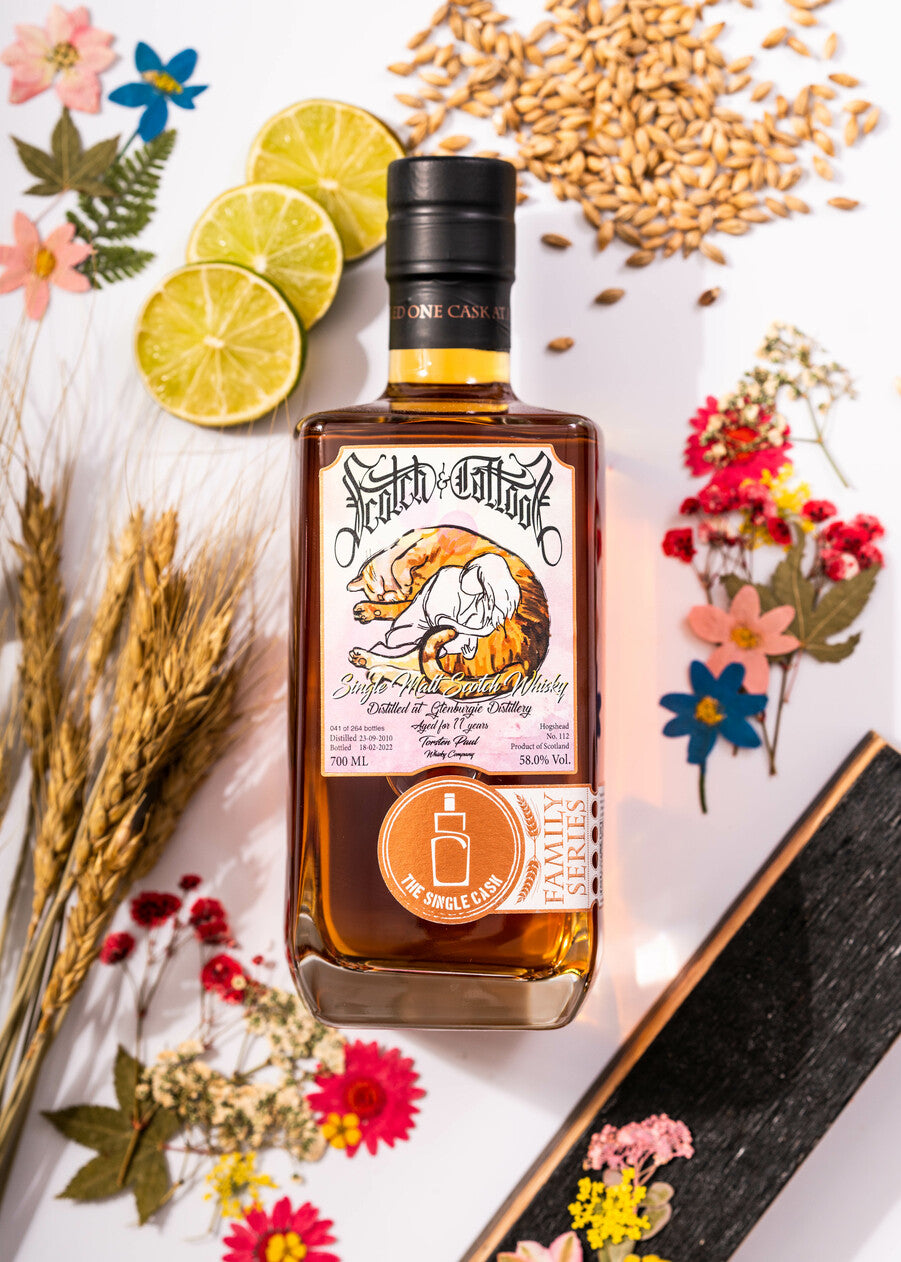
The first was cask 112, an 11 year old distilled in 2010 and drawn from a hogshead at cask strength, 58.0% ABV. It produced an outturn of 264 bottles and was bottled as part of a collaboration with Scotch & Tattoos, a label built around Torsten, one of our long standing customers who bought his first cask from us, a Dalmore, before starting his own bottling venture. The tasting notes on that release read true to what the trade descriptions above would lead you to expect from a relatively young Glenburgie in first or refill hogshead wood: floral character up front, citrus fruit, oak, malt and a run of raisin sweetness, with white pepper and white grape notes carrying through the palate and into the finish. It sold under our Family Series banner at £45 a bottle.

The second, from our Signature Series, was considerably older: a 21 year old distilled in 1995, cask ref 6288 (AQ795), bottled at 53.1% ABV. Cask type for this one is recorded as not available on our own records, so rather than guess we are saying so plainly. What this cask did show, at 21 years, was a noticeably more developed and elegant profile than the 11 year old: rose water, sugar syrup, cherry blossom, dates, plums and lemon juice on the nose, with a slightly soapy, herbal thyme note that people either loved or found unusual. The palate carried the same floral, spiced sweetness through to a drying, slightly oaky finish. It sold at £60 a bottle. We would flag one thing for the record rather than gloss over it: the pricing gap between an 11 year old at £45 and a 21 year old at £60 is on the narrow side given the age difference, and cask type being unrecorded on the older lot is a data gap worth checking against our original paperwork rather than treating as settled.
Frequently asked questions about Glenburgie
Is Glenburgie a single malt or a blend?
Glenburgie the distillery makes single malt spirit, but almost all of it disappears into Ballantine's and other blended Scotch. Bottlings under the Glenburgie name on their own, as a single malt, are uncommon.
Can you visit Glenburgie distillery?
No. It is a working production site owned by Chivas Brothers with no visitor centre, and it is not set up for public tours in the way that many single malt focused distilleries are.
Why is Glenburgie so hard to find as a single malt?
Because its owner uses most of its output as a blending component. Independent bottlers such as Gordon & MacPhail, Signatory Vintage, Hunter Laing and Douglas Laing are, for most drinkers, the realistic route to trying it as itself.
What does Glenburgie taste like?
Light and fragrant with citrus and floral notes, a soft waxy texture, and where sherry cask influence is present, dried fruit and spice layered on top. It is a gentle style rather than an assertive one.
Does The Single Cask have Glenburgie casks for sale right now?
Not at the moment. Both casks we have handled, an 11 year old and a 21 year old, are sold through. Check our current cask stock for what we do have available today, since availability changes regularly.
Plan a bottling inspired by Glenburgie
We will be straight with you: if your reason for reading this far is that you specifically want to buy or bottle a Glenburgie cask, the honest picture is that genuine opportunities are thin on the ground. This is a distillery built to feed a blend, its owner keeps a tight grip on stock, and the independent bottler market, while real, tends to move older casks that were laid down and traded years ago rather than fresh parcels coming onto the market. We would rather tell you that plainly than string you along.
What we can do is point you toward whiskies with a closely similar story. Speyside has several distilleries built primarily to serve blenders that occasionally throw off casks with real character of their own, and we have covered a few of them in this same series. Glentauchers is arguably the closest parallel: another Speyside distillery whose make blenders have quietly kept for themselves for decades, with independent bottlings offering the only real route to trying it neat. Allt-a-Bhainne and Braeval are two more, both built in the same era for the same reason, both worth a look if the appeal of Glenburgie is the idea of drinking something that usually only ends up in someone else's blend. If sherry cask character is what drew you to Glenburgie's flavour profile specifically, our Aberlour guide covers a Speyside distillery built much more explicitly around that style, with far more single cask stock moving through the market.
If any of that sounds like the starting point for your own project, our four steps to bottling your own whisky page walks through what independent bottling involves, from cask selection to label on bottle. Our whisky casks available page shows genuine current stock, and buying a cask explains how that process works with us directly. For anyone building their own brand rather than a one-off release, our private label whisky and independent bottling services pages cover bottling, labelling and logistics support. Casks bought through us are held under bond at our own bonded warehouse here in Glenrothes, so you can see exactly where your whisky sits while it matures.
One last honest note, since it comes up whenever cask ownership is discussed: a cask of whisky is a physical asset that can rise or fall in value depending on the spirit, the market and time itself, and the cask market is not a regulated financial product. We are not an investment company and we do not give financial advice. If you are drawn to cask ownership, come to it because you want a genuine connection to a whisky you will one day bottle yourself, not because anyone has promised you a return.
If you would like to talk through options, whether that is a Glentauchers, an Allt-a-Bhainne, an Aberlour, or something else entirely, get in touch with us and we will talk you through what is available right now.
Work with The Single Cask
Buy a whisky cask, bottle under your own label, or store casks in our HMRC approved bonded warehouse in Fife.
Read more
Glen Garioch Distillery: The Highland Malt That Swapped Peat for Fruit
Drive north out of Aberdeen for half an hour and the city gives way fast to open farmland. This is the Garioch, a broad valley of some of the best barley ground in Scotland, and it is where Glen Ga...
Read more
Tamnavulin Distillery: From Blending Workhorse to Wine Cask Specialist
Most Speyside distilleries built in the 1960s were designed to do one thing: make clean, reliable spirit for someone else's blend. Tamnavulin was built for exactly that reason, and for the best par...
Read more


