
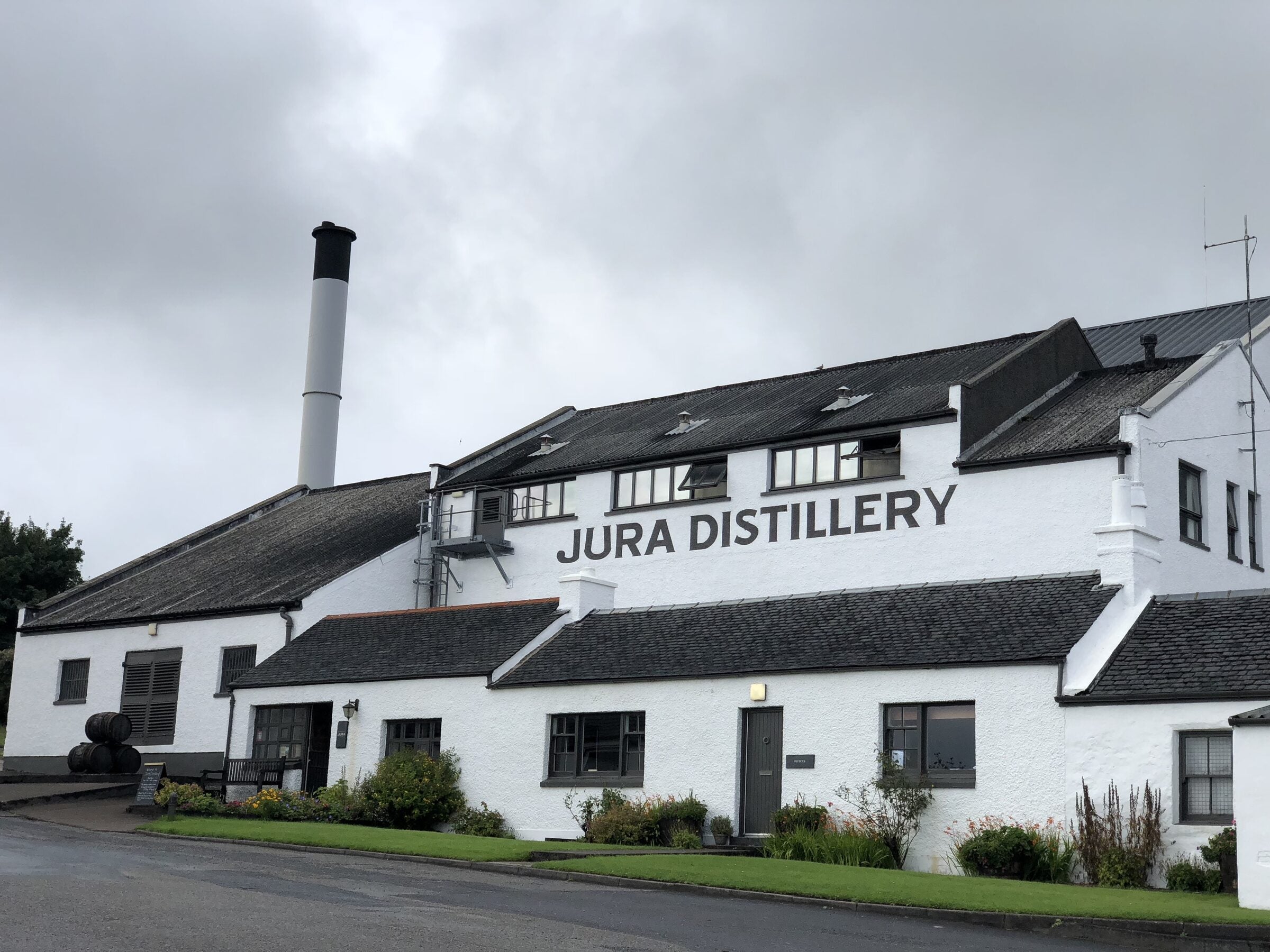
Jura Distillery: The Island Malt Rebuilt to Save a Community
George Orwell called Jura "extremely unget-at-able", and he meant it as a recommendation. He wrote most of Nineteen Eighty-Four in a farmhouse at the far north of the island, and the same remoteness that suited him is exactly why the island's distillery exists at all: it was rebuilt in the 1960s not because anyone needed more whisky, but because a community of a few hundred people needed work. Today the whitewashed still house at Craighouse turns out one of the most-drunk single malts in Britain, from an island with more red deer than people by a factor of roughly twenty-five.
For independent bottlers Jura is a distillery of two halves: an unfairly overlooked light, fruity, unpeated spirit that turns tropical with long ageing, and a smaller stream of heavily peated make. We have bottled the former twice, including the oldest whisky we have ever released. Here is the full story.
Jura at a glance
| Region | Islands, Isle of Jura, Inner Hebrides (a short ferry crossing from Islay) |
| Founded | 1810 as the Small Isles distillery; closed 1901; rebuilt 1960 to 1963 |
| Owner | Whyte & Mackay (owned by Emperador Inc. of the Philippines since 2014) |
| Capacity | Typically quoted at around 2.2 to 2.5 million litres of pure alcohol a year |
| Stills | Four: two wash, two spirit, lantern-shaped and around 7.7 metres tall, among the tallest in Scotland |
| Water source | Market Loch (Loch a' Bhaile Mhargaidh), fed from the Paps of Jura |
| Fermentation | Around 54 hours in six stainless-steel washbacks |
| Malt spec | Mainly unpeated; a short annual run of heavily peated malt for smoky expressions |
| Style | Light, fruity and coastal when young; tropical fruit and honeyed oak with age; peated make is earthy and medicinal |
| Visitor centre | Yes, at Craighouse, with tours, a shop and the Jura Lodge for overnight guests |

History of Jura
Whisky was almost certainly made illicitly on Jura long before anyone wrote it down; the island is covered in peat, has abundant soft water and lay conveniently far from any exciseman. The first legal operation dates from 1810, when the laird, Archibald Campbell, established the Small Isles distillery at Craighouse, named after the little islands that shelter the bay. It was formally licensed in 1831, and for the next seventy years it passed through a string of tenants and operators: Norman Buchanan from 1853, who went bankrupt; J. & K. Orr from 1867; and from 1876 James Ferguson & Sons, who reportedly spent more than £25,000 rebuilding it, a considerable sum for the time.
The Fergusons and the Campbell estate fell out over rent, and in 1901, with the whisky industry sliding into its post-Pattison slump, the distillery closed. The Fergusons stripped out the equipment when they left, the roof came off (a well-worn tale says it was removed to avoid paying rates on the building), and for six decades Jura had no distillery at all. The island's population, already falling, kept falling.
The revival was driven by two local landowners, Robin Fletcher and Tony Riley-Smith. Fletcher, incidentally, was Orwell's landlord at Barnhill. Their motive was blunt: without employment the island would empty. They persuaded the Leith blenders Charles Mackinlay & Co., then part of Scottish & Newcastle Breweries, to back a new distillery, and hired William Delmé-Evans, the architect-distiller who had already built Tullibardine and would later design Glenallachie. Rather than restore the old Victorian plant, Delmé-Evans designed a modern distillery from scratch, with unusually tall stills intended to make a light Highland-style spirit for blending, rather than an Islay-style peat monster. Construction ran from 1960 and the first spirit flowed in 1963, ending a 62-year silence.
The first single malt appeared in 1974. Capacity was doubled in 1978 when a second pair of stills was installed. Invergordon Distillers bought the distillery in 1985, and Whyte & Mackay took over Invergordon in 1993 (the brand's own site dates its ownership from 1994). Whyte & Mackay itself has changed hands more than most: bought by India's United Spirits in 2007, then sold to Emperador Inc. of the Philippines in 2014 for around £430 million. Through all of it, Jura's whisky kept being made by the same small team of islanders, the Diurachs, several of whom, like the long-serving Willie Tait and Willie Cochrane, spent entire careers at the distillery.
The modern brand story is one of reinvention. Superstition, a lightly peated vatting, arrived in 2002; the heavily peated Prophecy in 2009. In 2018 the whole range was rebuilt around a "subtly smoky" house style, and in 2025 it was rebuilt again: the 10 year old was retired, a 12 year old took its place as the entry point, and new packaging carried a flavour scale on the label. A sherry-led range followed in 2026, starting with a 12 year old oloroso edition and a 15 year old finished in manzanilla casks. Whyte & Mackay has said Jura became the UK's best-selling single malt in 2023, a remarkable turn for a whisky that spent much of the 1990s and 2000s in the shadow of its Islay neighbours.
How Jura makes its whisky
Everything about the plant reflects Delmé-Evans's brief. Water comes from Market Loch (Loch a' Bhaile Mhargaidh in Gaelic), fed by burns running off the quartzite Paps of Jura, and it is soft and peaty despite the whisky being mostly unpeated. Malted barley is bought in from a commercial maltster on the mainland; the distillery does not malt on site. Most of the year the malt is unpeated, with a phenol content close to zero. For a short spell each year, historically a couple of weeks, the distillery switches to heavily peated malt for its smoky expressions.
The five-tonne semi-lauter mash tun feeds six stainless-steel washbacks, and fermentation runs to around 54 hours, long enough to build the fruity esters that define the spirit. Then come the stills. Jura's four lantern-shaped stills stand around 7.7 metres tall, and the distillery is fond of saying their size was set by "the biggest we could fit on the boat over". Whatever the truth of that, the height matters. Heavy vapours fall back down the neck as reflux, so only the lightest, most aromatic compounds make it over into the condensers. It is the same principle at work in Glenmorangie's famously tall stills, and it produces a spirit that is delicate and fruity rather than oily and heavy. The wash stills hold roughly 24,000 litres each; the spirit stills are usually quoted at around 15,500 litres. New make is filled at 63.5%.
Maturation is a mix of on-site and mainland warehousing. Craighouse has racked and dunnage warehouses right on the shore, so a portion of Jura's stock spends its life a few metres from the sea, which the distillery credits for the salty, coastal edge in older casks. The bulk of the wood is first-fill and refill American oak ex-bourbon, with sherry, wine and other European casks used for finishing.
What does Jura taste like?
The honest answer is that it depends heavily on which Jura you mean. The unpeated distillery character, the one independent bottlers see most often, is light and clean at the outset: pear, green apple, cereal sweetness, a lick of brine, sometimes a slightly waxy or oily texture at cask strength. It is not a showy spirit at five or eight years old, and blends were its original purpose. Give it time in decent refill bourbon wood, though, and it does something few Scotch malts do so reliably: it goes tropical. Twenty-plus-year-old Jura from ex-bourbon barrels regularly shows pineapple, mango, passion fruit and ripe peach over honeyed oak, a profile that has won it a quiet following among people who buy on flavour rather than label.
The official bottlings sit somewhere else. Since 2018 the core range has been deliberately "subtly smoky", blending a little peated stock into the vattings, and it tends to be finished in sherry, wine or rum casks: peach and citrus, walnut and dried fruit, a wisp of woodsmoke. The heavily peated make, when it appears on its own (Prophecy was the best-known example), is a different beast again, earthy, medicinal and coastal, closer to its Islay neighbours across the Sound.
Jura and independent bottlers
Jura casks have reached the independent market fairly steadily over the years, and the names you will find on the shelf are the usual suspects: Gordon & MacPhail, Signatory Vintage, Cadenhead's, Douglas Laing, and a long tail of smaller bottlers, ourselves included. Nearly all of it is the unpeated make, and a large proportion of it is bourbon-cask, which suits the spirit. Because Jura's official range leans on cask finishes and a whisper of smoke, the independent releases are often the clearest window onto what the distillery's spirit actually tastes like on its own: naked, cask strength, and frequently older than anything in the core range.
Vintages from the late 1980s and 1990s have been particularly well represented, and it is these older ex-bourbon barrels that have earned Jura its reputation as a bit of a sleeper. Bottlers of Caol Ila and Bunnahabhain across the water can rely on the Islay name to sell a bottle; a Jura cask has to earn its keep on what is in the glass, and the good ones do.
The Single Cask and Jura
We have bottled Jura twice, and the first of them holds a record for us. Cask 829 was a single bourbon barrel filled in 1992 and bottled at 29 years old, at a cask strength of 44.7%, an outturn of 145 bottles. It remains the oldest single malt we have ever released, and it was everything the older Jura reputation promises: tropical fruit up front, then oak, malt and a touch of wood spice, with the low natural strength giving it a soft, easy texture that belied its age. It sold out, but the product page for our Isle of Jura 29 year old (cask 829) is still there for reference.
Our second is more recent: Jura 15 year old, cask 90103955, a single barrel filled on 17 April 2009 and bottled at 48.4%. Same approach as always: natural colour, no chill filtration, one cask, one bottling. As with all our releases, we tasted it before we bought it, and it earned its place on the strength of the spirit rather than the name on the label. If you would like to be told when we next have Jura in stock, or when we have another cask of it to bottle, drop us a line.

Collectability and cask ownership
Jura is not a distillery that sets auction rooms alight, and it is worth being clear-eyed about that. Standard official releases from the last two decades trade at or below retail on the secondary market; the collector interest sits in the older vintages (the 1970s and 1980s official bottlings, and well-aged single casks from the late 1980s and 1990s), in distillery-exclusive and Fèis Ìle releases, and in the occasional charity or anniversary bottling. The 2026 Fèis Ìle bottlings, a 16 year old with an Armagnac finish and a 24 year old finished in Sauternes casks, are the sort of thing that finds a small, keen audience.
For cask buyers, that muted collector market is arguably the attraction. Jura casks have historically been priced well below Islay names of similar age, the spirit ages gracefully in refill bourbon wood, and the distillery's rising commercial profile has not yet fed through into secondary prices the way it has for some competitors. A well-chosen barrel from a good vintage, left alone for another decade, is the kind of cask an independent bottler enjoys owning: it will make something delicious, and it will be a distinctive bottling because so few people bother.
The equal and opposite point: casks are illiquid, storage and insurance cost money every year, and Jura's own brand decisions, not yours, will shape how the name is perceived when you come to bottle or sell. As with any cask, ownership involves risk and values can go down as well as up, and none of this is financial advice. If you are weighing up a cask, our guide to whisky cask sizes and types explains why a barrel and a hogshead of the same age can behave quite differently, and we will always tell you plainly what we think a cask is worth.
Visiting Jura
Getting there is half the point. Most visitors reach Jura via Islay: ferry to Port Askaig, then the small car ferry across the Sound of Islay to Feolin, then eight miles of single-track road to Craighouse. There is also a summer passenger ferry from Tayvallich on the mainland. The distillery sits at the heart of the village, next door to the Jura Hotel and a few paces from the sea, and offers tours and tastings, with the Jura Lodge above the distillery available for overnight stays. Opening hours vary with the season, so check before you sail. Every year the distillery hosts its own day during Fèis Ìle, the Islay festival of music and malt, with tours, tastings, music and boat trips along the coast; 2026 marked its 40th festival.
Once you are there, do the island. The Paps of Jura dominate the skyline, the Corryvreckan whirlpool at the northern tip is one of the largest in the world, and Barnhill, the farmhouse where Orwell wrote Nineteen Eighty-Four, still stands at the end of the road, twenty-odd miles from the distillery and a long walk from the nearest tarmac.
Jura FAQs
Who owns Jura distillery?
Whyte & Mackay, which has owned Jura since it acquired Invergordon Distillers in the early 1990s. Whyte & Mackay has been owned by Emperador Inc., part of the Philippine group Alliance Global, since 2014.
Is Jura whisky peated?
Mostly not. Jura's stills were designed to make a light, unpeated spirit, and that is what they produce for most of the year. A short annual run of heavily peated malt supplies the smoky stock used in expressions like the former Prophecy and, in small proportions, the current "subtly smoky" core range.
Why are Jura's stills so tall?
The rebuilt distillery of 1963 was designed by William Delmé-Evans to make a lighter, Highland-style spirit for blending. Tall stills increase reflux, so only lighter, fruitier compounds reach the condenser. At around 7.7 metres they are among the tallest in Scotland.
Can you visit Jura distillery?
Yes. The distillery at Craighouse has a visitor centre and shop and runs tours and tastings, with accommodation in the Jura Lodge. It is reached by ferry via Islay, or by summer passenger ferry from Tayvallich.
Is Jura part of Islay?
No. Jura is a separate island across the Sound of Islay, and its whisky is usually classed as an Island malt rather than an Islay one. Its house style is much lighter and mostly unpeated, unlike its neighbours across the water.
Can you buy a cask of Jura?
Yes, casks of Jura do reach the independent market from time to time, mostly unpeated spirit in ex-bourbon wood. Ask us and we will tell you honestly what is available and what it should cost.
Own a piece of Jura
There is a good argument that Jura is one of the more sensible island distilleries to own a cask from: the spirit is proven to age beautifully, the price of entry has stayed reasonable, and the market has not yet caught up with what a well-aged bourbon barrel of it can taste like. Whether that means a bottle from our next Jura release or a cask of your own maturing a stone's throw from the Sound of Islay, the starting point is the same: taste it, understand it, then decide.
If you are curious about buying a whisky cask, from Jura or any distillery we work with, or about bottling a cask under your own label, get in touch. We will give you a straight answer about availability, cost and what the whisky is actually like, because we taste everything we sell.
Work with The Single Cask
Buy a whisky cask, bottle under your own label, or store casks in our HMRC approved bonded warehouse in Fife.
Read more
Dufftown Distillery: The Speyside Malt Hiding Inside Bell's and The Singleton
Six distilleries share the town of Dufftown, but only one carries its name, and it is the one whisky drinkers know least. The Speyside workhorse behind Bell's and The Singleton: history, production...
Read more
Glengoyne Distillery: The Unpeated Malt on the Highland Line
Half an hour from Glasgow, Glengoyne distils its whisky in the Highlands and matures it across the road in the Lowlands, with no peat, ever. Here is the full story: the illicit glen, the slowest st...
Read more


