
Glen Spey Distillery: The Oatmeal Mill That Still Feeds J&B
Below the vanished walls of a castle that burned down in 1662, a Speyside corn merchant turned an old oatmeal mill into a whisky still house, and for the next 140 years it barely made a ripple outside the trade. That mill became Glen Spey, one of five distilleries packed into the small town of Rothes, and one of the quietest big names behind Scotland's best known blends.
Glen Spey at a glance
| Region | Speyside, Rothes, Moray |
| Founded | 1878, as the Mill of Rothes; renamed Glen Spey in 1885 |
| Owner | Diageo |
| Capacity | Around 1.4 million litres of pure alcohol a year |
| Stills | Four: two wash, two spirit, lantern shaped with purifiers fitted |
| Water source | Doonie's Well, sometimes called the Doonie Burn, shared with neighbouring Rothes distilleries |
| Fermentation | Roughly 55 to 75 hours in wooden washbacks |
| Malt spec | Unpeated |
| Style | Light, floral and fruity, built for blending |
| Visitor centre | No, a working production site not open to the public |

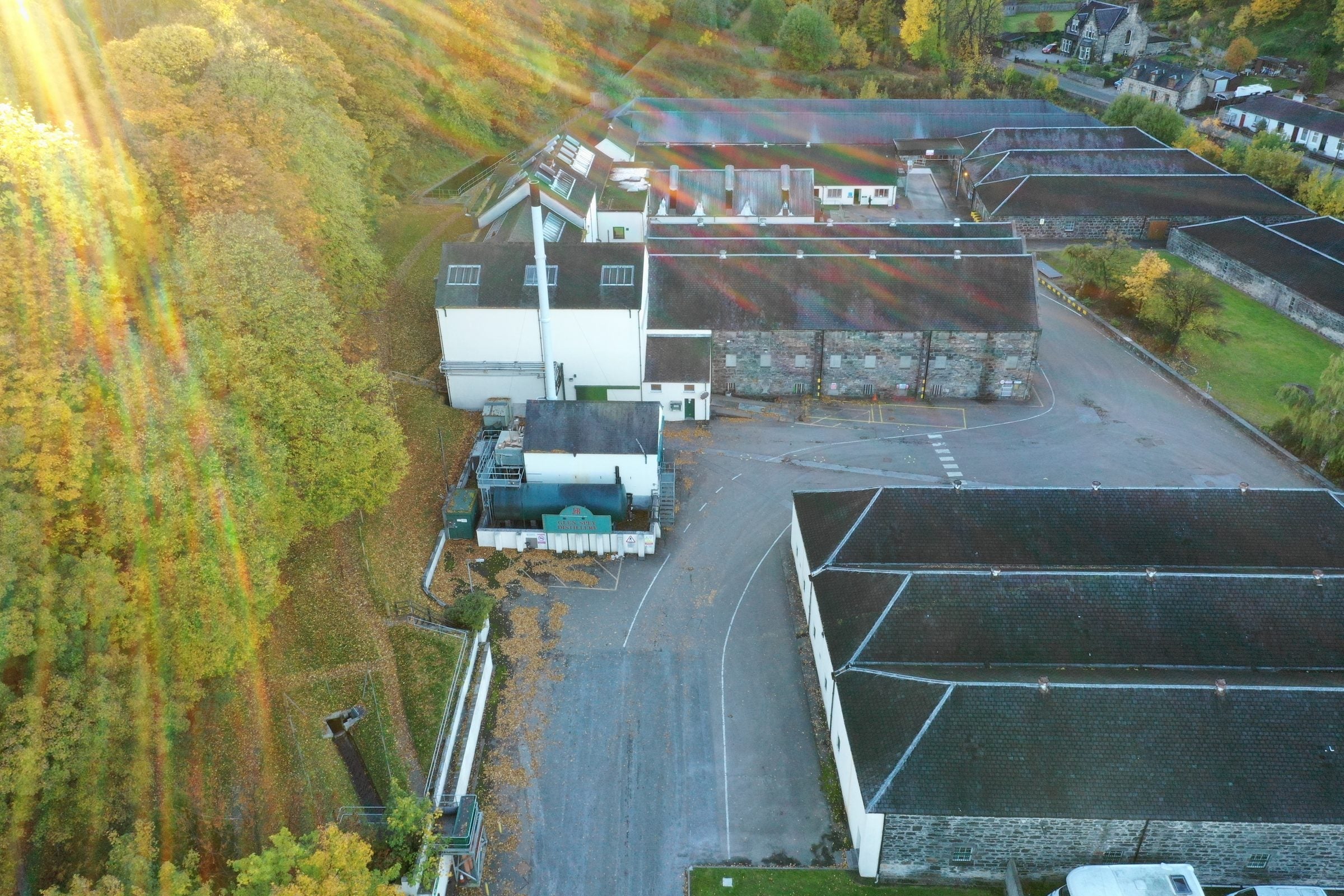
Glen Spey from above
We flew the drone over Glen Spey to catch the tight cluster of Rothes rooftops that surrounds it, a reminder of just how many distilleries share this one small stretch of the River Spey.
History
Glen Spey began life in 1878 as the Mill of Rothes, an oatmeal mill converted into a distillery by James Stuart, a local corn merchant. The site sits below the site of Rothes Castle, once home to the Earls of Rothes until it burned down in 1662, so whisky has effectively been made in the shadow of a ruin for almost a century and a half. Stuart renamed the operation Glen Spey in 1885, and two years later sold it to the London gin and wine merchant W & A Gilbey for £11,000. Gilbey already had ambitions in Scotch, and Glen Spey became one of the first distilleries a major English drinks house owned outright, a pattern that would repeat itself across Speyside over the following century.
The distillery was seriously damaged by a fire in 1920 and had to be substantially rebuilt, though detailed records of the incident are thin. Ownership shifted again in 1962, when Gilbey's merged with United Wine Traders to form International Distillers and Vintners, and it was under IDV that the distillery had its most significant production overhaul: a 1970 rebuild doubled the stills from two to four and reshaped Glen Spey into the plant that still stands today. Grand Metropolitan acquired the business in 1972, and when Grand Met merged with Guinness in 1997 to create Diageo, Glen Spey came along as part of the deal. It has been a Diageo distillery ever since, one of dozens feeding the group's blending needs rather than chasing single malt fame.
Locally, Glen Spey has picked up a ghost story along the way, a tale of a soldier said to have been electrocuted on site during the Second World War, kept alive more by word of mouth around Rothes than by any documented record. True or not, it fits a distillery that has spent most of its life working quietly rather than telling its own story.
How Glen Spey makes its whisky
Water is drawn from Doonie's Well, a source shared with several of Glen Spey's Rothes neighbours, in a town where five distilleries sit within walking distance of one another. The malt is unpeated and bought in from commercial maltsters; Glen Spey's own floor maltings closed decades ago, as they did almost everywhere once centralised malting became standard practice. Fermentation runs long, typically 55 to 75 hours, in wooden washbacks, giving the wash time to develop the fruity esters that carry through into the new make.
The real character of Glen Spey comes from its stills. All four, two wash and two spirit, are lantern shaped with constricted necks, and each is fitted with a purifier: a small secondary condenser sitting between the still's neck and the main condenser that catches heavier, oilier vapour and sends it back down to be redistilled rather than letting it pass straight through. The effect is a longer, more selective journey for the spirit and a noticeably lighter, cleaner new make than a plain pot still would give. Purifiers are unusual kit, only a handful of Diageo's malt distilleries use them, and Glen Spey shares the approach with its Rothes-area cousin Strathmill, another purifier-built malt with the same instinct for restraint over weight.
New make comes off at a fairly high strength and is filled into cask at around 63.5% ABV. Almost all of it is destined for blending, historically most closely associated with J&B, alongside Auchroisk and other Speyside malts built for the same purpose, though as with most Diageo distilleries today the precise blend allocations are not publicised.
What does Glen Spey taste like?
Glen Spey is built to be light rather than loud. The distillery's own description of its Flora and Fauna bottling calls it smooth and lightly fruity, with tropical notes of ripe peach and pineapple and a hint of lemon. On the nose that translates as greengages and white grapes, with an occasional wisp of something smoky in the background despite the unpeated malt, likely a trick of the wood rather than the spirit. The palate is medium bodied and warming, with light sweetness balanced by a touch of acidity, and the finish is dry and medium length, closing on notes of chocolate and coconut. Other tasters find more nuttiness and grassiness in the mix, along with a gentle vanilla sweetness from the cask, all consistent with a spirit engineered to sit quietly inside a blend rather than dominate a glass on its own.
Glen Spey and independent bottlers
Diageo has released remarkably little Glen Spey under its own name. The mainstay is the Flora and Fauna 12 Year Old, part of the range United Distillers launched in the early 1990s specifically to give lesser-known malts like this one an official outlet, alongside occasional Special Releases and travel exclusives. Beyond that, almost everything the whisky world knows about Glen Spey as a single malt has come from independent bottlers. Gordon & MacPhail's Connoisseurs Choice range has featured Glen Spey for decades, drawing on a long-standing relationship with Speyside distilleries that predates most of the modern independent bottling scene, and Signatory and others have released it too. Whiskybase currently lists several hundred distinct Glen Spey bottlings, and older vintage releases from the 1970s through the 1990s regularly score well among collectors who follow the make closely, evidence of a small but genuine following for a whisky most drinkers have never knowingly tasted.
The Single Cask and Glen Spey
We have bottled Glen Spey twice, and both times we went somewhere the official range never does: casks that had previously held Laphroaig. Our cask 801878A was distilled in 2008 and bottled at 13 years old, cask strength 57.3%, finished in a Laphroaig quarter cask. The result nosed of dusky oak, white pepper, hints of peat, white wine, green tea and sea salt, with camphor and pencil shavings underneath, and it carried that same interplay of malt, oak and gentle peat through to a medium length finish with lime and sage.
Our cask 801879 went further. Distilled on 17 March 2008 and bottled at 16 years old, cask strength 58.5%, it spent its finishing period in an ex-Laphroaig PX hogshead, one of the more unusual combinations we have put a Speyside spirit through, and it yielded an outturn of 267 bottles. The nose opened on stewed apples and crushed pears before the peated cask pushed through with smoked mackerel, game meat, burning heather and gorse, the apples turning almost scorched and sitting beside salty driftwood and anchovies in oil. On the palate that same fragrant fruit met pine needles and earthy peat, with smoked duck fading into iodine and seaweed on the finish. We categorised it as one of our bolder releases, and it earns that tag.
Both casks chose peated finishing wood deliberately, to see what happens when Glen Spey's usual delicacy meets real Islay smoke, and in both cases the base spirit's fruit held its ground rather than disappearing under the peat. Both bottlings have now sold through, so we do not have Glen Spey in stock at the moment, but they show what an independent bottler can do with a malt that almost never gets this kind of individual attention.

Collectability and cask ownership
Glen Spey does not get chased on the secondary market the way big single malt names do, and its thin official range means there is very little competing inventory to dilute interest in the bottlings that do exist. That has kept older independent releases within reach of collectors who value genuine scarcity over a famous label, and whiskybase data shows vintage bottlings from the 1970s through the 1990s holding steady interest and consistently strong scores at auction, even though trading volumes stay modest. A light, blend-oriented spirit like this will never sit among the small circle of malts that command headline prices, and that is worth being honest about. As with any cask, ownership involves risk and values can go down as well as up, this is not financial advice. If you are weighing up how cask size affects both maturation and eventual bottle count, our guide to whisky cask sizes and types is a sensible place to start before committing to anything.
Glen Spey FAQs
Who owns Glen Spey distillery?
Diageo. The distillery passed from its founder James Stuart to the London merchant W & A Gilbey in 1887, then through International Distillers and Vintners and Grand Metropolitan before landing with Diageo when it formed in 1997.
Is Glen Spey peated?
No, the distillery's own malt is unpeated. Any smoke you find in a Glen Spey whisky, including our own bottlings, has come from finishing in a cask that previously held a peated whisky, not from the original spirit.
Can you visit Glen Spey distillery?
No, it is a working production site with no visitor centre and no public tours.
Why is Glen Spey single malt so hard to find?
Almost all of its output goes into blending, historically associated with J&B. Diageo's own single malt releases have been limited mainly to the Flora and Fauna 12 Year Old, so most people who have tasted Glen Spey as a single malt have done so through an independent bottler.
Can you buy a cask of Glen Spey?
Occasionally. Diageo casks including Glen Spey do reach independent bottlers from time to time, usually through long-standing broker and bottler relationships rather than direct sale, and supply is inconsistent. Ask us and we will tell you honestly what is realistic at the moment.
Plan a bottling inspired by Glen Spey
Glen Spey is a Diageo distillery, and Diageo does not sell casks directly to individuals or independent bottlers. Whatever reaches the open market does so through established relationships, the kind Gordon & MacPhail has held for decades, and it surfaces occasionally rather than on demand. We have managed it twice ourselves, both times through exactly that sort of route. That is not the same as impossible, and it is not the same as readily available either, it is simply inconsistent, and we would rather tell you that plainly than oversell it.
If a cask of Glen Spey itself is not available when you ask, we can point you toward close alternatives instead: another light, purifier-built Speyside blending malt with a similar fruity, floral character, Strathmill and Auchroisk both share that lineage and we work with each of them, or, if it is the peated-finish style of our own Glen Spey bottlings that appeals, a different base spirit taken through the same treatment.
Either way, a real bottling project starts with a conversation. Tell us the flavour or distillery style you have in mind, roughly how many bottles you need, your approximate budget, a preferred bottling date, and whether this is for a brand, a retailer, a hospitality business, a company, a club, an event or purely private use. Let us know too if you will need help with naming, labels, storage or the bottling itself, whether through our own bonded warehouse or elsewhere. We will come back with an honest view of what is actually available, sensible alternatives if the named distillery is not one of them, an indication of likely bottle yield, the main costs and stages involved, and a practical route from cask selection through to finished bottles.
Curious about buying a whisky cask, or about building a private label bottling around a distillery like this one? Get in touch and we will talk it through properly.
Work with The Single Cask
Buy a whisky cask, bottle under your own label, or store casks in our HMRC approved bonded warehouse in Fife.
Read more
Cardhu Distillery: The Single Malt Hiding Inside Johnnie Walker
Cardhu quietly ranks among the best-selling single malts in the world, yet almost everything it makes goes into Johnnie Walker. Here is the story of the farm that started it, the 2003 controversy t...
Read more
Glencadam Distillery: The Highland Malt That Waited 200 Years
Founded in 1825 and quietly run by Angus Dundee since 2003, Glencadam only opened its doors to visitors in 2025. We look at the East Highland distillery's floral, creamy style, the single cask we b...
Read more


