
Cardhu Distillery: The Single Malt Hiding Inside Johnnie Walker
In December 2003, Diageo tried something with Cardhu that blew up in its face almost overnight: pulling the well-loved 12 year old single malt from shelves and replacing it with a blended malt called Cardhu Pure Malt, in packaging close enough to the original that plenty of drinkers picked it up without noticing the switch. The backlash from retailers, rival distillers and the Scotch Whisky Association was fierce enough that Diageo restored the single malt within three years, and the row is still cited as one of the moments that pushed the industry towards clearer labelling rules.
It is a strange footnote for a distillery that quietly ranks among the best-selling single malts on earth, mostly by staying out of the spotlight. Cardhu spends most of its life as the fruity, honeyed backbone of Johnnie Walker, and only a small share of what it makes ever reaches a single malt bottle. That combination, huge output and genuine scarcity for anyone outside Diageo, makes it an interesting case for anyone thinking about independent bottling.
Cardhu at a glance
| Region | Speyside, Knockando, Moray, on Mannoch Hill above the River Spey |
| Founded | Illicit production from around 1811; licensed in 1824 |
| Owner | Diageo |
| Capacity | Typically quoted at around 3.4 million litres of pure alcohol a year |
| Stills | Six: three wash, three spirit, colour-coded red and light blue |
| Water source | Springs on Mannoch Hill, supplemented by the Lyne Burn |
| Fermentation | Around 75 hours, long for a distillery this size |
| Malt spec | Lightly peated |
| Style | Pear, apple and honey, with spicy wood and a trace of smoke |
| Visitor centre | Yes, reopened in 2021 as Johnnie Walker's Speyside home |

History
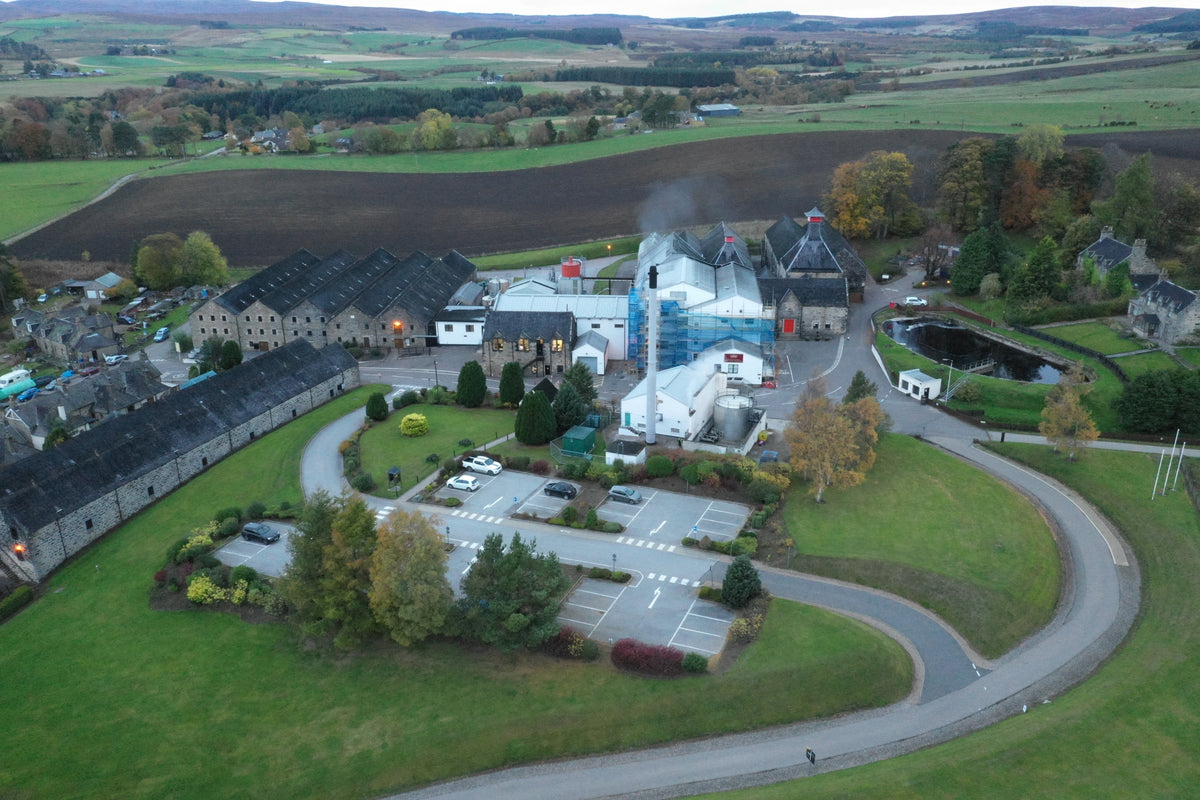
Cardhu from above
From the air, Cardhu sits low among Speyside's farmland on Mannoch Hill, its pale buildings giving little away about two centuries of history or its present life as Johnnie Walker's Speyside visitor home. The footage below shows that quiet, workaday setting better than any ground level photograph can.
Cardhu's story starts, like a good number of Speyside distilleries, with a farm and a still that was never meant to be found. John and Helen Cumming began distilling at Cardow farm around 1811, well before it was legal to do so, and Helen is remembered as one of whisky's sharpest early operators. Two versions of the same trick survive: that she flew a red flag from the farmhouse to warn neighbouring smugglers when excisemen were approaching, and that she threw flour over herself and claimed to be baking bread when officers called. Diageo's own retelling, built into the current visitor centre, leans on the flag, and a red flag installation there nods to her today.
The 1823 Excise Act made small-scale legal distilling viable for the first time, and the Cummings took out a licence in 1824, among the earliest Speyside farms to do so. The real transformation came later, under John Cumming's daughter-in-law Elizabeth. She rebuilt and enlarged the distillery in the mid-1880s, sold the old plant to a neighbouring farmer named William Grant, who put it towards starting his own distillery at Glenfiddich, and then sold Cardow itself to John Walker & Sons in 1893 for £20,500, a considerable sum at the time. It proved a shrewd deal: Walker's protection helped the distillery weather the Pattison crash that flattened so many of its neighbours a few years later.
From there the ownership trail runs through the twentieth century's great whisky consolidations: into the Distillers Company in 1925, to Guinness when it took over DCL in 1986, and into Diageo when Guinness merged with Grand Metropolitan in 1997. The distillery traded for decades as Cardow before the single malt brand was renamed Cardhu in 1981, a small spelling change that stuck. Then came the 2003 Pure Malt episode, brought on by a genuine shortage: Cardhu had become so popular, particularly in Spain, that Diageo ran short of aged stock and reached for a blended malt to fill the gap rather than let the brand go dark. It was a costly lesson in what drinkers will and won't tolerate when a label changes meaning without saying so.
How Cardhu makes its whisky
Water comes from springs on Mannoch Hill, topped up by the Lyne Burn when the distillery needs it. The mash tun is stainless steel with a distinctive copper dome, taking in around eight tonnes of malt a batch, and the malt itself is lightly peated rather than the fully unpeated spec some drinkers assume for a Johnnie Walker workhorse. Ten washbacks handle fermentation, an unusual mix of Scottish larch, Douglas fir and stainless steel, and fermentation runs to around 75 hours, noticeably longer than many distilleries of comparable size. That extra time is a large part of where Cardhu's fruit comes from.
The six stills are arranged as three wash and three spirit, with fittings colour-coded red for wash and light blue for spirit so operators can tell them apart at a glance, a small practical touch rather than a design flourish. The wash stills are relatively plain in shape; the spirit stills carry a fuller, rounder profile that helps keep the spirit soft and fruity rather than heavy. The great majority of what comes off those stills is destined for blending, chiefly Johnnie Walker, and only a modest proportion is set aside each year for Cardhu's own single malt range, which is one reason the brand can be simultaneously huge in blend form and comparatively hard to find as an independent single cask.
What does Cardhu taste like?
The house style is soft and orchard-driven: ripe pear and apple up front, a good measure of honey, and a gentle spiciness from the wood that never turns aggressive. Diageo's own tasting notes point to orchard pear, apple and honey with a hint of spicy wood and a trace of smoke, and that trace of smoke is the giveaway that the malt is lightly peated rather than clean. Older independent releases at cask strength, mostly aged sherry-cask examples from the 1970s bottled decades later, show a darker, more mature side, dried fruit and clean oak sitting over the same fruity core, but the everyday character of Cardhu is gentle and approachable rather than assertive. It is, in short, built to slot smoothly into a blend without shouting over anything else in the vatting, which happens to also make it a pleasant, easy dram in its own right.
Cardhu and independent bottlers
Very little Cardhu reaches the independent market, and it has for a long time. Diageo keeps the bulk of production for Johnnie Walker and releases the rest through its own channels, an official 12 year old core range, occasional Special Releases such as the 2008 vintage bottled at 11 years old and the 2006 vintage bottled at 14, and older Rare Malts editions from the 1990s and early 2000s at cask strength. Signatory has put out aged single casks from 1974 vintages, and more recently a handful of younger casks have surfaced through brokers, including a 2013 vintage bottled at ten years old by Old Particular, so the tap has not run completely dry. It is simply a thin trickle rather than a steady supply, which is worth knowing if you come across a Cardhu single cask and are wondering whether it is common. Speyside distilleries generally vary a great deal in how freely they release stock to independent bottlers, and Cardhu sits firmly at the tightly-held end of that spectrum.
The Single Cask and Cardhu
We have not bottled Cardhu, and we would rather say that plainly than dress it up. The reason is straightforward: Diageo retains almost everything this distillery makes for Johnnie Walker, and the small amount left over rarely finds its way to brokers we buy from. It is not a question of us passing on the whisky, there simply has not been a genuine, verifiable cask available to us at a price and quality we could stand behind. If one turns up, and the trickle of independent releases from other bottlers shows it does happen occasionally, we would look at it seriously, because a lightly peated, honeyed Speyside malt with this pedigree is exactly the kind of make we like to work with.
In the meantime, we have bottled other Diageo distilleries that play a similar role feeding a major blend, and they give a genuine sense of what a well-chosen sister cask can offer. Auchroisk, the backbone of J&B, and Glen Elgin, long relied on for White Horse, are both distilleries we know first-hand, both quietly excellent as single malts, and both far easier to find as independent casks than Cardhu. If Cardhu itself is not available when you ask, that is usually where our conversation with you would go next.
Collectability and cask ownership
Cardhu's collector interest sits in an unusual spot. As a brand it is enormous and well recognised, which keeps demand for official bottlings, especially older Cardow-labelled expressions from the 1970s and 1980s and the Rare Malts cask-strength releases, reasonably steady at auction. It has never been chased as hard as the true blue-chip Speyside names, partly because so much of its reputation rests on blending rather than a headline single malt story. Independent bottler releases are the opposite case: there are so few of them that each one tends to draw attention from collectors who focus specifically on distilleries that rarely get bottled outside Diageo, purely because of how uncommon they are.
None of this should be read as a promise of where prices go next. Cask ownership involves risk, and values can go down as well as up, this is not financial advice. If you are new to the idea of holding a cask rather than a bottle, our guide to whisky cask sizes and types is a sensible place to start before you commit to anything.
Visiting
Cardhu reopened to visitors in June 2021 after a substantial refit, part of a wider £185 million programme by Diageo to overhaul Scotch whisky tourism that also touched Clynelish, Glenkinchie and Caol Ila as the four Johnnie Walker "corners of Scotland" experiences. The new visitor centre leans hard into the Cumming family story: a story room built around animation from the Scottish studio Eyebolls, a red flag installation echoing Helen Cumming's warning signal, and a Tasting Kitchen where visitors can try both traditional drams and Highball-style serves. Tours run through the mash tun and stillhouse and finish with a tasting, and the site sits within easy reach of Craigellachie and Aberlour if you are touring more than one Speyside distillery in a day.
Cardhu FAQs
Who owns Cardhu distillery?
Diageo, which took ownership in 1997 when Guinness merged with Grand Metropolitan. Before that the distillery had passed through Distillers Company and, originally, John Walker & Sons, who bought it from the Cumming family in 1893.
Is Cardhu peated?
Lightly peated. It is not a smoky whisky in the Islay sense, but the malt specification includes a light peating level that shows up as a faint trace of smoke behind the pear, apple and honey.
What happened to Cardhu in 2003?
Diageo replaced the 12 year old single malt with a blended malt called Cardhu Pure Malt, in similar packaging, after demand outstripped aged stock. The reaction from drinkers and the wider industry was strong enough that Diageo restored the single malt by 2006.
Can you visit Cardhu?
Yes. The distillery reopened its visitor centre in June 2021, rebuilt as Johnnie Walker's Speyside home, with tours, a tasting kitchen and exhibits telling the Cumming family story.
Can you buy a cask of Cardhu?
Rarely, and only occasionally. Diageo keeps almost all of Cardhu's output for Johnnie Walker, so independent casks surface far less often than for most Speyside distilleries. It has happened in recent years through specialist brokers, so it is not impossible, just uncommon. Ask us and we will tell you honestly what we know of current availability.
Why is Cardhu sometimes called Cardow?
Cardow was the distillery's name for most of its history, taken from the farm and the Gaelic Carn Dubh, meaning black rock. The single malt brand was renamed Cardhu in 1981, and the two names still turn up side by side on older bottlings.
Plan a bottling inspired by Cardhu
If your heart is set on a cask carrying the Cardhu name specifically, we want to be honest rather than encouraging: it is genuinely one of the harder Speyside distilleries to source from, because Diageo holds back the overwhelming majority of production for Johnnie Walker. That said, it is not a flat no. Independent releases have appeared periodically, including a relatively recent 2013 vintage bottled by a broker in 2023, so a small amount does move through the market from time to time. What we can promise is that we will tell you plainly what we can find and won't pretend a cask is available when it isn't.
Most projects that start by asking for a specific distillery end up better served by thinking about the whisky style first and the name second. A fruity, honeyed, lightly peated Speyside profile like Cardhu's can often be matched, sometimes closely, through other casks we have access to, including distilleries like Auchroisk and Glen Elgin that share a similar blending pedigree and are considerably easier to buy into. Whether you are planning a bottling for a drinks brand, a retailer, a hospitality venue, a company gift, a whisky club, an event or simply for yourself, tell us the flavour or distillery style you are chasing, roughly how many bottles you need, your approximate budget, when you would like to bottle by, who the bottling is for, and whether you will need help with naming, labels, storage or the bottling run itself.
From there we can give you an honest view of what is realistically available, suggest alternatives when the named distillery is out of reach, estimate the bottle yield you can expect from a given cask size, set out the main costs and stages involved, and map a practical route from choosing a cask through to finished bottles in your hands. Our independent bottling service and private label whisky pages cover how that process works in more detail, and casks we hold can mature and wait in our own bonded warehouse until you are ready. Get in touch and we will start with a straight answer.
Work with The Single Cask
Buy a whisky cask, bottle under your own label, or store casks in our HMRC approved bonded warehouse in Fife.
Read more
Glendullan Distillery: Diageo's Biggest Secret
Glendullan produces around 3.7 million litres of spirit a year for Diageo, yet Whiskybase lists barely 300 independent bottlings of it. We bottled one ourselves, here is the full story of Scotland'...
Read more
Glen Spey Distillery: The Oatmeal Mill That Still Feeds J&B
Glen Spey is one of five distilleries packed into Rothes, built from an old oatmeal mill and fitted with rare purifier stills that keep its spirit light enough for J&B. We bottled two casks fin...
Read more


