
Glenfiddich Distillery: History, Whisky & Casks
Glenfiddich distillery sits on the northern edge of Dufftown in Speyside, where William Grant began building it by hand in 1886 with the help of his nine children and a set of second-hand stills bought from Cardhu for £120. The name is Gaelic for "valley of the deer" (hence the stag on every bottle), and the first spirit ran on Christmas Day 1887. What followed is arguably the most consequential story in Scotch whisky: this is the distillery that decided, in 1963, to sell single malt to the world, and for most of the decades since it has been the best-selling single malt on the planet, trading the top spot with The Glenlivet in recent years depending on whose figures you read.
It is also still family-owned. William Grant & Sons remains in the hands of the fifth generation of Grants, which makes Glenfiddich the rare industrial-scale distillery, producing around 21 million litres of pure alcohol a year, that answers to a family rather than a multinational. That independence shapes everything, including the fact that genuine independent bottlings of Glenfiddich are among the scarcest things in whisky. As an independent bottler ourselves, we find that both frustrating and rather admirable. This guide is part of our series on Scotland's distilleries.
Glenfiddich at a glance
| Region | Speyside (Dufftown, Banffshire) |
| Founded | 1886; first spirit Christmas Day 1887 |
| Owner | William Grant & Sons, family-owned since founding |
| Capacity | Approximately 21 million litres of pure alcohol per year |
| Stills | Around 43 small copper pot stills across two still houses; the original still house is direct gas-fired |
| Water source | The Robbie Dhu spring |
| Style | Fresh and fruity: pear, apple, gentle oak |
| Cask policy | Ex-bourbon and European oak sherry, on-site cooperage; casks are not traded to independent bottlers |
| Visitor centre | Yes, open to the public since 1969, one of the first in Scotland |
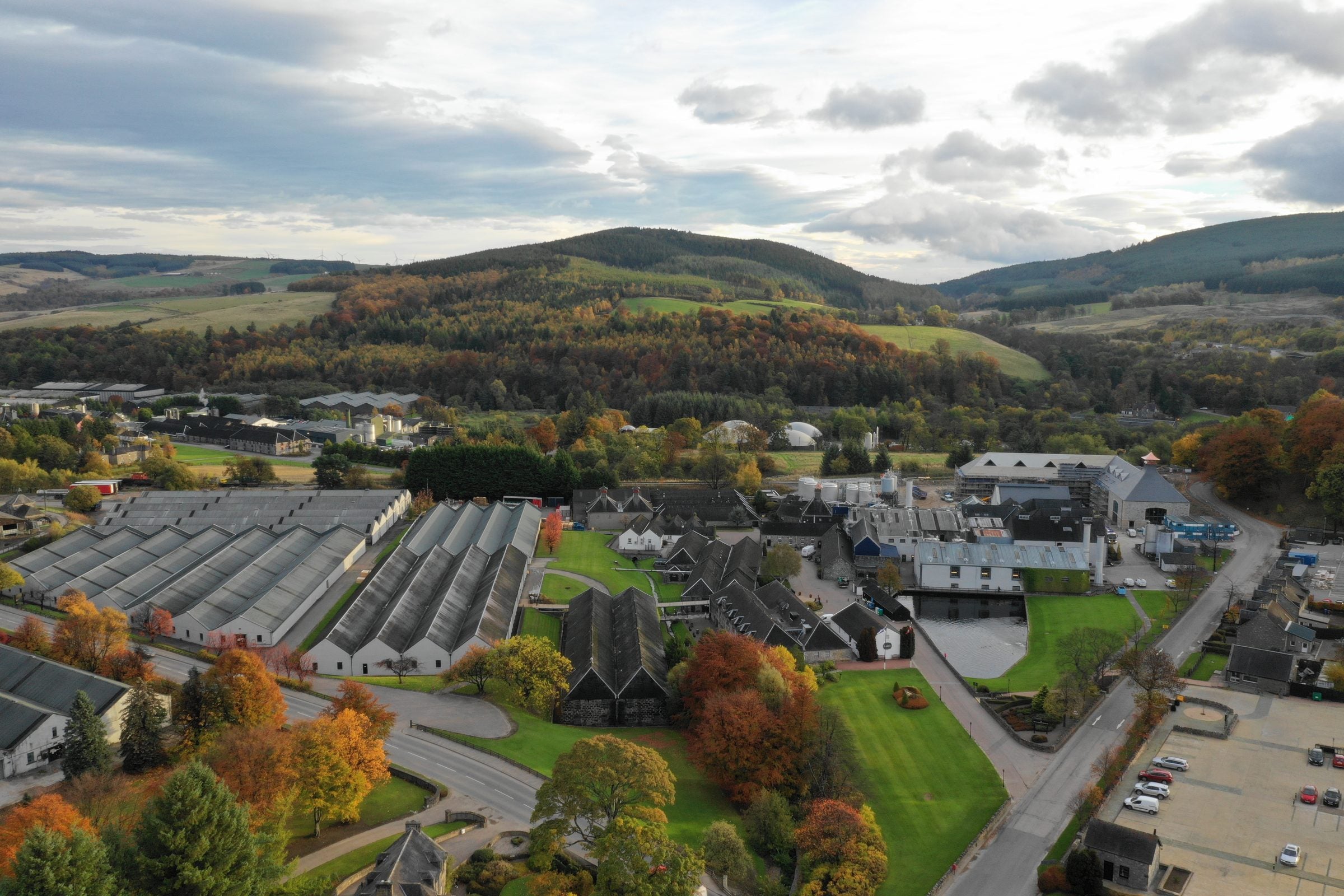
Glenfiddich from above
Our drone flew over Dufftown to capture the sheer scale of Glenfiddich from the air: two still houses, the cooperage and rank after rank of warehouses spread through the glen of the River Fiddich.
History of Glenfiddich
William Grant spent twenty years working at Mortlach distillery before striking out on his own. In the autumn of 1886 he bought a field near Balvenie Castle, acquired Cardhu's old stills from Elizabeth Cumming for £120, and built his distillery largely by hand with his family and a single stonemason. Spirit first flowed on Christmas Day 1887, a detail the marketing department has, understandably, never let anyone forget.
For its first seventy-odd years Glenfiddich did what every Speyside distillery did: it fed the blends. The pivotal moment came in 1963, when the Grant family took the then-eccentric decision to market Glenfiddich as a single malt outside Scotland. At the time, "Scotch" meant blended whisky to almost everyone on earth. The gamble, backed by the distinctive triangular bottle introduced in 1961 and, from 1969, the industry's first proper visitor centre, effectively invented the modern single malt category. Every distillery guide we write, including this one, exists downstream of that decision.
The family stayed put while the rest of the industry consolidated around them. Five generations of Grants have now run William Grant & Sons, which also built The Balvenie next door in 1892 and Kininvie on the same site a century later. In an industry where "heritage" is usually a word deployed by whichever conglomerate bought the brand most recently, 139 years of unbroken family ownership is genuinely unusual.
How Glenfiddich makes its whisky
Everything starts with the Robbie Dhu spring, which William Grant had the foresight to secure along with the surrounding land. It remains the distillery's sole water source for production, and the brand treats it with something approaching religious reverence.
The scale is enormous, roughly 21 million litres of pure alcohol a year, with dozens of Douglas fir washbacks feeding two still houses, but the method is deliberately old-fashioned. Rather than installing a handful of giant stills, Glenfiddich runs around 43 small ones, keeping the same modest proportions William Grant bought second-hand in 1886. The stills in the original still house are direct-fired by gas flame, a hotter, less forgiving method most of the industry abandoned decades ago; the newer still house, commissioned in 2020, runs on steam. Small stills and direct fire give more copper contact and a touch more weight to a spirit that is otherwise all about freshness.
Unusually, the site keeps its own coppersmiths to maintain those stills and its own cooperage to tend the casks, trades most distilleries outsourced generations ago. Maturation leans on ex-bourbon American oak and European oak sherry casks, with the majority of bottlings married across both.
Then there is the solera. In 1998 Glenfiddich borrowed a trick from sherry bodegas and installed a large Oregon pine solera vat for its 15-year-old: whiskies matured in bourbon, sherry and new oak casks are married in the vat, which is never emptied below halfway, so a thread of older liquid runs through every batch. It is one of the more genuinely interesting pieces of process in mainstream Scotch, and it costs less than a tenner extra on the shelf.
What does Glenfiddich taste like?
Fresh pear is the calling card, so much so that the brand put a pear tree on the 12-year-old's packaging. Around it you'll find green apple, cut grass, a little honey and cream, and soft, well-mannered oak. It is a light, precise, orchard-fruit style of Speyside malt, engineered to be approachable, and it is approachable in about 180 countries.
The range deepens as it climbs. The 15-year-old Solera adds baked apple, sultana and warm spice from that perpetual vat. The 18-year-old brings more sherried richness and baked orchard fruit; the 21-year-old, finished in Caribbean rum casks, layers toffee and banana over the house freshness. Above that sit the seriously old stocks, 30, 40 and 50 years, where the pear note survives, remarkably, under decades of polished oak. If you enjoy this style, our guide to Linkwood covers another distillery working similar orchard-fruit territory, with one crucial difference we'll come to now.
Why you almost never see independent Glenfiddich
Here is the collector's paradox: the world's most ubiquitous single malt is one of the rarest things in the independent bottling world. William Grant & Sons does not trade casks. There is no reciprocal exchange with blenders of the kind that lets casks of most Speyside malts drift onto the broker market, and there is no official cask sales programme. What the family makes, the family keeps.
The tiny quantity that does escape is "teaspooned": a spoonful of another malt, typically Balvenie, is added to each cask before it leaves the site, so the contents legally become a blended malt and can never be labelled Glenfiddich. These casks circulate under the trade name Wardhead, just as teaspooned Balvenie goes by Burnside. When you see a Wardhead from an independent bottler, you are looking at Glenfiddich in all but name, and the name, of course, is the point. The teaspoon protects the brand while quietly conceding that the liquid is good enough to protect.
For collectors, this means official bottlings are effectively the only game in town. For cask buyers, it means anyone offering to sell you "a cask of Glenfiddich" deserves very hard questions indeed. And for independent bottlers like us, it means finding that bright Speyside character elsewhere, which, happily, is not difficult. Our bonded warehouse in Scotland holds single casks from distilleries such as Craigellachie and Linkwood, workhorse Speysiders that rarely headline but regularly outperform their reputations at cask strength.
Collectability and auction interest
Old official Glenfiddich commands serious money. The benchmark is the 1937 Rare Collection: 61 bottles drawn from cask 843 after 64 years, one of which sold at Bonhams in Edinburgh in October 2016 for £68,500, at the time a record for any Glenfiddich at auction and a Scottish auction house record for a single malt. The distillery's 50-year-old releases sit in five figures on release and climb from there, while the Grand Series, the 21-year-old Gran Reserva rum finish, the 23-year-old Grand Cru and the cognac-cask 26-year-old Grande Couronne, gives the brand a luxury tier aimed squarely at the gifting and collecting market.
The honest caveats. Whisky values can fall as well as rise, and the secondary market has cooled noticeably since its 2022 peak. Bottle and cask trading is unregulated: no ombudsman, no compensation scheme, and headline auction results say little about what an ordinary bottle will fetch after fees. Anyone considering casks rather than bottles should also budget for storage, insurance, regauging and the eventual costs of bottling or resale before counting any theoretical gain; none of this is financial advice. We set out how ownership actually works, costs included, on our buy a whisky cask page. Buy whisky you would be content to drink; treat any profit as a bonus.
Visiting Glenfiddich
Glenfiddich opened its doors to the public in 1969, before distillery tourism was really a concept, and it shows: this is one of the most visited distilleries in Scotland, welcoming in the region of 125,000 people a year through a visitor centre rebuilt in 2005. Tours run from accessible introductions through to in-depth tastings of older stock, and the site itself, still houses, cooperage, warehouses and all, is genuinely impressive at scale.
Dufftown repays a longer stay. The town built on "seven stills" has The Balvenie next door (tours are small and book out well ahead), Mortlach and Diageo's own Dufftown distillery across town, and the wider Speyside region within easy reach.
Glenfiddich FAQs
Who owns Glenfiddich?
William Grant & Sons, the independent family company founded by William Grant, who built the distillery in 1886 to 1887. The firm is now run by the fifth generation of the family and also owns The Balvenie and Kininvie distilleries on the same Dufftown estate.
Is Glenfiddich the best-selling single malt in the world?
It held that title for most of the modern era and still sells in around 180 countries. Recent industry figures put The Glenlivet ahead on pure volume, and the two brands have traded the top spot for years. Either way, Glenfiddich created the category: it was the first single malt actively marketed worldwide, from 1963.
Why are independent bottlings of Glenfiddich so rare?
William Grant & Sons does not trade or sell its casks, so stock almost never reaches brokers or independent bottlers. The little that leaves the site is "teaspooned" with a splash of another malt, making it a blended malt sold under the trade name Wardhead, legally barred from carrying the Glenfiddich name.
What does Glenfiddich mean?
It is Gaelic for "valley of the deer", after the glen of the River Fiddich where the distillery stands, which is why a stag has appeared on the label since the brand's earliest days.
Is Glenfiddich peated?
No, the house style is unpeated, built on fresh pear and orchard fruit. The distillery has experimented at the margins, notably the peated Fire & Cane release in its Experimental Series, but smoke is the exception rather than the rule.
Can I buy a cask of Glenfiddich?
Realistically, no. There is no official cask sales programme and casks do not reach the open market, so treat any offer of a "Glenfiddich cask" with extreme scepticism. Casks from other excellent Speyside distilleries do come to market legitimately, and our cask ownership guide explains how.
Explore single cask Speyside whisky with The Single Cask
Glenfiddich casks don't come to market, but the flavours that made Speyside famous certainly do. Our single cask Speyside bottlings are drawn from our own bonded warehouse in Scotland: natural colour, non-chill filtered, cask strength, one cask at a time.
If owning a cask appeals, we can source Speyside casks with genuine provenance and store them in our warehouse until you're ready. Read our four steps to bottling your own whisky, explore cask ownership, or simply get in touch and talk to a human who spends their days nosing casks rather than selling spreadsheets.
Work with The Single Cask
Buy a whisky cask, bottle under your own label, or store casks in our HMRC approved bonded warehouse in Fife.
Read more
Dalmunach Distillery: Speyside's £25 Million Newcomer
Built on the bones of the lost Imperial distillery, Dalmunach is one of Speyside's most striking modern distilleries. We bottled one of the first independent Dalmunach casks, here is the full story...
Read more
Caol Ila Distillery: Islay's Quiet Giant
Islay's biggest distillery is also its quietest achiever, and our house malt. The complete Caol Ila guide from the bottler that has released more than 40 of its casks.
Read more


