
Glengoyne Distillery: The Unpeated Malt on the Highland Line
There is a line painted through the middle of Glengoyne, and it is not a metaphor. The Highland Line, the old boundary that divides Highland Scotland from the Lowlands, runs through the distillery's grounds, so the stills stand in the Highlands while the casks sleep in warehouses just across the A81 in the Lowlands. Glengoyne makes Highland whisky and matures Lowland whisky, at the same time, on the same site, and has done since 1833.
That is only the second most unusual thing about the place. The first is what it refuses to do: no peat, ever. Every grain of barley is air-dried rather than smoked, which the distillery argues lets the slow-distilled, sherry-matured spirit speak without interruption. Half an hour from Glasgow, at the foot of Dumgoyne hill with a waterfall behind it, this is one of the prettiest and most quietly stubborn distilleries in Scotland.
Glengoyne at a glance
| Region | Highland, right on the Highland Line at Dumgoyne, Stirlingshire, with warehouses over the road in the Lowlands |
| Founded | 1833, licensed to George Connell as Burnfoot distillery |
| Owner | Ian Macleod Distillers, the family firm that bought it from Edrington in 2003 |
| Capacity | Typically quoted at around 1.1 million litres of pure alcohol a year |
| Stills | Three: one wash still and two spirit stills with boil bulbs, run famously slowly |
| Water source | The burn tumbling off Dumgoyne hill, which feeds the waterfall behind the distillery |
| Fermentation | Long, with figures of up to around 56 hours quoted |
| Malt spec | Completely unpeated; 100% air-dried barley, never smoke-dried |
| Style | Sweet, fruity and sherried: apples, toffee, dried fruit and gentle oak spice |
| Visitor centre | Yes, and one of Scotland's busiest, open year round |

Glengoyne from above
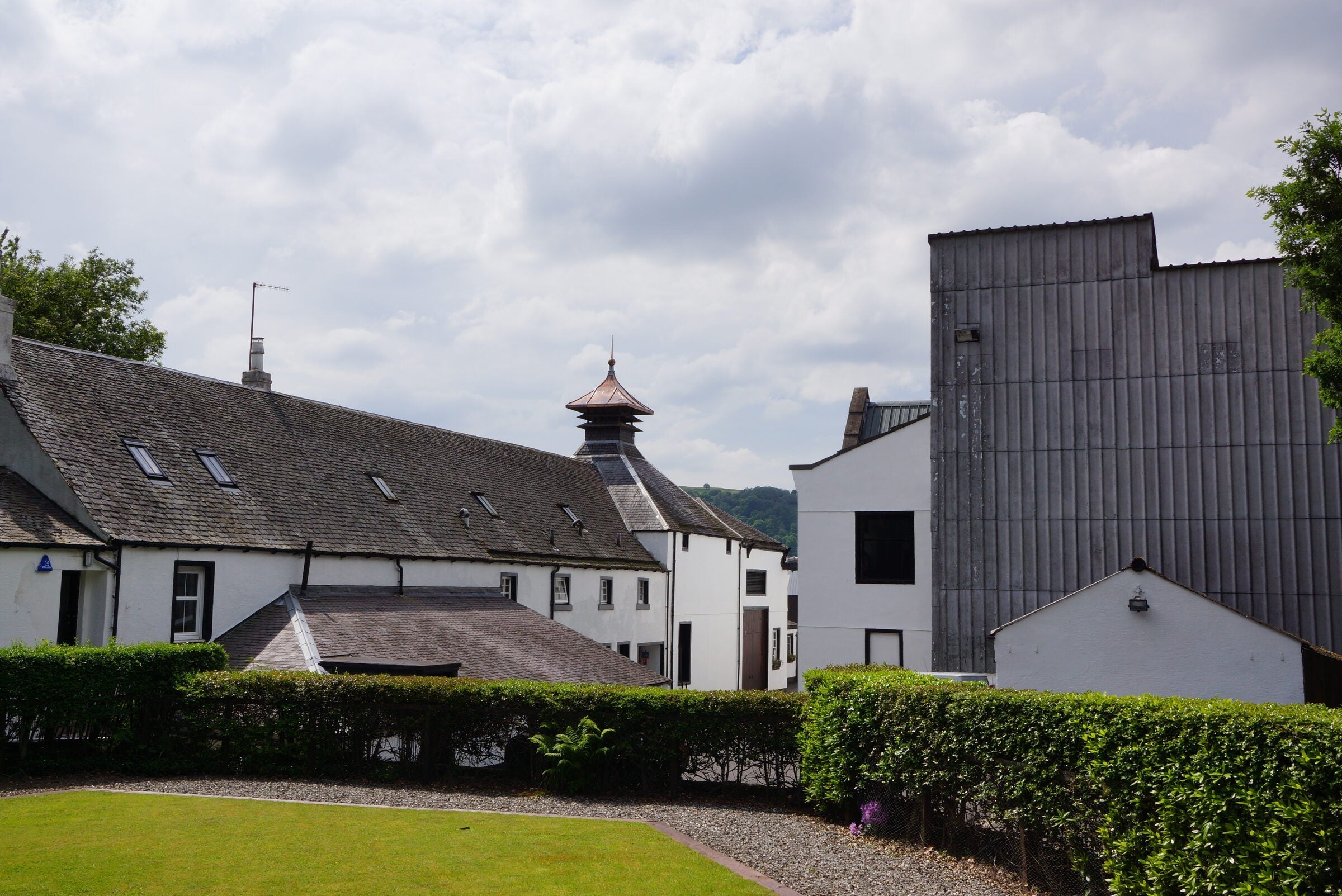
Few distilleries sit as photogenically as this one, and our drone made the most of it: the whitewashed buildings pressed against the wooded foot of Dumgoyne hill, the pagoda peeking through the trees, and the warehouses lying just across the road, technically in another whisky region. You can trace the Highland Line for yourself from the air.
History
Distilling around Dumgoyne is older than the paperwork. The glen behind the site, steep, wooded and conveniently hidden from the road, is exactly the sort of place illicit stills flourished in the early nineteenth century, and local tradition holds that whisky was being made here well before anyone thought to tell the excise. The record begins in 1833, when George Connell took out a licence for a small farm distillery called Burnfoot, on land at the foot of the hill.
Burnfoot passed through the McLelland family in the mid-nineteenth century before the Lang Brothers, whisky blenders from Glasgow, bought it in 1876. The Langs wanted malt for their blends and a name with more romance than "Burnfoot": they rebranded the distillery Glen Guin, usually translated as "glen of the wild geese", and by 1905 the spelling had settled into the modern Glengoyne. Glasgow was only an hour away by cart, and the distillery became, and remains, the closest thing the city has to a home distillery.
Lang Brothers stayed remarkably long in charge. Not until 1965 did the firm and its distillery join the Robertson & Baxter group, the business that would later become Edrington, owner of The Macallan and Highland Park. Under Edrington's wing Glengoyne was rebuilt and modernised in the 1960s and quietly supplied blends such as Langs and Cutty Sark, with single malt bottlings only becoming a serious focus in the 1990s as "the unpeated malt".
The modern chapter began in April 2003, when Edrington sold Glengoyne to Ian Macleod Distillers, the family-owned firm behind the Smokehead brand and, later, owner of Tamdhu and the revived Rosebank. The price is usually quoted at around £7.2 million. For a company that had spent decades blending and bottling other people's whisky, buying Glengoyne meant finally owning a distillery of its own, and it has invested in the brand ever since, building out a core range that now stretches from a 10-year-old to venerable 25 and 30-year-old expressions, and turning the site into one of the most visited distilleries in Scotland.
How Glengoyne makes its whisky
Glengoyne's production philosophy can be summarised in one word: slowly. The distillery claims the slowest distillation in Scotland. That's a marketing claim, admittedly, but one anchored in genuinely unhurried practice. The three stills (one wash, two spirit) are run at a gentle simmer rather than a rolling boil, giving the spirit vapour long contact with the copper. The spirit stills carry boil bulbs, the bulge in the neck that encourages reflux, sending heavier compounds back down for another pass. The result is a light, clean, estery new make with the rough edges polished off before it ever sees oak.
The barley is the other article of faith. Glengoyne uses no peat at all: its malt is dried with warm air, never smoke, so the phenol level is effectively zero. The distillery has long championed traditional barley varieties too, and for years made a point of using Golden Promise, the old-fashioned, low-yield variety also associated with The Macallan. Fermentation is long by industry standards, with figures of up to around 56 hours quoted, and that's part of what builds the fruity, appley character the make is known for. Water comes off Dumgoyne hill itself, via the burn that forms the small waterfall behind the stillhouse.
Then comes the part Glengoyne is perhaps most respected for: wood. Under Ian Macleod the distillery has leaned hard into sherry maturation, with European and American oak casks seasoned with sherry in Spain before being shipped to Scotland. First-fill sherry casks drive the richer end of the range, refill and bourbon wood keep the lighter bottlings bright, and because the warehouses sit in the cool, damp Lowlands just over the road, maturation is unhurried too. Unpeated spirit has nowhere to hide, which is why the distillery obsesses over its casks: there is no smoke to paper over a tired one. If you want to understand the difference a butt or a hogshead makes, our guide to cask sizes and types covers it in plain English.
What does Glengoyne taste like?
Orchard fruit, first and always. Fresh apples and pears in the young expressions, shading into stewed apple, toffee and dried fruit as the sherry wood takes hold. The 10 and 12-year-olds are bright and malty with vanilla and gentle spice; the 15 and 18 bring in more oloroso character, think raisins, walnuts, dark toffee, and the 21, 25 and 30-year-olds are unapologetically sherried, closer in spirit to Glenfarclas or old-school Macallan than to anything else made this far south. The Cask Strength batches, bottled without chill filtration at natural colour, are the enthusiast's pick and show how much texture the slow distillation leaves in the spirit.
What you will not find is smoke. Glengoyne built its modern identity on being "the unpeated malt", and the absence is the point: with no phenols in the way, the fruit, the wood and the malt do all the talking. Awards have followed. The distillery's teenage and older expressions have picked up golds at major competitions over the years, including honours at the San Francisco World Spirits Competition, but the house style has stayed consistent rather than chasing fashion.
Glengoyne and independent bottlers
Glengoyne is an interesting case in the independent market, because its owner is an independent bottler. Ian Macleod Distillers spent half a century bottling other distilleries' whisky before buying a distillery of its own, so it understands precisely what a single cask is worth, and it keeps its own make close. The overwhelming majority of Glengoyne goes into the official range, including the distillery's own single cask and hand-fill bottlings sold at the visitor centre.
Independent Glengoynes do exist. Casks escaped into the broker market in earlier eras, particularly under Lang Brothers and Edrington ownership, and bottlings from independent houses surface at auction from time to time. A handful of casks have also reached independent bottlers in the past year or so, so it does happen, but they are genuinely hard to find and tend not to stay available for long. That scarcity cuts both ways: harder for bottlers like us to buy, more interesting for collectors when one appears.
The Single Cask and Glengoyne
We will be honest: we have never bottled a Glengoyne. Casks from this distillery rarely reach the open market with provenance we can stand behind, because the family firm that owns it has little reason to sell them: it can bottle every good cask itself, and does. We would rather tell you that plainly than imply a bottling is around the corner.
The style, though, is one we know well and buy often. Unpeated, sherry-matured Highland and Speyside malt is a staple of our range: single casks chosen by taste, bottled at natural strength, without chill filtration or added colour, the same philosophy Glengoyne applies to its own Cask Strength releases. If the Glengoyne profile is your target, sherried casks from Glenfarclas country and beyond pass across our tasting bench through the year, and nearby Deanston shows what else the southern Highlands can do. Tell us what you love about Glengoyne and we will point you at whatever in our current range gets closest. Just get in touch.
Collectability and cask ownership
On the collecting side, Glengoyne rewards patience rather than speculation. The core range is widely available and priced to drink, but the older age statements (the 21, 25 and especially the 30), along with discontinued series, single casks from the distillery and the annual Cask Strength batches, all attract steady auction interest. Limited releases sold through the visitor centre have a habit of appreciating quietly, helped by the distillery's popularity with visitors and its loyal following among sherry-cask drinkers.
Cask ownership is more complicated. Ian Macleod does not operate an open cask sales programme for private buyers at scale, so genuine Glengoyne casks are uncommon on the private market, and any offer of one deserves careful scrutiny of its provenance and the paperwork attached. Closely held distillery names are, unfortunately, where questionable cask offers tend to congregate. If you are considering owning a cask from any distillery, start with the fundamentals: understand what kind of cask you are buying, where it is stored, and exactly what rights come with it. And remember the caveat that applies to every cask on earth: cask ownership involves risk, values can go down as well as up, and nothing on this page is financial advice.
Visiting Glengoyne
If you visit one distillery from Glasgow, make it this one. Glengoyne sits on the A81 at Dumgoyne, about 17 miles north of the city (half an hour's drive), with the West Highland Way footpath passing close by; plenty of walkers time their first day around a tour. The whitewashed buildings, the wooded glen and the waterfall behind the stillhouse make it one of the most photographed distilleries in Scotland, and the visitor operation is one of the country's busiest, welcoming tens of thousands of people a year.
Tours run daily year round, from a standard tour and tasting through whisky-and-chocolate pairings up to premium warehouse and "Malt Master" experiences where you can blend your own bottle. Because the site straddles the Highland Line, the guides enjoy pointing out that you taste Highland whisky in the Lowlands without ever leaving the grounds. Book ahead in summer, since proximity to Glasgow means it fills up fast.
Glengoyne FAQs
Who owns Glengoyne distillery?
Ian Macleod Distillers, a family-owned Scottish firm, bought Glengoyne from Edrington in April 2003 for a price usually quoted at around £7.2 million. Ian Macleod also owns Tamdhu and the revived Rosebank distillery.
Is Glengoyne peated?
No, not even slightly. Glengoyne uses 100% air-dried malt with no peat smoke at all, and has built its identity as "the unpeated malt". If you want smoke, this is not your dram; if you want fruit and sherry, it very much is.
Is Glengoyne a Highland or Lowland whisky?
Highland, but only just. The stills sit on the Highland side of the Highland Line, so the whisky is classed as Highland single malt, while the maturation warehouses across the road are technically in the Lowlands. It is distilled in one region and matured in another.
What does "Glengoyne" mean?
The name comes from the Gaelic Glen Guin, usually translated as "glen of the wild geese". The distillery was called Burnfoot until the Lang Brothers renamed it in the late nineteenth century; the modern spelling settled in around 1905.
Can you visit Glengoyne distillery?
Yes, easily. It is about half an hour from Glasgow on the A81 and open year round, with tours from standard tastings up to premium warehouse experiences. It is one of the most visited distilleries in Scotland, so booking ahead is wise.
Can you buy a cask of Glengoyne?
Occasionally, yes, but they are hard to come by. Ian Macleod keeps most Glengoyne for its own bottlings, and a small number of casks have reached independent bottlers in the past year or so. Check the provenance carefully on anything offered to you, and ask us if you would like an honest second opinion.
Own a piece of Glengoyne
Genuine Glengoyne casks for independent bottlers have surfaced now and again over the past year or so, so finding one is not impossible, but they do not come up often and they rarely stay available for long. If a real one crosses our path, with proper provenance and paperwork, we will bottle it.
In the meantime, everything that makes Glengoyne loved (slow-made spirit, orchard fruit, patient sherry maturation) shows up in other casks we already have in hand, sherried Highland and Speyside malt from distilleries whose casks we can buy more easily. We taste every cask before we buy it, and we bottle nothing we would not drink ourselves.
If the idea of owning your own cask appeals, whether to watch it mature, to bottle it under your own label one day, or simply to own a small piece of this whisky-making tradition, start with our guide to buying a whisky cask, then get in touch. Tell us if Glengoyne is what you are after and we will let you know the moment one comes in, or point you toward a cask from elsewhere in Scotland with a similar character in the meantime.
Work with The Single Cask
Buy a whisky cask, bottle under your own label, or store casks in our HMRC approved bonded warehouse in Fife.
Read more
Jura Distillery: The Island Malt Rebuilt to Save a Community
Rebuilt in 1963 to keep an island alive, Jura makes a light, fruity spirit from some of the tallest stills in Scotland. Our guide covers its history, production, flavour, casks and visiting, plus t...
Read more
Mortlach Distillery: Speyside's Beast of Dufftown
Six mismatched stills, worm tub condensers and a nickname it never tried to shake off: Mortlach is Speyside's meatiest whisky, and one of the region's longest-standing favourites among independent ...
Read more


