
Mortlach Distillery: Speyside's Beast of Dufftown
Six stills, no two the same size or shape, feeding a distillation process so odd that its own inventor kept the details secret for decades. Mortlach earned the nickname the Beast of Dufftown honestly, and once you understand how the whisky is actually made, the name stops sounding like marketing and starts sounding like plain description.
For most of its life this was a whisky you could only really meet through an independent bottler, because its owners kept almost all of it for blending. We are one of those bottlers, and this guide covers the history, the production quirks that make Mortlach taste like nothing else in Speyside, and what it means if you are thinking about a bottle, a cask, or a bottling project of your own.
Mortlach at a glance
| Region | Speyside, in Dufftown, Moray |
| Founded | 1823, traditionally credited to James Findlater together with Donald Mackintosh and Alex Gordon, the first legal distillery in Dufftown |
| Owner | Diageo |
| Capacity | Typically quoted at around 2.9 million litres of pure alcohol a year |
| Stills | Six, deliberately mismatched: three wash stills (two of around 7,500 litres, one of around 17,500 litres) and three spirit stills (around 8,000, 8,500 and 9,000 litres) |
| Water source | Springs rising in the Conval Hills above Dufftown |
| Fermentation | Around 50 to 60 hours in six wooden washbacks |
| Malt spec | Unpeated, coarsely milled on a traditional Porteus mill |
| Style | Meaty, savoury and spicy Speyside, known as the Beast of Dufftown |
| Visitor centre | No public visitor centre; private tours are occasionally possible by direct appointment |

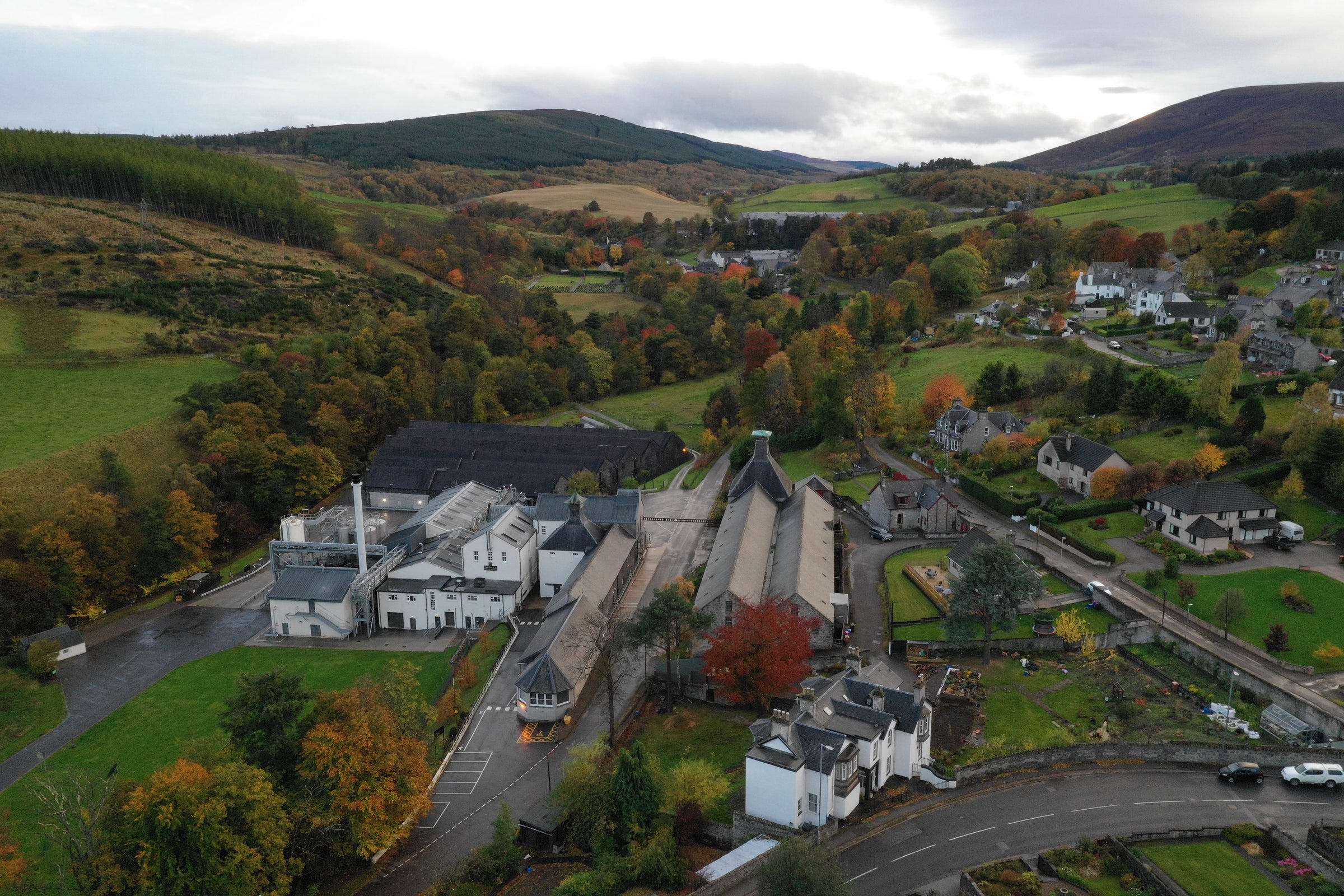
Mortlach from above
From the air, Mortlach sits in the cluster of distilleries packed into Dufftown, its rooflines close against the hills above the town that gave rise to the old local saying about six distilleries and one parish church. The footage below shows that tight, built up setting better than any ground level photograph can.
History of Mortlach
Dufftown likes to say it has six distilleries and one parish church, but Mortlach came a long time before any of the others. It was founded in 1823, within months of the Excise Act that made legal distilling worthwhile for the first time, and it is generally credited to James Findlater working with Donald Mackintosh and Alex Gordon. For more than sixty years it was the only legal distillery in a town that would eventually be famous for having more stills per head than anywhere else in Scotland. Glenfiddich, just up the road, would not exist until 1887, and its founder, William Grant, spent about twenty years working at Mortlach before he had the money and the knowledge to build his own distillery.
Ownership in the nineteenth century followed the usual pattern of partnerships, sales and near collapse. Things settled in 1853 when George Cowie took a share alongside John Gordon, and by 1867 Cowie was sole owner. It was his son, Alexander Mitchell Cowie, who took over running the distillery in 1896 and who is credited with the production quirk that still defines Mortlach today, a partial triple distillation regime that the Cowie family kept deliberately secret for years. In 1897 the distillery was rebuilt and expanded to a design by Charles Doig of Elgin, the architect who gave Scotland the pagoda roof, and gained its own railway siding onto the Strathspey line the same year, useful for getting spirit out and coal in. Mortlach was also among the first buildings in the area to install electric lighting, in 1898, a small detail that says something about how seriously its owners took the place.
John Walker and Sons bought Mortlach in 1923, and it passed into the Distillers Company Limited two years later. Walker's needed Mortlach's dense, characterful spirit as a backbone for its blends, above all Johnnie Walker, and for most of the twentieth century almost nothing was allowed to reach the public as single malt. DCL became part of Guinness in 1986, and Guinness merged with Grand Metropolitan in 1997 to form Diageo, which owns Mortlach today. It was only in 2014, when Diageo relaunched Mortlach as a standalone luxury single malt range, that the distillery finally got an official presence on shop shelves to match its reputation among people who already knew it.
How Mortlach makes its whisky
Everything about Mortlach's production is built to keep more of the spirit's weight than a typical Speyside distillery would want. Water is drawn from springs in the Conval Hills above the town, the same hills that also supply neighbouring Dufftown distillery, a shared source that reportedly caused friction between the two sites when Dufftown was built in the 1890s. The malt is unpeated and coarsely milled on a traditional Porteus mill, and fermentation runs for around 50 to 60 hours in six wooden washbacks holding about 54,000 litres each, long enough to build real depth of flavour before the spirit ever reaches a still.
The six stills themselves are the heart of the story, and no two are alike: three wash stills, two around 7,500 litres and one considerably larger at around 17,500 litres, feed three spirit stills of roughly 8,000, 8,500 and 9,000 litres. Rather than a straightforward double distillation, different fractions of spirit follow different paths through this mismatched still house, some redistilled more than once, some recombined at unusual points in the process, in a system that works out to a famous 2.81 times distillation. It is neither double nor triple, and it was developed and kept deliberately obscure by Alexander Cowie in the early twentieth century.
The other deliberate choice is condensation. Mortlach still uses traditional worm tubs, long coils of copper pipe submerged in cold water outside the still house, rather than the modern shell and tube condensers most distilleries switched to decades ago. Worm tubs give the vapour far less contact with copper, and copper is what strips out sulphur compounds formed during fermentation. Less copper contact means more of those compounds survive into the new make, and combined with the unusual distillation regime, that is what gives Mortlach its trademark density and meatiness, a deliberate outcome rather than a fault to be designed out.
What does Mortlach taste like?
New make and young Mortlach can be a shock to anyone expecting a typical honeyed Speyside dram. Think roast beef, Bovril, gravy browning and a savoury, almost bloody edge, sitting alongside dark stewed fruit, blackcurrant and plum. It is worth being precise about the kind of sulphur involved: this is not the cabbage or rotten egg note that sometimes comes from poorly treated sherry casks, but a structural, savoury character built into the spirit by design.
Good cask maturation does not erase that character, it reshapes it. In active sherry wood, the meatiness deepens into rancio, dried fruit, dark chocolate and leather, while ex-bourbon casks let the savoury, roast-beef core sit right at the front alongside vanilla and baking spice. Either way, this is a big, dense, powerful whisky built for people who like their Speyside with some grip, closer in spirit to a bold Highland sherry bomb than to the region's honeyed reputation.
Mortlach and independent bottlers
For most of the twentieth century, John Walker and Sons regarded Mortlach as too valuable to its blends to spare for single malt, so independent bottlers became the main, and often only, way to taste it. Gordon & MacPhail built a particularly deep relationship with the distillery, holding an official licence to bottle it since the 1960s under its distinctive eagle labels and drawing on stock going back to before the Second World War. Other names followed as the century went on: Silvano Samaroli included Mortlach in his first releases in the late 1970s, and Signatory Vintage and Wm Cadenhead were bottling it regularly by the 1980s. More recently, bottlers such as That Boutique-y Whisky Company have kept it in front of a newer generation of drinkers.
That history means Mortlach casks have reached the independent market with more regularity over the decades than many of its Diageo stablemates, even if any single year's supply can be thin. Our own current bottling, described below, is one small part of that long tradition. The whisky's meaty, uncompromising character also makes it a natural point of comparison for other worm-tub Speysiders such as Craigellachie and Benrinnes, distilleries that share Mortlach's taste for heavy, old-fashioned copper contact even if none of them run quite as strange a still regime.
The Single Cask and Mortlach
We currently have a Mortlach in our range: a 9 year old from cask 255, distilled on 25 November 2014 and matured in a first fill ex-Oloroso quarter cask, bottled at a cask strength of 59.8% from an outturn of just 132 bottles. It sits in our Curious range, and it shows exactly the character this distillery is known for, turned up loud by the small, active quarter cask: a robust nose of fruitcake, bruised apple and Christmas pudding soaked in brandy and navy rum, ginger, nutmeg and cinnamon alongside dark chocolate, toasted nuts and orange peel. On the palate the spice keeps coming, met by walnut oil, toffee and marzipan, with a long, assertive finish of coffee, marmalade and hazelnut liqueur. As with everything we release, it is bottled at natural cask strength, non chill-filtered and without added colouring, because filtering that kind of spirit for cosmetic clarity risks stripping out some of the oily, weighty character that makes Mortlach worth bottling in the first place.
Stock is limited: only two bottles of cask 255 remain as we write this. You can find the current details and buy a bottle here while it lasts.

Collectability and cask ownership
Mortlach's reputation has grown steadily over the last decade, helped by Diageo's 2014 relaunch as a standalone luxury range and by a long tail of well-regarded independent releases stretching back to Gordon & MacPhail's earliest eagle-label bottlings. Older independent bottlings, particularly pre-war and 1950s to 1970s Gordon & MacPhail releases, have shown real strength at auction, and a 31 year old Connoisseurs Choice bottling distilled in 1989 was named Whisky of the Year at the International Whisky Competition in 2023. Recognition like that tends to lift interest in the distillery generally, including in younger independent casks and bottlings, though it says more about specific rare releases than about the market as a whole.
None of that changes the basic reality of cask ownership. As with any cask, ownership involves risk and values can go down as well as up, and nothing here is financial advice. Mortlach's meaty, divisive character will not suit every palate or every market, and a distillery's growing reputation is no guarantee that any individual cask will mature into something special. If you are weighing up a cask purchase generally, our guide to whisky cask sizes and types is a sensible place to start, and we will always tell you plainly what we think a particular cask is worth and what it is likely to taste like.
Visiting Mortlach
Mortlach does not run a public visitor centre, and it is not part of the usual Speyside distillery trail. Private tours have occasionally been arranged directly with the distillery by appointment, though this is not guaranteed and is worth confirming with Diageo well in advance rather than turning up on the day. Dufftown itself makes a good base regardless: Dufftown distillery's near neighbours Glenfiddich and The Balvenie both run regular public tours a short walk from the town square, and Speyside Tours operates a guided walk that takes in the outside of all six of the town's distilleries, Mortlach included.
Mortlach FAQs
Why is Mortlach called the Beast of Dufftown?
Because of its unusually meaty, savoury spirit character, a result of its partial triple distillation and its use of traditional worm tub condensers, which give the new make roast beef, Bovril and gravy-browning notes rather than the light, fruity profile many people expect from Speyside.
What is 2.81 times distillation?
A partial triple distillation regime unique to Mortlach, in which different fractions of spirit are redistilled and recombined through the distillery's six mismatched stills. It works out to roughly two and eight tenths distillations rather than a clean double or triple, and it was developed by Alexander Cowie in the early twentieth century and kept deliberately secret for years.
Is Mortlach peated?
No. Mortlach uses unpeated malt. Its meaty, sulphury character comes from its distillation regime and worm tub condensers rather than from peat smoke.
Can you visit Mortlach distillery?
There is no public visitor centre, though private tours have occasionally been arranged by appointment directly with Diageo. Nearby Glenfiddich and The Balvenie both offer regular public tours in Dufftown.
Why were official Mortlach bottlings so rare for so long?
John Walker and Sons, and later Diageo, kept almost all of Mortlach's output for blending, above all Johnnie Walker, leaving little spirit to spare for single malt. That changed in 2014, when Diageo relaunched Mortlach as a standalone luxury range.
Can you buy a cask of Mortlach?
Casks have reached the independent market with reasonable consistency over the decades, more so than many Diageo stablemates, though supply in any given year can still be thin. Ask us and we will tell you honestly what is realistically available.
Plan a bottling inspired by Mortlach
Mortlach casks are not something we can promise you today. We do not currently hold an unfilled Mortlach cask for sale, and Diageo keeps the great majority of production for its own blends and its luxury single malt range. But it would be wrong to call a Mortlach cask impossible to find. The distillery has a long, genuine history of casks reaching independent bottlers, from Gordon & MacPhail's decades-old licence through to smaller parcels that still surface today, and our own current bottling shows that supply, while limited, is real rather than theoretical.
If a Mortlach cask specifically is what you want for a bottling project, we can watch the market on your behalf and tell you honestly when something suitable comes up, and what it is likely to cost. If timing matters more than the name on the warehouse door, we can also point you towards other meaty, worm-tub Speysiders such as Craigellachie or Benrinnes, or towards a different production style entirely, that would give a comparable weight and character while being realistically available now.
Either way, a bottling project works best when we understand what you are actually trying to achieve. Tell us the flavour or style you are after, roughly how many bottles you need, your approximate budget, when you would like to bottle by, and whether this is for a drinks brand, a retailer, a hospitality venue, a company, a whisky club, an event or purely private use. Let us know too if you will need help with naming, labelling, storage or the bottling itself. We will come back to you with an honest view of what is available, sensible alternatives if Mortlach itself is not, a realistic sense of bottle yield, the main costs and stages involved, and a practical route from cask selection through to finished bottles in your hand.
You can start that conversation through our page on buying a whisky cask, find out more about our independent bottling services, read through our four steps to bottling your own whisky, or simply get in touch and tell us what you have in mind.
Work with The Single Cask
Buy a whisky cask, bottle under your own label, or store casks in our HMRC approved bonded warehouse in Fife.
Read more
Glengoyne Distillery: The Unpeated Malt on the Highland Line
Half an hour from Glasgow, Glengoyne distils its whisky in the Highlands and matures it across the road in the Lowlands, with no peat, ever. Here is the full story: the illicit glen, the slowest st...
Read more
Glenlossie Distillery: The Top-Class Malt Almost Nobody Bottles
In 1974 the blending industry ranked just a dozen Scottish malts as top class, and Glenlossie was one of them. Here is the full story of the quiet Speyside workhorse behind Haig, and the family of ...
Read more


