
Glenkinchie Distillery: The Lowland Face of Diageo's Four Corners
Ask most whisky drinkers to name a Lowland distillery and they will hesitate. Ask them to name whisky's four flagship "corners" of Scotland and Glenkinchie is one of them, standing in for the entire Lowland region alongside three much better known names. It has done that job quietly, from a walled estate fifteen miles outside Edinburgh, since 1988.
For an independent bottler that is exactly what makes it interesting. Glenkinchie is a genuine Diageo flagship with real production pedigree, yet almost nobody outside the trade could describe how it is made or what a cask of it actually tastes like. Here is what we found out.
Glenkinchie at a glance
| Region | Lowland, Pencaitland, East Lothian, about fifteen miles from Edinburgh |
| Founded | Licensed and built as Glenkinchie in 1837, on a site distilling since 1825 |
| Owner | Diageo |
| Capacity | Around 2.5 million litres of pure alcohol a year |
| Stills | One wash still, one spirit still, often described as the largest pair of pot stills on the Scottish mainland |
| Water source | Burns rising in the Lammermuir Hills |
| Fermentation | Typically quoted at 60 to 75 hours, in six Oregon pine washbacks |
| Malt spec | Unpeated, or at most the faintest trace of peat depending on the source |
| Style | Light, floral and grassy Lowland malt with worm-tub weight |
| Visitor centre | Yes, a multi-million-pound centre opened in 2020, Diageo's Lowland stop on the Four Corners of Scotland trail |
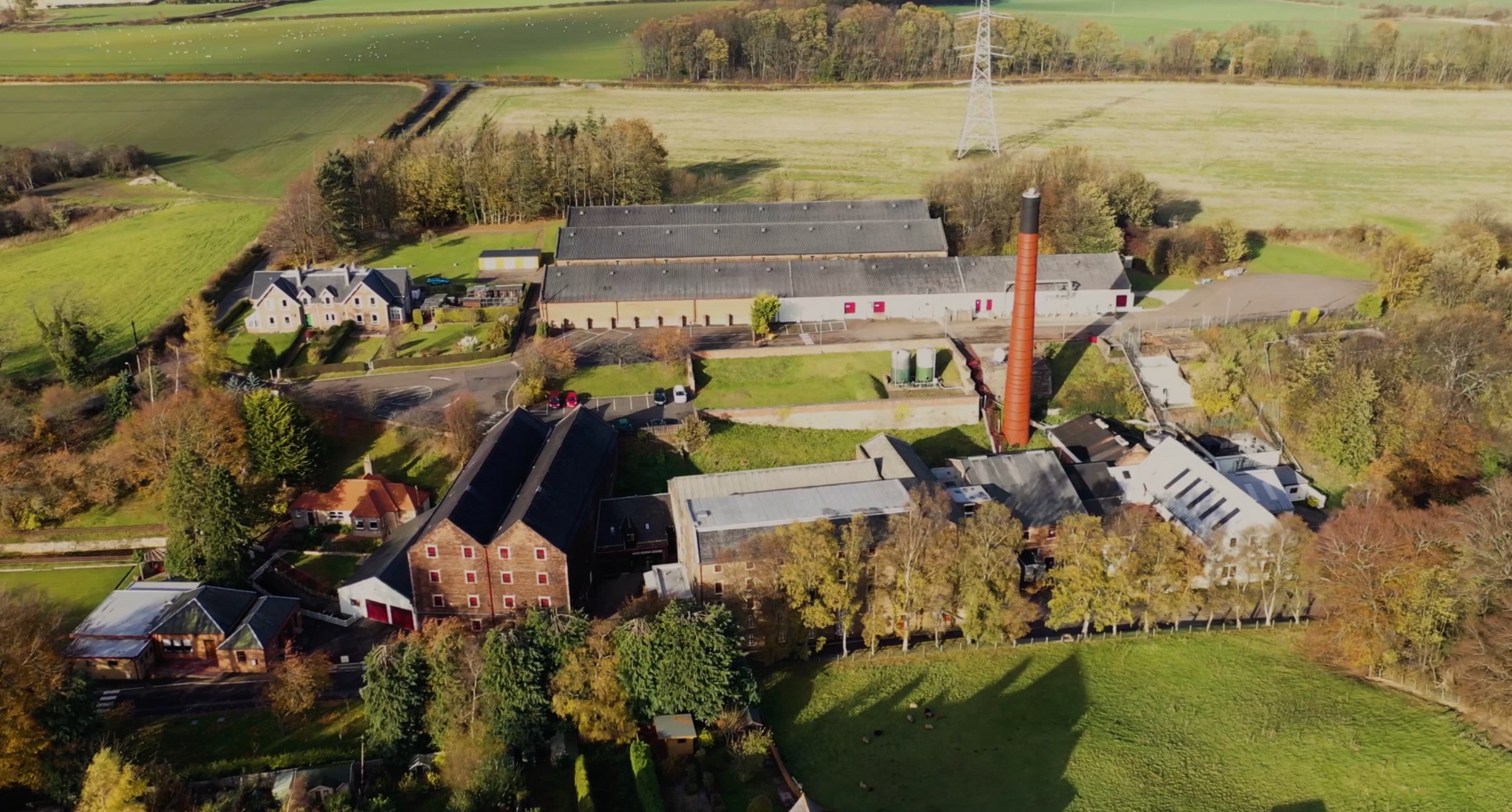
Glenkinchie from above
We flew our drone over Glenkinchie to take in the distillery's red-brick Victorian buildings and its setting among the fields of East Lothian, a landscape that has more in common with arable farmland than with the heather and burns most people picture when they think of Scotch whisky country.
History
Glenkinchie's story starts a little earlier than its official founding date. Brothers John and George Rate began distilling on the site in 1825, working out of converted farm buildings that had previously been known, in various accounts, as Milton. In 1837 the brothers rebuilt and licensed the operation properly under the Glenkinchie name, taken from the surrounding estate.
The Rate brothers' venture did not last. They were bankrupted in 1853 and the site fell quiet, reportedly doing time as a sawmill before whisky returned. Distilling resumed around 1880 to 1881 under a group of Edinburgh investors led by Major James Grey, who rebuilt the distillery into essentially the form it still holds today, and it was supplying blends, Johnnie Walker among them, by the 1890s.
Glenkinchie joined the newly formed Scottish Malt Distillers group in 1914, then passed through the Distillers Company Limited from 1925, United Distillers from 1986 and finally Diageo from 1997, a fairly typical ownership chain for a distillery of this vintage. What set it apart came later: floor malting stopped in 1969 and the old malting floor was converted into a malt whisky museum, complete with a large scale model of a working distillery that still draws visitors today.
The bigger turning point came in 1988, when United Distillers chose Glenkinchie as the Lowland representative in the original Classic Malts Selection, the six-strong range built to show off Scotland's different whisky regions through a single distillery each. It has held that role for almost forty years, which is a long time to be the public face of an entire style of whisky. Diageo doubled down more recently with a multi-million-pound visitor centre, opened in October 2020, completing a wider building programme across what it now markets as the Four Corners of Scotland: Glenkinchie for the Lowlands, Cardhu for Speyside, Caol Ila for Islay and Clynelish for the Highlands.
Recognition has followed. Glenkinchie 12 Year Old was named Best Lowland Single Malt at the 2013 World Whiskies Awards, a rare moment of individual attention for a distillery whose spirit mostly disappears into other people's blends.
How Glenkinchie makes its whisky
Water comes from burns rising in the Lammermuir Hills, feeding a nine-tonne stainless steel mash tun of the lauter type, filled from a Porteus mill roughly ten times a week. From there the wort goes into six wooden washbacks made of Oregon pine, some of them decades old, with fermentation typically running 60 to 75 hours depending on the source consulted, longer than many distilleries bother with. A long, slow ferment like that tends to build fruitier, more estery character, which suits the style Glenkinchie is going for.
The still house is the part that surprises people. Glenkinchie runs on just two stills, one wash and one spirit, and both are unusually large: the wash still in particular is often described as the biggest pot still on the Scottish mainland, somewhere around 21,000 litres, with the spirit still close behind at roughly 17,500 litres. Both stills carry distinctive constricted sections above the pot that encourage extra reflux, pushing the spirit towards a lighter, cleaner style before it even reaches the condensers.
Those condensers are traditional worm tubs rather than the shell-and-tube design most modern distilleries favour, coiled copper pipe submerged in cold water outside the still house. Worm tubs usually add weight and a touch of sulphur to new make, and Glenkinchie is no exception: distillers there openly describe the spirit coming off the still with an "overcooked vegetable" note that needs time in wood to burn off. What is left once it does is something genuinely delicate for a Lowland malt built at this scale.
Malt specification is one of the few points where sources disagree even slightly, some call Glenkinchie's malt entirely unpeated, others note the faintest trace of peat that never really shows in the glass. Either way this is not smoky whisky by any definition. The distillery's own floor maltings closed in 1969, so the barley is bought in rather than malted on site. Annual capacity runs to around 2.5 million litres of pure alcohol, and Diageo keeps its blending recipes confidential, but Glenkinchie's light, floral character is understood to find its way into blends including Johnnie Walker, alongside the distillery's own official releases.
What does Glenkinchie taste like?
Matured Glenkinchie is about as far from a peaty dram as Scotch gets. Expect sweet malt and cereal, ripe orchard fruit, honeysuckle and meadow flowers, a squeeze of lemon, and a soft waxy weight underneath that owes something to those worm tubs. It drinks lighter and more delicate than its still sizes might suggest, which is rather the point: this is a spirit built for elegance, not power. Older expressions and the Distiller's Edition, finished in ex-Amontillado sherry casks, layer in dried fruit, spice and a gentler nuttiness over that same floral core, while the core 12 Year Old keeps things bright, grassy and easy to drink.
Glenkinchie and independent bottlers
Most Glenkinchie spirit never sees a single malt label. The bulk goes into Diageo's blends, and what remains as single malt is largely accounted for by the distillery's own core range, the 12 Year Old and Distiller's Edition, plus occasional Special Releases and Manager's Drams such as a 15 Year Old that turns up periodically at auction. That leaves comparatively little for anyone else.
Independent releases do exist, they are just thinner on the ground than for a bigger blending workhorse. Gordon & MacPhail have bottled Glenkinchie under their Connoisseurs Choice and Secret Stills ranges, including well-regarded vintages from the 1980s, and smaller merchants such as Tanners have released it too. The most sought-after independent bottlings tend to be old: 1966 vintage Glenkinchie from bottlers including Moon Import and Duthie for Corti Brothers regularly makes £1,000 to £2,600 at auction, and a 2020 single cask release has reached as high as £3,200. That is a real and active secondary market, but it is built on scarcity of old stock rather than a steady flow of young casks reaching indies every year.
The Single Cask and Glenkinchie
We have not bottled Glenkinchie. We want to be straightforward about that rather than talk around it: it is a Diageo distillery that keeps a tight hold on its make, and casks simply do not come our way often enough for us to have one in the warehouse right now.
What we can offer is direct experience of the Lowland region it represents. We have bottled other Lowland spirit, including a peated cask from Glasgow Distillery and casks from the closed Dumbarton and North British sites, so we know the character this part of Scotland produces and how it behaves in wood. If a Glenkinchie cask does come to market, through an indie release, a broker or an auction lot, we are well placed to assess it honestly on your behalf, and to help you plan a bottling around it or around a comparable Lowland alternative.
Collectability and cask ownership
Glenkinchie sits in an unusual spot for collectors. As one of the original Classic Malts and the acknowledged face of the Lowland region, it carries genuine pedigree, and the scarcity of old independent bottlings has already shown up clearly at auction, with 1966 vintages fetching well over a thousand pounds. At the same time, current single malt releases are widely available and reasonably priced by comparison with more fashionable distilleries, which keeps entry-level buying accessible even as the rarest lots command strong prices.
For anyone weighing up a cask of Glenkinchie, or a comparable Lowland alternative, the same rules apply as anywhere else in the market. Cask ownership involves risk and values can go down as well as up, this is not financial advice, and nobody can promise what a given cask will be worth by the time it is ready to bottle. If you want to understand the practical side of ownership before you commit to anything, our guide to cask sizes and types is a sensible place to start.
Visiting
Glenkinchie is genuinely easy to visit, which is not something you can say about every distillery on this list. It sits around fifteen miles south east of Edinburgh in Pencaitland, with a regular bus service from the city centre, and the multi-million-pound visitor centre that opened in October 2020 gives it a proper welcome area, a shop, a tasting room and a cask draw experience alongside standard tours. The old malting floor, retired since 1969, now houses a malt whisky museum with a large scale model of a working distillery, a nice piece of history if you would rather look at how whisky used to be made than only how it is made now. As Diageo's Lowland stop on the Four Corners of Scotland trail, it also makes a natural pairing with a visit to Cardhu, Caol Ila or Clynelish if your trip stretches further.
Glenkinchie FAQs
Who owns Glenkinchie distillery?
Diageo. The distillery passed through Scottish Malt Distillers, the Distillers Company Limited and United Distillers before Diageo was formed in 1997, and it has been the group's Lowland representative in the Classic Malts Selection since 1988.
Is Glenkinchie whisky peated?
Essentially no. Most accounts describe Glenkinchie's malt as unpeated, though a few note only the faintest trace of peat that does not really register in the finished whisky. It is a light, floral, grassy style rather than a smoky one.
Can you visit Glenkinchie distillery?
Yes. A new visitor centre opened in October 2020 with tours, a tasting room, a cask draw experience and a malt whisky museum on the site of the old floor maltings. It is around fifteen miles from Edinburgh with a regular bus service.
Why is independently bottled Glenkinchie hard to find?
Most of the distillery's output goes into Diageo blends, and what remains as single malt is mostly accounted for by the official range and periodic Special Releases. Independent bottlings exist, from Gordon & MacPhail and others, but they surface far less often than from bigger blending distilleries.
Can you buy a cask of Glenkinchie?
Occasionally, through independent bottlers, brokers or auction, but it is not a routine source of young casks the way some other distilleries are. Ask us and we will tell you plainly what is realistically available and what a comparable Lowland alternative might look like.
What does Glenkinchie taste like?
Sweet malt, orchard fruit, honeysuckle, a little lemon and a soft waxy texture from its worm-tub condensers. It is one of the lightest, most floral styles in Scotch whisky, built to be elegant rather than powerful.
Plan a bottling inspired by Glenkinchie
We will be straight with you about Glenkinchie specifically: a cask of it is not something we can promise, and it would be wrong to suggest otherwise. Diageo keeps most of the make for its own blends and official range, and independent casks surface only occasionally, largely as older stock through specialist bottlers and auction rather than as a steady supply of young whisky. That does not mean it never happens, Gordon & MacPhail and others have released it over the years, but treat any specific claim of current availability with caution unless it comes with real evidence behind it.
What we can do well is help you build a bottling around the Lowland character Glenkinchie represents, whether that means tracking a genuine Glenkinchie lot if one surfaces or identifying another Lowland cask, from a distillery like Glasgow, Auchentoshan or one of the closed sites we occasionally work with, that gives you a similar light, floral, food-friendly profile. Either route can lead to a proper bottling project rather than a single bottle bought on a whim.
If that is the kind of project you are thinking about, tell us the flavour or style you are after, roughly how many bottles you need, your approximate budget, when you would like to bottle by, and who the whisky is for, a brand, a retailer, a hospitality venue, a company gift, a whisky club, an event or simply your own collection. Let us know too if you will need help with naming, label design, storage or the bottling run itself.
In return we will give you an honest view of what is realistically available, sensible alternatives when a named distillery is not, a rough idea of how many bottles a given cask will yield, the main costs and stages involved, and a practical path from choosing a cask through to finished bottles in your hand. Have a look at our page on buying a whisky cask for the basics, or if you are planning something under your own name, our private label whisky page covers how that process works. When you are ready, get in touch and we will take it from there.
Work with The Single Cask
Buy a whisky cask, bottle under your own label, or store casks in our HMRC approved bonded warehouse in Fife.
Read more
Edradour Distillery: The Smallest Distillery Owned by an Independent Bottler
Edradour, tucked outside Pitlochry, was Scotland's smallest traditional distillery for decades, and since 2002 it has belonged not to a drinks giant but to Signatory Vintage, one of the country's b...
Read more
Tomintoul Distillery: The Gentle Dram That Also Makes Smoke
Tomintoul spends most of the year making one of Speyside's gentlest whiskies, then once a year turns out something heavily peated called Old Ballantruan. We bottled our own single cask from this di...
Read more


