
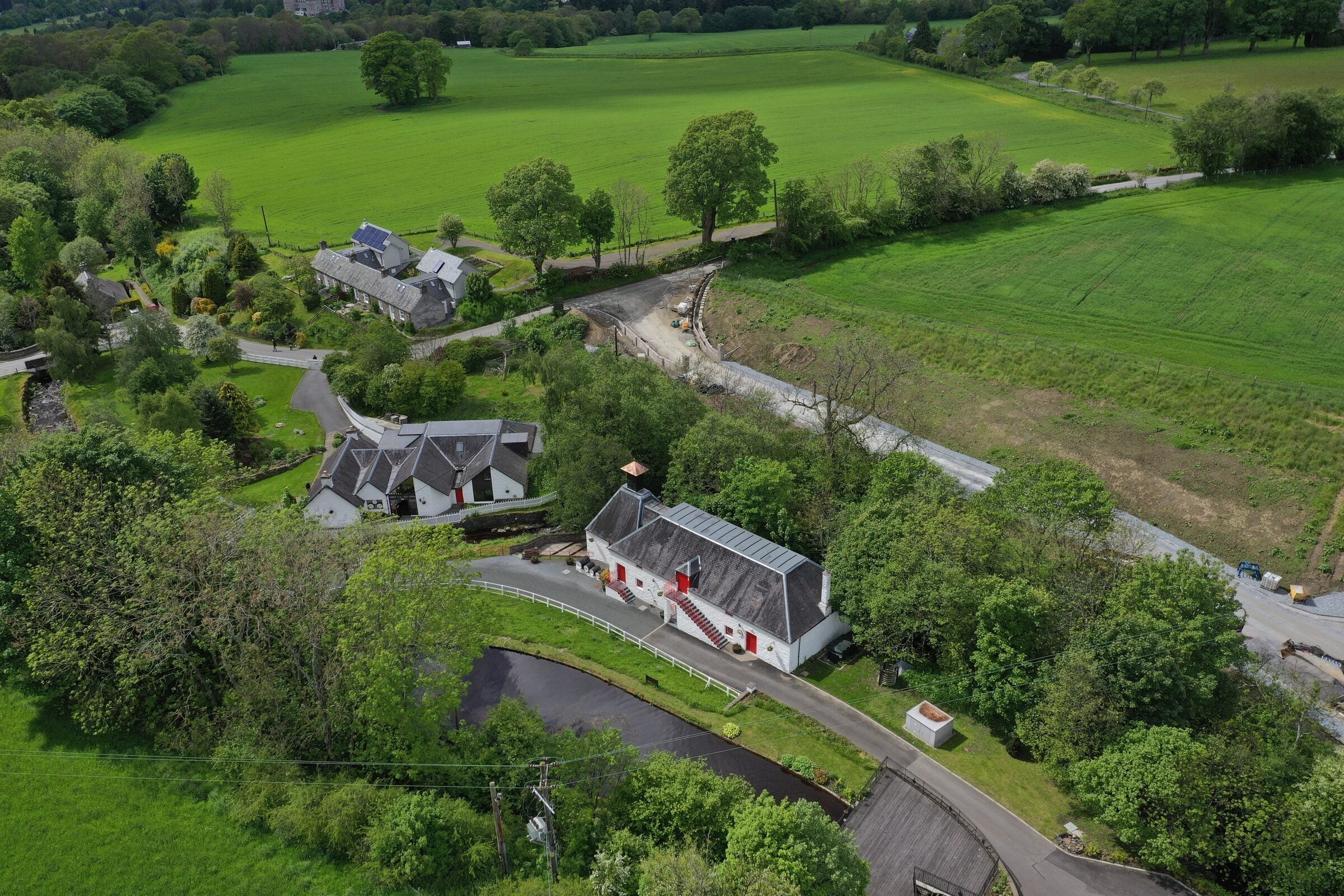
Edradour Distillery: The Smallest Distillery Owned by an Independent Bottler
Most distilleries are built to sell whisky to independent bottlers. Edradour is owned by one. Since 2002 the smallest working distillery on the main road through Highland Perthshire has belonged to Andrew Symington, founder of Signatory Vintage, which means the usual relationship between a distillery and the merchants who buy its casks does not really apply here. Signatory buys and bottles other people's whisky for a living, and mostly keeps its own.
Edradour at a glance
| Region | Highland (Pitlochry, Perthshire) |
| Founded | Distilling on the site is usually dated to 1825, by a group of local farmers; the Edradour name and a formal licence followed in 1837 |
| Owner | Signatory Vintage Scotch Whisky Co, bought from Pernod Ricard's Campbell Distillers in 2002 |
| Capacity | Historically well under 100,000 litres a year; a second distillery, Edradour II, built alongside the original in 2017 to 2018, took combined capacity to a figure usually quoted around 400,000 litres of pure alcohol annually |
| Stills | Two per site (four in total across Edradour I and II): a wash still of around 4,200 litres and a spirit still of around 2,200 litres, among the smallest in Scotland, cooled by traditional worm tubs |
| Water source | Springs on Ben Vrackie and the burns that feed the River Edradour, which gives the distillery its name, "between two rivers" |
| Fermentation | Long by industry standards, typically quoted at 48 to 96 hours, in wooden washbacks |
| Malt spec | Unpeated for standard Edradour; the Ballechin range uses malt peated to around 50 ppm, distilled on separate days each week |
| Style | Fruity, floral and full-bodied Highland malt: apple, citrus, creamy vanilla and dried fruit; Ballechin is heavily smoked |
| Visitor centre | Yes in normal times, though closed to the public since 2025 because of staff shortages |

History
The paperwork around Edradour's early years is thinner than most, which is fairly typical for a distillery this small and this old. The date most commonly given for the start of distilling on the site is 1825, when a group of local tenant farmers pooled their barley and their stills, much as farmers across Perthshire had always done, legally or otherwise, in the years after the Excise Act made licensed distilling worth the paperwork. The name Edradour, Gaelic for roughly "between two rivers", and a more formal footing are usually dated to 1837, credited to James Scott and Duncan Stewart.
For a century Edradour stayed a small farmhouse operation, changing hands quietly. The Mackintosh family sold it to the blending house William Whiteley & Co in 1933, and it later passed into the ownership of the American firm behind Irving Haim's whisky interests, who held it from around 1938 until 1976. Pernod Ricard's Campbell Distillers took over in 1982 and ran Edradour largely as a source of malt for blends such as House of Lords and Clan Campbell, while the distillery itself became a popular stop for visitors driving north through Pitlochry.
The decisive change came in 2002, when Andrew Symington bought Edradour from Pernod Ricard, reportedly for a little over £3 million, though other figures have been quoted since. Symington had built Signatory Vintage into one of the country's best-known independent bottlers over the previous fourteen years, and buying a working distillery of his own was a natural next step. He kept the tiny original equipment, added warehousing for Signatory's own stock, and in 2003 began experimenting with peated malt, releasing the results in 2006 under a new name, Ballechin, borrowed from a distillery that had once stood nearby and closed in 1927. By 2017 demand had outgrown the original stillhouse, and a second distillery, Edradour II, was built next to it with matching equipment, roughly doubling capacity from early 2018.
How Edradour makes its whisky
Edradour's production has always been shaped by scale rather than ambition, and that is precisely what makes it distinctive. The mash tun is a one-tonne, open-topped rake-and-plough design, tiny even by the standards of Highland distilling, and it feeds wooden washbacks where fermentation typically runs long, anywhere from 48 up to around 96 hours depending on the batch. Long ferments favour fruity, estery character over cereal weight, and that shows through clearly in the finished spirit.
The stills are about as small as licensed stills get in Scotland: a wash still of roughly 4,200 litres and a spirit still of around 2,200 litres, run by hand rather than by the automated systems most modern distilleries rely on. Vapour is cooled the old way too, through worm tubs, coiled copper pipes submerged in cold water rather than the shell-and-tube condensers used almost everywhere else, which tends to carry through a heavier, more textured spirit. Edradour also uses a Morton refrigerator, a design borrowed from the dairy industry, to cool the wort before fermentation, a piece of equipment few other distilleries still bother with.
Barley for the core Edradour range is unpeated. The Ballechin variant, distilled on separate days most weeks using malt peated to around 50 parts per million, phenol levels that put it in Islay territory rather than typical Highland smoke, is where the distillery does its most experimental work. Both spirits go into an unusually wide range of wood: ex-bourbon casks alongside sherry butts, port pipes, Madeira drums and burgundy casks, many of them used for a second maturation or finish rather than filled from new. Casks are generally not reused more than twice before being sold on, which keeps the wood active and the flavour pronounced. Warehousing has expanded steadily since 2002 to hold Signatory's own stock alongside Edradour and Ballechin.
What does Edradour taste like?
Standard Edradour is built around fruit rather than smoke or spice. Expect ripe apple and citrus on the nose, moving into creamy vanilla, honey and soft dried fruit on the palate, with a gentle, warming finish that rarely overstays its welcome. Sherry-finished expressions add darker notes, raisin, walnut and a touch of chocolate, while the wine-cask experiments, port, Madeira and burgundy among them, tend to push things towards red fruit, spice and a slightly tannic grip.
Ballechin is a different animal entirely. Heavy peat smoke sits over the same fruity base spirit, so you get bonfire and iodine notes wrapped around apple and citrus rather than the coastal, medicinal character of Islay peat. It is one of the more distinctive peated malts made outside Islay precisely because the underlying spirit was never designed to carry smoke, and the contrast is the point.
Edradour and independent bottlers
Edradour occupies an unusual place in the independent bottling world because its owner is one. Signatory Vintage releases Edradour and Ballechin extensively under its own name, in vintage-dated single casks, small-batch series and the core Edradour and Ballechin ranges, so in one sense almost everything sold as Edradour is an independent bottling. What you will not find, as far as our research turned up, are separate third-party independent releases from the likes of Gordon & MacPhail, Cadenhead's or Douglas Laing. Signatory has no obvious reason to sell casks to its own competitors, and we are not aware of that happening in any meaningful way in recent years.
That is a genuinely different situation from a distillery whose owner simply keeps a tight grip on stock, such as GlenDronach, or one where casks quietly circulate through brokers, such as Blair Athol up the road in Pitlochry. Here, the independent bottler and the distillery are the same company, and Edradour's own extensive vintage programme is, in effect, the independent scene for this whisky.
The Single Cask and Edradour
We have never bottled a cask of Edradour, and we would rather say so plainly than pretend otherwise. Signatory Vintage, which owns the distillery, is itself one of the most prolific independent bottlers in Scotland and releases Edradour and Ballechin constantly under its own labels. That leaves very little reason for casks to reach anyone else, and in the course of researching this guide we found no evidence of genuine third-party independent bottlings reaching the market in recent years. We would rather tell you that clearly than dress it up.
What we can offer is the style. If what draws you to Edradour is fruity, sherry and wine-cask-finished Highland malt, or the idea of a heavily peated whisky built on an unusually delicate base spirit, those are characters we buy for regularly from distilleries whose casks do reach the open market. Glengoyne shares the orchard-fruit, sherry-led profile fairly closely, while a peated Highlander like Ardmore gives a sense of what smoke does to a spirit built for something gentler. Tell us what you like about Edradour and Ballechin and we can point you towards a cask in our own range, or currently on our tasting bench, that gets close.
Collectability and cask ownership
Edradour and Ballechin are not major auction names, but they have a loyal following, and older Signatory vintage releases, particularly wine-cask finishes and early Ballechin bottlings from the mid-2000s, do turn up at auction and sell steadily rather than spectacularly. The appeal for collectors is largely about the sheer variety Signatory has put out under the Edradour and Ballechin names over the past two decades: distinct cask finishes, one-off wine cask experiments and vintage-dated releases that will never be repeated exactly.
Cask ownership is a different matter here than at most distilleries this guide covers. Because Signatory both owns Edradour and is itself in the business of buying and bottling casks, there is no meaningful open market in Edradour casks for private buyers, and we would treat any offer of one with real caution until its paperwork and chain of ownership were verified beyond doubt. If a genuine one does ever surface, understanding what kind of cask you would actually be buying is the sensible place to start. As with any distillery, cask ownership involves risk, values can go down as well as up, and nothing in this article is financial advice.
Visiting Edradour
For decades Edradour billed itself as Scotland's smallest traditional distillery, and its visitor centre, a cluster of whitewashed farm buildings just outside Pitlochry, was one of the most charming stops on the whisky trail: small enough that tours felt personal rather than corporate, with tastings often poured straight from the cask. As of our research for this guide, the site has been closed to the public since 2025 because of staff shortages, and we could not confirm a reopening date. If a visit matters to your plans, we would suggest checking directly with the distillery before travelling. Pitlochry itself remains an easy base for exploring Highland Perthshire whisky, with Blair Athol open for tours at the southern edge of town.
Edradour FAQs
Who owns Edradour distillery?
Signatory Vintage Scotch Whisky Co, the independent bottler founded by Andrew Symington, which bought Edradour from Pernod Ricard's Campbell Distillers in 2002.
Is Edradour peated?
The core Edradour range is unpeated. A separate peated expression, Ballechin, is distilled on dedicated days most weeks using malt peated to around 50 parts per million, and is bottled and marketed under its own name.
What is Ballechin whisky?
Ballechin is Edradour's heavily peated malt, first released in 2006 and named after a nearby distillery that closed in 1927. It uses the same small stills and fruity base spirit as standard Edradour, matured across a similarly wide range of wine and sherry casks.
Is Edradour the smallest distillery in Scotland?
It was long described that way, and its original stills remain among the smallest licensed in the country. Since a second distillery, Edradour II, was built alongside the original in 2017 to 2018, combined capacity has grown, so the claim applies more to the historic site than to current total output.
Can you visit Edradour distillery?
Not currently. The visitor centre has been closed to the public since 2025 because of staff shortages, and we could not confirm a reopening date while researching this guide. Check directly with the distillery before planning a trip.
Can you buy a cask of Edradour?
Realistically, no, not through the ordinary independent cask market. Edradour is owned by Signatory Vintage, which is itself an independent bottler and keeps its own stock, so casks rarely if ever reach outside buyers. Treat any Edradour cask offered to you with real caution and verify its provenance carefully.
Plan a bottling inspired by Edradour
We will be honest about where things stand: a genuine cask of Edradour or Ballechin is not something we can realistically source for you. The distillery is owned outright by an independent bottler that keeps its own stock for its own labels, and we have found no evidence of casks reaching other bottlers in any meaningful way. That is not a scarcity we can solve by looking harder, so we would rather say so upfront than let you plan a project around a cask that is not coming.
What we can do is help you build a bottling around the character you actually love about Edradour: fruity, sherry and wine-finished Highland malt, or a peated whisky built on a delicate rather than coastal base spirit. We source and mature casks with a comparable flavour, region and maturation style, and can talk you through what a project like that would actually involve, from private label and hospitality bottlings to a small run for a whisky club or a personal project.
Tell us the flavour or style you are chasing, roughly how many bottles you need, your approximate budget, when you would like to bottle, and whether the project is for a drinks brand, retailer, hospitality business, company, club, event or private use, along with whether you would like help with naming, labels, storage or bottling. In return we can give you an honest view of what is realistically available, suggest alternatives when a named distillery is out of reach, indicate likely bottle yield, outline the main costs and stages involved, and set out a practical route from cask selection through to finished bottles, including our independent bottling services. Get in touch and tell us about your project.
Work with The Single Cask
Buy a whisky cask, bottle under your own label, or store casks in our HMRC approved bonded warehouse in Fife.
Read more
Glen Keith Distillery: Chivas Brothers' Own Laboratory
Glen Keith spent decades as Chivas Brothers' own experimental distillery, then sat silent for fourteen years. We bottled one of its rare aged casks ourselves, here is the full story of Speyside's q...
Read more
Glenkinchie Distillery: The Lowland Face of Diageo's Four Corners
Glenkinchie is Diageo's Lowland flagship near Edinburgh, one of the original Classic Malts and the smallest-known of the Four Corners of Scotland. We have never bottled it, and our new guide says s...
Read more


