
Tomintoul Distillery: The Gentle Dram That Also Makes Smoke
Most Speyside distilleries pick a lane and stay in it. Tomintoul spends eleven months of the year making one of the softest, sweetest malts in the region, then turns around for a few weeks and makes some of the smokiest spirit in Scotland under a different name. It is an odd split personality for a distillery best known for being gentle, and it is exactly what makes Tomintoul worth a proper look.
Tomintoul at a glance
| Region | Speyside, on the Glenlivet Estate near Ballindalloch, Banffshire |
| Founded | 1965 |
| Owner | Angus Dundee Distillers (since 2000) |
| Capacity | Around 3.3 million litres of pure alcohol a year |
| Stills | Four: two wash, two spirit (expanded from an original pair in 1974) |
| Water source | The Ballantruan spring, on the Cairngorms side of the estate |
| Fermentation | Typically 54 to 60 hours, across six washbacks |
| Malt spec | Mostly unpeated, with one small heavily peated batch (around 55ppm) run each year for the Old Ballantruan range |
| Style | Light, sweet and honeyed as standard, smoky and medicinal in its peated form |
| Visitor centre | Yes, pre-bookable tours and a shop open Monday to Saturday |
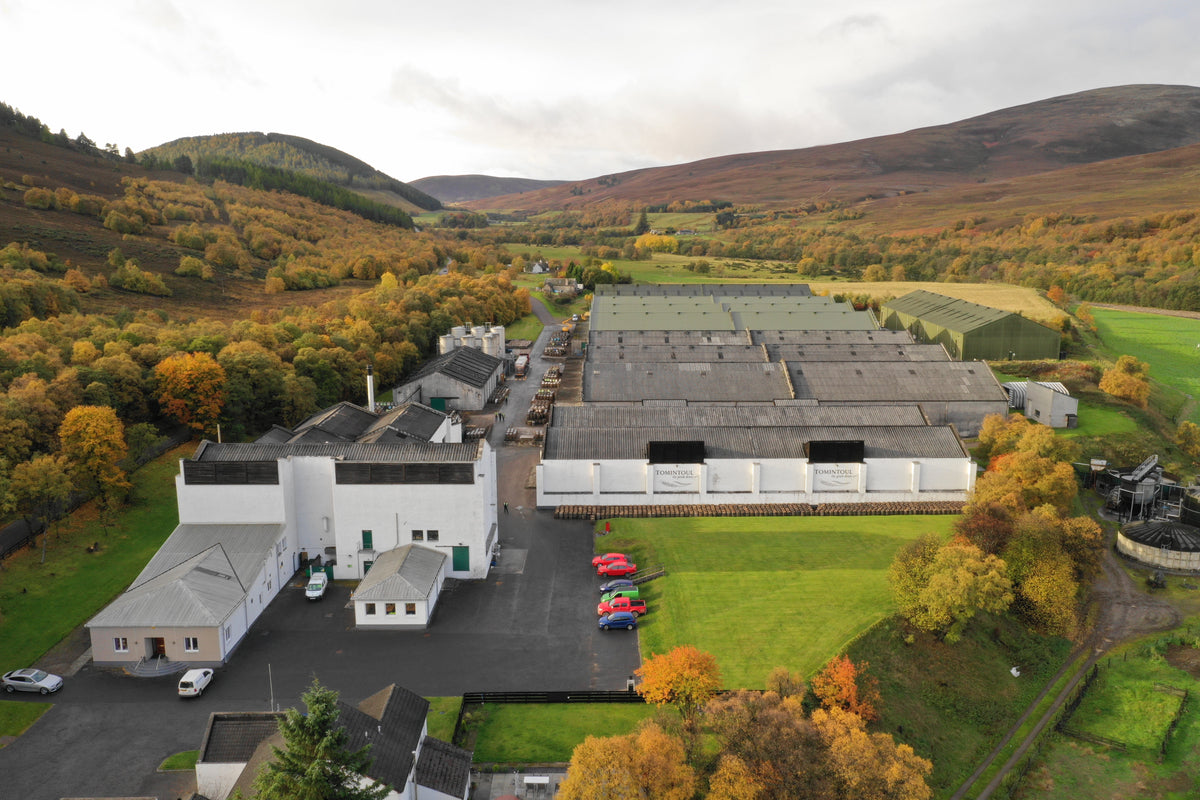
Tomintoul from above
Our drone found Tomintoul tucked well into the Glenlivet Estate, low buildings against the moor with the Cairngorms rising behind, easy to miss entirely if you did not know the turning off the single track road.
History
Tomintoul is a relative newcomer by Speyside standards. It was built in 1965 by two Glasgow whisky trading firms, Hay & MacLeod and W. & S. Strong, who joined forces as the Tomintoul-Glenlivet Distillery Company and went looking for a site with good water rather than an easy road. It took them roughly a year to settle on the spot, a stretch of the Glenlivet Estate fed by the Ballantruan spring, several miles from the village of Tomintoul itself, which at around 345 metres above sea level is usually described as the highest village in the Highlands.
The distillery started with a single pair of stills and was already expanding by 1974, when a second pair was added to double capacity. Ownership has moved several times since: Scottish and Universal Investments took over in 1973, Whyte and Mackay (then under Brent Walker's ownership) held it from 1989, and in 2000 Angus Dundee Distillers bought the site, along with a large stock of maturing whisky. Angus Dundee also owns Glencadam in Brechin, and under its management Tomintoul has grown from a blending workhorse into a distillery that sells the great majority of its own make as single malt, an unusual position for a distillery of its size. Its nearest neighbour is The Glenlivet, whose estate Tomintoul actually sits on, though the two whiskies could hardly be more different in how they are sold.
The 2009 stunt of filling what was, at the time, the world's largest bottle of whisky, 105.3 litres of 14 year old, says something about how the current owners have marketed the brand: playful, a little theatrical, and happy to have some fun with a whisky that does not take itself too seriously. A decade later the judges took it rather more seriously, naming Tomintoul's 33 year old the best Speyside whisky at the World Whiskies Awards in 2010, and the 16 year old picked up an ISC gold medal in 2021.
How Tomintoul makes its whisky
Water comes from the Ballantruan spring, soft and clear, and it took the founders the best part of a year to find a supply they were happy with before building started. The mash tun holds around 11.6 tonnes, and wort is fermented across six washbacks for a fairly long 54 to 60 hours, longer fermentation generally coaxing out more fruit and fewer sulphury notes. Four stills, steam heated and unusually tall and slender for the region, follow. The combination of long ferments and tall stills is a large part of why Tomintoul spirit runs so light and clean off the still, the make is built for gentleness rather than weight.
Once a year the entire mindset flips. The distillery mills and mashes a batch of heavily peated malt, sourced to a phenol specification of around 55 parts per million, well into Islay territory, and runs it through exactly the same stills and washbacks used for the unpeated spirit the rest of the year. The resulting new make is bottled and matured separately under the Old Ballantruan name rather than as standard Tomintoul, but it comes from the same water, the same yeast, and the same stills, filtered through a very different grain of barley.
What does Tomintoul taste like?
Standard Tomintoul is built to be approachable. Expect a medium body, plenty of orchard and stone fruit, pear, peach and apple, with vanilla, honey and a light malty sweetness underneath, and very little in the way of smoke, peat or heavy oak to get in the way. It is the kind of whisky that gets described as smooth so often the word almost stops meaning anything, but in Tomintoul's case it is a fair description of a spirit engineered for easy drinking, backed by bourbon, sherry and increasingly port cask finishes across the range.
Old Ballantruan is close to a different distillery in a glass. Heavy peat smoke, coastal and medicinal notes, and a drier, more austere finish than anything in the standard range, closer in feel to a west coast or Islay malt than to Tomintoul's own gentle image. Tasting the two side by side is one of the better ways to demonstrate to a sceptical friend just how much of a whisky's character comes from decisions made in the mash house and still room, rather than anything inherent to a particular patch of Speyside ground.
Tomintoul and independent bottlers
Tomintoul sits in a slightly unusual spot for a distillery of its size. Angus Dundee bottles most of its own output under the Tomintoul and Old Ballantruan names, across a wide official range running from entry level expressions up to a 50 year old, so this is not a distillery starved of single malt bottlings the way some blend-focused sites are. Even so, independent bottlers have released Tomintoul with some regularity over the years, cask strength single casks turning up from names such as Infrequent Flyers and other specialist bottlers, usually distilled in the 1990s or 2000s and finished in ex-bourbon wood. It is a reasonably well documented distillery among collectors of independent bottlings, helped by the contrast between its two personalities giving indie bottlers an easy story to tell. It sits alongside other family or independently run Speyside names such as Glenfarclas and Aberlour as a distillery drinkers actively seek out by name, rather than one known mainly as blend filler.
The Single Cask and Tomintoul
We have bottled Tomintoul ourselves. Our cask 2156 was distilled in 1995 and bottled at 22 years old, straight from an ex-bourbon American oak cask at a cask strength of 53.2%, giving an outturn of 264 bottles. It leaned into Tomintoul's less publicised side: smoke and a coastal, salty edge on the nose alongside citrus and fern, then a creamy vanilla palate with soft stone fruit and a gentle smokiness running through to the finish, alongside oak and wood shavings. It read to us as a cask that had picked up the distillery's peated character somewhere along the way, proof that the gentle dram has more than one voice when a cask happens to catch it.
Our Tomintoul 22 year old (cask 2156) is now sold out, but it shows the kind of single cask Tomintoul we look for, distinctive, well documented, and honest about what is actually in the bottle. Casks with a similar profile do turn up on the independent market from time to time, and we would rather tell you plainly when we do not have one in stock than pad out a page with whisky we cannot sell you.

Collectability and cask ownership
Tomintoul is not a distillery with a long history of headline auction results the way some of its Speyside neighbours have, and that is really the point for a certain type of collector. Prices for official bottlings remain reasonable by Speyside standards, and independent cask strength releases, especially anything carrying the Old Ballantruan peated profile, have built a following among drinkers who want something unusual without paying Islay prices for it. Older official releases such as the 33 year old, recognised by the World Whiskies Awards, do carry more secondary market interest than the core range.
As with any distillery, cask ownership involves risk and values can go down as well as up, this is not financial advice. Whisky is a slow moving, illiquid asset, and a cask's eventual value depends on decisions made years in advance about wood, warehousing and timing, none of which can be guaranteed in advance. If you are new to the idea, our guide to whisky cask sizes and types is a useful starting point before going any further.
Visiting
Tomintoul now offers pre-bookable tours, run Monday to Friday, through its own booking system, and the shop is open Monday to Saturday from 10am to 4.30pm selling whisky, glassware and merchandise. The distillery sits on the Glenlivet Estate within the Cairngorms National Park, around an hour from Inverness and a little under two hours from Aberdeen, and the final approach is along single track roads, so it is worth building in extra time.
Tomintoul FAQs
Who owns Tomintoul distillery?
Angus Dundee Distillers, which bought the site in 2000. Angus Dundee also owns Glencadam distillery in Brechin.
Is Tomintoul whisky peated?
Mostly not. The core range is unpeated and built to be smooth and approachable, but Tomintoul also runs one heavily peated batch a year, matured and sold separately as Old Ballantruan.
What does Tomintoul taste like?
Standard Tomintoul is light, sweet and fruity, with pear, apple, honey and vanilla and very little smoke. Old Ballantruan, the peated version, is smoky, coastal and considerably more austere.
Can you visit Tomintoul distillery?
Yes. Tours run Monday to Friday and can be booked in advance, and the shop is open Monday to Saturday. It sits on the Glenlivet Estate, reached along single track roads.
Can you buy a cask of Tomintoul whisky?
Independent bottlers do release Tomintoul casks from time to time, though it is not one of the most heavily traded distilleries on the cask market. Ask us and we will tell you honestly what is realistically available.
Why is Tomintoul sometimes called "the gentle dram"?
The nickname refers to the standard range's light, smooth, low intensity character, deliberately built through long fermentation and tall stills, which sets it apart from punchier Speyside styles.
Plan a bottling inspired by Tomintoul
A cask specifically from Tomintoul is not something we can promise on demand. It is not a distillery that floods the independent market, but casks, particularly ex-bourbon fills carrying either the standard gentle profile or the rarer peated Old Ballantruan character, do reach independent bottlers from time to time, as our own cask 2156 shows. If a genuine Tomintoul cask becomes available, we can help verify its provenance, arrange a sample so you know exactly what you are buying, assess the spirit honestly, store it properly, and plan its route to bottling.
Where a named cask is not available when you need one, we can also point you toward other Speyside or peated malts with a comparable character, whether that means a similarly light and fruity style for an easy-drinking bottling or a smokier alternative if it was Old Ballantruan's profile that caught your interest.
Either way, a bottling project works best when you tell us the real detail rather than us guessing at it. That means the flavour or distillery style you are chasing, roughly how many bottles you need, your approximate budget, a preferred bottling date, and whether this is for a drinks brand, a retailer, a hospitality business, a company event, a whisky club or purely private use. Let us know too whether you will need help with naming, label design, storage or the bottling run itself.
Tell us that much and we can come back with an honest view of availability, sensible alternatives if the named distillery is not realistic, a rough idea of likely bottle yield, the main costs and stages involved, and a practical route from choosing a cask to holding finished bottles. Have a look at buying a whisky cask and our four steps to bottling your own whisky for the basics, or if you already have a brand in mind, our page on private label whisky covers how that works. When you are ready, get in touch and we will talk it through properly.
Work with The Single Cask
Buy a whisky cask, bottle under your own label, or store casks in our HMRC approved bonded warehouse in Fife.
Read more
Glenkinchie Distillery: The Lowland Face of Diageo's Four Corners
Glenkinchie is Diageo's Lowland flagship near Edinburgh, one of the original Classic Malts and the smallest-known of the Four Corners of Scotland. We have never bottled it, and our new guide says s...
Read more
Auchentoshan Distillery: Scotland's Full-Time Triple Distiller
Auchentoshan is one of only two Scotch distilleries that triple distil their entire output, a light, citrus-driven Lowland malt from the edge of Glasgow. We bottled our own single cask from here, a...
Read more


