
Kilchoman Distillery: Islay's Farm Distillery From Barley to Bottle
In December 2005 a former independent bottler filled a cask of new-make spirit in a converted steading on a farm at the western edge of Islay, and became the first person to open a new distillery on the island in 124 years. Anthony Wills did not have a corporate parent, a famous name or a warehouse full of old stock. He had a lease on Rockside Farm, a pair of small stills, and an idea the big Islay houses had abandoned generations earlier: grow the barley, malt it, distil it, mature it and bottle it, all in one place.
Twenty years on, Kilchoman is still family-owned, still on the farm, and still the only Islay distillery that can put a whisky in your glass without a single grain of barley having left the island. This guide covers how it got there, how the two peating levels and two still houses shape the spirit, what it tastes like, why you almost never see it from an independent bottler, and where that leaves anyone hoping to own a cask.
Kilchoman at a glance
| Region | Islay (Rockside Farm, the Rhinns, near Kilchoman church and Machir Bay) |
| Founded | 2005 by Anthony Wills; first cask filled 14 December 2005 |
| Owner | The Wills family (Kilchoman Distillery Company), fully independent |
| Capacity | Around 480,000 litres of pure alcohol a year after the 2019 second still house; the distillery has more recently quoted up to 600,000 |
| Stills | 4 (2 wash at about 3,000 litres, 2 spirit at about 1,600 litres) across two identical still houses; the spirit stills are among the smallest in Scotland |
| Water source | The Allt Gleann Osamail burn beside the distillery |
| Fermentation | Long, in stainless steel washbacks; the distillery quotes around 84 to 90 hours |
| Malt spec | Two streams: bought-in Port Ellen malt at around 50 ppm phenols, and farm-grown barley floor-malted on site to around 20 ppm |
| Style | Fresh, citrus-bright and gently ashy peat with a buttery, oily texture; softer and more floral from the 100% Islay malt |
| Visitor centre | Yes; shop, tastings, tours and a café in the old stables, opened February 2020 |

Kilchoman from above
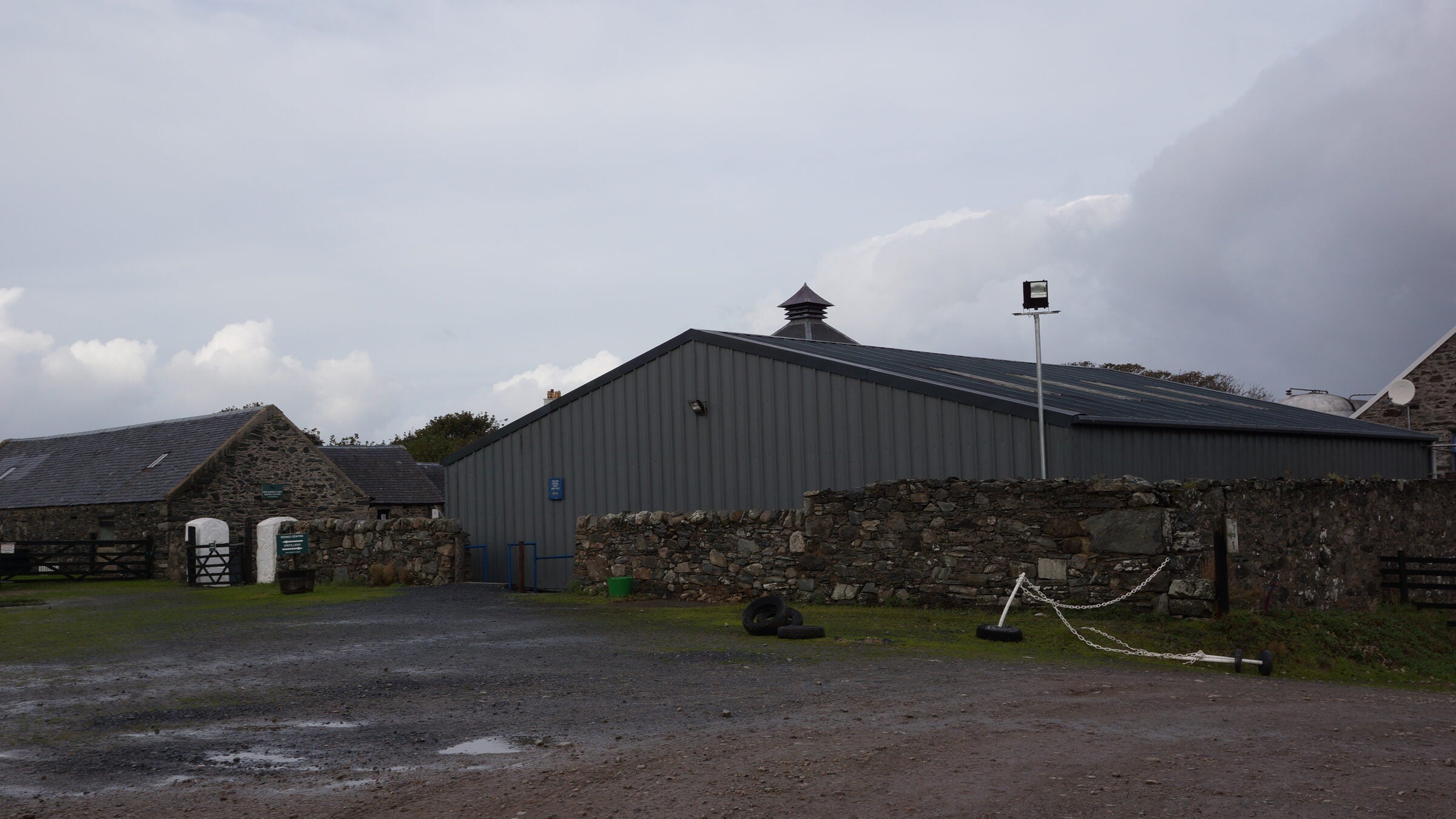
From the ground Kilchoman looks like what it is, a working farm with a distillery in it. From the air you see the whole idea at once: barley fields running down towards Machir Bay, the malt floor and kiln, the two still houses and the warehouses, all within a few hundred metres of each other. We flew our drone over the Rhinns to capture it.
History of Kilchoman
Anthony Wills spent the best part of two decades in the drinks trade, latterly as an independent bottler, before deciding that the whisky he really wanted to sell did not exist yet. Kilchoman Distillery Company was incorporated in November 2001, and in 2004 Wills, his wife Kathy and their three sons moved to Islay. The site was a spare steading at Rockside Farm on the Rhinns, the windswept western peninsula of the island, a mile or so from the ruined Kilchoman church and the sands of Machir Bay. Building started that winter, and on 14 December 2005 the first cask was filled. Jim Swan, the late consultant whose fingerprints are on half the new distilleries of the last twenty years, tasted the new-make and gave it his blessing.
It was not a smooth start. A fire in the malt kiln in 2006 disrupted the maltings and made the first full year harder than it needed to be, and only a few hundred casks were filled. But by September 2009 there was enough three-year-old spirit for an Inaugural Release, 8,450 bottles of bourbon-matured whisky given a five-month finish in oloroso, and it sold out. The 100% Islay range followed in 2011, made entirely from Rockside barley, and Machir Bay, the flagship, arrived in 2012 and promptly picked up a best-in-class award at the International Wine and Spirit Competition. For a distillery barely seven years old, that was the moment people stopped calling it a curiosity.
The Wills family bought Rockside Farm outright in 2015 after a decade of leasing it, and from that point the expansion came in steps: a warehouse at Conisby in 2013, a new malt floor and kiln in 2018 that doubled malting batches from two tonnes to four, and, most significantly, a second still house completed in May 2019 that doubled the number of stills to four. A new visitor centre in the old stables opened alongside it in February 2020, part of a project reported at around six million pounds. Two more bonded warehouses followed in 2020. Through all of it the company has stayed independent, with George, James and Peter Wills now running sales and marketing across the world while their father remains managing director. In 2025 the distillery marked its twentieth birthday with a series of anniversary casks and a prize draw for a 20 year old drawn from Cask No.1, and in July 2026 it added Rockside 11 Years Old, its first age-statement core bottling, to the range.
How Kilchoman makes its whisky
Kilchoman is really two distilleries in one, distinguished not by equipment but by barley. Most of the malt is bought in from Port Ellen Maltings on the south of the island, peated to around 50 ppm phenols, and it goes into Machir Bay, Sanaig, Loch Gorm and the bulk of the limited editions. The rest is grown on Rockside Farm itself. The farm runs to around 2,300 acres, with up to 440 acres under barley in a good year; the 2025 harvest, for instance, brought in 214 tonnes of Laureate off 140 acres. That grain is steeped, spread on the malt floor, turned by hand and kilned over Islay peat to a gentler 20 ppm, and it becomes the 100% Islay range and the new Rockside 11. Sources vary on exactly what share of the total is malted in-house, with figures of 15 to 25 per cent quoted.
Water comes from the Allt Gleann Osamail, the burn beside the distillery. Each still house has its own 1.2 tonne semi-lauter mash tun, one of which is kept for the farm malt, and each takes three waters over roughly six hours. Fermentation is deliberately long: the distillery describes it as around 90 hours, and other sources say 84, in stainless steel washbacks whose exact number is quoted differently depending on who is counting, but which now run into double figures across the two houses. Long fermentation is where Kilchoman builds the fruit and butteriness that keep its peat from tasting merely medicinal.
The stills are small. Each house has a wash still with a charge of about 3,000 litres and a spirit still of about 1,600 litres with a tall, narrow neck, among the smallest spirit stills in Scotland. A run yields roughly 300 litres of new-make, the heart is cut from around 76 down to 65.5 per cent, and the spirit is filled at 63.5 per cent. Cask policy has been consistent from the beginning: around four fifths first-fill bourbon barrels, historically from Buffalo Trace and, since 2023, from Breckenridge Distillery in Colorado, shipped whole rather than knocked down; and about a fifth first-fill oloroso hogsheads and butts from Bodega Miguel Martín in Jerez, with smaller experiments in Sauternes, red wine, port, Madeira, rum and Cognac wood. Everything matures on Islay, in warehouses that now hold around 15,000 casks, and every bottle is filled on site.
What does Kilchoman taste like?
Young Kilchoman is one of the most recognisable new-make styles on Islay: lemon and lime, a soft ashy smoke rather than tar or iodine, buttery biscuit, honey and a slick, oily texture that coats the palate. Machir Bay, the flagship, is roughly nine parts bourbon to one part oloroso at 46 per cent, and it is that profile in bottle form, what one reviewer neatly called lightly ashy peat lathered in citrus butter. Sanaig flips the ratio towards sherry for dried fruit and a darker, spicier smoke; Loch Gorm is the all-oloroso annual release; and Batch Strength, launched in 2024 at 57 per cent, adds recharred Portuguese red wine casks to the mix.
The 100% Islay whiskies, at 20 ppm, are a different animal: softer, more floral and cereal-led, with earth and dead leaves in place of ash, and a maltiness that gets more interesting with age. As the stock has matured the distillery has been able to show what time does, with a 16 year old in 2023 and the anniversary casks at 14, 15 and 18 years, and reviewers who were sceptical of the early three and five year olds have come round; Whiskyfun has scored recent releases in the high 80s and called the older spirit soft and civilised. Awards have piled up accordingly, including a run of golds at the 2025 International Spirits Challenge and a Master medal for Rockside 11 at the 2026 Scotch Whisky Masters.
Kilchoman and independent bottlers
Here Kilchoman is the odd one out on Islay. Its neighbours Caol Ila, Bowmore and Laphroaig have all appeared under independent labels for decades because their owners sell or swap casks for blending. Kilchoman does not blend, does not have a parent company with a filling programme, and has never needed to sell spirit to fund itself in the way some of the newer distilleries do. As a result there is no regular flow of Kilchoman casks to independent bottlers, and the handful of third-party bottlings that exist are private casks that individuals or bars have bought direct and later released.
The company channels its rarer stock through its own routes instead. Comraich is a series of batch bottlings available only through a network of accredited bars; the Kilchoman Club gets first sight of new releases and occasional cask offers; and the Fèis Ìle bottling each May sells only from the distillery shop. If you want single cask Kilchoman, you are far more likely to find it at the distillery than on an independent bottler's shelf.
The Single Cask and Kilchoman
We should be straight about this: we have never bottled a Kilchoman, and the reason is the one set out above. In nearly two decades of buying casks we have bottled the smoke of Caol Ila, peated Bunnahabhain under its Staoisha name and Islay's other blending stalwarts, but Kilchoman simply does not release casks into the broker market that supplies independent bottlers like us. The only Kilchoman casks that change hands do so through the distillery's own private cask programme, on the distillery's terms, and stay in its warehouses on Islay.
That is not a complaint. It is a business model, and a coherent one: a farm distillery whose whole point is that everything happens on site is never going to ship casks to a bonded warehouse on the mainland for someone else to put their name on. We admire what the Wills family have built, and Machir Bay is a bottle we are happy to recommend to anyone who asks us where to start with peated Islay. If a private Kilchoman cask ever comes to us on the secondary market with clean paperwork, we will look at it seriously; until then, this is one Islay distillery whose whisky you buy from the distillery.
Collectability and cask ownership
Kilchoman has a genuine collector following, unusual for a distillery this young. The 2009 Inaugural Release, which sold for well under fifty pounds, has traded at auction for roughly double that, and the earliest single casks, Fèis Ìle bottlings and the 100% Islay editions all attract interest. The first bottle from Cask No.1 fetched £5,400 for charity in 2009 and a 10 year old from the same cask made £10,000 in 2015. Even so, this is a distillery whose whisky is overwhelmingly bought to drink, and most of its releases sell at prices that reflect that.
Cask ownership works differently here from anywhere else on Islay. Kilchoman sells private casks directly, and periodically to club members: as we write, a 200 litre bourbon barrel or a 250 litre sherry hogshead of 50 ppm spirit filled at 63.5 per cent, with ten years of storage on Islay included, and conditions that the cask stays at the distillery and that Kilchoman has first refusal if you sell. That is a clean, well-documented route, and it is the only realistic one; you will not find Kilchoman casks through brokers. The usual caveats apply in full: whisky cask ownership is unregulated, values can go down as well as up, storage and insurance beyond the included period cost money, and nothing in this article is financial advice. Small casks in a windy Islay warehouse also mature quickly and lose spirit to the angels faster than a butt in a Speyside dunnage, so read our guide to cask sizes and types before you decide what to fill.
Visiting Kilchoman
Kilchoman is one of the best distillery visits on Islay, partly because there is so much to see in one place. The visitor centre in the old stables has a shop, tasting rooms and a café with a log stove, and tours take in the malt floor and kiln, the mash house, both still houses and the warehouses, so you can follow barley to bottle without leaving the farm. It is open seven days a week from late March, with reduced hours in winter, and it is worth booking tours ahead in summer. The distillery sits at the end of a single-track road on the Rhinns, about 20 minutes from Bowmore and ten from Bruichladdich, and Machir Bay, one of the finest beaches on the island, is a short walk away. Fèis Ìle, the island's festival at the end of May, brings the distillery-only bottling and a day of events, and sells out fast.
Kilchoman FAQs
Who owns Kilchoman distillery?
Kilchoman is owned by the Wills family through Kilchoman Distillery Company, founded by Anthony Wills in 2001. It is one of the few fully independent, family-owned distilleries in Scotland and has never had a corporate parent.
Is Kilchoman heavily peated?
It depends on the bottling. Machir Bay, Sanaig and Loch Gorm use Port Ellen malt peated to around 50 ppm, similar to Ardbeg or Laphroaig, but the smoke tastes softer and more citrus-led than either. The 100% Islay range and Rockside 11 use farm-grown barley malted on site to around 20 ppm, and are noticeably gentler.
What does 100% Islay mean on a Kilchoman label?
It means every stage happened on the island: barley grown at Rockside Farm, floor-malted and kilned at the distillery, distilled, matured and bottled on site. Kilchoman is the only Islay distillery producing whisky this way.
Can you visit Kilchoman distillery?
Yes. The visitor centre, tours, tastings and café are open seven days a week from late March, with shorter winter hours. Booking ahead is sensible in summer and essential during Fèis Ìle at the end of May.
Why are there so few independent bottlings of Kilchoman?
Because the distillery does not sell casks to brokers or blenders. Almost all Kilchoman is bottled by Kilchoman, and the rare third-party bottlings are private casks bought direct from the distillery.
Can I buy a cask of Kilchoman?
Only from the distillery. Kilchoman runs its own private cask programme with storage on Islay included and first refusal on resale. Casks do not circulate through the open broker market.
Own a piece of Kilchoman
Kilchoman is proof that a distillery does not need two centuries of history to matter, only a clear idea carried out well. Its casks are not ours to sell, and we would rather say so than pretend otherwise. If it is the farm-to-bottle story that appeals, the distillery's own cask programme is the honest route; if it is Islay smoke you are after, we can help. The Single Cask helps clients buy whisky casks from Islay and beyond with verified provenance, store them in bond, and bottle them under their own label when the whisky is ready, and our own shelves usually carry a peated Islay single cask or two.
Read first, buy second: our guides set out the costs and the risks plainly, and when you want a straight conversation about owning an Islay cask, contact us.
Work with The Single Cask
Buy a whisky cask, bottle under your own label, or store casks in our HMRC approved bonded warehouse in Fife.
Read more
Strathmill Distillery: The Purifier Malt Behind J&B
Strathmill guide: the converted oatmeal mill on the River Isla, the rare purifier stills that make its light, orange-and-honey spirit, its sixty years inside J&B Rare, our five Strathmill singl...
Read moreStrathmill Distillery: The Purifier Malt Behind J&B
Strathmill guide: the converted oatmeal mill on the River Isla, the rare purifier stills that make its light, orange-and-honey spirit, its sixty years inside J&B Rare, our five Strathmill singl...
Read more


