
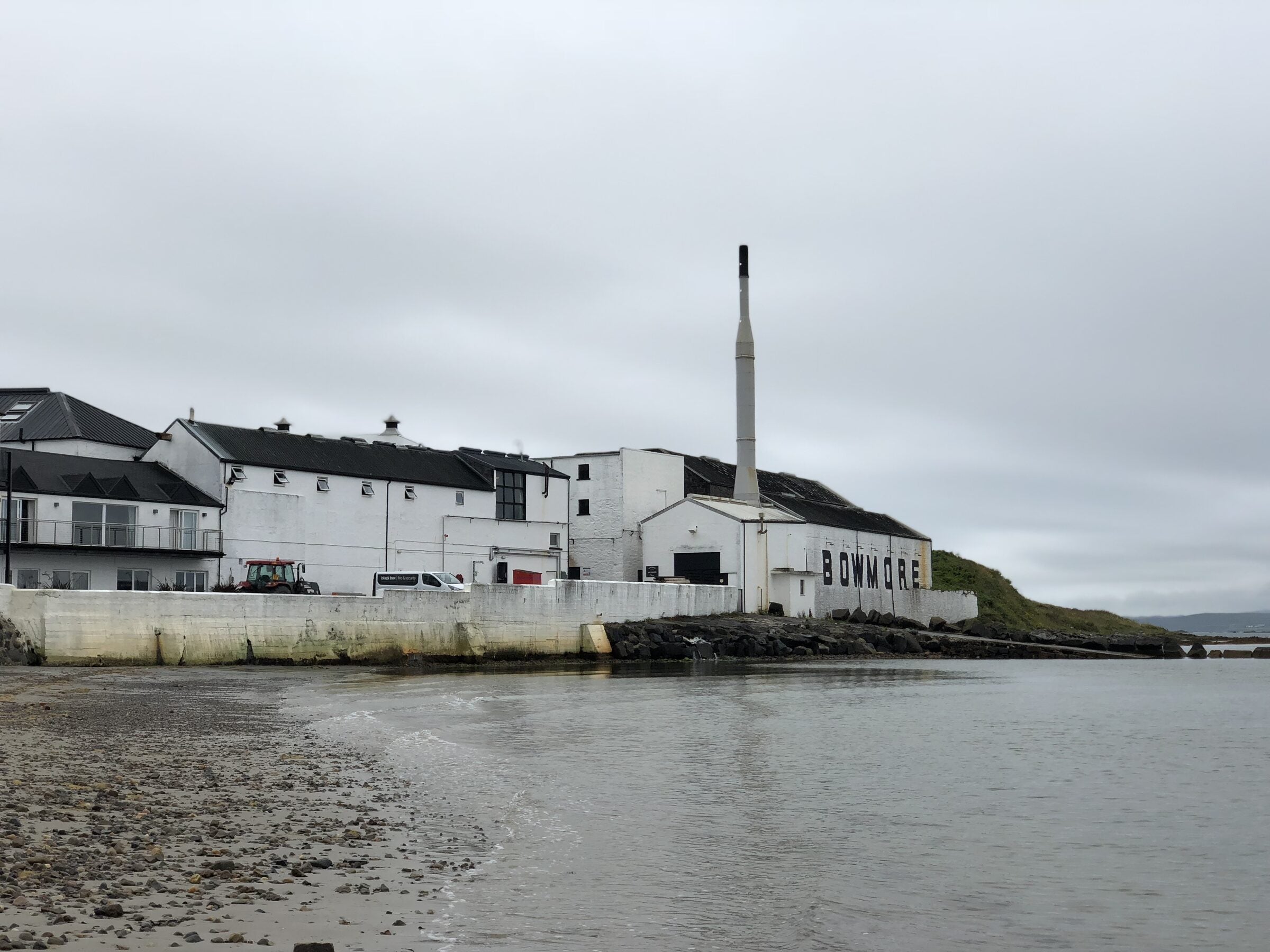
Bowmore Distillery: Islay's Oldest, and the Vaults Below the Sea
Two hundred years before "sea-matured" became a marketing line, Bowmore was already ageing whisky below sea level. The No.1 Vaults, cut into the shore of Loch Indaal in the heart of Islay's little capital, is often described as the oldest maturation warehouse in Scotland, and at high tide the water sits above the floor on the other side of its thick stone walls. Whisky has slept in that damp, salty darkness since 1779, which makes Bowmore Islay's oldest licensed distillery.
It is also one of the most quietly unusual. Bowmore still turns around a quarter of its own malt by hand on traditional floor maltings, sits at a peating level that splits the difference between Islay's smoke monsters and its gentler malts, and has produced some of the most valuable bottles ever sold at auction. For cask buyers it is one of the great names of Islay, and one we know first-hand: we have bottled Bowmore more than once, and we will get to what those casks actually tasted like further down.
Bowmore at a glance
| Region | Islay, on the shore of Loch Indaal in the village of Bowmore |
| Founded | 1779 by local merchant John P. Simson, making it Islay's oldest licensed distillery |
| Owner | Suntory Global Spirits (formerly Beam Suntory), via Morrison Bowmore Distillers; Suntory arrived in 1994 |
| Capacity | Around 2 million litres of pure alcohol a year |
| Stills | Four, pear-shaped: two wash stills charged at about 20,000 litres and two spirit stills with rising lyne arms |
| Water source | The River Laggan, which runs through peat on its way to the distillery |
| Fermentation | Long and unhurried, from around 48 to 70-plus hours in Douglas fir washbacks |
| Malt spec | Peated to around 25 to 30 ppm; roughly a quarter still malted on the distillery's own floors, the rest from Simpsons on the mainland |
| Style | Medium-peated and maritime: beach-bonfire smoke, sea salt, citrus and tropical fruit, with a floral thread |
| Visitor centre | Yes, on School Street in the centre of Bowmore village, with tours of the maltings and the No.1 Vaults |

Bowmore from above
Our drone lifted off from the shore of Loch Indaal to film Bowmore the way the geese see it: a huddle of whitewashed buildings pressed right against the sea wall, with the village climbing the hill behind and the round church at the top of the street. From the air you can see just how little separates the No.1 Vaults from the water.
History of Bowmore
Bowmore was founded in 1779 by John P. Simson, a local merchant, at a time when most Islay whisky was still being made in unlicensed bothies in the hills. The distillery grew up with the planned village around it, and in the nineteenth century both passed into the hands of the Mutter family, Glasgow merchants of German descent. James Mutter was a splendidly improbable figure: a farmer and distiller who also served as Vice Consul for the Ottoman Empire, Portugal and Brazil through their Glasgow consulates. Under the Mutters, Bowmore whisky travelled by small steam vessel from the pier to Glasgow and on to markets as far away as Canada.
The twentieth century was rockier. The distillery passed to J.B. Sheriff & Co. in 1925 and William Grigor & Son of Inverness in 1950, pausing production through both World Wars. During the Second World War it went further than most: distilling stopped and the buildings hosted RAF Coastal Command, whose flying boats operated from Loch Indaal on anti-submarine patrols over the Atlantic.
The modern era began in 1963, when Stanley P. Morrison's firm bought the distillery and created Morrison Bowmore Distillers. The Morrisons modernised the stillhouse, moved from direct coal firing to gas, and, without quite knowing it at the time, laid down the casks that would later make Bowmore's name at auction; the first spirit of the new regime, distilled in late 1964 and filled into first-class Oloroso sherry wood, became the legendary Black Bowmore. Japanese distiller Suntory, a customer and admirer since the 1980s, took a stake in 1989 and bought Morrison Bowmore outright in 1994. Today the distillery sits within Suntory Global Spirits, the renamed Beam Suntory, alongside Laphroaig, Ardmore and Auchentoshan.
One more piece of history worth knowing: when the distillery decommissioned one of its old warehouses, it did not knock it down. The building became the MacTaggart Leisure Centre, and its swimming pool is heated by waste heat piped from the distillery next door. There cannot be many places where you can swim in the by-product of whisky making.
How Bowmore makes its whisky
Bowmore is one of only a handful of Scottish distilleries that still operates its own floor maltings, and they are not a museum piece. Around a quarter of the distillery's malt is produced on site: barley is steeped, spread across the malting floors, turned by hand with wooden shovels and dried in the kiln over a smouldering peat fire to somewhere around 25 to 30 ppm. The remainder arrives from Simpsons Malt on the mainland, made to the same specification. That 25 to 30 ppm figure matters, because it places Bowmore deliberately in the middle of the Islay spectrum: noticeably smokier than Bruichladdich's unpeated make, but well short of the heavyweight Kildalton trio of Ardbeg, Lagavulin and Laphroaig.
Soft water comes off the hills via the River Laggan, picking up peat along the way. Mashing happens in a stainless steel semi-lauter tun, and fermentation is long, running from around 48 hours to 70 or more in washbacks of Douglas fir, which is where Bowmore's fruit comes from; short ferments make nutty, cereal spirit, while long ones build the esters that read as pineapple, peach and citrus in the glass. Distillation is in four pear-shaped stills, the two spirit stills with gently rising lyne arms that encourage a touch of reflux and keep the spirit poised rather than heavy.
Then comes the part no one else can copy. A large share of Bowmore's maturation happens on Islay itself, much of it in the three warehouses by the shore, including the below-sea-level No.1 Vaults, where the air is cool, damp and thick with salt spray off Loch Indaal all year round. Whether the sea air truly gets into the whisky is a debate for late in the evening, but nobody who has stood in the Vaults doubts that it is a singular place for a cask to grow old.
What does Bowmore taste like?
Bowmore is Islay in the middle of its register. The smoke is unmistakable but conversational, closer to a beach bonfire drifting on the wind than a face full of tar, and it shares the stage with sea salt, lemon and orange peel, honey, malt and a distinctive floral note that runs through the make like a watermark. Sherry casks suit it unusually well: ex-Oloroso Bowmore layers dark fruit, chocolate and coffee over the smoke, while ex-bourbon casks leave it brighter, all citrus, vanilla and salted caramel.
Its party trick, though, is age. Old Bowmore, particularly from the 1960s and from well-aged refill casks today, develops an exotic fruitiness that whisky writers reach for superlatives to describe: mango, passion fruit, guava and peach, with the smoke faded to a distant sea-mist. It is one of the most prized flavour profiles in all of Scotch, and a large part of why old Bowmore commands the prices it does. Collectors of a certain vintage will also tell you about the heavily floral, lavender-led character of some 1980s bottlings, which remains one of whisky's great love-it-or-loathe-it arguments. The modern make is widely agreed to be back to its fruity, smoky best.
Bowmore and independent bottlers
Unlike its tightly-held neighbour Lagavulin, Bowmore has a long and healthy history with independent bottlers. Casks filled in the Morrison era circulated through brokers and blenders, and well-chosen independent Bowmore, particularly at cask strength and natural colour, has introduced many drinkers to sides of the distillery the official range never shows: austere refill-cask Bowmore where the salt and citrus do the talking, or single sherry casks with the smoke wrapped in dried fruit. For whisky lovers, independent bottlings are often the best-value route into the distillery's famous older, fruitier style, since they are priced as whisky rather than as trophies.
Supply has tightened in recent years, as it has across Islay; Suntory Global Spirits keeps more back for official releases, and good parcels of aged Bowmore change hands quickly and quietly. But casks do still move, which is more than can be said for several of its island neighbours, and that keeps Bowmore firmly on every serious independent bottler's wish list, including ours.
The Single Cask and Bowmore
We have had the pleasure of bottling Bowmore several times, and the casks have shown exactly the range described above. Back in the day we bottled a pair of sister casks, Bowmore 14 years old, cask 31931 and cask 31932, both distilled in 2001 and bottled at 50%. Tasted side by side they were a masterclass in why single casks are worth bottling at all: 31931 gave us light wafts of bonfire on the beach, vanilla-rich caramel and black tea, with salted butter on crumpets and earthy peat on the palate, while its neighbour 31932 went another way entirely, all smoky wood, star anise and mint, opening into sea breeze, pears, cinnamon and fudge with a salted caramel finish. Same distillery, same day of distillation, two different whiskies.
More recently we were lucky enough to bottle a Bowmore 29 year old from cask 266034, a refill hogshead filled on 16 May 1996 and bottled at its natural cask strength of 48%. This one showed the old-Bowmore magic in full: deep gold in the glass, citrus and sea salt over calm peat on the nose, then chewable malt, salted caramel, basil and oak, the smoke serene rather than shouting, fading out on a long herbal finish. Casks like that are why collectors whisper about refill-matured Bowmore. All three bottlings are now sold out, which tells its own story about how quickly this distillery's name moves whisky off a shelf; if a Bowmore cask crosses our path again, our mailing list will hear about it first.

Collectability and cask ownership
Bowmore sits in the very top tier of collectable Scotch. The benchmark is Black Bowmore, distilled in November 1964 into first-rate Oloroso casks and released as a trilogy of 29, 30 and 31 year olds between 1993 and 1995 at prices that seem unreal now, around a hundred pounds a bottle. Those bottles today change hands for five-figure and six-figure sums, and the name has carried an entire category of dark-sherried collectables with it. The distillery's oldest stock has gone further still: Bowmore Onyx, a 51 year old, comfortably exceeded expectations at the first Distillers One of One charity auction in 2021, and in October 2023 Bowmore STAC, drawn from 1962 spirit matured in second-fill American oak in the No.1 Vaults, sold at the same auction series for £562,500, a record for the distillery. Even the archives perform: a bottle of 1850s-era Bowmore sold at auction back in 2007 for £29,400. Add a high-profile partnership with Aston Martin, which has produced releases such as the ARC-52 and the Black Bowmore DB5, and you have one of the few distilleries whose rarities sit alongside Macallan and Dalmore in the auction headlines.
What does that mean for cask buyers? Genuine Bowmore casks do exist in private hands, ours have come and gone through the years, and demand for them is deep and international. Age suits the spirit, refill wood matures it gracefully, and the distillery's auction record gives well-documented casks an obvious audience when the time comes to bottle. But the same cautions apply here as anywhere, and more so because famous names attract chancers: provenance is everything, so insist on proper documentation, a delivery order or direct warehouse confirmation, and independent advice before any money moves. Remember too that cask ownership involves risk, values can go down as well as up, storage and insurance cost money every year, and whisky can only be sold as whisky; none of this is financial advice. If you are new to the subject, our guide to cask sizes and types explains the practicalities in plain English, and we are always happy to give an honest view on any Islay cask you are considering, whether or not it comes from us.
Visiting Bowmore
Most distilleries stand apart from their communities; Bowmore is the community. The distillery sits on School Street in the centre of Islay's capital, a short walk from the famous round church built, so the story goes, so the devil would have no corners to hide in. The visitor centre runs tours year round that take in the malting floors, the kiln, the stillhouse and, on the more in-depth experiences, the No.1 Vaults itself, where you can taste whisky in the oldest maturation space in Scotch. The bar upstairs looks straight out over Loch Indaal. Time a visit for late May and you will catch Feis Ile, the island's festival of malt and music, when Bowmore's open day takes over the village. Caol Ila and Bruichladdich are each about twenty minutes away by car, and the Kildalton trio not much further.
Bowmore FAQs
Who owns Bowmore distillery?
Bowmore is owned by Suntory Global Spirits, the Japanese-owned company formerly known as Beam Suntory. Suntory first invested in Morrison Bowmore Distillers in 1989 and took full ownership in 1994.
Is Bowmore the oldest distillery on Islay?
Yes. Bowmore was licensed in 1779, making it the oldest licensed distillery on Islay and one of the oldest in Scotland. Its No.1 Vaults warehouse is often described as the oldest whisky maturation warehouse in the world still in use.
How peaty is Bowmore?
Bowmore's malt is peated to around 25 to 30 ppm, roughly half the level of Islay's smokiest distilleries. The result is a balanced, medium-peated style where smoke shares the glass with fruit, salt and honey rather than dominating it.
What is Black Bowmore?
Black Bowmore is a legendary series of whiskies distilled in November 1964 and matured in dark Oloroso sherry casks, first released as 29, 30 and 31 year olds between 1993 and 1995. Originally sold for around £100 a bottle, they now trade for five- and six-figure sums at auction.
Can you buy a cask of Bowmore?
Occasionally, yes. Unlike some famous Islay names, genuine Bowmore casks do appear on the private market from time to time, though supply is tight and provenance must be checked carefully. We have bottled Bowmore casks ourselves; contact us if you are interested and we will tell you honestly what is available.
Can you visit Bowmore distillery?
Yes. The visitor centre in the centre of Bowmore village runs tours and tastings year round, including experiences that visit the working floor maltings and the No.1 Vaults warehouse below sea level.
Own a piece of Bowmore
Islay's oldest distillery has a way of getting under your skin: the hand-turned malt, the salt-heavy air in the Vaults, and that slow drift from bonfire smoke to tropical fruit as the decades pass. If that story appeals to you as an owner and not just a drinker, start with our plain-English guide to buying a whisky cask, have a look at how cask sizes and types shape a whisky's future, and then talk to us. We will tell you what Islay casks are honestly available, what they are likely to become, and, as with everything at The Single Cask, we will only ever recommend a cask we would be happy to bottle under our own label.
Work with The Single Cask
Buy a whisky cask, bottle under your own label, or store casks in our HMRC approved bonded warehouse in Fife.
Read more
Glen Ord Distillery: The Malting Giant That Feeds Talisker
Glen Ord grows most of its own barley and supplies malt to Diageo's other Highland distilleries, yet almost none of its own whisky is sold in the UK. Our guide covers the Black Isle history, the ho...
Read more
Ardmore Distillery: The Peated Highlander Built for Teacher's
Built beside the railway in 1898 to feed Teacher's Highland Cream, Ardmore is the Highlands' quiet peated giant: coal-fired until 2001, barely bottled as a single malt for a century, and a favourit...
Read more


