
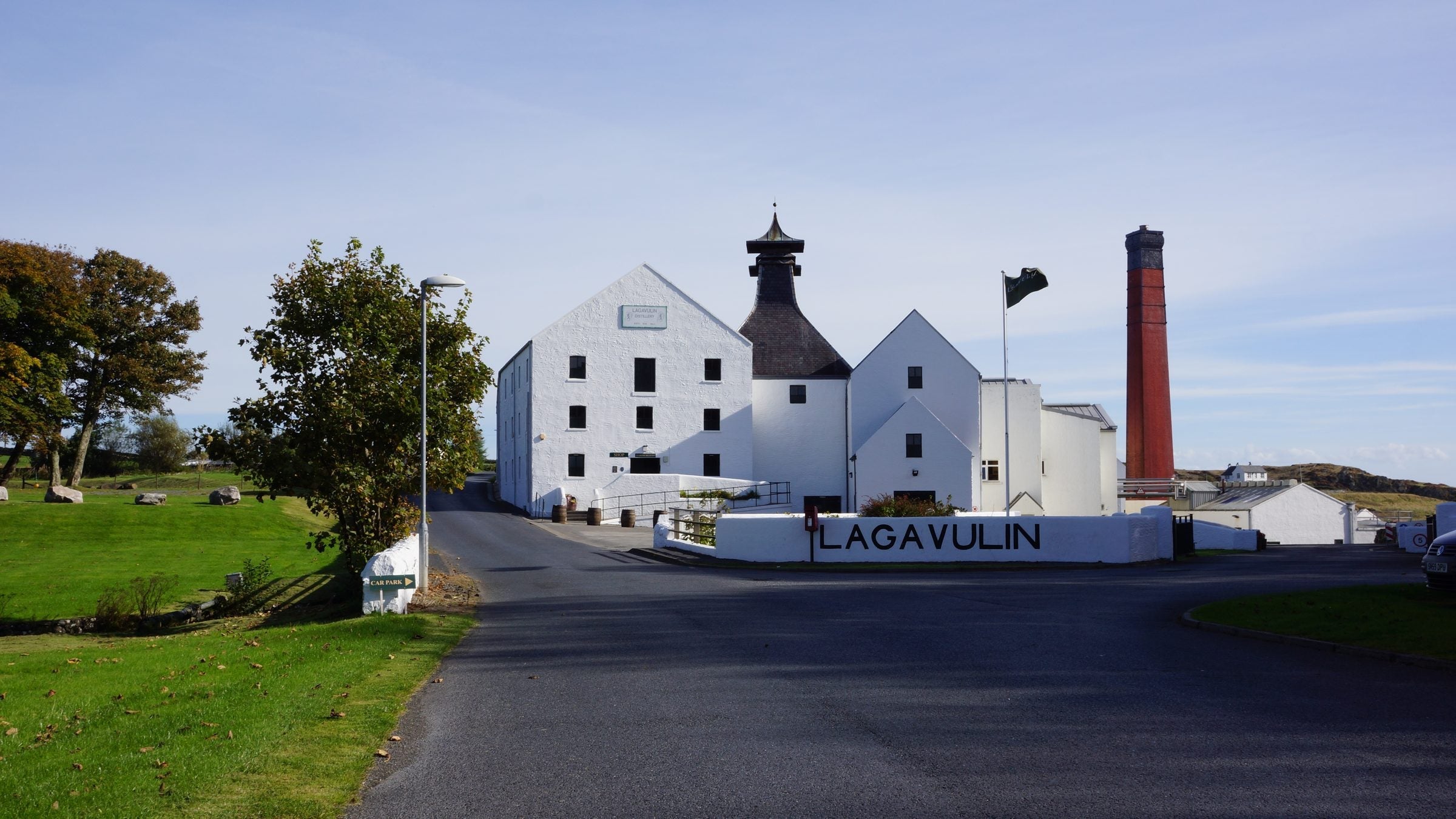
Lagavulin Distillery: Islay's Slow-Burning Legend
It takes more than nine hours for spirit to come off Lagavulin's second distillation, the slowest run on Islay, and the result then waits sixteen years in the warehouse before most drinkers are allowed to meet it. In an industry that has spent two centuries learning to do everything faster, Lagavulin has built one of the most revered names in Scotch by point-blank refusing to hurry.
For whisky lovers the name means one thing above all: the 16 year old, all peat smoke, sherry fruit and Lapsang Souchong depth, the bottle that has introduced generations to Islay's south coast. For cask buyers the name means something more frustrating, because Lagavulin is one of the hardest distilleries in Scotland to own outside the official range, bottle or cask. Here is the full story, including an honest answer to that last problem.
Lagavulin at a glance
| Region | Islay, on the Kildalton coast between Port Ellen and Ardbeg |
| Founded | Licensed in 1816 by John Johnston, on a site with records of illicit stills back to around 1742 |
| Owner | Diageo |
| Capacity | Around 2.5 million litres of pure alcohol a year running seven days a week; older references quote 1.4 million |
| Stills | Four, pear-shaped: two wash stills of about 11,000 litres and two larger spirit stills of about 12,500 litres |
| Water source | Lochan Sholum, in the hills above the distillery, running down through peat |
| Fermentation | Around 55 hours in ten wooden washbacks |
| Malt spec | Peated to roughly 35 ppm, malted at Port Ellen Maltings |
| Style | Rich, smoky and maritime; peat, iodine, dried fruit and dark tea |
| Visitor centre | Yes, housed in the old Malt Mill distillery buildings |

Lagavulin from above
Our drone flew over Lagavulin Bay to capture the distillery's famous white walls, the shoreline warehouses and the ruin of Dunyvaig Castle guarding the entrance to the bay.
History of Lagavulin
Lagavulin Bay was important long before whisky. The ruined stump of Dunyvaig Castle, once a naval stronghold of the Lords of the Isles, still guards the entrance to the bay, and the distillery's name comes from the Gaelic lag a' mhuilinn, the hollow by the mill. By the mid-eighteenth century the hollow was busy with less official activity: accounts describe as many as ten illicit bothies distilling on the site around 1742, conveniently far from the excisemen and conveniently close to the sea.
John Johnston took out a licence in 1816, and a second small distillery appeared beside it soon afterwards; by 1837 the two had been folded into one. The Graham family and then James Logan Mackie carried the business through the middle of the century, but the man who made Lagavulin famous arrived in 1878: Peter Mackie, James's nephew, who learned distilling at Lagavulin and took charge of the firm in 1889.
"Restless Peter" was one of the great Victorian whisky barons, a man whose motto was reputedly that nothing was impossible. In 1890 he launched the White Horse blend, built around Lagavulin malt and named after a Canongate coaching inn, and it became one of the best-selling whiskies in the world, earning a royal warrant in the early 1900s. Mackie's restlessness had its sharp edges. When he lost the sales agency for neighbouring Laphroaig in 1907, he first tried diverting its water supply, and when the courts stopped that he built a replica distillery inside Lagavulin in 1908, staffed with poached Laphroaig workers, to copy the whisky outright. The experiment, Malt Mill, never tasted remotely like Laphroaig and closed in 1962, but it earned a strange immortality: a mythical cask of Malt Mill is the treasure at the heart of Ken Loach's 2012 film The Angels' Share, and the old Malt Mill buildings now house Lagavulin's visitor centre.
After Mackie died in 1924 the company renamed itself White Horse Distillers and by 1927 had joined the Distillers Company, the giant that eventually became Diageo by way of Guinness in 1986 and the Grand Metropolitan merger of 1997. The modern turning point came in 1988, when the 16 year old was chosen as the Islay representative in the new Classic Malts range. Demand has run ahead of supply more or less ever since, which is why the distillery moved to round-the-clock working. Lagavulin marked its bicentenary in 2016 with, among other things, an 8 year old inspired by the writer Alfred Barnard, who tasted an eight-year-old Lagavulin on his visit in the 1880s and pronounced it exceptional.
How Lagavulin makes its whisky
Everything about the process is calibrated for weight and smoke. The water rises at Lochan Sholum in the hills above the distillery and runs down through peat before it ever reaches the mash house. The barley is malted along the road at Port Ellen Maltings to Lagavulin's own specification, peated to roughly 35 ppm, similar on paper to its Kildalton neighbours yet unmistakably different in the glass.
Fermentation runs long, around 55 hours in ten wooden washbacks, building the fruity depth that sits underneath the smoke. Then comes the part Lagavulin is famous for. The four pear-shaped stills are unusual twice over: the spirit stills are larger than the wash stills, the reverse of most distilleries, and they are filled almost to the brim, around 95 per cent full. A full still gives the vapour very little copper to converse with, and less copper contact means a heavier, oilier, more characterful spirit. The first distillation takes about five hours, the second more than nine, the slowest on Islay, and the spirit is collected on a long, generous cut. Maturation is mostly in refill and ex-bourbon casks, with sherry wood playing its part in the 16 year old and the Pedro Ximenez-finished Distillers Edition. A portion still sleeps in the shoreline warehouses, close enough to the Atlantic that winter spray reaches the walls.
What does Lagavulin taste like?
Lagavulin is the baritone of the Kildalton coast. Where Caol Ila is grassy and bright and Ardbeg is sharp and citric, Lagavulin is broad, deep and dry: thick peat smoke, iodine and seaweed, then dried figs, dates and treacle, Lapsang Souchong tea, a savoury meatiness, and a long, ashy, sea-salted finish. The 16 year old shows that character at its most polished, rounded by age and a measure of sherry wood. The 8 year old is the same voice younger and louder, more ash and brine, less fruit. The annual 12 year old cask strength releases are for many enthusiasts the purest expression of the distillery, intense, smoky and mineral at full power. However it is dressed, Lagavulin rarely tastes like anything else on earth, which is precisely why people spend their lives coming back to it.
Lagavulin and independent bottlers
Here is the uncomfortable truth for independent bottlers like us: Lagavulin casks essentially do not circulate. Diageo keeps this make on the tightest of leashes, reserving it for the official range, the annual Special Releases and the Feis Ile and Jazz Festival bottlings. Independent Lagavulin was never common, and in the modern era it has all but vanished; the handful of examples that surface at auction tend to date from decades ago or hide behind teasing cover names such as "a secret Islay distillery", and even those are rare enough to cause a stir when they appear.
That scarcity is no accident. Lagavulin 16 is one of the most important single malts in Diageo's portfolio, and its owner has no need to sell new-make to brokers or blenders. Contrast that with Caol Ila along the coast, which was built to feed blends at scale and has long been the independent bottler's favourite Islay malt. If you want a single cask taste of smoky Islay, that is where realistic roads lead.
The Single Cask and Lagavulin
We will be straight with you: we have never bottled Lagavulin, and it is not for want of trying. In our years of hunting casks we have never once been offered a genuine parcel of Lagavulin at sensible money, and we are deeply sceptical of anyone who claims otherwise. When a name commands this much devotion, honesty is worth more than a good story.
What we can offer is the next warehouse along. We have bottled Caol Ila many times over the years, from a bright 5 year old to sherried teenagers, always at cask strength, natural colour and without chill filtration. Our current shelf includes a Caol Ila 9 year old from cask 321526, distilled in 2014 and bottled at 52.8%, smoky, coastal and a fraction of the price a comparable Lagavulin would fetch if one existed. It is the closest thing to a Kildalton experience an independent bottler can honestly sell you, and we think it stands proudly on its own merits.
Collectability and cask ownership
On the bottle side, Lagavulin has a devoted collector following. The annual Feis Ile and Jazz Festival releases sell out on the island in hours and trade briskly at auction, the 12 year old cask strength Special Releases are followed closely, and older official expressions, the 21, 25 and 30 year olds and the occasional single cask, command serious prices. A charity single cask bottled for the bicentenary raised hundreds of thousands of pounds. Scarce official Lagavulin has a track record of holding attention, though like all whisky at auction its prices move with fashion and the wider market.
On the cask side, we owe you the same honesty as above: genuine Lagavulin casks are, to all practical purposes, never for sale. Diageo does not sell new-make from this distillery to private buyers, and aged casks do not reach the open market. If you are offered one, ask very hard questions about provenance before any money moves, and take independent advice; too-good-to-be-true has a particular smell, and it is not peat smoke. More generally, remember that cask ownership involves risk and values can go down as well as up, and nothing here is financial advice. If you are exploring cask buying seriously, start with our plain-English guide to cask sizes and types, and ask us what is genuinely available from Islay; we will tell you straight.
Visiting Lagavulin
Lagavulin sits on the A846 a short way east of Port Ellen, with Laphroaig and Ardbeg within a few miles either side, three of the greatest names in whisky along one small stretch of coast road. The visitor centre, in the old Malt Mill buildings, runs tours and tastings year round, including warehouse tastings drawn straight from the cask that rank among the best experiences on the island. During Feis Ile, the island's festival of malt and music each spring, Lagavulin's open day fills the courtyard with drams, seafood and music. Walk the shore path to the Dunyvaig Castle ruin for the classic photograph of the white distillery walls across the bay.
Lagavulin FAQs
Who owns Lagavulin distillery?
Diageo, the world's largest Scotch whisky company, which traces its ownership of Lagavulin back through Guinness and the Distillers Company to the White Horse firm of Peter Mackie.
How peaty is Lagavulin?
The malt is peated to roughly 35 ppm, a similar specification to its Kildalton neighbours. Slow distillation in very full stills gives Lagavulin a deeper, richer smokiness than the numbers alone suggest.
Why is Lagavulin 16 so famous?
It was chosen as the Islay representative of the Classic Malts range in 1988 and became many drinkers' first serious peated whisky, admired for combining heavy smoke with sherried fruit and remarkable smoothness at sixteen years old.
Can you visit Lagavulin?
Yes. The visitor centre in the former Malt Mill buildings offers tours, tastings and warehouse experiences year round, and the distillery hosts a celebrated open day during the Feis Ile festival.
Can you buy a cask of Lagavulin?
Realistically, no. Diageo does not sell Lagavulin casks to private buyers and genuine casks do not reach the open market. Treat any offer of one with great caution, and ask us for an honest view before parting with money.
Are there independent bottlings of Lagavulin?
Very few. A small number of independent and cover-name bottlings have appeared over the decades, but modern independent Lagavulin is effectively non-existent, which is why smoky-whisky lovers turn to Caol Ila and other Islay malts for single cask bottlings.
Own a piece of Islay's south coast
We would love to end by offering you a cask of Lagavulin. We cannot, and neither, honestly, can anyone else. What we can offer is the real thing from the same coastline: single casks of smoky Islay malt, chosen by people who taste everything they sell, bottled at natural strength and colour. Explore our current Caol Ila bottling, read our guide to buying a whisky cask, or get in touch and tell us what you are looking for. If a Lagavulin cask ever does cross our path at honest money, our mailing list will be the first to know.
Work with The Single Cask
Buy a whisky cask, bottle under your own label, or store casks in our HMRC approved bonded warehouse in Fife.
Read more
Glentauchers Distillery: The Speyside Malt the Blenders Keep
Almost nobody writes seriously about Glentauchers, yet blenders prize it and independent bottlers compete for its casks. Having bottled it from 7 to 22 years old, we explain why this Ballantine's w...
Read more
Mannochmore Distillery: The Quiet Speysider Behind the Black Whisky
Mannochmore made Loch Dhu, the notorious black whisky, but its real story is a light, floral Speyside spirit that blenders have trusted for fifty years. We have bottled more than a dozen casks of i...
Read more


