
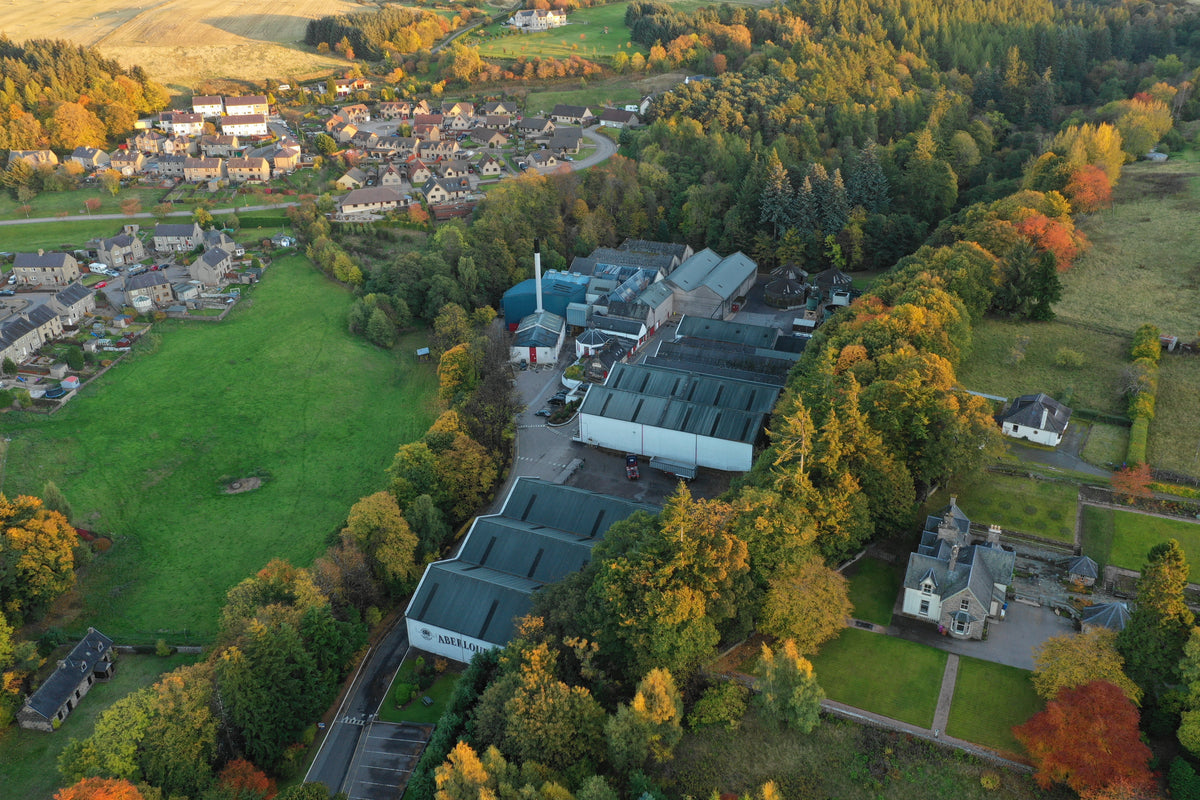
Aberlour Distillery: History, Casks & Whisky
Ask ten whisky drinkers to name a classic Speyside malt and Aberlour turns up on most lists. Ask the same ten who owns it and most will guess wrong. It belongs to Chivas Brothers, sits in the same stable as The Glenlivet, and sells more whisky than its modest visibility on the shelf suggests, mostly as the cask strength, all sherry cask A'bunadh rather than the familiar green bottle.
Aberlour at a glance
| Region | Speyside, on the Spey where it meets the Lour Burn, below Ben Rinnes |
| Founded | Whisky was first made on the site in 1826; the present distillery was rebuilt in 1879-80 by James Fleming after fire destroyed the original |
| Owner | Chivas Brothers (Pernod Ricard) |
| Capacity | Around 3.9 million litres a year historically, doubling toward roughly 7.8 million litres under an £88 million expansion announced in 2022 and targeted for completion by 2025 |
| Stills | Four: two wash, two spirit, classic Speyside shape |
| Water source | The Burn of Aberlour, fed in part by the spring known as St Drostan's Well |
| Fermentation | Six washbacks of around 70,000 litres each |
| Malt spec | Unpeated |
| Style | Sweet, honeyed and sherry-driven, more dried fruit than smoke |
| Visitor centre | Yes, five-star VisitScotland rated, opened in 2002 |
History of Aberlour
There has been a distillery on this stretch of the Spey since 1826, when James Gordon and Peter Weir set up on a site near the village. That original operation didn't survive intact: a fire in 1879 destroyed the buildings, and it was James Fleming, a local banker and grain merchant, who financed a completely new distillery about a mile upstream, at the point where the Lour Burn runs into the Spey. It opened in December 1880, and when the Victorian writer Alfred Barnard visited a few years later he called it, without much modesty on Fleming's behalf, the perfect modern distillery.
Fleming was more than a distiller. He built Fleming Hall for the village, endowed a cottage hospital, and paid for the bridge over the Spey that locals still call the Penny Bridge. It's the kind of local philanthropy that shows up more often in Victorian distilling history than people expect, and Aberlour has stayed proud of it.
The distillery burned again in 1898, this time after an explosion at the malt mill, and was rebuilt within six months by the architect Charles Doig, best known for the pagoda roof design used across Speyside. Ownership then moved steadily through the twentieth century: Robert Thorne & Sons from 1892, the Manchester brewing family W.H. Holt & Sons from 1921, and S. Campbell & Sons from 1945. Pernod Ricard acquired Campbell's, and Aberlour with it, in 1975, and the distillery has sat inside the Chivas Brothers portfolio since the group's formation in 2001.
The most recent chapter is a big one. In 2022 Chivas Brothers announced an £88 million investment to expand both Aberlour and neighbouring Miltonduff, adding a new still house with large windows at Aberlour and aiming to roughly double the distillery's output. The stated target was full operation by around 2025, alongside a new bio plant and heat recovery technology intended to help the site toward carbon neutral distillation. It's a serious vote of confidence in a distillery that, outside whisky circles, still isn't especially well known by name.
How Aberlour makes its whisky
Water comes from the Burn of Aberlour, which the original distillery land included along with a spring called St Drostan's Well, named for the sixth century Celtic saint associated with the area. Malt has been bought in from Scottish maltsters since 1962, when Aberlour gave up floor malting on site, and the spirit itself is unpeated.
Six washbacks, each around 70,000 litres, give a long fermentation before the wash goes to four stills, two wash and two spirit, in a classically Speyside onion shape. The second pair was added in 1973 to match the originals as closely as possible, which is one reason Aberlour's house style has stayed consistent for decades even as the distillery has grown around it.
What really sets Aberlour apart is what happens after distillation. A high proportion of the make goes into first fill and refill oloroso sherry casks, more so than at many of its Speyside neighbours, though Glenfarclas down the road runs an even heavier sherry programme, and that policy is the backbone of both the official range and A'bunadh in particular, which matures exclusively in sherry wood. Bourbon casks are used too, mostly for the lighter end of the range, but sherry is where Aberlour's reputation is built.
What does Aberlour taste like?
The entry point, Aberlour 10 Year Old, is often called a textbook Speyside for good reason: apple, honey, a little toffee and a gentle nutty spice, easy drinking without being simple. Move up through the 12, 14 Double Cask and 16 and the sherry influence builds steadily, bringing dried fruit, orange peel, ginger and dark chocolate over the same honeyed base.
A'bunadh is a different animal. Bottled at cask strength straight from oloroso sherry casks with no age statement and no chill filtration, it comes across dense and rich: raisins, treacle, orange marmalade, cinnamon and a slow, warming heat that rewards a drop of water. Batch to batch it varies a little, which is part of its appeal to people who follow it closely, but the sherry-forward, spiced, dried fruit character is the constant.
Independent bottlings, when they turn up, tend to show a slightly different side: refill wood in particular lets more of the malty, honeyed distillery character through before the sherry takes over, which is why cask hunters value them alongside the heavily sherried official range rather than instead of it.
Aberlour and independent bottlers
Most people who drink Aberlour are drinking the official range or A'bunadh, and a meaningful share of the distillery's output goes into Chivas Brothers' blends rather than any single malt bottling at all. That's the normal pattern for a distillery of this size inside a big blending house, and it means independent releases of Aberlour have never been as constant a presence on shop shelves as, say, some of the smaller, more exposed Speyside names.
That doesn't mean independent Aberlour doesn't exist. Bottlers including Gordon & MacPhail, who have a long relationship with Speyside distilleries generally, and others working through brokers and private cask purchases, have released Aberlour over the years, and casks do surface for the independent market from time to time. It's worth treating each one as a genuine find rather than assuming stock is always available, because it usually isn't.
The Single Cask and Aberlour
We've bottled Aberlour twice. The first was an 8 year old from cask 800854, distilled in 2013 and matured in a rum quarter cask, bottled at a cask strength of 59.9% for an outturn of 143 bottles. It's a lively, food-friendly dram: honeyed and malty on the nose with rum soaked sponge cake, lime, allspice and white pepper, carrying through to a palate of Demerara sugar, banana, oak and milky coffee, and a finish that lingers on gummy bears, lime and honey. The rum quarter cask gave it a fruitier, spicier edge than you'd get from Aberlour's usual sherry wood, which made it an interesting one to pour blind.
The second was older and quieter: a 21 year old from cask 965, distilled in 1995 and bottled at 45.8%, herbal and citrus-led with mint, basil, lemon peel and cinnamon on the nose, and a drier palate of white grapes, lemon zest, grass and black pepper running into a long, cinnamon-and-oak finish.
Both casks have sold out, so we don't have Aberlour in stock at the moment. We'd happily look at another cask if the right one came up, and if you're specifically after Aberlour, tell us and we'll keep an eye out rather than promising something we can't deliver.

 Collectability and cask ownership
Aberlour A'bunadh has built a genuine following at auction. Its batch system, running since batch 6 in 1999 with two to six releases a year, gives collectors a reason to chase particular batches, and early or unusual editions, like the sterling silver labelled millennium bottling, command real attention when they come up for sale. The wider official range and older independent bottlings both turn up at auction too, generally holding steady interest given Aberlour's standing as a well-regarded, sherry-forward Speyside name.
None of that is a guarantee for a cask bought today. Aberlour casks change hands less often than some Speyside names simply because fewer of them reach the open market, and a distillery's collector reputation can shift over years in ways nobody can call in advance. As with any cask, ownership involves risk and values can go down as well as up. This isn't financial advice, and we'd rather you went in with clear eyes than a rosy prediction. If you're weighing up a cask purchase generally, our guide to whisky cask sizes and types is a good place to start before you commit to anything.
Visiting Aberlour
Aberlour's visitor centre opened in 2002 and holds a five star VisitScotland rating, aimed more at people who already know their whisky than casual passers-by. Tours run in small groups and last around an hour and three quarters, longer than the average distillery visit, and the standout extra is the chance to fill your own bottle straight from a cask for an additional charge, a nice touch for anyone planning a bottling project of their own to see how it's done at scale. The distillery sits right on the edge of Aberlour village on Speyside, an easy stop alongside neighbours such as Craigellachie and Benrinnes if you're touring the area's distilleries by road.
Aberlour FAQs
Who owns Aberlour distillery?
Chivas Brothers, the Scotch whisky arm of Pernod Ricard. Aberlour joined the group when Pernod Ricard acquired S. Campbell & Sons in 1975, and has been part of Chivas Brothers since the company's formation in 2001.
Is Aberlour peated?
No. Aberlour distils an unpeated Speyside spirit, and its character comes mainly from extensive use of oloroso sherry casks rather than smoke.
What is Aberlour A'bunadh?
A'bunadh is Aberlour's cask strength, no age statement expression, matured entirely in oloroso sherry casks and bottled unchillfiltered in numbered batches, usually two to six a year since the system began in 1999.
Can you visit Aberlour distillery?
Yes. It has a five star VisitScotland rated visitor centre with in-depth tours lasting around an hour and three quarters, including the option to fill your own bottle from a cask.
Can you buy a cask of Aberlour?
Occasionally. Most Aberlour spirit goes into blends and the distillery's own bottlings, so independent casks are less common than at some Speyside distilleries, but they do reach the market from time to time. Ask us and we'll tell you honestly what's realistic right now.
How old is Aberlour distillery?
Whisky has been made on the site since 1826, though the current distillery was rebuilt on a new site nearby in 1879-80 after fire destroyed the original, and rebuilt again after a second fire in 1898.
Plan a bottling inspired by Aberlour
An honest answer on availability: Aberlour casks aren't impossible to find, but they aren't sitting on a shelf waiting either. We've bottled two ourselves in the past, both now sold out, and independent releases from bottlers like Gordon & MacPhail show that casks do reach the market now and again. The real constraint isn't cost, it's simply that most of what Aberlour distils each year is earmarked for its own official range and Chivas Brothers' blends, so supply into the independent market is thin and unpredictable rather than closed off entirely.
If you'd like us to look specifically for an Aberlour cask, we can keep watch and tell you plainly when something suitable turns up, including provenance checks, a sample before you commit, and help assessing whether a given cask is actually worth what's being asked. If nothing surfaces in a useful timeframe, we can also point you toward other sherry led Speyside casks with a comparable weight and dried fruit character, from distilleries where stock is currently easier to source.
Either way, a cask is only the start of a bottling project, not the whole of it. Tell us the flavour or style you're after, roughly how many bottles you need, your approximate budget, when you'd like to bottle by, and whether this is for a drinks brand, a retailer, a hospitality business, a company, a whisky club, an event or your own private use. Let us know too if you'll need help with naming, label design, storage or the bottling run itself.
From there we can give you a straight view of what's realistically available, sensible alternatives if Aberlour itself is out of reach for now, a rough indication of how many bottles your cask would yield, the main costs and stages involved, and a practical route from choosing a cask through to finished bottles on a shelf. Have a look at our page on buying a whisky cask for the basics, or if you're planning a bottling under your own name, our private label whisky and independent bottling services pages cover how we help from selection through to labelling. When you're ready, get in touch and tell us what you have in mind.
Work with The Single Cask
Buy a whisky cask, bottle under your own label, or store casks in our HMRC approved bonded warehouse in Fife.
Read more

Macduff Distillery: The Blend's Best-Kept Secret on the Moray Coast
Macduff makes millions of litres a year for William Lawson's blend and barely sells any of it under its own name. Here is the full story, how the whisky is made on its unusual five stills, and hone...
Read more
Tormore Distillery: Speyside's Extravagant Comeback
Tormore looks like nowhere else in Speyside, and spent sixty years as an anonymous blending malt despite it. We look at its extravagant design, its 2022 sale to Elixir Distillers, our own cask note...
Read more


