
Article: Auchentoshan Distillery: Scotland's Full-Time Triple Distiller
Auchentoshan Distillery: Scotland's Full-Time Triple Distiller
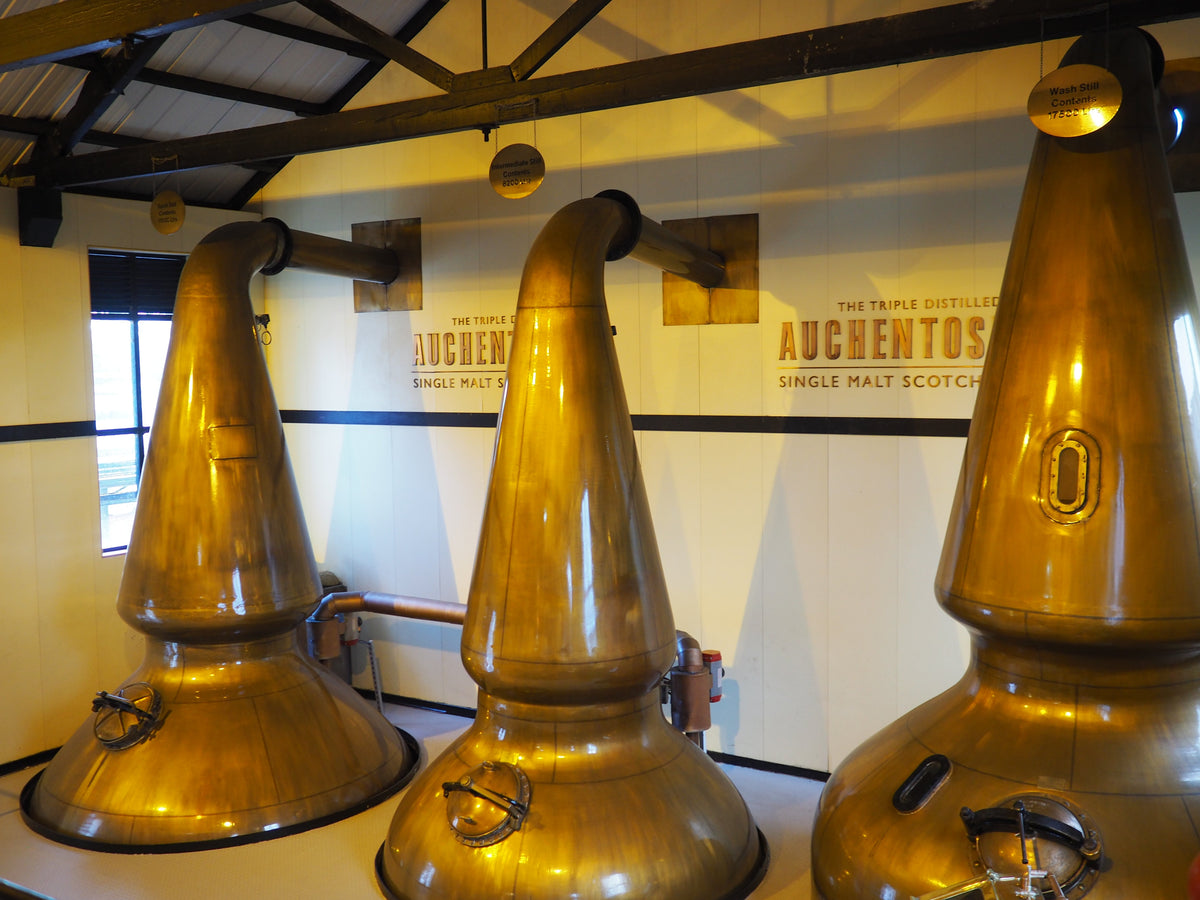
Walk into almost any Scotch still house and two stills do the work, a wash still and a spirit still. Walk into Auchentoshan and there are three, and every single drop that comes off them passes through all three, every time. No other working distillery in Scotland runs its entire output through triple distillation as a permanent, year round process, which is a large part of why this Lowland malt from the edge of Glasgow tastes so different from almost everything else in the country.
Auchentoshan at a glance
| Region | Lowland, Dalmuir, Clydebank, on the north bank of the River Clyde west of Glasgow |
| Founded | 1823 (occasionally given as 1817 in older sources) |
| Owner | Suntory Global Spirits (formerly Beam Suntory), via Morrison Bowmore Distillers since 1994 |
| Capacity | Around 1.8 million litres of pure alcohol a year at full production; distillation is currently paused (see History) |
| Stills | Three: one wash, one intermediate, one spirit, all three used for every distillation |
| Water source | Loch Katrine for production, Loch Cochno for cooling |
| Fermentation | Roughly 50 to 70 hours, in nine washbacks of Oregon pine and stainless steel |
| Malt spec | Unpeated |
| Style | Light, citrus led and cereal sweet, with oak that speaks loudly given time |
| Visitor centre | Yes, open Tuesday to Sunday with tours, tastings and a bar |

History
Auchentoshan traces back to 1823, when a corn merchant named John Bulloch built a distillery on the Clyde at Dalmuir, then a rural spot well outside Glasgow. Bulloch went bankrupt within a few years, his son Archibald fared no better, and by 1834 the site had passed to John Hart and Alexander Filshie, whose families ran it for more than four decades. Ownership moved on steadily through the nineteenth and twentieth centuries: C.H. Curtis and Company from the 1870s, then the McLachlan brothers from 1900 or so, who ran it alongside their brewing interests.
The distillery's most dramatic moment came during the Second World War. Clydebank, a shipbuilding town a short walk from Auchentoshan's gates, was flattened over two nights in March 1941 in what became known as the Clydebank Blitz, and Auchentoshan did not escape entirely. Bombs fell close enough to destroy warehouse stock and, according to local accounts, sent burning spirit running into the surrounding ground; the crater left behind was later turned into the cooling pond still used on site today. It is a story the distillery tells itself, and it is one of the more vivid survival tales in Scotch whisky.
Post-war ownership continued to shift: J&R Tennent by 1960, Eadie Cairns from 1969, who rebuilt much of the plant and pushed Auchentoshan harder as a single malt in its own right rather than blend filler. Stanley P. Morrison, the Glasgow firm behind Morrison Bowmore Distillers, bought Auchentoshan in 1984, putting it under the same roof as Bowmore. Suntory, the Japanese drinks group, took a stake in Morrison Bowmore in 1989 and full ownership in 1994, a deal that also brought Auchentoshan into what has since become, after a 2014 merger with Beam Inc that added Islay's Laphroaig to the same stable, and a 2024 rebrand, Suntory Global Spirits.
A proper visitor centre opened in 2005, and for two decades Auchentoshan has been one of the more accessible working distilleries around Glasgow, a short drive rather than a Highland pilgrimage. More recently, the distillery's own website states plainly that distillation on site is currently paused. Suntory Global Spirits has been trimming its wider Scotch operations through 2025 and 2026, consolidating teams at its Islay sites and shelving a planned £150 million maturation facility, and Auchentoshan's pause appears to sit within that broader belt tightening rather than being a story specific to this one site. The visitor centre itself remains open.
How Auchentoshan makes its whisky
Everything at Auchentoshan starts with unpeated malting barley and water drawn from Loch Katrine, prized for its softness, with a separate supply from Loch Cochno used for cooling. The mash tun handles a grist of a little over seven tonnes at a time, and the resulting wort ferments for somewhere between 50 and 70 hours, depending on which account you read and presumably which batch, across nine washbacks split between old Oregon pine and modern stainless steel.
The defining step comes after fermentation. Almost every other Scotch distillery distils twice, wash still then spirit still. Auchentoshan adds a third vessel, an intermediate still, and runs its entire output through all three in sequence: wash still, intermediate still, spirit still. The technique is not unique in isolated cases, a handful of distilleries occasionally triple distil part of a batch, but Auchentoshan is the only one in Scotland that does it as standard practice for one hundred per cent of what it makes, and has done for as long as anyone can document.
The extra pass through copper strips out more of the heavier, oilier compounds that would otherwise survive into the spirit, and the cut points on the final still are set with some care, since triple distillation makes it easier to run off spirit that is technically clean but characterless if you are not paying attention. The new make comes off at a notably high strength, into the low eighties per cent ABV, lighter and more delicate than most Scotch spirit before a single day in wood. Whatever weight the finished whisky carries has to come from the cask, which is exactly why cask selection matters so much here.
What does Auchentoshan taste like?
Standard Auchentoshan reads as one of the lightest, most citrus forward single malts in Scotland: lemon and lime zest, green apple, a soft cereal sweetness and often a faint floral note, with little to no smoke and comparatively gentle oak in youth. Because the new make itself is so clean and high strength, the cask does most of the talking as the whisky matures, ex-bourbon barrels tend to sharpen the citrus and add vanilla, while sherry butts and finishing casks bring dried fruit, spice and a deeper colour that can make an older Auchentoshan almost unrecognisable next to the entry level range.
That sensitivity to wood cuts both ways. Well chosen casks let Auchentoshan age gracefully into something rounded and complex, but because the base spirit has less inherent character to fall back on than a heavier, more sulphury make, a mediocre cask shows up more obviously in the glass. It is a style that rewards a bottler who actually tastes before buying rather than one working from a spec sheet.
Auchentoshan and independent bottlers
Auchentoshan has a longer history with independent releases than its low public profile might suggest. Specialist bottlers have released single casks under their own labels for decades, vintages from the 1970s, 1980s and 1990s turn up regularly enough in tasting notes and auction listings that the distillery is clearly well known to people who buy casks for a living, and names such as Malts of Scotland have picked up medals for their own Auchentoshan bottlings at international competitions. Cask brokers who specialise in buying and selling maturing whisky, including firms that publicly advertise Auchentoshan casks among their stock, treat it as an established, tradeable distillery rather than a curiosity. Together with fellow Lowland distillery Glenkinchie, it is a reminder that the Lowlands still produce whisky worth seeking out by name, not just blend filler.
What that history does not tell you is how easy a cask is to find today. Auchentoshan puts almost everything it makes into its own single malt range rather than blends, which limits how much ever reaches the open market in the first place, and the current pause in distillation means no fresh spirit is being filled into wood at the site right now. Anything available is drawn from existing maturing stock, some of it many years old, rather than from a steady, ongoing supply, and we would rather say that plainly than imply otherwise.
The Single Cask and Auchentoshan
We have bottled Auchentoshan ourselves. Our cask 700970, a refill barrel distilled in 2010, was bottled at 12 years old at cask strength, 57.7% ABV, giving an outturn of 204 bottles. Refill wood was the right call for a spirit this delicate, it let the whisky's own character lead rather than smothering it in fresh oak, and what came through was classic Auchentoshan with a bit of extra depth: malt and oak up front, then lime, lemon and green tea, hazelnuts and walnuts, white grapes, white pepper and a warm thread of cinnamon running through the finish.
Our Auchentoshan 12 year old, cask 700970, is now sold out, but it is a genuine record of what this distillery can do in the right wood, and it is why we keep an eye on the market for another one worth bottling. Given how little fresh Auchentoshan is currently being distilled, we are honest that another cask like it may take patience to find, but casks of already matured stock do still change hands, and we would rather wait for the right one than bottle something ordinary just to have Auchentoshan on the shelf.

Collectability and cask ownership
Older official Auchentoshan carries more collector weight than the current range might suggest. Limited releases such as a 1975 vintage, a 32 year old from 1979 stock and a 50 year old put out in 2008 have all built followings among collectors of Lowland whisky specifically, a smaller and less crowded field than Speyside or Islay. Specialist cask brokers actively list and trade Auchentoshan, which is a reasonable sign that a functioning secondary market exists, though trading volumes are modest next to the biggest Speyside and Islay names, and the current production pause adds a layer of uncertainty about how supply develops from here.
As with any cask, ownership involves risk and values can go down as well as up, this is not financial advice. A distillery with a smaller, thinner market can move sharply in either direction on comparatively little trading, and a pause in production is exactly the kind of development that can cut supply further or, just as plausibly, do very little to prices if existing stock is enough to meet demand. If you are new to any of this, our guide to whisky cask sizes and types is a sensible place to start before going further.
Visiting
Auchentoshan's visitor centre sits on Great Western Road in Dalmuir, Clydebank, close enough to Glasgow city centre to work as a half day trip rather than a full expedition. It is open Tuesday to Sunday, with tours, tastings and a bar on site, and tours can be booked directly through the distillery. Given that distillation is currently paused, it is worth checking directly what a visit currently includes, since the working stills that usually anchor a distillery tour may not be running when you go.
Auchentoshan FAQs
Who owns Auchentoshan distillery?
Suntory Global Spirits, the Japanese drinks group formerly known as Beam Suntory. Auchentoshan came under Suntory's ownership in 1994 via Morrison Bowmore Distillers, which had bought it in 1984.
Is Auchentoshan whisky peated?
No. Auchentoshan uses entirely unpeated malt, and its light, citrus driven style is one of the least smoky in Scotch whisky.
Why is Auchentoshan triple distilled?
It is a long standing house style. Auchentoshan is the only Scotch distillery that runs its entire output through three stills rather than the usual two, producing a lighter, higher strength new make than almost anywhere else in the country.
Is Auchentoshan currently distilling?
As of our research, no. The distillery's own website states that distillation on site is currently paused, which appears to be part of wider cost cutting across Suntory Global Spirits' Scotch operations rather than a closure specific to Auchentoshan. The visitor centre remains open.
Can you visit Auchentoshan distillery?
Yes. The visitor centre near Clydebank is open Tuesday to Sunday with tours, tastings and a bar, though it is worth checking in advance what a tour currently covers while production is paused.
Can you buy a cask of Auchentoshan whisky?
Occasionally. Casks of already matured Auchentoshan do reach specialist brokers and independent bottlers, as our own cask 700970 shows, but with fresh distillation paused, supply depends entirely on existing stock rather than a steady new flow. Ask us and we will tell you honestly what is realistically available.
Plan a bottling inspired by Auchentoshan
An Auchentoshan cask is not something we can promise on demand. Distillation at the site is currently paused, so there is no fresh spirit being filled into wood there right now, and everything available on the independent market is drawn from existing, ageing stock rather than an ongoing supply. That does not mean it is impossible, casks and older official bottlings do still move through brokers and independent bottlers, as our own cask 700970 demonstrates, but it does mean patience and realistic expectations matter more here than with a distillery still filling new casks every week.
If a genuine Auchentoshan cask becomes available, we can help verify its provenance, arrange a sample so you know exactly what you would be buying, assess the spirit honestly against what you are trying to achieve, store it properly, and plan its route through to finished, labelled bottles. If nothing suitable turns up in a sensible timeframe, we can also point you toward other Lowland or triple distilled malts with a comparable light, citrus driven character, so your project is not left waiting on one specific distillery's stock levels.
Either way, a bottling project works best when you tell us the real detail rather than us guessing at it: the flavour or distillery style you are chasing, roughly how many bottles you need, your approximate budget, a preferred bottling date, and whether this is for a drinks brand, a retailer, a hospitality business, a company event, a whisky club or private use. Let us know too whether you will need help with naming, label design, storage or the bottling run itself. Tell us that much and we can come back with an honest view of availability, sensible alternatives where the named distillery is not realistic, a rough idea of likely bottle yield, the main costs and stages involved, and a practical route from choosing a cask to holding finished bottles.
Have a look at buying a whisky cask and our four steps to bottling your own whisky for the basics, or if you already have a brand in mind, our page on private label whisky covers how that works. When you are ready, get in touch and we will talk it through properly.
Work with The Single Cask
Buy a whisky cask, bottle under your own label, or store casks in our HMRC approved bonded warehouse in Fife.
Read more
Tomintoul Distillery: The Gentle Dram That Also Makes Smoke
Tomintoul spends most of the year making one of Speyside's gentlest whiskies, then once a year turns out something heavily peated called Old Ballantruan. We bottled our own single cask from this di...
Read more


