
Tormore Distillery: Speyside's Extravagant Comeback
Few working distilleries have a curling pond nobody uses, a clock tower that plays four different tunes every quarter hour, and hedges clipped into the shape of pot stills. Tormore has all three, built in the late 1950s as Scotland's grandest new whisky venture in a century, then largely left to get on with anonymous blending work for the next sixty years.
That changed in 2022, when the independent bottler and retailer behind The Whisky Exchange bought the place and started treating it like the serious Speyside distillery it always could have been. Here is the full story, and what it means for anyone thinking about a cask.
Tormore at a glance
| Region | Speyside, near Advie, above the River Spey |
| Founded | Built 1958 to 1960; first distilled 1960 to 1961 |
| Owner | Elixir Distillers, bought from Pernod Ricard's Chivas Brothers in 2022, deal completed 2023 |
| Capacity | Around 5 million litres of pure alcohol a year (nameplate) |
| Stills | Eight: four wash, four spirit, each fitted with an unusual purifier |
| Water source | The Achvochkie Burn, also referred to in places as the Allt an Torra Mhoir |
| Fermentation | Eleven stainless steel washbacks split across three rooms |
| Malt spec | Unpeated |
| Style | Full bodied for Speyside, nutty, pear and melon, firm oak grip |
| Visitor centre | Not currently open, one is planned |
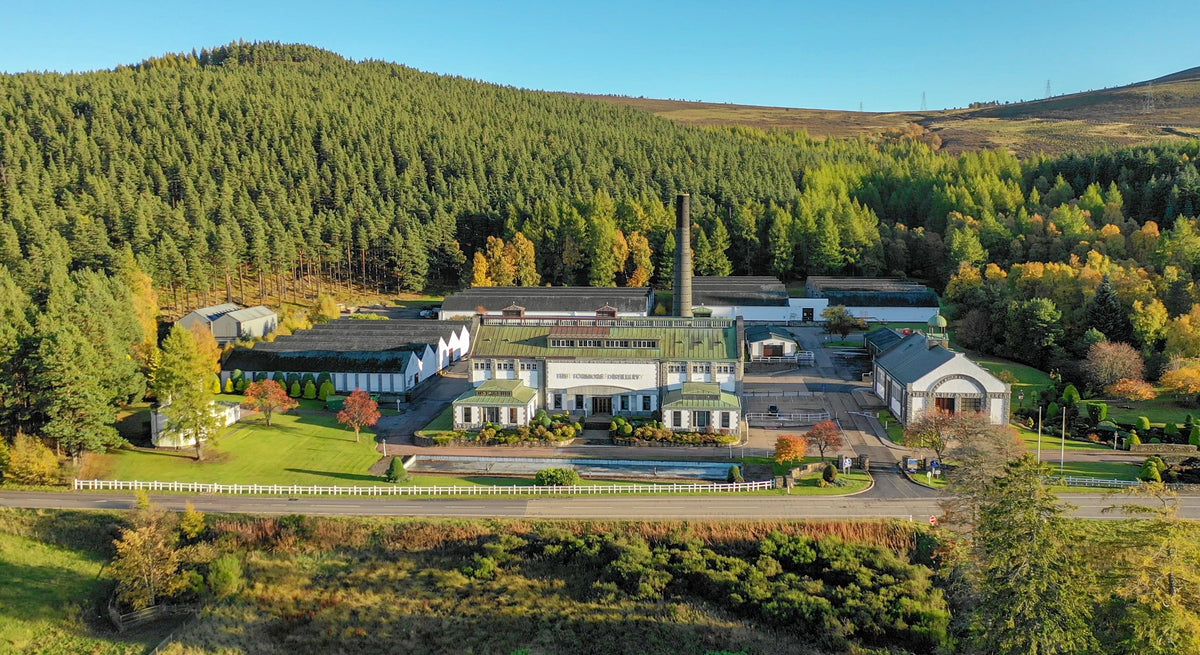
Tormore from above
We flew our drone over Tormore to take in a still house that looks more like a Baltic hotel than a working distillery, complete with its own curling pond and topiary clipped into the shape of stills. It is one of the more eccentric distillery sites we have filmed.
History of Tormore
Tormore was Scotland's first entirely new malt whisky distillery of the twentieth century, built between 1958 and 1960 by Schenley International, the American drinks conglomerate that also owned Long John and, for a time, Laphroaig. Schenley's chairman Lewis Rosenstiel wanted a flagship, and he got one. The architect was Sir Albert Richardson, then president of the Royal Academy, and the result looks nothing like a working distillery: granite buildings under a copper roof, an ornate clock tower that plays Scottish tunes on the quarter hour, topiary clipped into the shape of bells and pot stills, and a curling pond that has, as far as anyone can tell, never actually been used for curling. Two crescents of whitewashed cottages house the workers in a style closer to a model village than an industrial estate. The site was granted listed building status in 1986, one of the few working distilleries recognised for its architecture rather than its age or its whisky.
For all the grandeur, Tormore spent most of its life as an anonymous blending component. Whitbread absorbed Long John's interests in 1975, Allied Distillers, later Allied Domecq, took over in the late 1980s, and Pernod Ricard folded the distillery into Chivas Brothers when it bought Allied Domecq's spirits business in 2005. Under three different owners the distillery quietly filled casks for blends and released the occasional 12 or 14 year old single malt without much fanfare. It grew from four stills to eight in 1972 to keep pace with demand, but real attention to the brand itself never really followed.
That changed in June 2022, when Elixir Distillers, the drinks group behind The Whisky Exchange and a string of well regarded independent bottling labels, agreed to buy Tormore from Pernod Ricard. The deal completed and production resumed under the new ownership in January 2023. Elixir brought in Polly Logan as distillery manager and Oliver Chilton as master blender, and set about testing barley varieties, yeast strains, fermentation lengths and cut points to push the spirit's fruit character further. The first results appeared as the Blueprint Series in June 2025, three 10 year old single malts, followed by a full core range in June 2026: Tormore Timeless, a 12 year old and a 16 year old, with 18 and 21 year old expressions due in 2027. It is an unusual thing in Scotch whisky, a well known independent bottler buying the distillery outright rather than just buying its casks.
How Tormore makes its whisky
Water is drawn from the Achvochkie Burn, which rises in the hills above the distillery and feeds a site that has grown piecemeal since 1960. Malt is unpeated, then mashed and fermented in eleven stainless steel washbacks split across three separate rooms, each with its own microclimate, so fermentation times vary slightly from room to room rather than running to one fixed schedule.
The still house holds eight stills, four wash and four spirit, arranged in pairs and fitted with an unusual set of purifiers, small chambers with baffle plates in the neck that send heavier vapours back down for redistillation rather than letting them carry through into the spirit. Purifiers are not common in Scotch whisky production. Glen Grant, a little further east, uses a version of the same idea, and both distilleries get a similar benefit from it: a spirit that comes off noticeably cleaner and lighter than the still shapes alone would suggest. Tormore's nameplate capacity sits at around 5 million litres of pure alcohol a year, though production under Elixir Distillers has been more selective than that figure implies, prioritising quality and consistency while the new ownership settles in.
What does Tormore taste like?
New make Tormore is fuller and firmer than most Speyside spirit, less about delicate orchard fruit and more about texture. The distillery's own team describe it as fruity but structured, with pear, apple and a distinct nuttiness that holds up well in cask. Older independent releases have shown black pepper, beeswax, honey, melon and apricot, with a dry, oaky finish leaning towards blackberry and raisin in sherry wood. The 2026 core range gives a useful map of how the spirit develops: the entry level Timeless brings vanilla, lemon zest and honeysuckle from mostly bourbon wood, the 12 year old moves into peach cobbler, toasted almonds and cream from a mix of bourbon, toasted oak and cream sherry casks, and the 16 year old, matured in American and European sherry wood, turns towards blackberry jam, vanilla fudge and dates. It is whisky that rewards patience in the right cask rather than showing everything at once.
Tormore and independent bottlers
For most of its life Tormore was exactly the kind of distillery independent bottlers quietly relied on: plentiful, consistent, and largely ignored by its own owner as a single malt. Casks distilled under Whitbread, Allied Domecq and Chivas Brothers found their way to bottlers including Signatory Vintage, Cadenhead's, Gordon & MacPhail and the Scotch Malt Whisky Society over the decades, and older vintages from the 1980s and early 1990s still turn up at auction from firms such as Cadenhead's and Signatory today. It sits in similar company to other Speyside distilleries that spent years as unglamorous blending workhorses before drawing wider attention, among them Auchroisk, Glentauchers and Miltonduff.
Since Elixir Distillers took over in 2022 and 2023, the picture has shifted. The new owner is, after all, an independent bottler itself, and it has chosen to put most of its energy into building Tormore's own single malt identity rather than releasing casks to competitors: the Blueprint Series, the Legacy vintage casks drawn from pre 2022 stock, and the 2026 core range are all official Elixir releases. We have not seen confirmed evidence of fresh Tormore casks reaching the open independent market since the change of ownership, though that could shift as the distillery's own programme matures and older stock is worked through.
The Single Cask and Tormore
We have bottled Tormore three times, all from stock distilled in 1995 under the distillery's previous ownership. Our most recent release, cask 20095A, was a 23 year old sherry hogshead bottled at cask strength, 50.8%, with oak and malt on the nose opening into fresh fruit, then black pepper, beeswax and malt on the palate alongside honey, melon and apricot, and a dry finish of oak, blackberries, apricot and raisins. A companion cask, 20095, gave a near identical profile at a slightly higher strength, and an earlier 21 year old, cask TM96VG, rounded out the trio. You can still see our full notes on cask 20095A, though all three bottlings are currently sold out, which says something about how few Tormore casks tend to circulate once bottled.
We would happily bottle Tormore again if the right cask came along, but that is now less straightforward than it was before Elixir Distillers took over. The distillery's new owner has its own plans for the spirit, and we would rather tell you that plainly than pretend otherwise.

Collectability and cask ownership
Tormore occupies an odd corner of the collector's market. Its architecture and its recent change of ownership make good stories, but its single malt reputation is still being built from a low base. Decades of near anonymity mean there is not a long back catalogue of celebrated official releases the way there is for some Speyside names. Older independent bottlings, particularly 1980s and early 1990s vintages from Cadenhead's and Signatory, do turn up at auction and have found a following among collectors who like a distillery with an interesting backstory, but volumes are modest and prices vary a good deal from bottle to bottle.
As with any cask, ownership involves risk and values can go down as well as up, this is not financial advice. What has genuinely changed for the better is the quality of information available: with Elixir Distillers publishing tasting notes, cask types and a clear release plan for the first time in Tormore's history, anyone weighing up an existing bottle or a future cask has more to go on than they would have had five years ago. If you are new to cask ownership generally, our guide to whisky cask sizes and types is a good place to start before looking at any specific distillery.
Visiting Tormore
Tormore does not currently have a working visitor centre, though the building itself, with its clock tower, topiary and curling pond, is visible from the A95 as it runs alongside the River Spey near Advie, and it is worth a slow drive past even without a formal tour. Elixir Distillers has said a visitor centre is part of its longer term plans for the site, so that may change, but there is no confirmed opening date at the time of writing.
Tormore FAQs
Who owns Tormore distillery?
Elixir Distillers, the drinks group behind The Whisky Exchange, bought Tormore from Pernod Ricard's Chivas Brothers in a deal agreed in June 2022 and completed in January 2023.
Is Tormore peated?
No. Tormore distils an unpeated Speyside spirit, historically used mainly for blending and now increasingly bottled as single malt.
Can you visit Tormore distillery?
Not yet. There is no working visitor centre, though one is understood to be part of Elixir Distillers' longer term plans for the site.
Why did Tormore stay obscure for so long?
Under Whitbread, Allied Domecq and Chivas Brothers, Tormore was used mainly to supply blends and its owners put little marketing behind it as a single malt. That changed after Elixir Distillers bought the distillery in 2022 and 2023.
Can you buy a cask of Tormore?
Not with any confidence right now. Elixir Distillers appears to be keeping current production for its own single malt programme, and we have not seen fresh casks reaching the independent market since the 2022 to 2023 change of ownership. Older stock occasionally surfaces at auction. Ask us and we will tell you honestly what, if anything, is available.
What is in Tormore's core range?
As of 2026 it comprises Tormore Timeless, a no age statement expression, a 12 year old and a 16 year old, all released under Elixir Distillers. Older independent bottlings from before 2022 also circulate at auction.
Plan a bottling inspired by Tormore
Be honest with yourself, if you want a cask specifically from Tormore right now, the picture is uncertain rather than firmly closed. Casks reached independent bottlers steadily in the past, ourselves included, but that supply ran mostly through the years before 2022, while Pernod Ricard's Chivas Brothers still owned the site. Since Elixir Distillers took over, we have not seen confirmed fresh Tormore casks come to the open market, most likely because the new owner is understandably focused on building its own single malt range first. That is not the same as saying it will never happen again, just that we cannot point you to a live cask today, and we would rather say that plainly than promise something we cannot deliver.
If Tormore's story appeals to you, the purifier driven, fuller bodied Speyside style, or simply the idea of backing a distillery mid turnaround, we can help you find a comparable cask from a distillery with a similar production character or maturation style, and talk you through realistic timelines and pricing.
More broadly, a cask is one part of a bigger project, and that is where we spend most of our time with customers. Tell us the flavour or distillery style you are after, roughly how many bottles you need, your budget, when you would like to bottle by, and whether this is for a drinks brand, a retailer, a hospitality venue, a company, a whisky club, an event or purely private use. Let us know too if you will need help with naming, label design, storage or the bottling run itself.
In return we will give you an honest view of what is realistically available, sensible alternatives when a named distillery like Tormore is not on the table, a rough idea of how many bottles a given cask will yield, the main costs and stages involved, and a practical route from choosing a cask through to finished, labelled bottles in your hands. Our guide to buying a whisky cask and our page on private label whisky cover the basics, or you can just get in touch and talk it through directly.
Work with The Single Cask
Buy a whisky cask, bottle under your own label, or store casks in our HMRC approved bonded warehouse in Fife.
Read more
Aberlour Distillery: History, Casks & Whisky
Aberlour is one of Speyside's most sherry-driven distilleries, and one of the least visible by name. We look at its history, its sherry cask policy, the two independent casks we've bottled ourselve...
Read more
Cragganmore Distillery: Speyside's Deliberate Outlier
Diageo picked Cragganmore to represent Speyside's whole range of character, not just its honeyed side. Flat-topped stills and old-fashioned worm tubs give it a savoury, meaty style unlike its neigh...
Read more


