
Article: Allt-A-Bhainne Distillery: Speyside's Blending Workhorse With a Secret Smoky Side
Allt-A-Bhainne Distillery: Speyside's Blending Workhorse With a Secret Smoky Side
Not every Speyside distillery wants to be found. Allt-A-Bhainne was built in 1975 to do one job well: pour malt whisky into Chivas Regal and 100 Pipers by the tanker load, then stay out of the way. There is no visitor centre, no gift shop, no tour bus turning up the drive. And yet tucked inside that plain industrial brief is a distillery capable of something genuinely unusual for its size. On a handful of days each year it switches to heavily peated production, turning out spirit that has almost nothing in common with the light, fruity make it usually sends off in bulk. That contradiction, more than anything else, is why Allt-A-Bhainne is worth a proper look rather than a footnote in someone else's blend.
Allt-A-Bhainne at a glance
| Region | Speyside, on the slopes of Ben Rinnes near Dufftown |
| Founded | 1975 |
| Owner | Chivas Brothers, part of Pernod Ricard, since 2001; built under Seagram ownership |
| Capacity | Around 4 million litres of pure alcohol a year |
| Stills | Four: two wash, two spirit (expanded from an original pair in 1989) |
| Water source | Springs on Ben Rinnes and the Mains Burn |
| Fermentation | Roughly 48 hours, across eight stainless steel washbacks |
| Malt spec | Mostly unpeated and built for a light blending style, with occasional heavily peated production runs |
| Visitor centre | No. Allt-A-Bhainne is not open to the public |
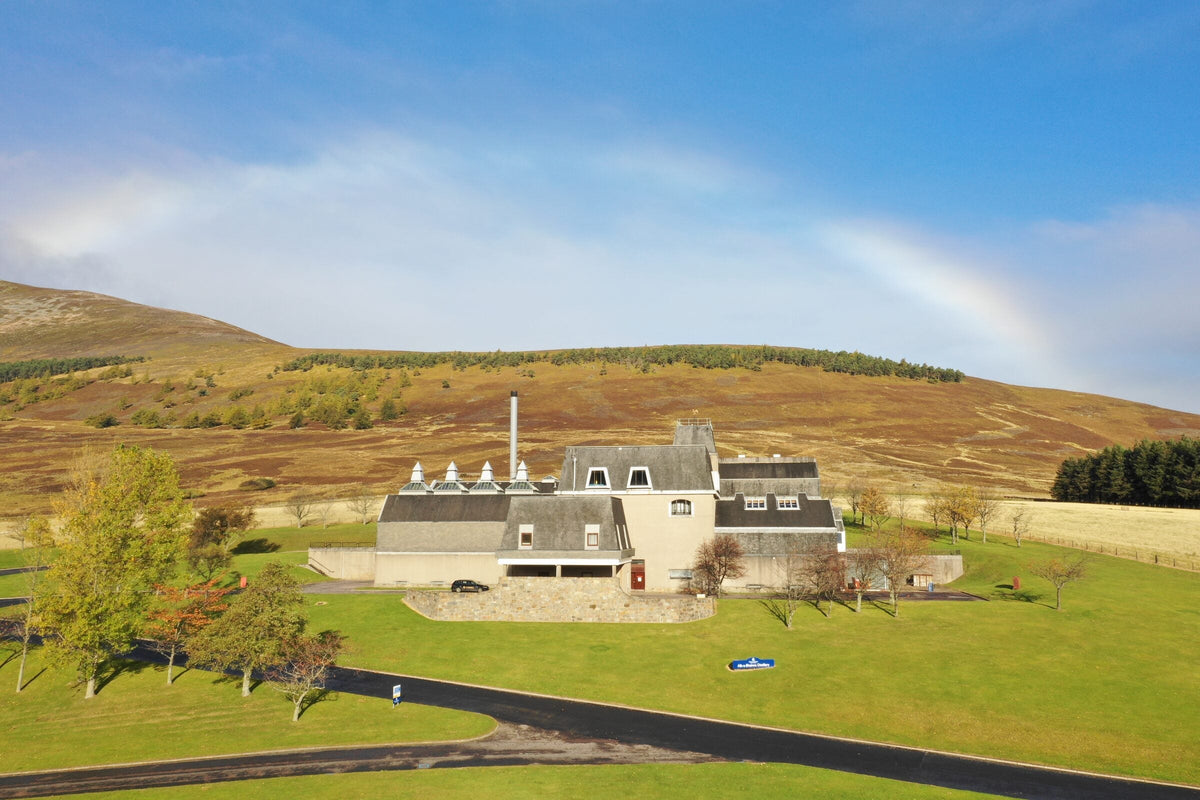
Allt-A-Bhainne from above
Our drone caught Allt-A-Bhainne on a clear day, its pale, low buildings set against the green shoulder of Ben Rinnes with a rainbow arcing over the site, more scenic than a distillery built purely for bulk production has any right to be.
History
Allt-A-Bhainne takes its name from the Gaelic for "burn of milk," said to describe the pale, fast-running water that comes off Ben Rinnes above the site. It was built in 1975 by Chivas Brothers, then part of the Seagram group, during the industry-wide expansion of the 1960s and 70s, when several distillers were racing to secure supply for blends that were selling faster than they could be made. Unlike most of that generation, Allt-A-Bhainne was never meant to introduce itself to drinkers. Its entire reason for existing was to feed malt whisky into 100 Pipers and, later, Chivas Regal.
That utilitarian brief produced a genuinely forward-thinking building. Allt-A-Bhainne was designed with all its equipment under one roof, mash house, tun room and still house arranged so the whole process could, in principle, be run by a single operator, an efficiency-first layout that was unusual for its time. It also wears the pagoda-shaped kiln roofs that most people associate with malting floors, purely for the look of the thing: Allt-A-Bhainne has never malted its own barley, and those roofs have never done a day's work.
A second pair of stills went in during 1989, doubling capacity to four and taking annual output to somewhere around 4 million litres, though published figures vary a little depending on the source. The early 2000s were less kind: like a number of distilleries built for the 1970s boom, Allt-A-Bhainne was mothballed for a few years in the early part of that decade as the industry worked through a supply glut, before reopening in 2005. Pernod Ricard had by then acquired Seagram's spirits and wine business, in 2001, folding the distillery into Chivas Brothers as it exists today.
Own-name bottlings have always been the exception rather than the rule here. An official single malt did appear from Chivas Brothers in the late 2010s, but it never became a fixture of the core range the way Aberlour or Longmorn have. Allt-A-Bhainne sits alongside those two, plus Strathisla, Glen Keith, Miltonduff and The Glenlivet, as one of Chivas Brothers' cluster of Speyside malt distilleries, most of them built or expanded for exactly the same reason: to keep the blending vats full.
How Allt-A-Bhainne makes its whisky
Water is drawn from springs on Ben Rinnes and the Mains Burn, feeding an 8-tonne mash tun. The resulting wort ferments for around 48 hours across eight stainless steel washbacks, each holding somewhere in the region of 42,000 to 44,000 litres, a fermentation length pitched squarely toward a clean, fruity wash rather than anything heavier.
The stills are the more distinctive part of the story. Allt-A-Bhainne runs two large, pear-shaped wash stills at around 22,000 litres each, paired with two noticeably taller spirit stills of about 14,500 litres, their necks topped with a reflux bowl sitting on a conical section before narrowing further. That shape encourages plenty of copper contact and reflux, stripping out heavier, oilier compounds and pushing the new make toward something lighter and more floral. Spirit comes off the stills at a fairly high strength, in the high 60s percent ABV, reinforcing the same light, blend-friendly character. None of this is a barley story: Allt-A-Bhainne has no malting floors and never has, buying in malt to a standard specification rather than doing anything unusual with the raw material.
The one deliberate wrinkle in an otherwise straightforward setup is that Allt-A-Bhainne occasionally runs a heavily peated batch through the same equipment, in the same way several of its Speyside neighbours do. It is not an annual certainty in the way Tomintoul's Old Ballantruan run is, and it is not sold under a separate brand name, but it is a real and recognised part of the distillery's output, which is exactly why casks of Allt-A-Bhainne can turn up with more smoke on them than the standard style would suggest.
What does Allt-A-Bhainne taste like?
The everyday spirit is built to disappear politely into a blend: light-bodied, floral and fruity, with cereal sweetness and a clean, fairly short finish, exactly what a blender wants from a component whisky rather than a showpiece single malt. Where Allt-A-Bhainne gets more interesting is in single cask releases, where age, wood and the occasional peated run all have room to show themselves. Our own cask leaned into malt, orchard fruit, wood spice and honey, with none of the peat, but tasting notes from other independent releases have run from pear and vanilla in younger, ex-bourbon casks through to a firmer, spicier profile in older, more sherried examples. It is a distillery where the cask does a lot of the talking.
Allt-A-Bhainne and independent bottlers
This is not a distillery independent bottlers reach for as a headline name, and Chivas Brothers keeps the overwhelming majority of what it makes for its own blends. That said, Allt-A-Bhainne is far from invisible on the independent market. Signatory Vintage has released it several times over the years, including vintage 2000 casks in its Cask Strength Collection bottled into their late teens and early twenties, and Hepburn's Choice, the range from Langside Distillers, has put out younger expressions from the late 2000s. It is the kind of distillery that specialist independent bottlers and cask brokers track more closely than most drinkers realise, precisely because there is so little official single malt to compare it against.
The Single Cask and Allt-A-Bhainne
We have bottled Allt-A-Bhainne ourselves. Our cask 2429 was distilled in 2000 and matured for 21 years in a single bourbon hogshead before we bottled it at cask strength, 56.5%, for an outturn of 199 bottles as part of our Signature Series. It showed hints of malt, orchard fruit, wood spice and honey, a fair example of what patient bourbon-cask maturation can do for a distillery whose own-name bottlings are otherwise so rare.

Our Allt-A-Bhainne 21 year old, cask 2429, is now sold through, but it is a genuine example of the kind of cask this distillery can produce when it is given long enough in decent wood, and the sort of thing we look for when a lesser-known Speyside name comes our way.
Cask ownership, honestly
A cask like this is not a guaranteed return, and nobody should treat it as one. Whisky cask ownership sits outside financial regulation, prices for any given cask can move down as easily as up, and none of what we write here is investment advice, just an honest account of a distillery and what we have done with its whisky. If you are weighing up buying a cask for the first time, our guide to whisky cask sizes and types is a sensible place to start before anything else.
Visiting Allt-A-Bhainne
There is nothing to book. Allt-A-Bhainne has no visitor centre, no shop and no public tours, and Chivas Brothers has never run it as anything other than a working production site. If you want to see Speyside distilleries built with visitors in mind, neighbours such as The Glenlivet and Strathisla are a better bet for a day out.
Allt-A-Bhainne FAQs
Who owns Allt-A-Bhainne distillery?
Chivas Brothers, part of Pernod Ricard, which has owned it since acquiring Seagram's spirits business in 2001. The distillery itself was built in 1975 under Seagram ownership.
Is Allt-A-Bhainne whisky peated?
Mostly not. The everyday production is light and unpeated, built for blending, but the distillery does run occasional heavily peated batches through the same stills.
Can you visit Allt-A-Bhainne distillery?
No. It has no visitor centre and is not open to the public.
What does Allt-A-Bhainne taste like?
Light, floral and fruity as standard, with cereal sweetness and a clean finish. Older or more heavily wooded single casks can show more spice, honey and orchard fruit, and the occasional peated batch brings genuine smoke.
Can you buy a cask of Allt-A-Bhainne whisky?
Occasionally. It is not a headline name for independent bottlers, but casks do reach the market through specialists such as Signatory Vintage and Hepburn's Choice from time to time. We will tell you honestly when we do, and do not, have access to one.
What does the name Allt-A-Bhainne mean?
It is Gaelic for "burn of milk," a reference to the pale, fast water running off Ben Rinnes near the distillery.
Plan a bottling inspired by Allt-A-Bhainne
We cannot promise a cask of Allt-A-Bhainne on demand. Chivas Brothers keeps almost everything this distillery makes for its own blends, so genuine single casks surface irregularly, and mostly through specialist independent bottlers rather than the open market. When one does come our way, as cask 2429 shows, it is worth taking seriously.
Where a named Allt-A-Bhainne cask is not realistically available, we can suggest close alternatives instead, whether that means another light, blending-house Speyside malt from the same Chivas Brothers stable such as Longmorn or Miltonduff, or something further afield if it was the occasional smoky side of Allt-A-Bhainne that caught your interest.
Tell us what you are actually after: the flavour or distillery character you are chasing, roughly how many bottles you need, your budget, a target bottling date, and whether this is for a drinks brand, a retailer, a hospitality business, a corporate gift or your own private bottling. Let us know too if you will want help with naming, label design, storage or the bottling run itself. Have a look at buying a whisky cask and our four steps to bottling your own whisky for the basics, or if you already have a brand in mind, our page on private label whisky covers how that works. When you are ready, get in touch and we will give you an honest view of what is realistic.
Work with The Single Cask
Buy a whisky cask, bottle under your own label, or store casks in our HMRC approved bonded warehouse in Fife.
Read more
Aberfeldy Distillery: The Honeyed Malt Behind Dewar's
The Highland distillery built to feed Dewar's blend, its Bacardi stablemates, and the rare port-cask bottling we've released from it.
Read more


