
Aultmore Distillery: The Dram of the Buckie Road
Ask for a whisky by name in most Speyside pubs and you will get one. Ask for "a nip of the Buckie Road" and, for the best part of a century, you would have been handed Aultmore. That is the story Dewar's tells, anyway: a distillery on the moor road between Keith and the fishing port of Buckie, in country once busy with illicit stills, whose whisky was known to locals and fishermen by the road it stood on rather than by the name on the gate. Whatever the precise truth of it, the nickname stuck, and it says something about Aultmore that its owners now print it on the label.
For most of its life this was a blender's distillery, quietly filling casks for Dewar's White Label while the single malt was a rumour. That changed in 2014, and it is changing again now: Bacardi has just finished a £15 million expansion that roughly doubles the place. For a distillery with no visitor centre and a name most people cannot pronounce (it is "Olt-more"), Aultmore has a surprising amount going on, and we have bottled it more than once, so we can tell you what it actually tastes like from the cask.
Aultmore at a glance
| Region | Speyside, a couple of miles north of Keith on the road to Buckie |
| Founded | Built in 1895 by Alexander Edward of Benrinnes; sources vary between 1895 and 1897 for the first spirit, and Bacardi celebrated the 125th anniversary in 2022 |
| Owner | John Dewar & Sons, part of Bacardi, since 1998 |
| Capacity | Typically quoted at around 3 to 3.2 million litres of pure alcohol before the 2022-24 expansion, which Bacardi says roughly doubles output |
| Stills | Historically four (two wash, two spirit): plain, onion-shaped, run slowly, with shell-and-tube condensers; the expansion added a new still house |
| Water source | The Auchinderran Burn, which drains off the Foggie Moss |
| Fermentation | A minimum of around 56 hours in wooden washbacks |
| Malt spec | Unpeated |
| Style | Light, grassy and green-apple fresh on the nose, with more waxy weight on the palate than you expect |
| Visitor centre | No, not open to the public |

Aultmore from above
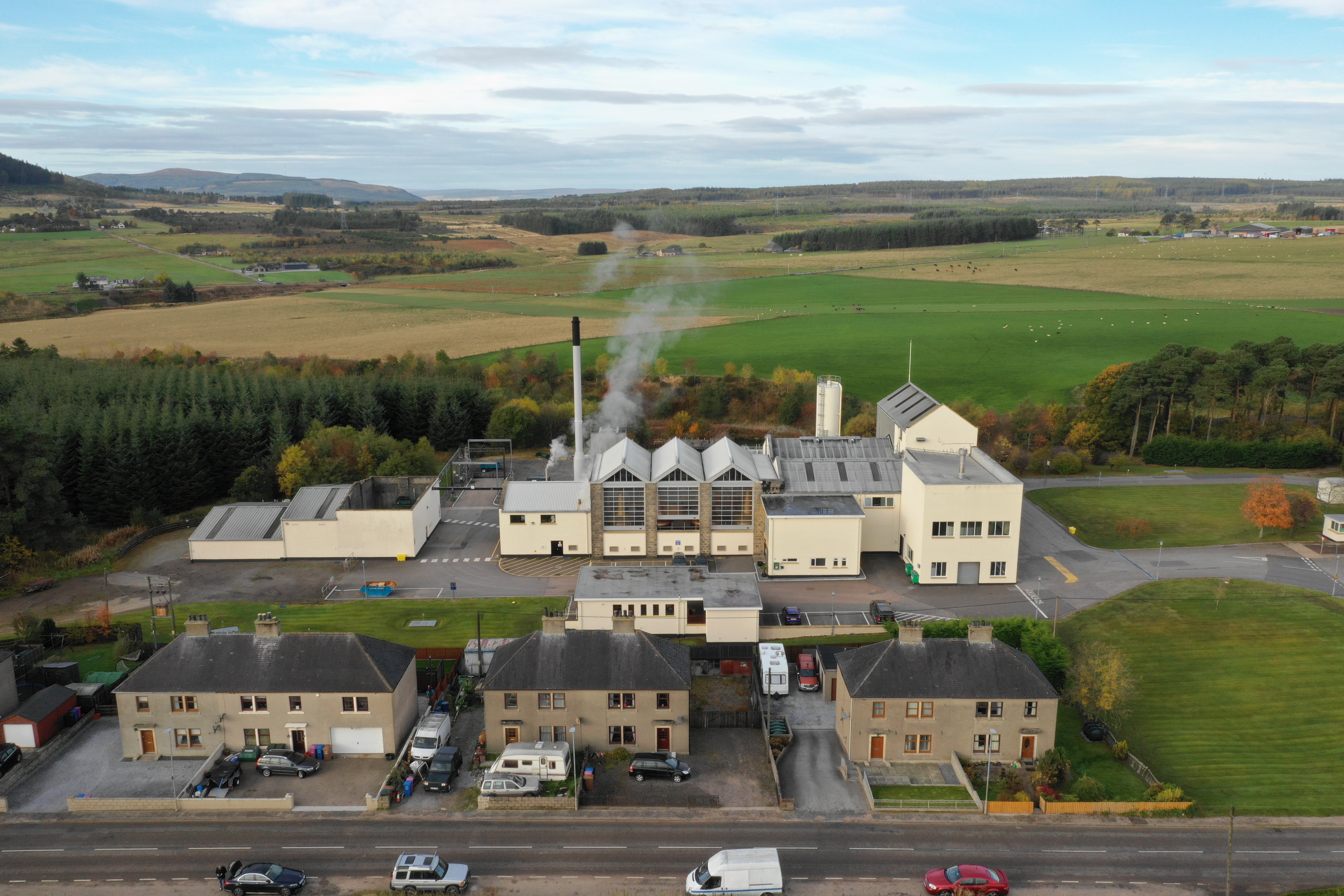
Aultmore is one of the Speyside distilleries you can only really see from the sky, because there is no visitor centre and no reason to stop unless you know what it is. We sent our drone up over the tall red-brick chimney to show the layout: the plain 1970s production block, the older cottages alongside, and the flat farmland and moss running away north towards the Moray Firth.
History of Aultmore
Aultmore was one of the many children of the 1890s whisky boom, and it had a well-connected father. Alexander Edward already owned Benrinnes and had a hand in Craigellachie and Dallas Dhu, and he commissioned Charles Doig, the architect behind the pagoda roof, to build a new distillery on the flat ground north of Keith. The name comes from the Gaelic An t-Allt Mòr, "the big burn", after the Burn of Auchinderran that runs past the site. Building started in 1895, spirit was flowing by 1897, and demand was strong enough that capacity was doubled almost immediately. A steam engine arrived in 1898 to replace the original waterwheel; remarkably, it survived in use until 1969, and Bacardi still keeps it on show at the distillery.
Then came the crash. Edward folded Aultmore into a new company, Oban & Aultmore-Glenlivet Distilleries, in 1898, just in time for the Pattison brothers of Leith to go bankrupt and take half the industry's confidence with them. Aultmore limped along on reduced output for several years, closed again for barley shortages in the First World War, and in 1923 was sold to John Dewar & Sons for £20,000. Two years later Dewar's joined the Distillers Company Limited (DCL), which meant Aultmore spent the next seven decades as a cog in the DCL and later United Distillers machine, feeding Dewar's, and, in various periods, other blends in the group.
Little of the Victorian distillery survives. In 1970 the whole site was closed and rebuilt, reopening in early 1971 with four stills instead of two, which is why Aultmore looks like a functional 1970s plant rather than a Doig postcard. The floor maltings had already gone in 1968; the warehouses were demolished in 1996 and every drop now leaves by tanker to mature at Dewar's central warehousing in the Central Belt. Aultmore also had a spell as an unlikely pioneer of by-product recycling: it built a dark grains plant in the 1970s to turn draff and pot ale into animal feed, and local lore has it that pigs on a neighbouring farm did rather well out of the distillery. That last bit we cannot verify, so treat it as a story rather than a fact.
The big turn came in March 1998, when Bacardi bought Dewar's from what was about to become Diageo, and picked up Aultmore, Aberfeldy, Craigellachie and Royal Brackla with it. For sixteen years Bacardi kept Aultmore mostly for blending; then, in 2014, it launched the Last Great Malts of Scotland range and Aultmore finally got a proper single malt of its own. In December 2022 Bacardi marked the distillery's 125th anniversary by announcing a £15 million expansion, a new tun room, still house and hydrogen-ready boiler house, which was completed in late 2024 and roughly doubles the site's capacity.
How Aultmore makes its whisky
The process at Aultmore is about as classic Speyside as it gets, and everything is tuned for a light, clean spirit. Water is drawn from the Auchinderran Burn as it comes off the Foggie Moss, a stretch of gorse and heather moorland north-east of Keith, which is why the official bottlings carry the words "of the Foggie Moss". The malt is unpeated and bought in from commercial maltsters. Since 2002 mashing has been done in a Steinecker full-lauter tun, which gives the clear worts that light, fruity Speysiders depend on.
Fermentation is long by industry standards, a minimum of around 56 hours in six wooden washbacks, and that length is where much of the fruit comes from: short ferments give nutty, cereal spirit, longer ones build the esters that read as green apple and pear in the glass. The stills are the interesting bit. Aultmore's four stills (before the expansion) were relatively small, plain onion shapes with slightly descending lyne arms and shell-and-tube condensers, and they are run slowly. Slow distillation in modest stills gives the spirit its two-sided personality: fragrant and grassy on the nose, but with a waxy, mouth-coating weight that surprises people who have written it off as a lightweight. Blenders have long rated Aultmore among the top tier of Speyside malts precisely because it brings that texture to a blend without shouting.
Maturation is overwhelmingly in American oak, refill and first-fill ex-bourbon, which suits a spirit this delicate; heavy sherry can flatten it, though the occasional sherry finish turns up in special editions and, as you will read below, we have seen it work beautifully in small casks. The official range is bottled at 46%, without chill filtration or colouring, which was a quiet statement of intent when the 12 year old first appeared in 2014.
What does Aultmore taste like?
The house style is fresh, dry and fragrant. On the nose expect cut grass, green apple, pear drops, a little lemon, cereal sweetness and a herby note somewhere between hay and mint. On the palate that lightness fills out into something more substantial: waxy, malty, with white pepper and soft vanilla from the wood, and a clean, drying finish. Whisky writers often compare it to Linkwood, another Speyside malt that blenders prize for the same combination of perfume and grip.
Age is kind to it. At 12 the apple and grass are front and centre; by 18 and 21 (both of which have picked up World Whiskies Awards gold medals and category wins over the past decade) the wax deepens into honeycomb and beeswax, and there is a gentle tropical fruit note that some old Speysiders develop in refill wood. Older stock also carries a whisper of the pre-1971 distillery, which is said to have been heavier, oilier and even faintly smoky, but very little of that survives outside the auction room. Give it a sherry cask, especially a small one, and Aultmore turns into a different animal altogether: dried fruit, coffee, dark chocolate and spice sitting on that same waxy backbone.
Aultmore and independent bottlers
Because Aultmore spent so long as a blending malt inside DCL and then Bacardi, a healthy volume of casks found their way onto the broker market over the years, and independent bottlers have done more to build its reputation than the official range ever did before 2014. Gordon & MacPhail, Signatory, Cadenhead, Adelphi, Duncan Taylor and Douglas Laing have all bottled it, and a run of 1970s casks bottled by Samaroli in the 1980s and 1990s remains the collector's benchmark for what Aultmore can be at its most exotic.
The pattern with independent Aultmore is consistent: refill bourbon casks let the grassy, waxy distillate speak plainly, at cask strength and natural colour, and usually at prices that make it one of the better-value Speyside malts you can buy. That value is exactly why we like it. A distillery whose spirit is rated by blenders and under-priced by drinkers is the sweet spot for an independent bottler.
The Single Cask and Aultmore
We have bottled Aultmore several times, and between them the casks show both faces of the distillery. The most recent was Aultmore 12 year old from cask 800775, a single ex-bourbon barrel filled on 26 July 2010 and bottled at its natural cask strength of 55%. This one is Aultmore in its Sunday best: white grapes, malt and fresh oak on the nose, then white pepper, banana, green tea and cinnamon on the palate, closing on brown sugar. It is the grassy, waxy Speyside style in a glass, with the cask strength giving it real presence.
Before that we did something rather more experimental. From the same 2010 vintage we bottled a pair of 8 year olds that had been finished in firkins, tiny casks that hurry the whisky along. Cask 900020C, a PX firkin bottled at 62.7% (75 bottles), gave us coffee bean, dried fruit and a hint of pineapple on the nose, then an intense attack of raisin and raspberry, tempered by vanilla pod and earthiness, and a finish with a hint of coastal air, chocolate and malt. Its sibling, cask 900020D, an Oloroso firkin at 62.8% (65 bottles), went darker still: blackcurrant, Christmas spices and straw, then spiced hot chocolate, toasted teacake and a hint of oaky smoke, with intense dried fruit sweetness at the end. Same distillery, same year, three very different whiskies, which is the whole point of bottling single casks.
All of our Aultmore bottlings have now sold out. Given how well the spirit takes to both refill bourbon and small sherry casks, it is a distillery we will keep looking for, and anyone on our mailing list will hear first when the next one lands.

Collectability and cask ownership
Aultmore is not, and is unlikely to become, a trophy distillery in the Macallan or Bowmore mould. At auction it is a value name: most official and independent bottlings trade in the tens to low hundreds of pounds, with the 1970s Samaroli casks the exception at several thousand pounds a bottle, and the odd single cask from the 2000s reaching four figures at the major houses. That is not a criticism. It reflects a distillery whose whisky has always been drunk rather than hoarded, and whose spirit is more highly rated by the people who make blends than by the people who collect labels.
For cask owners that profile has a particular logic. Aultmore casks come onto the private market with reasonable regularity, especially 2008-2014 vintages in refill bourbon wood, and typically at prices well below the famous names, which means less capital tied up per litre and less exposure if the market cools. The spirit matures gracefully in refill American oak and, as our firkins showed, responds dramatically to sherry re-racking, so an owner has genuine choices about where to take it. The obvious end use is bottling as a single malt under your own or an independent label, which is exactly what we help people do. What it will not offer is a headline auction result. Remember, too, that cask ownership involves risk, values can go down as well as up, storage and insurance cost money every year, and none of this is financial advice. If you are weighing up sizes, our guide to cask sizes and types explains why an Aultmore hogshead and an Aultmore firkin end up in such different places.
Aultmore FAQs
Who owns Aultmore distillery?
Aultmore is owned by John Dewar & Sons, part of Bacardi, which bought the Dewar's business and the distillery from Diageo in 1998. Most of its output goes into Dewar's blended Scotch.
Where is Aultmore distillery?
Aultmore is in Speyside, about two miles north of Keith in Moray, on the road to the fishing town of Buckie, which is where the local nickname "the Buckie Road" comes from.
Is Aultmore whisky peated?
No. Aultmore uses unpeated malt and makes a light, grassy, waxy Speyside style. Its water comes off the Foggie Moss, but that is heather and gorse moorland rather than a source of smoke.
Can you visit Aultmore distillery?
No. Aultmore has no visitor centre and is not open to the public. Nearby Strathisla in Keith runs tours, and Glen Grant, Cardhu and Glenfiddich are all within a short drive.
What does Aultmore taste like?
Fresh and fragrant: cut grass, green apple, pear drops and lemon on the nose, with a surprisingly waxy, malty weight and white pepper on the palate. Older bottlings pick up honeycomb and beeswax; sherry-cask versions add dried fruit and chocolate.
Can you buy a cask of Aultmore?
Yes, Aultmore casks appear on the private market more often than most Speyside names, usually in refill bourbon wood, and at accessible prices. We have bottled several ourselves; contact us and we will tell you honestly what is available and what it is likely to become.
Own a piece of Aultmore
The dram of the Buckie Road has been the blenders' quiet favourite for over a century, and it is only now, with an expanded distillery and a proper single malt range, starting to get its due. If the idea of owning a cask of a well-made, well-priced Speyside malt appeals more than chasing famous labels, Aultmore deserves a look. Start with our plain-English guide to buying a whisky cask, read up on cask sizes and types, and then talk to us. We will tell you what is available, what we would do with it, and, as always, we will only recommend a cask we would be happy to bottle ourselves.
Work with The Single Cask
Buy a whisky cask, bottle under your own label, or store casks in our HMRC approved bonded warehouse in Fife.
Read more
Arran Distillery: The Island That Waited 158 Years for Legal Whisky
Harold Currie, a pair of golden eagles and a north-coast loch gave Arran its first legal distillery since the 1830s. Our guide to Lochranza covers its history, stills, casks, flavour, visiting, and...
Read more
Royal Brackla Distillery: The King's Own Whisky
Royal Brackla near Nairn was the first Scotch whisky ever granted a Royal Warrant, yet most of its elegant, fruity Highland spirit has spent two centuries hidden in Dewar's blends. Our guide covers...
Read more


