
Coleburn Distillery: The Speyside Ghost That's Coming Back
Most of the closed distilleries in this series stay closed. Coleburn is the exception worth watching. It shut in 1985, had its distilling licence formally revoked in 1992, and spent the following three decades as a warehouse rather than a working distillery, its old pagoda roofs sitting quietly beside the Elgin to Rothes road. That is changing. The site's owners have appointed a master distiller with 26 years at Benromach behind him and are working towards bringing the stills back to life later this decade. We do not hold a cask of Coleburn, and given how little genuine stock exists, we are not going to pretend that is likely to change soon. But a distillery that is actually coming back is a different proposition to one that is gone for good, and worth a proper look now rather than later.
Coleburn at a glance
| Region | Speyside, near Longmorn, five miles south of Elgin |
| Founded | 1897, by John Robertson & Son; designed by Charles Doig, the architect behind the pagoda roof used across the industry |
| Owner | D and M Winchester Ltd (Dale and Mark Winchester), since 2004; brand rights held by Coleburn Distillery Ltd |
| Status | Mothballed since 1985, licence revoked 1992; a revival is under way, targeting commissioning in 2027 |
| Capacity (planned) | Around 1,000,000 litres of pure alcohol a year once back in production |
| Current use | The Victorian dunnage warehouses are leased to Aceo Ltd, parent of independent bottler Murray McDavid, who use the site as their headquarters and maturation base |
| Historic style | Two pot stills, unpeated malt, spirit built as anonymous blending stock rather than a marketed single malt |

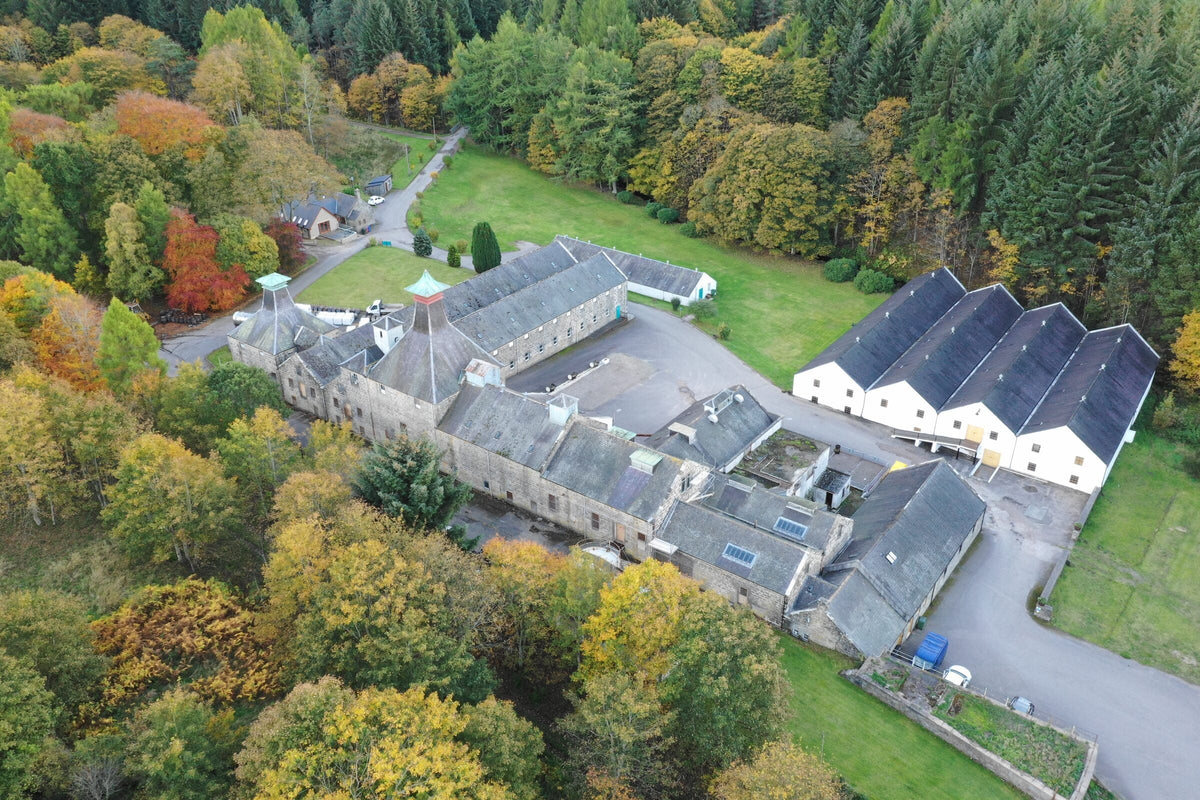
Coleburn from above
From above, Coleburn looks exactly like what it is: a complete, dormant Victorian distillery. The pagoda-topped kiln, the warehouse ranges and the old still house are all still standing, arranged around a courtyard a short walk from the Speyside Way, with the wooded ground around Longmorn spreading out beyond the site. It is a rare thing in Scotch whisky, a distillery frozen in place rather than demolished or rebuilt, which is part of why a genuine revival here is possible at all.
History of Coleburn
Coleburn was built in 1897 by John Robertson & Son and designed by Charles Doig, the Elgin architect whose pagoda-topped kiln became the visual shorthand for a Highland distillery across the whole industry. Two pot stills went into production the following year, and Coleburn spent almost its entire working life doing the job most Speyside distilleries of its era were built for: supplying anonymous malt whisky for blends, in this case Usher's and later Johnnie Walker Red Label, rather than building a name of its own. Ownership passed to the Clynelish Distillery Company in 1916, then into the Distillers Company Limited fold in 1925, where it stayed through DCL, United Distillers and finally Diageo after the 1997 merger.
The distillery closed in 1985 as part of the same wave of rationalisation that shut so many small, blend-only Speyside sites that decade, and Diageo formally gave up its distilling licence in 1992. Unlike many of its contemporaries, though, Coleburn was never demolished. The Winchester brothers, Dale and Mark, bought the buildings in 2004 with an eye on a much bigger redevelopment, and in 2014 the site's Victorian dunnage warehouses were leased on a long-term basis to Aceo Ltd, the parent company of independent bottler Murray McDavid, who made Coleburn their headquarters and main maturation base rather than a working distillery.
The genuinely new chapter started more recently. D and M Winchester Ltd has appointed Keith Cruickshank, master distiller and head of whisky at Benromach for more than 26 years before leaving in January 2025, to lead a rebirth of production at Coleburn, working with Organic Architects on the plans. The stated first phase is the distillery itself alongside a bistro, with a longer-term vision that includes a resort with accommodation, dining and spa facilities built around it. The target commissioning date given publicly is 2027, which would make Coleburn one of the more unusual distillery revivals in Scotch whisky: a site that never lost its buildings, only its stills.
Coleburn and independent bottlers
What exists of Coleburn today is old stock, and not very much of it. Diageo included a Coleburn 1979 21 year old in its Rare Malts series, the collector-focused range the company used in the late 1990s and 2000s to release small quantities from distilleries that rarely if ever appeared as single malts. Gordon & MacPhail has bottled Coleburn under its Connoisseurs Choice and Rare Old labels from several vintages, including casks distilled in 1972 and 1981, most of which now circulate through specialist retailers and auction rather than sitting on an ordinary shelf. There is no current production to draw fresh stock from, so what independent bottlings exist are finite by definition, and prices reflect that scarcity rather than any particular fame the distillery built for itself while it was running.
Coleburn and The Single Cask
We do not hold a cask of Coleburn, and with the distillery silent since 1985 there is no realistic way to source new stock until production actually resumes. What we can say honestly is that this is one to watch rather than write off. If Coleburn does return in 2027 under a master distiller with Cruickshank's background, it will be a genuinely new distillery in commercial terms, and we would expect to take an interest in its early output the way we would for any newly commissioned Scotch whisky distillery. In the meantime, if the old, pre-1985 stock is specifically what interests you, whether as a collector or someone building a bottling around distillery history rather than volume, tell us and we will help however we can, while being upfront that genuine casks are effectively unobtainable outside auction.
Plan a bottling inspired by Coleburn
If it is specifically Coleburn you want, the honest position is that there is no current cask market to speak of, and that will remain true until the revived distillery is actually producing and its first spirit has had time to mature. If what actually interests you is the story, a small, unpeated Speyside blending malt from a Doig-designed distillery, there is more flexibility. Longmorn, Coleburn's near neighbour, shares the same unpeated Speyside blending-house history and is considerably easier to source. Glentauchers and Imperial, two other distilleries built to the same brief of feeding blends rather than building a name, are also worth a look for a similar profile with actual cask availability behind them.
For an independent bottler or a new brand working from a wider brief than one specific distillery name, we can talk through independent bottling and private label whisky built around stock that actually fits, walk through the four steps from cask to bottle, and hold everything in our own bonded warehouse while a plan comes together. If you are earlier in the process and thinking about buying a whisky cask generally, our guide to cask sizes and types is a sensible next stop. A cask is not a regulated investment, values can move in either direction over however many years it spends maturing, and nothing here is financial advice, only a straightforward account of what we see buying and selling casks day to day.
Get in touch and tell us what you are trying to build. We will give you a straight answer about what is realistically available and what it is likely to cost.
Coleburn FAQs
Is Coleburn distillery still operating?
No, not currently. Coleburn closed in 1985 and its distilling licence was revoked in 1992. The site's owners, D and M Winchester Ltd, are working towards bringing production back, with master distiller Keith Cruickshank leading the project and a target commissioning date of 2027.
Who owns Coleburn distillery?
The buildings have been owned by D and M Winchester Ltd, run by brothers Dale and Mark Winchester, since 2004. The distillery's Victorian warehouses are separately leased to Aceo Ltd, parent company of independent bottler Murray McDavid, who use the site as their headquarters.
Can you buy Coleburn whisky?
Only old stock distilled before the 1985 closure, and there is very little of it. Diageo released a 1979 21 year old under its Rare Malts series, and Gordon & MacPhail has bottled several vintages including 1972 and 1981 casks under its Connoisseurs Choice and Rare Old labels. Most of what exists now trades through specialist retailers or at auction rather than through ordinary retail.
Why does Coleburn have a pagoda roof if it never used peat for its own malt?
The pagoda kiln was designed by Charles Doig, the Elgin architect who created the design and saw it adopted across the Scotch whisky industry as a standard feature, whether or not a distillery malted its own barley on site or burned peat in the process. It became an architectural signature for the industry rather than proof of any particular production method.
Will Coleburn make whisky again?
That is the plan. D and M Winchester Ltd has appointed Keith Cruickshank, previously master distiller and head of whisky at Benromach for over 26 years, to lead the distillery's revival, working towards a target commissioning date of 2027 alongside a wider development that includes a bistro and, longer term, a resort.
Work with The Single Cask
Buy a whisky cask, bottle under your own label, or store casks in our HMRC approved bonded warehouse in Fife.
Read more
Scapa Distillery: Orkney's Other Whisky, Now With Something to Say
Orkney has two distilleries, and everyone has heard of the other one. Scapa sits half a mile down the coast from Highland Park, on the shore of the great natural harbour that gives it its name, and...
Read more
Girvan Distillery: The Grain Giant That Started From a Grudge
Girvan does not look like most distilleries in this series, and it does not run like one either. There is no pot still, no visitor centre built around a single malt story, and no single building mo...
Read more


