
Article: Scapa Distillery: Orkney's Other Whisky, Now With Something to Say
Scapa Distillery: Orkney's Other Whisky, Now With Something to Say
Orkney has two distilleries, and everyone has heard of the other one. Scapa sits half a mile down the coast from Highland Park, on the shore of the great natural harbour that gives it its name, and for most of the last century it has lived quietly in that shadow, making whisky almost entirely for someone else's blend. We do not hold a cask of Scapa ourselves. What makes the distillery worth a proper look now is that Pernod Ricard has, for the first time in Scapa's 140 year history, actually tried to build it into a single malt brand in its own right, with a new age-statement range and a visitor centre that did not exist for most of that history at all.
Scapa at a glance
| Region | Islands (Orkney); officially grouped within the Highland region |
| Founded | 1885, by Glasgow blenders Macfarlane & Townsend |
| Owner | Chivas Brothers (Pernod Ricard), since 2005; previously Hiram Walker (1954) and Allied Distillers |
| Capacity | Around 1,000,000 litres of pure alcohol a year |
| Stills | One wash still, originally a Lomond still fitted in 1959, and one conventional spirit still |
| Water source | The Lingro Burn |
| Malt spec | Unpeated, kept away from the peaty malt pipeline used for its Orkney neighbour |
| Style | Honeyed, waxy and salt-edged, noticeably softer and less smoky than most island whisky |
| Visitor centre | Yes, opened to the public for the first time in April 2015 after 130 years as a working-only site |

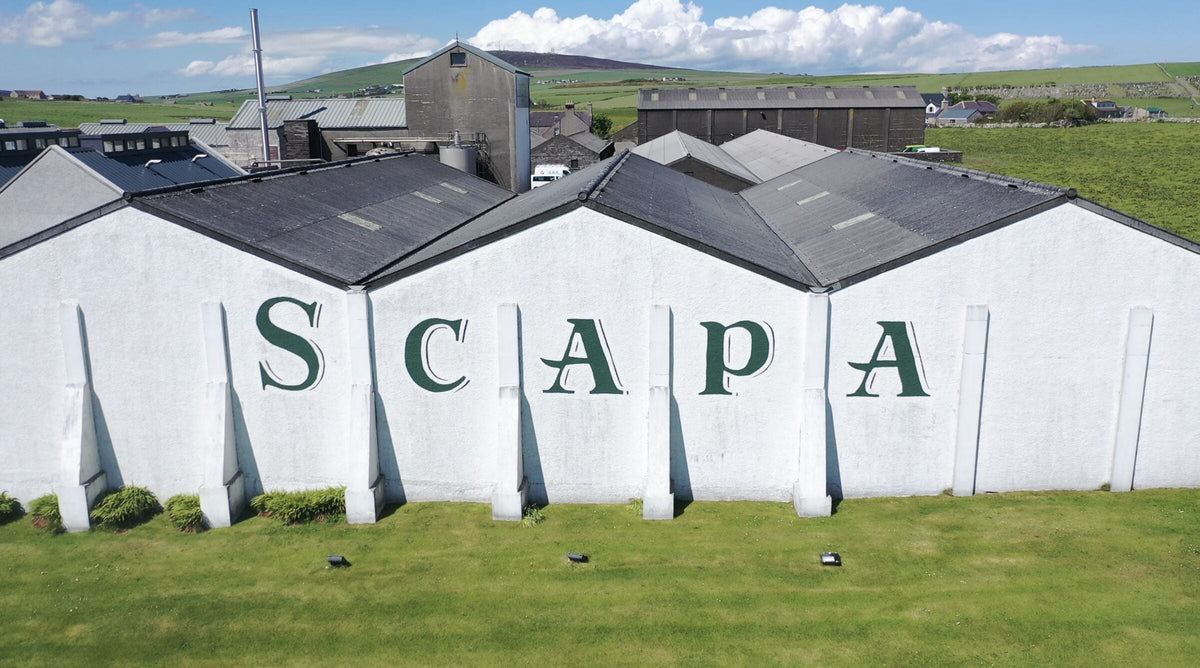
Scapa from above
From the air, Scapa is a small, low cluster of stone and harled buildings right on the water's edge, with Scapa Flow opening out beyond the distillery wall and Highland Park's pagoda roofs visible along the coast towards Kirkwall. It is a working harbourside site rather than a picture-postcard one, which is honestly part of the appeal: this is whisky made a few feet from the anchorage where the German High Seas Fleet scuttled itself in 1919, not a distillery built for the tour bus.
History of Scapa
Scapa was built in 1885 by Macfarlane & Townsend, a Glasgow blending firm, on a site chosen for its water rather than its scenery: the Lingro Burn ran close by, and the harbour meant casks and coal could move easily by sea to a mainland with no rail link at all. It very nearly did not survive its own first century. A fire in 1919 came close to destroying the distillery outright and was only put out with help from sailors of the Grand Fleet, still anchored in Scapa Flow at the end of the First World War. The distillery limped through the interwar years and various changes of hand before Hiram Walker, the Canadian group behind Ballantine's, bought it in 1954 and rebuilt much of the plant.
It is Hiram Walker's era that explains most of what makes Scapa unusual. The 1959 rebuild gave the distillery its wash still, an experimental Lomond design with internal rectifying plates intended to let a single still produce more than one style of spirit. Distilleries across Scotland tried Lomond stills in this period and mostly abandoned the idea within a decade or two; Scapa's plates were eventually removed as well, leaving a still with an unusually tall, straight-sided profile even though it no longer works as a true Lomond. Ownership passed to Allied Distillers when Hiram Walker's UK interests were absorbed in 1987, and Scapa spent much of the 1990s mothballed, kept alive only by production runs staffed by workers from Highland Park down the road. Pernod Ricard bought the distillery along with the rest of Allied's Scotch business in 2005 and put roughly £2.1 million into restoring it, bringing full production back in October 2005 after more than a decade of stop-start operation.
The most significant change, though, is recent. In October 2024 Chivas Brothers relaunched Scapa with its first ever permanent age-statement range, a 10, 16 and 21 year old, all matured in first-fill American oak and sold under a new Signature Range identity. For a distillery that spent most of its 140 years bottled sporadically or not at all under its own name, that is a genuine change of status rather than a marketing refresh.
How Scapa makes its whisky
Scapa draws its process water from the Lingro Burn and uses unpeated malt, kept deliberately separate from the peated malt pipeline that supplies Highland Park, so none of the smoke that defines its neighbour crosses over. Fermentation and distillation both run on the slow, patient side, and the single wash still, the old modified Lomond, and the single spirit still between them produce a spirit built for softness rather than punch. Chivas Brothers has also pointed to the distillery's location right on Scapa Flow as part of the character: sea air reaching the warehouses during maturation is a common claim across coastal Scotch, but here it is a literal harbourside site rather than a hillside one.
The resulting new make is lighter and gentler than most whisky made this far north, which is precisely why the house style leans on honey and orchard fruit rather than the salt, smoke and iodine more usually associated with island malts. First-fill American oak, the wood used across the new Signature Range, pushes that further towards vanilla and soft spice rather than the darker, drier notes sherry wood tends to add.
What does Scapa taste like?
The current official range, the 10, 16 and 21 year old launched in 2024, is built entirely on first-fill American oak: the 10 and 16 year old bottled at 48%, the 21 year old at cask strength. Tasting notes across the range run consistently to honey, vanilla, soft orchard fruit and a gentle waxiness, with the older expressions adding more depth and spice without ever tipping into anything smoky or aggressive. It replaced an older, thinner lineup, Skiren and the lightly peated Glansa, that had kept Scapa on shelves through the 2010s without ever quite establishing what the distillery was supposed to taste like on its own terms. The new range is a more confident answer to that question.
Independent bottlings tend to show a slightly more direct version of the same character, since they usually skip the finishing and blending Chivas Brothers applies to its own range. A Gordon & MacPhail Connoisseurs Choice bottled from a 2001 vintage, and another from a 2005 cask bottled in 2017, both show the house honey and orchard fruit with less obvious wood influence than the official range, closer to what comes off the still.
Scapa and independent bottlers
Scapa reaches the independent market more freely than most Chivas Brothers distilleries, since Pernod Ricard does not apply the same cover-name policy that Edrington uses to keep Highland Park off independent labels. Gordon & MacPhail has bottled Scapa under its Connoisseurs Choice label for years, with vintages spanning the 2000s regularly appearing. Wm Cadenhead's has released older Scapa going back to a 1965 cask, and both Cadenhead's and Signatory Vintage have put out cask strength Scapa more recently, generally drawn from refill hogsheads and barrels rather than first-fill sherry wood. None of this makes Scapa a high-volume name for brokers the way some Speyside distilleries are, but a genuine independent cask surfacing on the market is a realistic prospect rather than a rare event, which is not something we can honestly say about every distillery in this series.
Scapa and The Single Cask
We do not currently hold a cask of Scapa. It has not, so far, come up on the market at a moment when it suited what we were buying, and we would rather say that plainly than imply otherwise. What we can say is that the supply situation is genuinely more favourable than most: independent bottlers do get Scapa, regularly enough that a cask crossing our path in the future is a real possibility rather than wishful thinking. If Scapa specifically matters to you, whether for the Orkney story, the honeyed style, or simply because you want something other than its more famous neighbour, tell us and we will keep it in mind as stock moves through the market.
Plan a bottling inspired by Scapa
If you want the Orkney name specifically, Scapa is one of the more realistic asks in this series, given how often independent bottlers already handle it. If what actually matters is the style, honeyed, waxy, gentler than the typical island dram, there is room to widen the search. Highland Park, Scapa's own neighbour across the flow, shares the coastal setting and some of the honeyed character, though its whisky reaches the independent market under the cover name Whitlaw rather than its own. Further south, Old Pulteney and Balblair are both coastal Highland distilleries with a similar instinct for restraint over smoke, and both have shown up on the independent market more than once.
For an independent bottler or a new brand working from a wider brief than one specific distillery name, we can talk through independent bottling and private label whisky built around stock that actually fits, walk through the four steps from cask to bottle, and hold everything in our own bonded warehouse while a plan comes together. If you are earlier in the process and thinking about buying a whisky cask generally, our guide to cask sizes and types is a sensible next stop. A cask is not a regulated investment, values can move in either direction over however many years it spends maturing, and nothing here is financial advice, only a straightforward account of what we see buying and selling casks day to day.
Get in touch and tell us what you are trying to build. We will give you a straight answer about what is realistically available and what it is likely to cost.
Scapa FAQs
Who owns Scapa distillery?
Chivas Brothers, part of Pernod Ricard, since 2005. Before that Scapa passed through Hiram Walker, which bought it in 1954, and Allied Distillers after 1987.
Is Scapa peated?
No. Scapa uses unpeated malt kept separate from the peated pipeline that supplies Highland Park down the coast, which is a large part of why the two Orkney distilleries taste so different from each other.
What is the Scapa Lomond still?
The wash still installed in 1959 was originally a Lomond still, a design with internal rectifying plates meant to give one still more than one spirit character. Those plates have since been removed, leaving an unusually tall, straight-sided still that no longer functions as a true Lomond but still shapes the site's stillhouse character.
Can you visit Scapa distillery?
Yes, since April 2015, when Scapa opened to the public for the first time in its 130 year history. Tours take in the stillhouse, a traditional Orcadian warehouse, and a tasting, and the distillery sits a short drive from Kirkwall on the shore of Scapa Flow.
Can you buy a cask of Scapa?
Independent bottlers including Gordon & MacPhail, Wm Cadenhead's and Signatory Vintage have all released Scapa over the years, so genuine casks do reach the open market more often than at many distilleries. We do not currently hold one ourselves, but we are glad to look for one and to suggest well-matched alternatives in the meantime. Ask us what is realistically available.
Work with The Single Cask
Buy a whisky cask, bottle under your own label, or store casks in our HMRC approved bonded warehouse in Fife.
Read more
Royal Lochnagar Distillery: Whisky From Queen Victoria's Back Garden
Royal Lochnagar is easy to overlook simply because of where it sits. The distillery is tucked into the hillside above the River Dee, less than a mile from Balmoral Castle, and for most of its life ...
Read more


